Best Data Annotation Companies in 2026: 8 Companies Compared
We compared the best data annotation companies for image, text, and video labelling, covering quality, security, pricing, and workforce to help AI teams choose.
- Editor's choice
 Scale AI
Enterprise AI labs at scale
Starts atSee websiteVisit scale.comFull review - Great alternative
 Appen
Large, diverse crowdsourced labelling
Starts atSee websiteVisit appen.comFull review - Also consider
 Labelbox
Teams that need a platform plus services
Starts atSee websiteVisit labelbox.comFull review
TL;DR:
- The best image annotation companies are not always the best for text or audio, so match the provider to your data type and quality bar.
- Quality control, security, and workforce management matter more than a low per-label price, because bad labels cost more in model retraining.
- Managed services suit teams without in-house annotators, while annotation platforms suit teams that already have labelers and need tools.
- Always run a pilot on your real data, with your real guidelines, before committing to a large volume.
Quick comparison
| Tool | Best for | Starts at | Free plan? | |
|---|---|---|---|---|
| Scale AI | Enterprise AI labs at scale | See website | No | Visit |
| Appen | Large, diverse crowdsourced labelling | See website | No | Visit |
| Labelbox | Teams that need a platform plus services | See website | No | Visit |
 SuperAnnotate | Computer vision teams | See website | No | Visit |
 Snorkel AI | Programmatic labelling and data development | See website | No | Visit |
 Sama | Managed annotation with social impact focus | See website | No | Visit |
 CloudFactory | Managed teams for steady volume | See website | No | Visit |
 iMerit | Managed annotation for complex data | See website | No | Visit |
The best data annotation companies
We compared companies on data types, quality control, security, workforce, tooling, and pricing clarity. Here are eight that serve AI teams in October 2026.
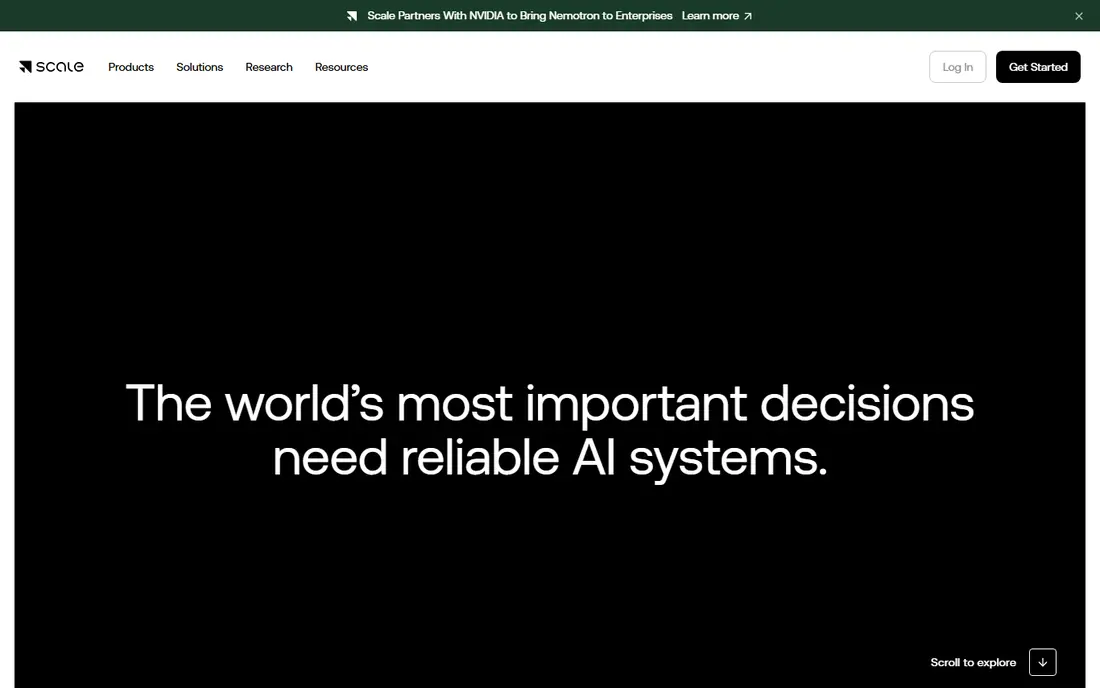
Scale AI is the largest name in this list, known for labelling and evaluation work for AI labs and large companies. It covers computer vision, language, audio, and multimodal data, with quality checks and dataset management tools. For a large team building a production model, that breadth and scale are hard to match.
The trade-off is access. Pricing is custom and enterprise-led, and smaller teams may find the sales process and minimums heavy. If you are a large AI team with steady, high-volume needs, Scale is a strong choice. If you are a startup with a small pilot, a platform-led option may fit better.
- Wide data types including image, text, audio, and video
- Model evaluation alongside labelling
- Large managed workforce
- Pricing is quote based and enterprise-led
- Onboarding can be heavy for small teams

Appen, now operating with CrowdGen for contributor work, offers one of the largest crowdsourced annotation networks. That scale helps with multilingual text, speech, search relevance, and image tasks that need many annotators quickly. The company has worked with large technology firms for many years.
Quality depends heavily on guidelines, training, and review, so a vague brief will produce uneven labels. Budget time for a pilot, clear examples, and a review loop. For a team that needs scale and language diversity, Appen is a practical option.
- Very large global contributor network
- Wide language and data type coverage
- Long track record
- Quality can vary by project without tight guidelines
- Pricing is quote based

Labelbox suits teams that want both a tool and, when needed, a managed workforce. Its platform supports image, video, text, and document labelling, with review workflows, consensus checks, and model-assisted pre-labelling. That helps a team that already has annotators but needs better tooling and quality control.
The platform rewards a clear workflow design, so plan your label taxonomy and review steps before scaling. For a team that wants to keep labelling in-house with strong tooling, Labelbox is a strong choice. For a team that wants a fully managed service, ask how Labelbox services are scoped and priced.
- Annotation platform with quality workflows
- Model-assisted labelling
- Managed services available
- Pricing is quote based for most enterprise use
- Platform learning curve for new teams
SuperAnnotate is built for computer vision, with tools for bounding boxes, polygons, segmentation, keypoints, and video tracking. Automation features, such as model-assisted pre-labelling, can speed up repetitive image work, while quality workflows help catch errors before they reach training. That makes it a good fit for robotics, autonomous systems, and medical imaging teams.
Language-heavy teams may find a more general platform a better fit, though SuperAnnotate does cover text and document tasks. For a vision-first team that needs precise image and video labels, SuperAnnotate is a focused and capable option.
- Strong image and video annotation tools
- Automation and model-assisted labelling
- Quality management features
- Less focus on pure language tasks than some rivals
- Pricing is quote based
Snorkel AI takes a different approach: instead of labelling every example by hand, teams write labelling functions, use weak supervision, and build training data programmatically. That can speed up large language and document projects, especially where expert labels are costly. The platform also supports evaluation and data versioning.
This approach needs data science skill and a clear understanding of your data, so it is not a simple drop-in for a team that just needs a few thousand images labelled. For an enterprise AI team that wants to develop data at scale, Snorkel AI is a powerful option.
- Programmatic labelling from rules and models
- Data development platform
- Enterprise security options
- Requires data science skills to use well
- Less suited to simple manual labelling jobs
Sama offers managed data annotation with a workforce trained for computer vision and language tasks, alongside a social impact model that emphasises employment and training. That managed approach suits teams that want a partner to run labelling, quality checks, and delivery, rather than managing annotators themselves.
One-off, very small jobs may be less efficient than a self-serve platform, because managed services are built for steady work. For a team with ongoing labelling needs that values a managed workforce and impact reporting, Sama is a thoughtful choice.
- Managed annotation workforce
- Focus on training and employment in underserved communities
- Computer vision and language coverage
- Pricing is quote based
- Managed model suits steady volume more than one-off small jobs
CloudFactory provides managed annotation teams for image, video, and text, with quality checks and workforce management handled by the provider. That suits companies with steady labelling volume that do not want to hire and train annotators in-house. The managed model also helps when data types change, because the provider can adjust team skills.
As with other managed services, the first weeks matter: clear guidelines, examples, and feedback loops determine quality. For a company that wants a reliable, managed labelling partner for ongoing work, CloudFactory is a solid option.
- Managed, trained teams
- Quality workflows
- Image, video, and text coverage
- Pricing is quote based
- Setup and guidelines work take time
iMerit offers managed annotation for complex data, including medical, geospatial, and autonomous vehicle work, where domain knowledge matters. Its teams are trained for detailed tasks, and the company emphasises security and quality for sensitive datasets. That makes it a good fit for regulated or high-stakes projects.
Smaller, simple labelling jobs may be better served by a platform tool, because iMerit is built for managed, complex work. For a team with difficult data, strict quality needs, and security requirements, iMerit is a strong choice.
- Managed annotation for complex and sensitive data
- Domain expertise in several sectors
- Quality and security focus
- Pricing is quote based
- Enterprise and managed focus means less self-serve access
How we picked these
We compared official company pages, data types, quality workflows, security practices, and workforce models for firms still operating in October 2026. We favoured firms with a clear quality process, a real tool or managed service, and experience with production AI data. We left out firms that only offer a marketplace with no quality control, firms with no current website or service, and firms that focus only on contributor pay rather than client labelling services.
What to check before you buy
Start with a pilot on your real data. Give each shortlisted provider the same guidelines, the same edge cases, and the same quality bar, then measure agreement, error types, and turnaround. A provider that looks cheap on a simple sample can become costly when edge cases, ambiguous labels, and rework appear.
Next, check security and data handling. Ask where data is stored, who can access it, how annotators are vetted, and whether the provider supports NDAs, data deletion, and compliance needs such as HIPAA or GDPR where relevant. For sensitive data, a managed provider with clear security controls beats a low-cost crowd option.
Finally, check the full cost and workflow. Per-label pricing, platform fees, project management, quality review, and rework all affect the total. Also check how labels are delivered, whether you own the data, and how feedback loops work. A provider that improves guidelines with you over time will produce better models than one that simply returns labels.
FAQ
What is the best image annotation company?
For image annotation, SuperAnnotate, Labelbox, and Scale AI are strong starting points, because they combine precise image tools with quality workflows. SuperAnnotate suits vision-first teams, Labelbox suits teams that want a platform, and Scale suits large enterprise volume. Run a pilot on your images before choosing.
How much does data annotation cost?
Costs vary by data type, complexity, volume, and quality bar, and most enterprise providers quote per project rather than publishing a price list. Simple image labels cost far less than expert medical or legal labels. Get a pilot quote for your exact data and guidelines, and include rework and quality review in the total.
Should I use a platform or a managed service?
Use a platform if you already have annotators and need better tools, review workflows, and automation. Use a managed service if you lack annotators, need scale quickly, or work with complex data. Many teams start managed for a pilot, then move to a platform as internal skills grow.
How do I check annotation quality?
Measure agreement between annotators, sample labels for review, and track error types, not just overall accuracy. Use consensus checks for ambiguous cases, gold-standard examples for training, and a feedback loop with the provider. Quality should be measured on your real data, not just on a demo set.
Is my data safe with an annotation company?
It depends on the provider. Ask about access controls, vetting, storage location, NDAs, and deletion policies, and check compliance support for your sector. For sensitive data, choose a provider with clear security practices and a managed workforce, and avoid uploading sensitive data to a public crowd tool without safeguards.