Shortlist: 7 Best Chemical Inventory Software Options for 2026
Weighing the best chemical inventory software? We lined up 7 products by cost, free access and fit. Verdicts stay brief and factual. Built for quick decisions.
- Editor's choice
 CDD Vault
Drug discovery teams
Starts atSee websiteVisit collaborativedrug.comFull review - Great alternative
 Quartzy
R&D labs that also order supplies
Starts atFreeVisit quartzy.comFull review - Also consider
 CloudLIMS
Cloud LIMS with chemical tracking
Starts atSee websiteVisit cloudlims.comFull review
Direct answer
Start with CDD Vault if you need Drug discovery teams. Quartzy is the stronger choice for R&D labs that also order supplies, while CloudLIMS suits cloud LIMS with chemical tracking. The remaining 4 options are covered below with prices and limits.
TL;DR:
- CDD Vault is the opening pick, best for Drug discovery teams.
- Before buying Quartzy, weigh this: inventory depth is lighter than dedicated systems.
- ChemInventory is the one to check for research groups on a budget.
- Free plans exist at 2 of 7 tools (Quartzy, SciNote).
- CDD Vault, CloudLIMS, LabCollector and others: pricing is by quote only, so plan time for a sales conversation.
Quick comparison
| Tool | Best for | Starts at | Free plan? | |
|---|---|---|---|---|
| CDD Vault | Drug discovery teams | See website | Free trial | Visit |
| Quartzy | R&D labs that also order supplies | Free | Yes | Visit |
| CloudLIMS | Cloud LIMS with chemical tracking | See website | Free trial | Visit |
 LabCollector | Configurable lab management | See website | Free trial | Visit |
 SciSure | University and institutional labs | See website | No | Visit |
 SciNote | ELN with inventory included | See website | Yes | Visit |
 ChemInventory | Research groups on a budget | $56/year | Free trial | Visit |
Chemical Inventory Software profiles
LinkVetted put together this guide to chemical inventory software for readers who want a clear shortlist without reading every vendor page. It compares 7 tools on starting price, free plans, who each one suits and where each one falls short.
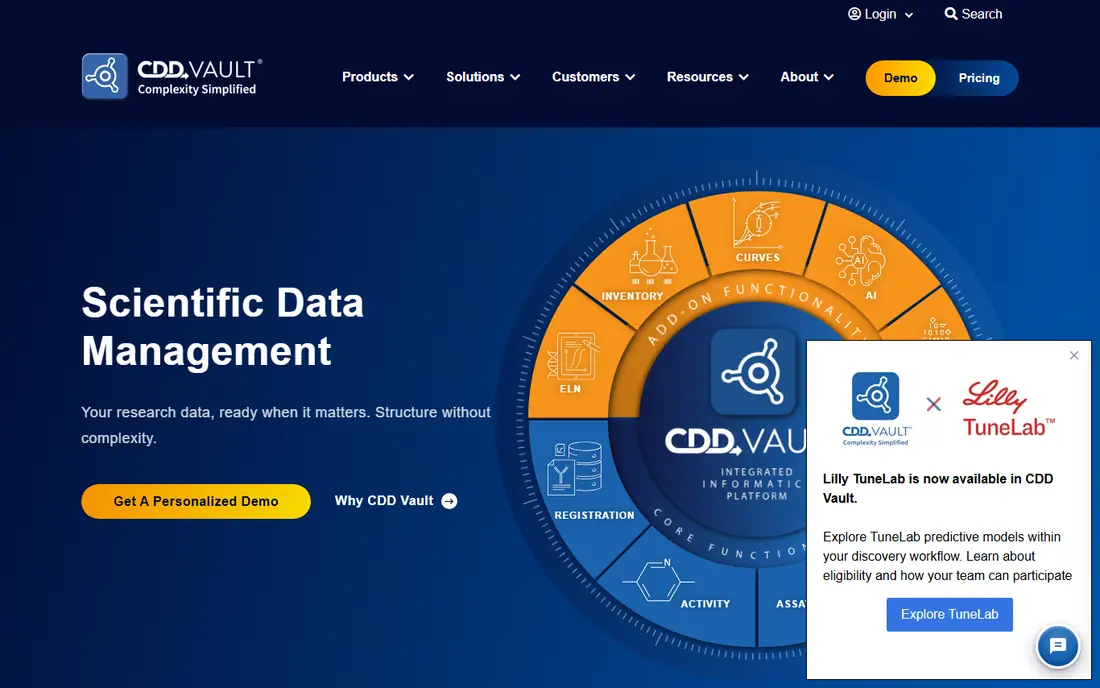
Think of CDD Vault for Drug discovery teams. External collaboration features let partners share data securely.
The main drawbacks: Specialized for pharma.
General chemistry labs will find it overspecialized. CDD Vault does not show a starting price in this comparison, so check the vendor site for current pricing. Trial and free access: Free trial.
- Designed for drug discovery data
- Collaboration tools
- Quote-based pricing

Quartzy serves R&D labs that also order supplies. For R&D labs where ordering friction is the real problem, the free product plus integrated supply chain is a compelling combination.
Also, inventory tracking, order requests and approvals live alongside a catalog of 10 million products from over 1,800 brands, so reordering a chemical is two clicks from seeing it run low. The starting price for Quartzy: Free. Quartzy has a free plan.
What to check first: Tied to the Quartzy marketplace.
- Free inventory system
- Integrated ordering from 1,800+ brands
- Inventory depth is lighter than dedicated systems
CloudLIMS is aimed squarely at cloud LIMS with chemical tracking. As a full LIMS, it is more than a chemical database; labs that only need inventory may find it wide. Pricing is quote-based.
For labs outgrowing spreadsheets that also need sample and workflow management, CloudLIMS includes the growth path. It serves both regulated labs and research organizations. This comparison lists no price for CloudLIMS; ask the vendor. Trial and free access: Free trial.
Where it falls short: Quote-based pricing.
- Serves regulated and research labs
- Cloud-native LIMS
- LIMS breadth exceeds pure inventory needs
Where LabCollector fits: configurable lab management. The chemical module tracks lots, SDS documents, hazard pictograms and storage locations, with barcode support. On top of that, the interface displays its age and configuration takes real effort.
Pricing is quote-based. For labs that want one configurable system including inventory plus equipment and samples, LabCollector's breadth justifies the setup work. Beyond that, modules can be customized extensively to match lab workflows. Worth adding: LabCollector is a modular lab information system handling chemical inventory, equipment, samples, ELN and more. LabCollector does not show a starting price in this comparison, so check the vendor site for current pricing. Free access: Free trial.
Limits to weigh: Configuration takes effort.
Upsides: Wide lab coverage.
- Chemical inventory with SDS
- Highly configurable modules
- Interface feels dated
SciSure is aimed squarely at University and institutional labs. SciSure, formerly known as SciShield (and before that BioRAFT), is the chemical inventory and lab safety system used across major universities and research institutions. It tracks chemical containers with hazard information, handles safety data sheets, supports regulatory reporting and links inventory to inspections and training records.
Downsides: Quote-based pricing.
In practice, pricing is quote-based and targeted at institutional buyers. Note the name: longtime users will know it as SciShield or BioRAFT. As for the details, for a university EHS department or a large research organization that needs defensible compliance, SciSure is the established standard. SciSure shows no starting price here, so confirm the cost on the vendor site. No free plan comes with SciSure.
- Institutional reporting
- Chemical inventory with hazard data
- Geared toward institutions, not small labs
SciNote works best for ELN with inventory included. Reagents and chemicals link straight to experiments, so usage tracking happens naturally in the research workflow.
Limits to weigh: Advanced features need premium plans.
For labs that require both experiment documentation and chemical tracking, getting both in one free-to-start system is efficient. Pricing for SciNote is not stated here, so ask the vendor for current figures. A free plan is available with SciNote.
- A decent match for academic labs
- Inventory linked to experiments
- Inventory is secondary to the ELN
Where ChemInventory fits: research groups on a budget. Data is encrypted and backed up daily. Search by name, CAS registry number, chemical structure or custom fields, with structures shown alongside results.
Downsides: Fewer compliance features.
Unique barcodes per container make stocktaking quick with a scanner. At $56 a year, it is the cheapest serious choice here by a broad margin. ChemInventory is made for research groups that require to stop losing track of compounds. For an academic research group or small lab that needs chemical organization without enterprise software, ChemInventory is the value pick. ChemInventory starts at: $56/year. On free options: Free trial.
- Cloud-based
- Structure and CAS number search
- Smaller vendor
How we chose
We compared the tools on published pricing, free plan or trial availability, feature coverage for chemical inventory software, and the limits each vendor documents. Plan names, prices and limits change often. Treat the figures here as a starting point and verify them with the vendor. The ranking is editorial: typical fit first, then clear pricing, then free access. If your needs are unusual, read the profiles rather than relying on position.
A buyer's checklist
- Ask CDD Vault, CloudLIMS, LabCollector and others for a written quote, since no starting price is shown.
- Check what the free option really includes: Quartzy and SciNote offer a free plan, and usage caps differ.
- Use real work to test the free trial from CDD Vault, CloudLIMS, LabCollector and ChemInventory, rather than a demo project.
- Read the limits listed for CDD Vault first: specialized for pharma.
- See whether SciSure offers onboarding or training, and whether it is included in the price.
- Check how data leaves SciNote: formats, limits and whether exports are available on every plan.
FAQ
How are the tools for chemical inventory software ordered?
The order follows typical fit for chemical inventory software, with CDD Vault first and ChemInventory last, then price clarity and free access. It is editorial judgement, not a score, so another team could rank the tools differently.
Is CDD Vault the right pick for everyone comparing chemical inventory software?
No single tool suits every team. CDD Vault comes first because it fits Drug discovery teams, while Quartzy suits R&D labs that also order supplies and CloudLIMS suits cloud LIMS with chemical tracking. Match the tool to your own size, budget and workflow before deciding.
Which options for chemical inventory software have a free plan?
On this list, Quartzy and SciNote include a free plan. Caps on seats, usage or features are common, so test the free plan against your real workload. Several others offer a trial instead.
Can I try these options before paying?
Often, yes. Quartzy and SciNote have a free plan and CDD Vault, CloudLIMS, LabCollector and ChemInventory offer a free trial. Use your own data and a real task during the test, and check what the free tier or trial limits before you rely on it.
Can it track chemicals across several labs?
Yes. Institutional products like SciSure are designed for multi-lab and multi-building tracking with centralized reporting. Smaller tools manage single labs well; confirm multi-location support if you need it.