Best Cards for Companies With Global Vendors in 2026: 8 Cards Compared
Compare the best cards for companies with global vendors in 2026, from Airwallex and Brex to Ramp and Mercury, with FX, controls, rewards and fees compared.
- Editor's choice
 Airwallex
Multi-currency vendor payments
Starts atSee websiteVisit airwallex.comFull review - Great alternative
 Brex
Venture-backed teams with heavy SaaS spend
Starts atSee websiteVisit brex.comFull review - Also consider
 Ramp
Spend controls and expense automation
Starts atSee websiteVisit ramp.comFull review
TL;DR:
- Airwallex and Wise Business are the strongest picks when most vendor spend is outside your home currency, thanks to multi-currency accounts and local payment details.
- Ramp and Brex lead on spend controls and expense automation for US-based teams, but check their global card coverage before relying on them abroad.
- Mercury and Rho suit startups that want banking and cards in one place, with simple cashback and no personal guarantee in many cases.
- This is not financial advice. Card eligibility, limits and FX fees depend on underwriting and location, so confirm current terms with each issuer before applying.
Quick comparison
| Tool | Best for | Starts at | Free plan? | |
|---|---|---|---|---|
| Airwallex | Multi-currency vendor payments | See website | No | Visit |
| Brex | Venture-backed teams with heavy SaaS spend | See website | No | Visit |
| Ramp | Spend controls and expense automation | See website | No | Visit |
 Mercury | Startups banking and spending in one place | See website | No | Visit |
 Rho | Vendor cards and banking controls | See website | No | Visit |
 Payhawk | European teams with VAT and global spend | See website | No | Visit |
 Wise Business | Low-cost FX for international vendors | See website | No | Visit |
 BILL Spend and Expense | Budget-based cards for growing teams | See website | No | Visit |
The best cards for companies with global vendors
We compared official pricing and feature pages for corporate card platforms that support international vendors, multi-currency spending or global card issuance. The list favors platforms with clear FX pricing, card controls and accounting integrations, since those three items drive most of the cost for global teams.
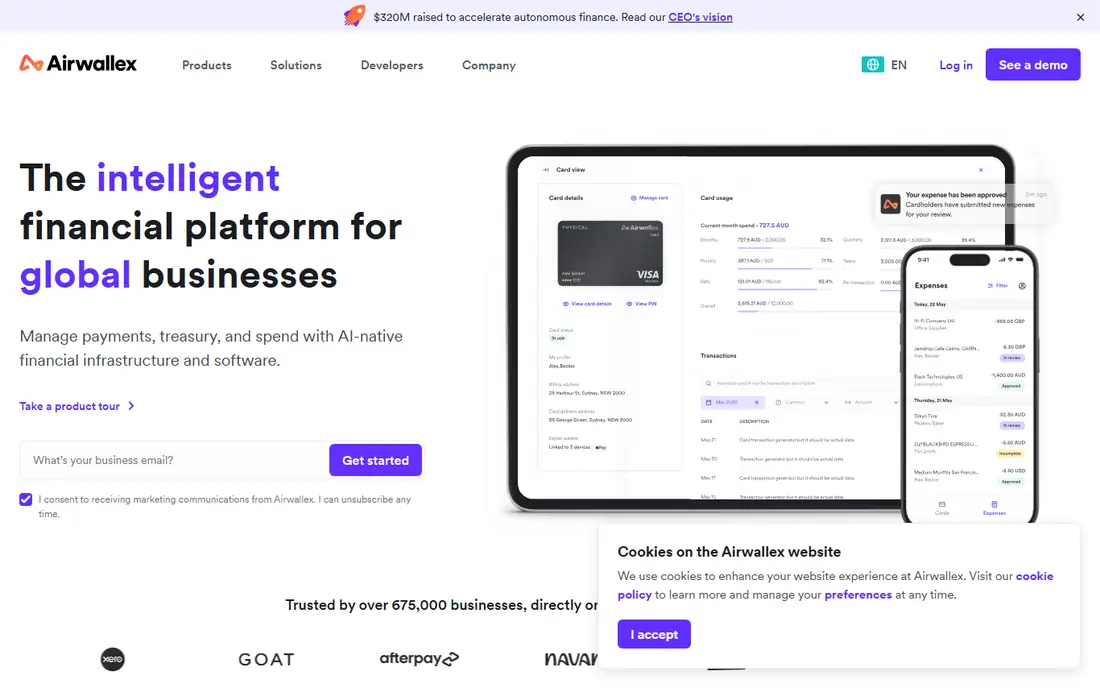
Airwallex is our pick for companies whose vendor list spans several countries. It lets teams hold balances in multiple currencies, issue cards in different currencies, and pay vendors from local details rather than routing everything through one home account. That setup can cut conversion steps and make reconciliation cleaner.
The card program includes single-use and recurring vendor cards, merchant controls and expense management, plus syncing with common accounting tools. Check the current FX markup, card fees and plan limits for your volumes, since Airwallex pricing changes by region and tier.
- Multi-currency accounts and cards
- Local bank details in many currencies
- Strong FX and expense tools
- Paid tiers for larger teams
- Cashback terms are promotional in some regions
- Support quality varies by market
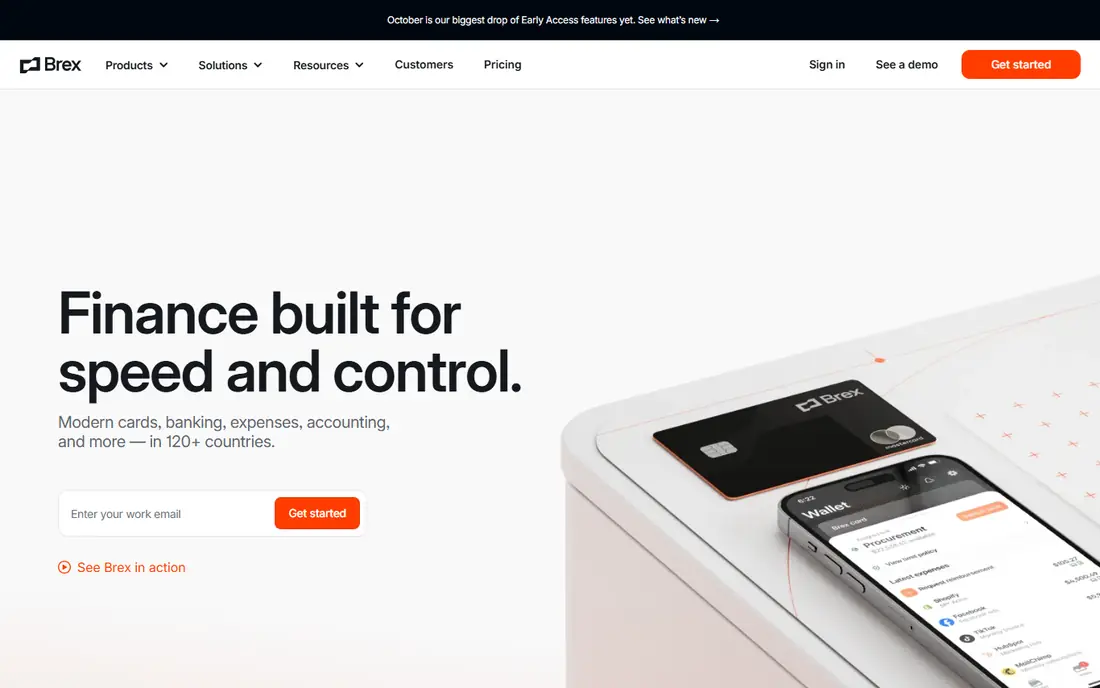
Brex remains a strong card for funded startups and mid-market companies, with rewards weighted toward rideshare, travel, restaurants and software. Its controls let finance teams set limits by team, category and merchant, and track spend across subsidiaries, which helps when vendors sit in several countries.
Approval often requires a minimum cash balance or revenue level, so early-stage companies may not qualify. Brex was acquired by Capital One in 2026, so buyers should confirm the current product terms and roadmap during sales talks rather than relying on older reviews.
- Tiered rewards on travel and software
- Strong spend controls
- No personal guarantee for many companies
- Higher approval bar than some rivals
- Rewards favor certain categories
- Capital One ownership may change the roadmap
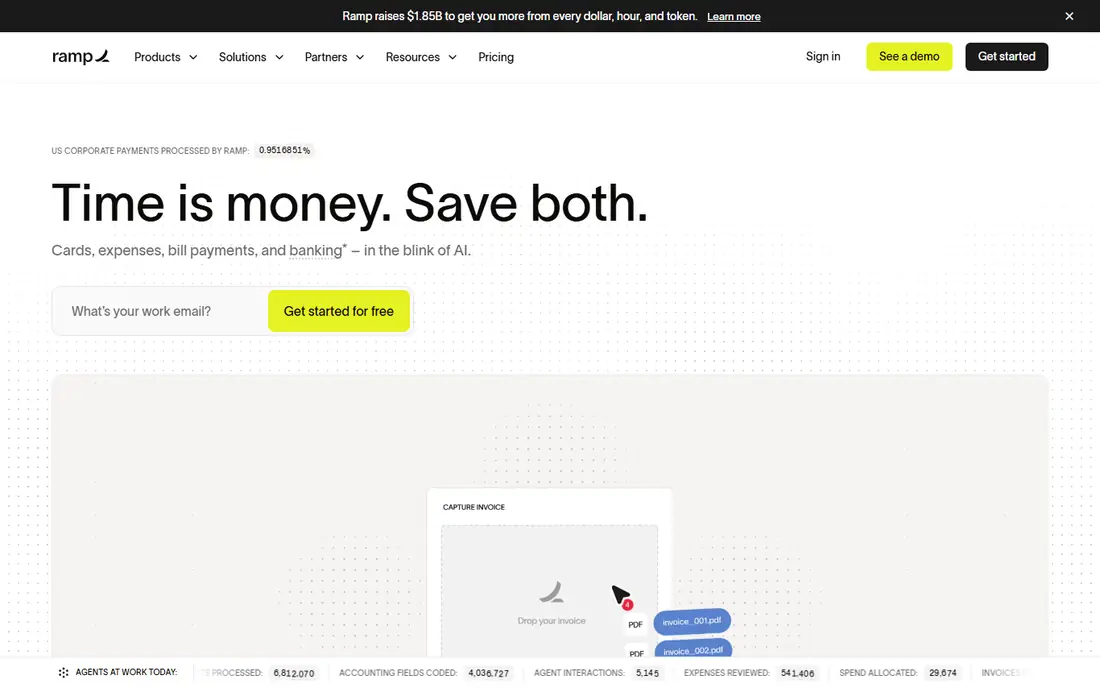
Ramp wins on day-to-day finance work. Cards come with limits, category blocks and approval routing, while receipts and accounting coding are largely automated. For a US team paying a mix of domestic and overseas vendors, that automation can save hours each month.
For heavily international teams, the key question is card acceptance and FX handling in each vendor country. Ramp works well as a primary US card platform, but companies with large non-USD spend should compare its FX terms directly with Airwallex or Wise before committing.
- Strong approval workflows
- Automated receipt capture
- Accounting integrations
- Global card coverage is narrower than Airwallex
- Rewards rate is not always published
- Eligibility checks apply
Mercury suits startups that want one dashboard for banking and cards. Its IO Card offers flat cashback without points to redeem, and cards can be locked automatically when tasks go overdue. Treasury and banking features sit alongside cards, which keeps finance work in one place.
The trade-off is global depth. Mercury is strongest for US companies with some international spend, rather than companies whose vendor base is mostly overseas. Payment terms also start on daily repayment for lower balances, moving to 30-day terms at higher balances, so cash flow planning matters.
- Simple flat cashback on its IO Card
- Banking and cards together
- No personal guarantee in many cases
- Card is tied to a Mercury account
- Payment terms depend on balance
- Global features are thinner than Airwallex
Rho is a good fit for companies that pay many vendors by card and want tight control over each one. Vendor cards can be set as single-use, monthly or fixed-limit, and a single-use card locks after one transaction, which limits exposure if a vendor is compromised. Banking, payments and cards live in the same platform.
Rho is more US-centered than Airwallex, so international teams should test card acceptance and FX costs for their main vendor countries. For domestic-heavy teams with a global tail, Rho offers a clean mix of controls and banking without per-user platform fees for expense management.
- Single-use and monthly vendor cards
- Banking and cards together
- Native accounting sync
- US-focused
- Global vendor coverage varies
- Higher cashback tiers have balance conditions
Payhawk stands out for European companies and global teams with VAT obligations. Its card controls cover merchant, category, country and time of day, and its expense tools are built to capture VAT data for accounting. That detail matters when vendor invoices cross borders and tax rules differ.
US-based companies may find Payhawk less central than Ramp or Brex, but for a European headquarters with vendors worldwide, it is a strong contender. Request a demo with your own entity structure, since multi-entity setup is where implementation time is won or lost.
- Detailed card controls by country and time
- VAT-ready expense handling
- Multi-entity support
- Pricing is quoted
- US coverage is thinner
- Setup takes time for multi-entity teams
Wise Business is less a corporate card platform and more a low-cost way to pay vendors abroad. Teams can hold balances in many currencies, receive payments through local details, and spend with business debit cards, with FX fees shown upfront rather than hidden in a rate.
The catch is control depth. Wise cards and expense tools are simpler than Ramp or Payhawk, and there is no corporate credit line in the same way. Many companies use Wise for vendor payments and FX, alongside a separate card platform for employee spend, which can be the cheapest overall setup.
- Transparent FX fees
- Local account details in many currencies
- Business debit cards
- Not a full corporate card platform
- Credit limits are limited
- Expense controls are lighter
BILL Spend and Expense, formerly Divvy, organizes cards around budgets rather than individual limits alone. Finance teams assign budgets, cards draw from them, and approvals follow the budget rules. Combined with BILL bill pay, it suits companies that pay vendors by both card and bank transfer.
For global vendors, BILL is a solid domestic-first choice with international card use, rather than a multi-currency specialist. If most vendor spend is in your home currency with a global minority, its budget controls and bill pay integration can outweigh the thinner FX toolkit.
- Budget-first card controls
- Bill pay in the same platform
- Accounting integrations
- Global card features are less deep
- Pricing tiers vary
- Setup effort for large teams
How we picked these
We compared official pricing, card control, FX and accounting pages for corporate card platforms, and we favored vendors with published global features and live card programs in 2026. We excluded personal credit cards and prepaid travel cards, since they lack business controls and accounting tools. Terms change often, so confirm FX fees, eligibility and limits with each issuer.
How to choose a card for global vendors
Start by mapping where your vendors are and in which currencies you pay them. If more than half your spend is non-domestic, prioritize multi-currency accounts, local payment details and transparent FX fees over rewards. If most spend is domestic, prioritize controls, receipt automation and accounting sync, and treat FX as a secondary check.
Next, test controls with a real vendor list. Issue a single-use card for a new vendor, set a category block, and run an approval for a larger payment. The platforms that make those tasks simple in a demo are the ones your team will actually use. Also check card acceptance in your top vendor countries, since a card that works well at home may be declined abroad.
Finally, compare total cost, not just rewards. Add FX markups, foreign transaction fees, plan costs and accounting time saved. A card with slightly lower cashback but much lower FX costs often wins for global teams. Keep a second payment route for vendors who do not accept cards, since bank transfer remains common outside the US and Europe.
FX and fees to compare
Compare the FX markup, any foreign transaction fee, ATM fees and the rate shown at payment time. Ask whether the rate is locked at authorization or settlement, since that gap can change the final cost on large vendor payments.
Controls that prevent overspend
Look for per-card limits, merchant and category blocks, single-use cards, approval workflows and automatic locking. Those controls matter more than rewards when dozens of vendors and employees can spend on your behalf.
FAQ
What is the best card for companies with global vendors?
Airwallex is the strongest all-round pick for mostly international spend, while Ramp or Brex suit US teams with a global minority. Wise Business is a strong low-cost payment route alongside a card platform. The best choice depends on your currency mix and control needs.
Do corporate cards charge foreign transaction fees?
Some do, and others build the cost into the exchange rate, so compare both the stated fee and the FX markup. Ask the issuer for a sample transaction in your main vendor currencies before you decide.
Can I issue cards in multiple currencies?
Yes, with Airwallex, Wise Business and Payhawk, among others, depending on region and plan. Check which currencies and countries are supported for your vendors, since coverage varies by issuer and card network.
Is Brex still independent in 2026?
No. Capital One announced and closed its acquisition of Brex in 2026, so Brex now sits inside a bank-led group. Confirm current terms, rewards and roadmap with Brex sales before relying on older product reviews.
Do I need a personal guarantee for a corporate card?
Many fintech corporate cards do not require a personal guarantee, relying instead on company cash balance or revenue, while traditional bank cards often do. Eligibility and terms vary by issuer, so confirm this point in writing during application.
Should I use one card platform for all vendors?
Not always. Many global companies pair a multi-currency payment account for bank transfers with a card platform for card spend. That split can lower FX costs while keeping controls tight on employee cards.