The 6 Best AR Platform for the Money in 2026, Ranked
Best AR platform for the money: 6 contenders ranked by fit, with entry costs and free tiers. Fit, price and catches for every tool. Full profiles inside.
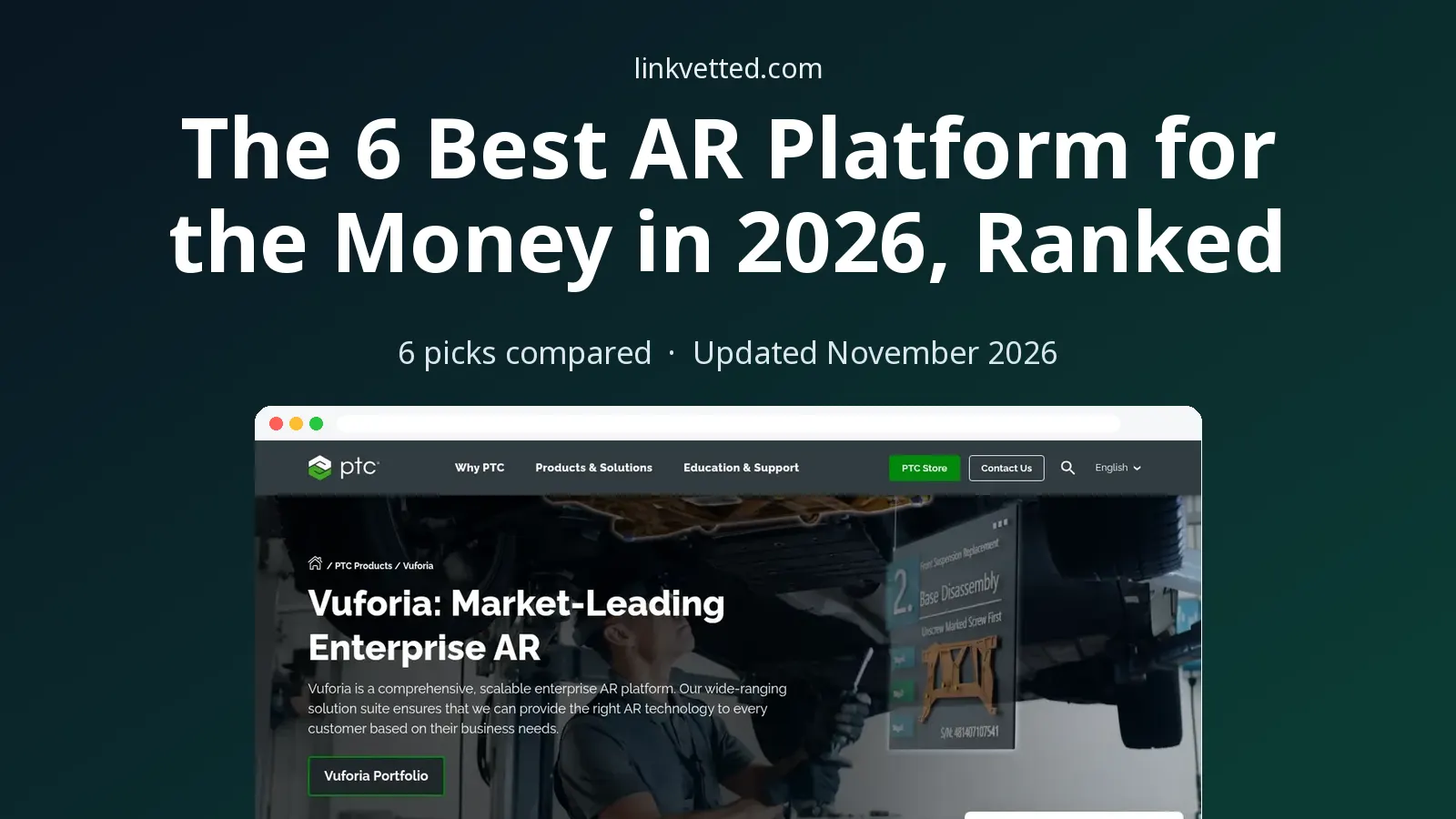
- Editor's choiceVuforia
Enterprise AR options and tracking
Starts atSee websiteVisit ptc.comFull review - Great alternativeARKit
IOS and iPadOS AR experiences
Starts atSee websiteVisit developer.apple.comFull review - Also consider
 Unity
All-in-one 3D engine with AR support
Starts at$210.00 a monthVisit unity.comFull review
Direct answer
Vuforia comes first here, mainly for enterprise AR options and tracking. Listed starting prices: Unity from $210.00 a month. Look at ARKit for iOS and iPadOS AR experiences, and at Unity for all-in-one 3D engine with AR support. The full list of 6 tools follows, with prices and free plan facts.
TL;DR:
- Vuforia takes the first slot, best suited to enterprise AR options and tracking.
- Vuforia, Wikitude and the 4 others all need a premium plan or a trial, since no free plan is listed.
- Unity comes with a trade-off: large editor with a ramp-up time.
- For cross-platform AR SDK, Wikitude is worth a look.
- Unity has the lowest monthly starting price in this list: $210.00 per month.
Last checked November 2026. Prices and plan details were read from the vendors' own pages in November 2026; vendors change plans often, so confirm the current price on the vendor site before you buy.
Quick comparison
| Tool | Best for | Starts at | Free plan? | |
|---|---|---|---|---|
| Vuforia | Enterprise AR options and tracking | See website | Not stated | Visit |
| ARKit | IOS and iPadOS AR experiences | See website | Not stated | Visit |
| Unity | All-in-one 3D engine with AR support | $210.00 a month | Free trial | Visit |
| Zappar | Brand AR with creative and hardware | See website | Not stated | Visit |
 8th Wall | Web-based AR and open source | See website | Not stated | Visit |
| Wikitude | Cross-platform AR SDK | See website | Not stated | Visit |
AR Platform for the Money profiles
Short on time? The summary and table above give the quick view of 6 tools for AR platform for the money, and the profiles that follow give the detail behind each entry.
Vuforia
Best for: Enterprise AR options and tracking

Vuforia is designed for enterprise AR options and tracking. The homepage stresses adoption by market leaders and a wide feature set.
Worth adding: teams prioritizing light web AR or open source tooling may be better served elsewhere. On top of that, since it is framed for enterprise use, the system can feel heavier than needed for a straightforward consumer AR demo or a small web experience. Vuforia shows no starting price here, so confirm the cost on the vendor site. Trial and free access: Not stated.
What to check first: Enterprise orientation may overwhelm small teams.
- Enterprise-focused AR software
- Geared toward business transformation
- Less suited to casual game projects
ARKit
Best for: IOS and iPadOS AR experiences
ARKit is built with iOS and iPadOS AR experiences in mind. Teams wanting one codebase across devices frequently choose a cross-platform engine or SDK instead.
For everyday use, ARKit is Apple's framework for building augmented reality experiences on iOS and iPadOS, described on the developer site as powering the biggest AR products. It hands Apple developers native access to device cameras and motion sensors for immersive apps. Pricing for ARKit is not stated here, so ask the vendor for current figures. As for free access: Not stated.
Honest limits: Apple products only.
- Aimed at iOS and iPadOS
- Apple developer documentation and tools
- Does not include Android devices

Unity is designed for all-in-one 3D engine with AR support. Pick Unity when AR is part of a bigger interactive product.
Worth adding: the tradeoff is weight: Unity is a full engine, so small AR-only projects may find it more than they need and steeper to learn than a focused SDK. Price to start with Unity: $210.00 per month. As for free access: Free trial.
Where it falls short: Large editor with a ramp-up time.
- Supports monetization and player growth
- Builds for mobile, PC
- Heavier than a light AR SDK
Zappar
Best for: Brand AR with creative and hardware
Where Zappar fits: brand AR with creative and hardware. Zappar describes itself as an augmented reality options provider helping brands, companies and AR creators through an in-house creative studio alongside its system and hardware offerings.
The combination of software and services is its primary differentiator. Since it leans on creative services and hardware, developer teams that only want a bare SDK may find the offering broader than necessary. This comparison lists no price for Zappar; ask the vendor. Free access: Not stated.
What to check first: Bundled services can be more than DIY teams need.
- Product plus hardware options
- In-house creative studio backing
- Studio-led approach may not fit pure developers
8th Wall makes the most sense for web-based AR and open source. 8th Wall concentrates on building immersive AR and interactive 3D experiences, with an open source approach highlighted on its homepage.
What to check first: Less suited to heavy native app needs.
That makes it appealing to web developers who want AR reachable through a browser link instead of an app install. Browser-based AR relies on device and browser capabilities, so performance and sensor access can vary across phones. No starting price is listed for 8th Wall here; confirm pricing on the vendor site. Free options: Not stated.
- Supports interactive 3D content
- Runs immersive experiences in the browser
- Web AR can be constrained by device browsers
Wikitude
Best for: Cross-platform AR SDK
Think of Wikitude for cross-platform AR SDK. Teams already comfortable with native or hybrid development can integrate it into existing products.
Limits to weigh: SDK-centric, so you build more yourself.
Beyond that, groups wanting bundled creative help or a complete engine may prefer Zappar or Unity. Wikitude does not show a starting price in this comparison, so check the vendor site for current pricing. On free options: Not stated.
- Cross-platform AR SDK
- Established AR tooling
- Less emphasis on creative services
Our selection method
The comparison looks at four things: starting price, free access, how well the feature set matches AR platform for the money, and the main limit of each tool. Plan names, prices and limits change often. Treat the figures here as a starting point and verify them with the vendor. Tools are placed by general fit for AR platform for the money, with price clarity and free access as tie-breakers. A different team can reasonably rank them differently.
What to confirm before you sign up
- Ask Vuforia, ARKit, Zappar and others for a written quote, since no starting price is shown.
- Run a trial of Unity with real work before paying for a year; your own workflow is the best test.
- Read the limits listed for Vuforia first: enterprise orientation may overwhelm small teams.
- Before rolling out Vuforia, verify the integrations your workflow depends on.
- Ask Zappar about contract length, onboarding fees and user minimums before you sign.
FAQ
What should enterprise buyers check first?
Enterprise teams should confirm tracking capabilities, supported devices and integration with existing systems. Vuforia is framed around enterprise AR, whereas Zappar brings creative services.
What is the cheapest option for AR platform for the money in this list?
On published monthly entry prices, Unity is the lowest here at $210.00 per month. Entry price is only part of the cost, because seats, add-ons and billing terms can change the total. Prices, free plan details and limits for all 6 tools in this AR platform for the money roundup sit on the individual cards above.
Can I try these tools before paying?
Often, yes. Unity offers a free trial. Use your own data and a real task during the test, and check what the free tier or trial limits before you rely on it.
Do these tools publish their prices?
Not all of them. Vuforia, ARKit, Zappar and others publish no starting price, so expect a quote request for those. The rest, Unity included, show a starting price, though seats and billing terms still change the final cost.
Is Vuforia the right pick for everyone comparing AR platform for the money?
No single tool suits every team. Vuforia comes first because it fits enterprise AR solutions and tracking, while ARKit suits iOS and iPadOS AR experiences and Unity suits all-in-one 3D engine with AR support. Match the tool to your own size, budget and workflow before deciding.
Sources
- https://www.ptc.com/en/products/vuforia
- https://developer.apple.com/augmented-reality
- https://unity.com
- https://www.zappar.com
- https://www.8thwall.com
- https://www.wikitude.com