Best App to Learn Thai in 2026: 9 Apps Compared
Compare the best app to learn Thai, from Duolingo and Ling to ThaiPod101, Pimsleur, and italki, with prices, tones, and Thai script help, updated for 2026.
- Editor's choice
 Ling
Thai script and tones
Starts atFreeVisit ling-app.comFull review - Great alternative
 Duolingo
Free daily lessons
Starts atFreeVisit duolingo.comFull review - Also consider
 ThaiPod101
Audio lessons
Starts atFreeVisit thaipod101.comFull review
TL;DR:
- Ling is our pick for most learners, since it is built for Thai script, tones, and daily practice.
- Duolingo suits complete beginners who want short, free daily lessons in Thai.
- ThaiPod101 and Pimsleur suit listeners who want real conversation and pronunciation help.
- italki is best for speaking practice with a real tutor, while Drops suits vocabulary in short bursts.
Quick comparison
| Tool | Best for | Starts at | Free plan? | |
|---|---|---|---|---|
| Ling | Thai script and tones | Free | Yes | Visit |
| Duolingo | Free daily lessons | Free | Yes | Visit |
| ThaiPod101 | Audio lessons | Free | Yes | Visit |
 Pimsleur | Speaking and listening | See website | Free trial | Visit |
 Drops | Quick vocabulary | Free | Yes | Visit |
 italki | Live tutors | See website | No | Visit |
 Mondly | Beginner phrases | Free | Yes | Visit |
 Mango Languages | Structured courses | See website | Yes | Visit |
 Rosetta Stone | Immersion practice | See website | Free trial | Visit |
The best apps to learn thai
Thai is a tonal language with its own script, so the best app to learn Thai must do more than teach tourist phrases. It should help with tones, reading Thai script, and polite forms, and it should give you listening practice with native speakers. This list covers free starters, audio courses, and live tutors, so you can match the app to how you learn and how much time you have each day.
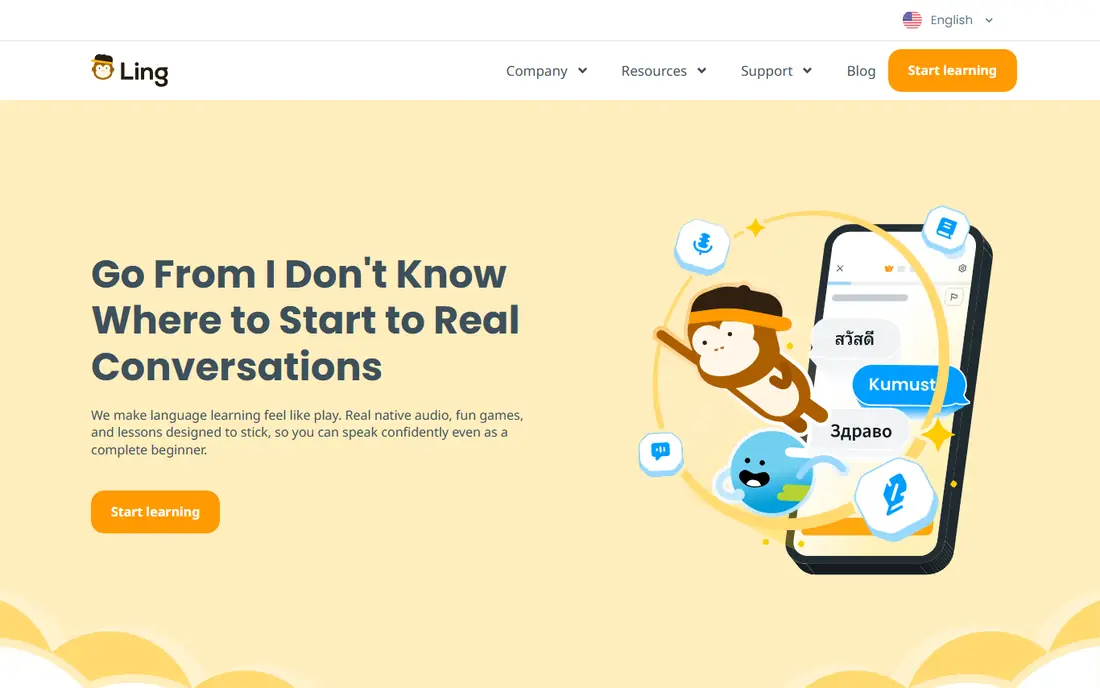
Ling is our pick for most Thai learners because it treats Thai as a distinct language, not a translated template. Lessons cover the Thai alphabet, tones, vocabulary, and sentence patterns, with audio from native speakers and writing practice for script learners. A chatbot feature lets you practice short conversations without the pressure of a live tutor, which helps beginners who feel shy about speaking.
The free tier is useful but limited, so regular learners will likely need a paid plan, with pricing listed on the vendor site and in app stores. Ling also will not replace real conversation at higher levels, so pair it with listening or a tutor when you reach intermediate Thai. For a structured start that respects tones and script from day one, Ling is the strongest all-round app.
- Built for Asian languages including Thai
- Script, tone, and writing practice
- Chatbot speaking practice
- Free tier limits lessons
- Advanced conversation needs a paid plan or a tutor

Duolingo is the easiest Thai app to start, because lessons take only a few minutes and the free tier is genuinely usable. The Thai course covers basic vocabulary, phrases, and sentence patterns, with streaks and reminders that help you practice daily. For a traveler who wants polite basics before a trip, or a beginner testing whether Thai suits them, Duolingo is a low-risk first step.
Depth is the limit. Thai tones and script need more focused practice than short game-style lessons provide, so Duolingo works best as a habit builder alongside a Thai-specific app such as Ling or ThaiPod101. The free tier also shows ads and limits mistakes, while Super removes ads and adds extra practice. Start free, build the habit, then add depth.
- Short free lessons that build a habit
- Thai course for beginners
- Streaks and reminders
- Limited depth for script and tones
- Free tier has ads and mistake limits
ThaiPod101 suits learners who learn by listening. The library covers beginner to advanced lessons, with dialogues, vocabulary lists, grammar notes, and cultural context that help you understand polite forms and everyday Thai. Audio lessons work well on a commute or walk, and you can repeat a lesson until tones and phrases feel natural. A free tier gives a sample of lessons, with paid plans for full access.
The platform can feel busy, since it offers many lesson types, tools, and upsells. Start with one lesson path at your level and ignore the rest until you finish it. Pricing varies by plan and sale, so check the current pricing page. For listening and real conversation patterns, ThaiPod101 is one of the best Thai learning apps available.
- Large library of Thai audio and video lessons
- Lessons by level
- Cultural notes
- Website and app can feel busy
- Full features need a paid plan
Pimsleur is the pick for learners who want to speak Thai without staring at a screen. Its audio lessons use spaced repetition and prompt you to answer aloud, which builds pronunciation and recall for tones and phrases. Lessons are about 30 minutes, so they suit a commute, a workout, or housework. A free trial lets you test the method before subscribing, with pricing listed on the vendor site.
Reading and writing are the gaps. Pimsleur focuses on speaking and listening, so you will need Ling or another script app to learn Thai letters. The subscription also costs more than a free app, so it suits learners who will actually use the audio daily. If speaking confidence is your main goal, Pimsleur is worth the trial.
- Audio-first method builds speaking confidence
- Spaced repetition
- Hands-free lessons
- No permanent free plan
- Reading and writing need a second app
Drops is a vocabulary app built around short, visual sessions. Each session lasts five minutes on the free tier, which makes it easy to fit Thai words into a busy day. Words are paired with illustrations and audio, and Thai script is included, so you start recognizing letters while you learn words. That visual approach suits learners who forget words from plain lists.
Grammar is the limit. Drops teaches words and phrases, not full sentences or tone rules, so use it as a supplement, not your only Thai app. The free tier limits session length, while Premium removes the limit. For a daily vocabulary habit that takes five minutes, Drops is a fun and effective extra.
- Five-minute vocabulary sessions
- Visual word learning
- Thai script included
- Free sessions are time-limited
- Not a full grammar course
italki is the best Thai language app for speaking with a real person. You can choose a Thai tutor by price, specialty, availability, and reviews, then book a one-to-one video lesson at a time that suits you. A tutor can correct tones, explain polite forms, and practice the exact situations you need, from travel to work to family conversations. That personal feedback is something no app alone can match.
Cost varies by tutor, so check lesson prices before booking, and try a trial lesson with two tutors before committing to one. italki has no free plan, since you pay per lesson, but you control how often you book. For speaking confidence and tone correction, even one lesson a month alongside an app makes a clear difference.
- Real Thai tutors by price and specialty
- Flexible scheduling
- Lessons tailored to you
- Tutor prices vary
- No free plan, you pay per lesson
Mondly suits beginners who want useful Thai phrases fast. Lessons focus on travel, dining, shopping, and daily conversation, with speech recognition to check pronunciation. The app also offers chatbot and augmented reality features that make practice feel less like a textbook. A free tier covers basic lessons, while Premium gives full access to all languages and lessons.
Intermediate learners will outgrow Mondly, since grammar and script depth are limited. Use it for a trip or a first month of Thai, then move to Ling or ThaiPod101 for deeper study. For a quick, friendly start with phrases you can use right away, Mondly is a solid pick.
- Phrase-based lessons for travel and daily life
- Speech recognition
- Augmented reality features
- Depth is limited for intermediate learners
- Full access needs a paid plan
Mango Languages offers a structured Thai course that moves step by step through conversation, grammar, and cultural notes. Lessons explain why a phrase works, not just what it means, which helps with polite forms and tone awareness. Many public libraries offer Mango free with a library card, so check your library before paying for a direct subscription. That library route makes Mango one of the best-value Thai courses available.
The app is less playful than Duolingo or Ling, so learners who need streaks and games may find it plain. Direct pricing also varies by plan, so confirm on the vendor site if your library does not offer it. For a calm, structured course with clear progression, Mango is a dependable choice.
- Structured Thai course with cultural notes
- Clear lesson progression
- Free through many libraries
- Direct pricing varies
- App is less game-like than Duolingo or Ling
Rosetta Stone uses immersion, pairing images and audio without translation, to build Thai vocabulary and patterns. Speech recognition helps with pronunciation, and structured units move from basic words to longer phrases. A free trial lets you test the method, with subscription pricing listed on the vendor site. For learners who like a consistent, translation-free routine, Rosetta Stone feels focused and calm.
The Thai course is not as deep as Thai-specific platforms for advanced grammar and script, so higher-level learners will need a supplement. The subscription also costs more than free apps, so it suits learners who will use it daily. If immersion suits your learning style, Rosetta Stone is a respected option for Thai basics and beyond.
- Immersion method with images and audio
- Speech recognition
- Structured units
- No permanent free plan
- Thai course depth varies by level
How we picked these
We compared official course pages, pricing pages, and app store listings, and we favored apps with a real Thai course, native-speaker audio, and a clear free tier, trial, or library option. We left out generic language apps with no Thai course and phrasebooks with no audio or tone help. Each pick had to cover a distinct job, from script and tones to listening, speaking, and live tutoring, so you can combine two apps without paying twice for the same lessons.
How to learn Thai faster with an app
Practice a little every day, and focus on tones early. Thai tones change meaning, so listening and repeating aloud matter more than memorizing long word lists. Learn the script as soon as you can, since reading Thai helps with tones, pronunciation, and real signs, menus, and messages in Thailand.
Combine an app with listening and speaking
Use one app for structure, such as Ling, plus one listening source, such as ThaiPod101, and a tutor on italki when you can. That mix covers reading, listening, and speaking, which a single app rarely does well. Even 15 minutes a day, split between an app and audio, beats a long session once a week.
FAQ
What is the best app to learn Thai?
Ling is our pick for most learners, since it covers Thai script, tones, and daily practice in one app. Duolingo is best for free daily habits, ThaiPod101 is best for listening, and italki is best for live speaking practice.
What are the best apps to learn Thai for beginners?
Duolingo, Ling, Mondly, and Drops all suit beginners, with short lessons and basic phrases. Start with one, build a daily habit for two weeks, then add a second app for script or listening when you are ready.
What is the best Thai learning app for speaking?
Pimsleur and italki lead for speaking, with Pimsleur building confidence through audio repetition and italki giving live correction from a real tutor. Use Pimsleur daily and book a tutor lesson when you want feedback on tones.
Can I learn Thai script with an app?
Yes. Ling, Drops, and Mango Languages include Thai script practice, and ThaiPod101 offers script lessons and notes. Learning the script takes time, but it improves pronunciation and reading far more than romanized Thai alone.
Is Thai hard to learn with an app?
Thai is challenging because of tones and script, but an app makes the start manageable with short lessons and native audio. Progress is slower than with a European language, so expect months for basics and a year or more for comfortable conversation, with regular practice.