Best Apps to Learn Chinese for Beginners in 2026: 8 Apps Compared
Find the best app to learn chinese for beginners, from structured Mandarin courses to tones, characters, reading, and speaking practice for new learners.

- Editor's choice
 HelloChinese
Structured beginner course
Starts atFreeVisit hellochinese.ccFull review - Great alternative
 Duolingo
Free daily habit building
Starts atFreeVisit duolingo.comFull review - Also consider
 Pleco
Dictionary and lookup
Starts atFreeVisit pleco.comFull review
TL;DR:
- HelloChinese is our pick for most beginners, because it teaches pinyin, tones, characters, grammar, and speaking in one structured course.
- Duolingo suits habit building and free daily practice, while Pleco is the dictionary every learner ends up using.
- Du Chinese suits graded reading, Skritter suits character writing, and Pimsleur suits audio learning on a commute.
- No single app covers everything, so pair a core course with a dictionary and a reading or speaking tool.
- The best chinese app for you depends on whether you want to speak, read, write, or pass an HSK exam first.
Quick comparison
| Tool | Best for | Starts at | Free plan? | |
|---|---|---|---|---|
| HelloChinese | Structured beginner course | Free | Yes | Visit |
| Duolingo | Free daily habit building | Free | Yes | Visit |
| Pleco | Dictionary and lookup | Free | Yes | Visit |
 Du Chinese | Graded reading practice | Free | Yes | Visit |
 Skritter | Character writing practice | See website | Free trial | Visit |
 Pimsleur | Audio speaking and listening | See website | Free trial | Visit |
 Memrise | Gamified vocabulary | Free | Yes | Visit |
 ChineseSkill | Comprehensive beginner study | Free | Yes | Visit |
The best apps to learn Chinese for beginners
Chinese is different from many languages for beginners, because tones, characters, and pinyin all matter from day one. The apps below cover those skills in different ways, so pick a core course first, then add tools for the skills you find hardest.
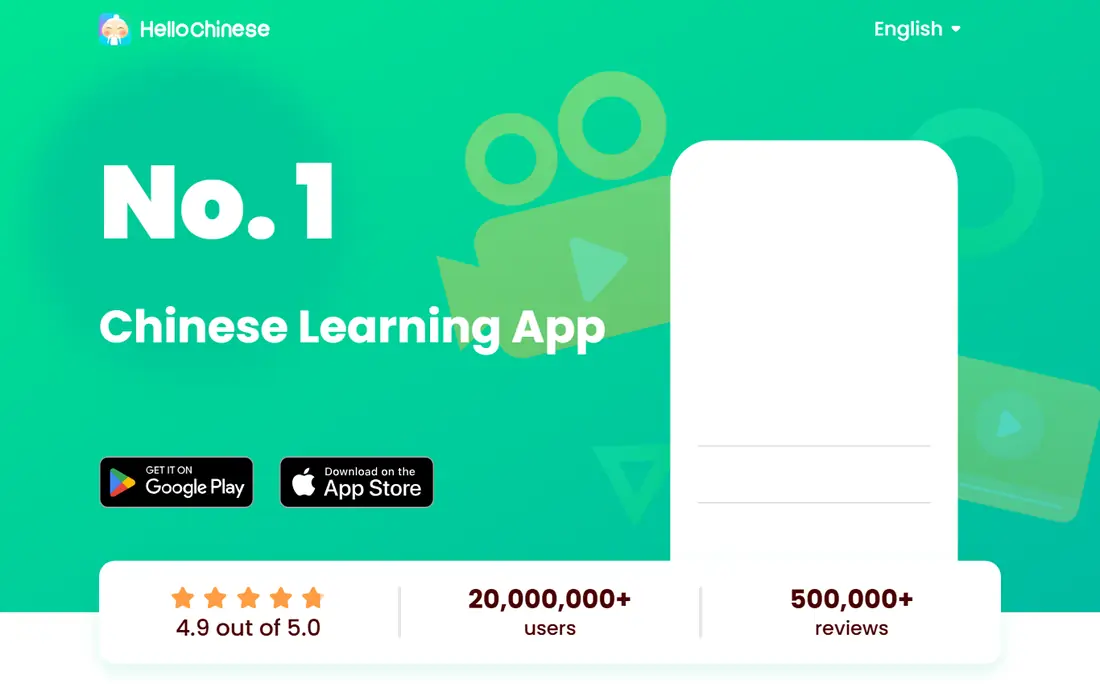
HelloChinese is purpose-built for Mandarin, and that focus shows in how it teaches tones and pinyin from the very first lesson. Lessons cover listening, speaking, reading, writing, and grammar in a clear order, with speech recognition that gives feedback on pronunciation and tones. Character writing practice with stroke order guidance also helps beginners who want to read, not just speak.
The free tier covers core lessons, while Premium, at around $11.99 per month or $69.99 per year for US users in recent listings, opens all courses and advanced features. Content plateaus around the intermediate level, so advanced learners will need reading and speaking tools next. For complete beginners, HelloChinese is the best app to learn chinese for beginners in this group.
- Structured pinyin, tones, and grammar course
- Speech recognition
- Character writing practice
- Content plateaus around intermediate level
- Best features need Premium
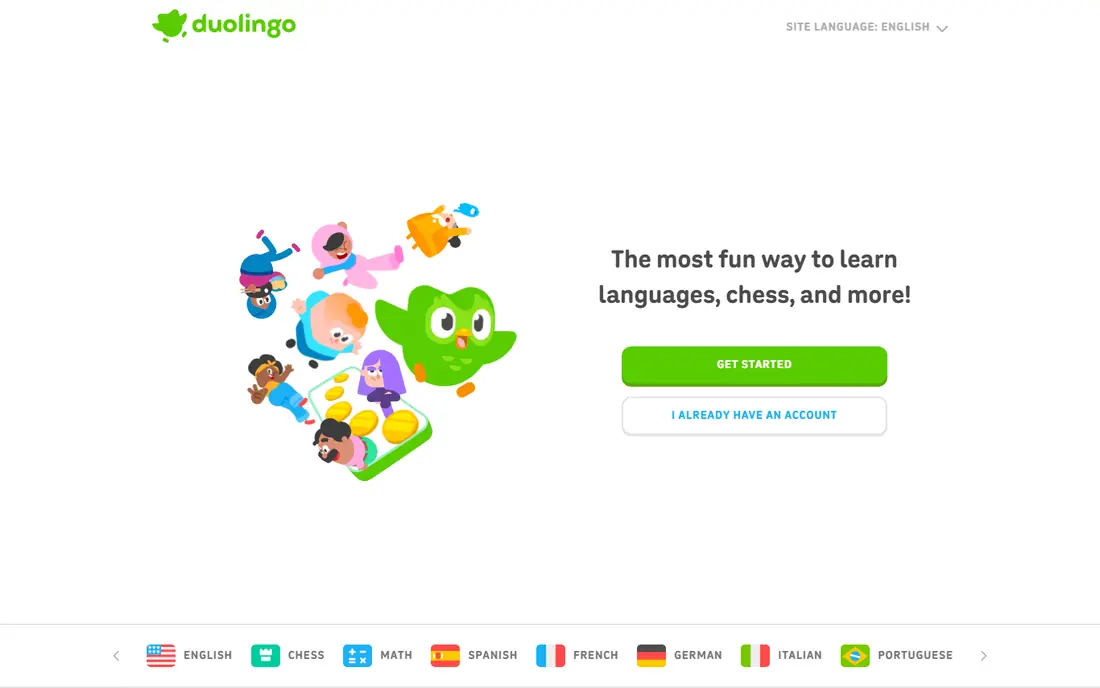
Duolingo is the easiest way to build a daily Chinese habit, with short, gamified lessons that fit into a few minutes. It covers basic vocabulary, pinyin, and simple sentences, and its streak and reward system keeps many beginners coming back. For a first taste of Mandarin, or as a supplement to a core course, it works well.
The limits show quickly for serious learners. Grammar explanations are thin, tone training is weaker than HelloChinese, and character learning is shallow compared with Skritter. Paid Super Duolingo removes ads and limits, but it does not fix those depth gaps. Use Duolingo to build a habit, then pair it with HelloChinese for structure.
- Free and gamified
- Easy daily habit
- Good for basic vocabulary and pinyin
- Shallow grammar explanations
- Weak tone and character depth for serious learners
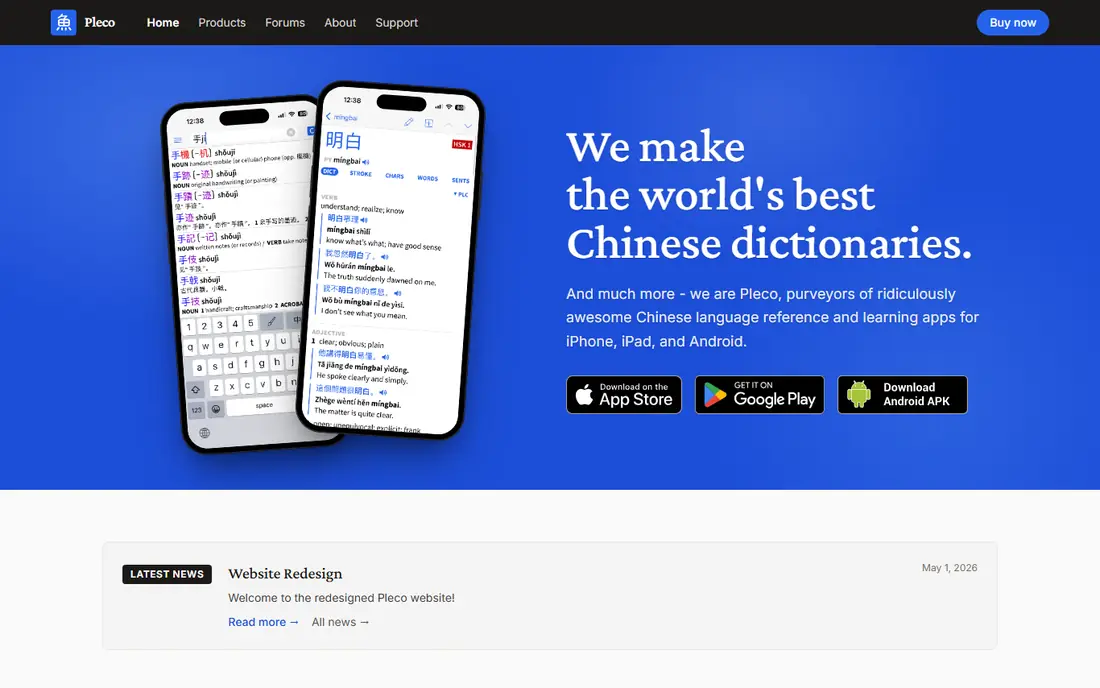
Pleco is the dictionary every Chinese learner ends up using, and beginners should install it on day one. Look up a word by pinyin, character, handwriting, or camera, hear native audio, and see stroke order animations for characters. That lookup power turns every menu, sign, or lesson word into a learning moment.
Pleco is not a course, so it will not teach you grammar or a lesson order on its own. The base app is free, with paid add-ons for flashcards, a document reader, and other tools, typically in the $30 to $50 range for bundles in recent listings. As a companion to HelloChinese or Duolingo, Pleco is indispensable.
- Best Chinese dictionary for learners
- Handwriting and camera lookup
- Stroke order and audio
- Not a course
- Paid add-ons needed for flashcards and reader features
Du Chinese solves a common beginner problem: how to start reading real Chinese text without drowning in unknown characters. Graded readers are leveled by HSK, from beginner to advanced, and you can tap any character for a definition and audio. Listening mode also lets you follow along, which links reading to pronunciation.
The app focuses only on reading and listening, so it cannot replace a core course for speaking and grammar. A free tier covers some content, while a paid plan, at around $12 to $13 per month in recent listings, opens the full library. For beginners who want to read early, Du Chinese is uniquely good.
- Graded readers by HSK level
- Tap any character for definition and audio
- Listening mode
- Reading only
- Paid plan needed for full library
Skritter is unmatched for learning to write Chinese characters, with stroke order guidance, handwriting recognition, and spaced repetition that brings characters back just before you forget them. For learners who want to read and write, not just speak, that practice is essential, since characters do not follow an alphabet.
Skritter is a specialist, so it does not teach conversation or grammar on its own, and the subscription, at around $15 per month in recent listings, is a real cost on top of a core course. A free trial lets you test whether character writing matters to your goals. If writing matters, Skritter is worth it; if speaking matters more, spend that money on tutoring instead.
- Best character writing practice
- Stroke order feedback
- Spaced repetition for characters
- Subscription cost adds up
- Focused only on characters and vocabulary
Pimsleur uses audio-only lessons to build speaking and listening reflexes, with spaced repetition and tone-aware drills from the first lesson. That method suits beginners whose learning time is mostly commuting, driving, or walking, since you can learn without a screen. Pronunciation and listening improve faster than with text-only apps for many users.
Pimsleur will not teach you to read characters, and its subscription, at around $15 to $21 per month in recent listings, costs more than many app courses. Use it as an audio complement to HelloChinese, not as a replacement. For audio-first beginners, Pimsleur is genuinely effective within its scope.
- Audio-only drills build speaking reflexes
- Tone-aware listening
- Good for commutes
- Does not teach reading or characters
- Subscription cost is higher than app-only courses
Memrise suits vocabulary building, with gamified reviews, native speaker videos, and short lessons that fit a daily routine. It helps beginners memorize words and phrases, hear natural pronunciation, and keep a streak going. For learners who struggle with vocabulary retention, that game-like loop can make a difference.
Memrise is less structured than HelloChinese as a full course, and grammar explanations are limited. It works best as a vocabulary supplement, paired with a core course and Pleco for lookup. If you like gamified learning but find Duolingo too shallow for Chinese, Memrise is a useful middle step.
- Gamified vocabulary learning
- Native speaker videos
- Easy daily reviews
- Less structured than HelloChinese
- Grammar depth is limited
ChineseSkill offers a comprehensive beginner course with lessons, games, speaking practice, and clear progression through early levels. It covers pinyin, vocabulary, grammar, and characters in a structured way, which suits beginners who want an alternative to HelloChinese. The game elements also help younger learners stay engaged.
The community and content depth are smaller than Duolingo or HelloChinese, and advanced content is thinner, so most learners will outgrow it. The free tier covers a good amount, with a paid plan at around $10 per month in recent listings for full access. As a first or second beginner course, ChineseSkill is a solid choice.
- Comprehensive beginner lessons
- Games and speaking practice
- Clear progression
- Smaller community than Duolingo
- Advanced content is thinner
How we picked these
We compared official feature pages, pricing pages, and app store listings for Chinese learning apps that are still available in October 2026. We favored apps with a clear beginner path, tone and pinyin teaching, and a usable free tier or trial, and we included specialists for reading, writing, and speaking, since no single app covers all skills. We mixed free habit builders with structured courses, since beginners need both motivation and depth. We did not claim hands-on testing, and we noted where pricing varies by region and plan.
How to learn Chinese as a beginner
A core course plus two supplements beats five half-used apps.
Start with tones and pinyin
Tones change meaning in Mandarin, so learn pinyin and tones properly in your first weeks, even if it feels slow. HelloChinese and Pimsleur both teach tones early, with speech feedback or audio drills. Practice tones aloud daily, since silent reading alone will not build tone accuracy.
Build a daily stack
Use HelloChinese as your core course, Pleco as your dictionary, and one supplement for your weakest skill: Du Chinese for reading, Skritter for writing, or Pimsleur for speaking. Keep daily sessions short and regular, with spaced repetition for vocabulary, rather than long weekend cramming. Review old lessons often, since Chinese vocabulary fades fast without review.
Move from app to real language
Apps teach patterns, but real progress comes from reading graded texts, listening to native audio, and speaking with a tutor or language partner. Du Chinese helps you read early, while italki or HelloTalk can add conversation practice once you have basic sentences. Set a clear next goal, such as HSK 1 or a short conversation, and pick tools that serve that goal.
FAQ
What is the best app to learn chinese for beginners?
HelloChinese is our pick for most beginners, because it teaches pinyin, tones, characters, grammar, and speaking in one structured course. Duolingo suits free daily habit building, while Pleco is essential as a dictionary. The best app learn chinese beginners choose often pairs HelloChinese with Pleco and one reading or speaking tool.
What is the best chinese app that is free?
Duolingo offers the best free daily practice, with gamified lessons and no upfront cost. HelloChinese and Pleco also offer free tiers that cover core lessons and lookup. For a free stack, use Duolingo for habit, HelloChinese free lessons for structure, and Pleco for dictionary lookup.
How long does it take to learn basic Chinese with an app?
Basic conversational Chinese, with simple sentences and everyday vocabulary, can take several months of daily study, depending on time and consistency. Reading characters takes longer than speaking, since each character must be learned separately. Apps help with daily practice, but speaking with real people speeds progress more than app lessons alone.
Should I learn Simplified or Traditional characters first?
Most beginners start with Simplified characters, since they are used in mainland China and in most beginner courses, including HelloChinese. Traditional characters are used in Taiwan, Hong Kong, and many overseas communities. Pick the set that matches where you plan to use Chinese, and do not try to learn both at once as a beginner.
Is Duolingo enough to learn Chinese?
Duolingo is enough to build a habit and learn basic vocabulary, but it is not enough on its own for serious progress. Its grammar, tone, and character depth are limited compared with HelloChinese, Skritter, and Du Chinese. Use Duolingo as a supplement, not as your only course, if you want to speak and read with confidence.