6 Agentic Analytics Software for Startups Worth Shortlisting in 2026
6 best agentic analytics software for startups, with entry costs, free tiers and the buyer each one serves. Verdicts stay brief and factual. See the full list.
- Editor's choiceSigma Computing
AI apps on warehouse data
Starts atSee websiteVisit sigmacomputing.comFull review - Great alternative
 ThoughtSpot
AI-driven insights and agents
Starts at$25 per user per monthVisit thoughtspot.comFull review - Also consider
 Google Looker
Semantic layer and embedded analytics
Starts atSee websiteVisit cloud.google.comFull review
Direct answer
This list puts Sigma Computing first for AI apps on warehouse data. Listed starting prices: ThoughtSpot from $25 per user per month and Tableau from $15 per user per month. For a different need, ThoughtSpot covers AI-driven insights and agents and Google Looker covers semantic layer and embedded analytics. The full list of 6 tools follows, with prices and free plan facts.
TL;DR:
- Top of the list is Sigma Computing, which targets AI apps on warehouse data.
- Tableau suits visual analytics and dashboards.
- The lowest published monthly entry price here is $15 per user per month, from Tableau.
- The main caution on Databricks: can be complicated for small teams.
Last checked November 2026. Prices and plan details were read from the vendors' own pages in November 2026; vendors change plans often, so confirm the current price on the vendor site before you buy.
Quick comparison
| Tool | Best for | Starts at | Free plan? | |
|---|---|---|---|---|
| Sigma Computing | AI apps on warehouse data | See website | Free trial | Visit |
| ThoughtSpot | AI-driven insights and agents | $25 per user per month | Free trial | Visit |
| Google Looker | Semantic layer and embedded analytics | See website | Not stated | Visit |
 Databricks | Unified data and AI system | See website | Not stated | Visit |
 Qlik | Data integration and analytics | See website | Not stated | Visit |
 Tableau | Visual analytics and dashboards | $15 per user per month | Yes | Visit |
Tool-by-tool breakdown
Short on time? The summary and table above give the quick view of 6 agentic analytics software for startups, and the profiles that follow give the detail behind each entry.
Sigma Computing
Best for: AI apps on warehouse data
Sigma Computing targets AI apps on warehouse data. Sigma Computing gives you an AI runtime for business, allowing teams to build and run AI apps, dashboards, and agents on governed warehouse data. It supports several interfaces including chat, spreadsheet, SQL, and Python.
This makes Sigma a solid fit for startups that want to enable several teams to build with data without sacrificing governance. More specifically, consider Tableau if you need straightforward visualizations. On top of that, Sigma needs a data warehouse to function, which may be an additional cost for startups without one. This comparison lists no price for Sigma Computing; ask the vendor. On free options: Free trial.
The main drawbacks: May be overkill for straightforward analytics.
- Works on governed warehouse data
- Build AI apps, dashboards, agents
- Needs a data warehouse
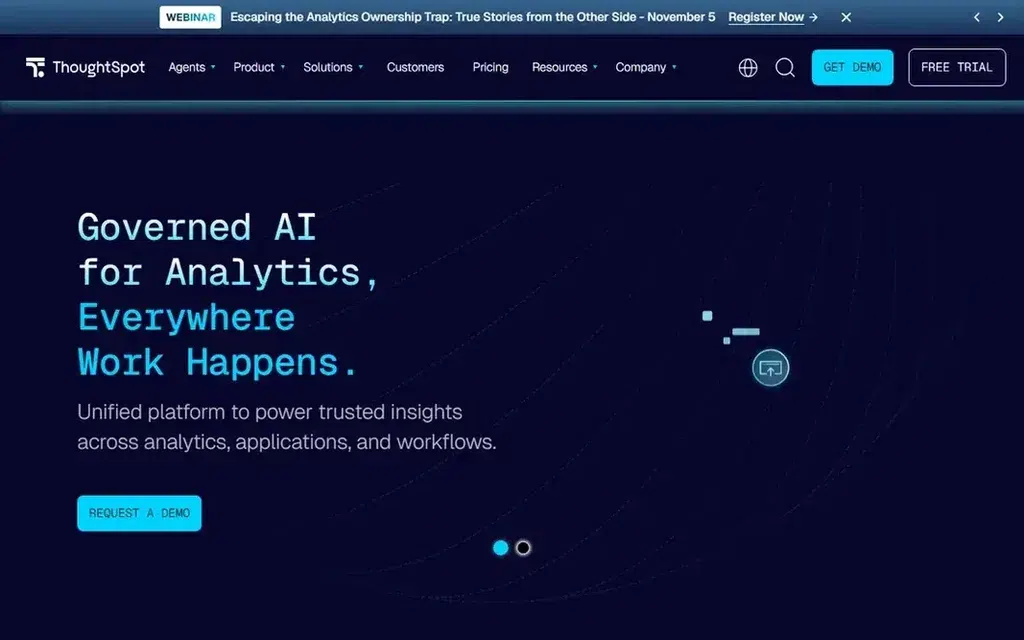
Where ThoughtSpot fits: AI-driven insights and agents. ThoughtSpot is an agentic analytics platform that uses AI agents to automate insights and embed intelligence into workflows. It is meant to transform insights into action, making it a good match for startups that want to democratize data access and enable teams to ask questions in natural language.
Downsides: May need training for full use.
Its focus on AI-driven analytics aligns with the needs of fast-moving startups. In practice, startups with complicated data pipelines might have to pair it with a solid data warehouse. As for the details, Whereas ThoughtSpot excels at AI-driven insights, it may have limitations in data integration compared with broader systems. What you pay to start with ThoughtSpot: $25 per user per month. Free access: Free trial.
- Agentic analytics with AI agents
- Automatic insights and embedded intelligence
- Restricted data integration compared with bigger systems
Google Looker is built with semantic layer and embedded analytics in mind. For a more standalone agentic analytics tool, consider ThoughtSpot. In daily use, Looker is Google Cloud's agentic business intelligence and embedded analytics system.
It brings together metrics with a trusted semantic layer and uses Gemini agents to offer AI-driven insights. Startups that are already on Google Cloud or need embedded analytics will find Looker a natural fit, notably those that value a consistent metric definition across teams. It also needs technical setup to use the semantic layer completely. This comparison lists no price for Google Looker; ask the vendor. On free options: Not stated.
Points against: May need technical setup.
- Trusted semantic layer for unified metrics
- Gemini agents for AI-driven BI
- Tied to Google Cloud ecosystem
For unified data and AI system, Databricks is a natural candidate. Databricks gives you a unified system for data, analytics, and AI.
From a buyer's view, the system may need significant setup and expertise. No starting price is listed for Databricks here; confirm pricing on the vendor site. Free plan details: Not stated.
Watch-outs: Needs data engineering expertise.
- Supports ETL, warehousing, governance
- Merges data engineering, analytics, AI
- Can be complicated for small teams
Pick Qlik if this describes you: data integration and analytics. Qlik, now with Talend, provides a data fabric and next-level insights with end-to-end data integration, data quality, and analytics options. As for the details, for startups prioritizing AI agents, other choices may be more direct.
The main drawbacks: Less emphasis on agentic AI.
Qlik is less concentrated on agentic analytics compared with products like ThoughtSpot. On top of that, Qlik's strength lies in its comprehensive data management capabilities, which can support AI initiatives. Check the vendor site for Qlik pricing; none is listed in this comparison. Trial and free access: Not stated.
- End-to-end data integration with Talend
- Data quality and analytics options
- May need integration effort
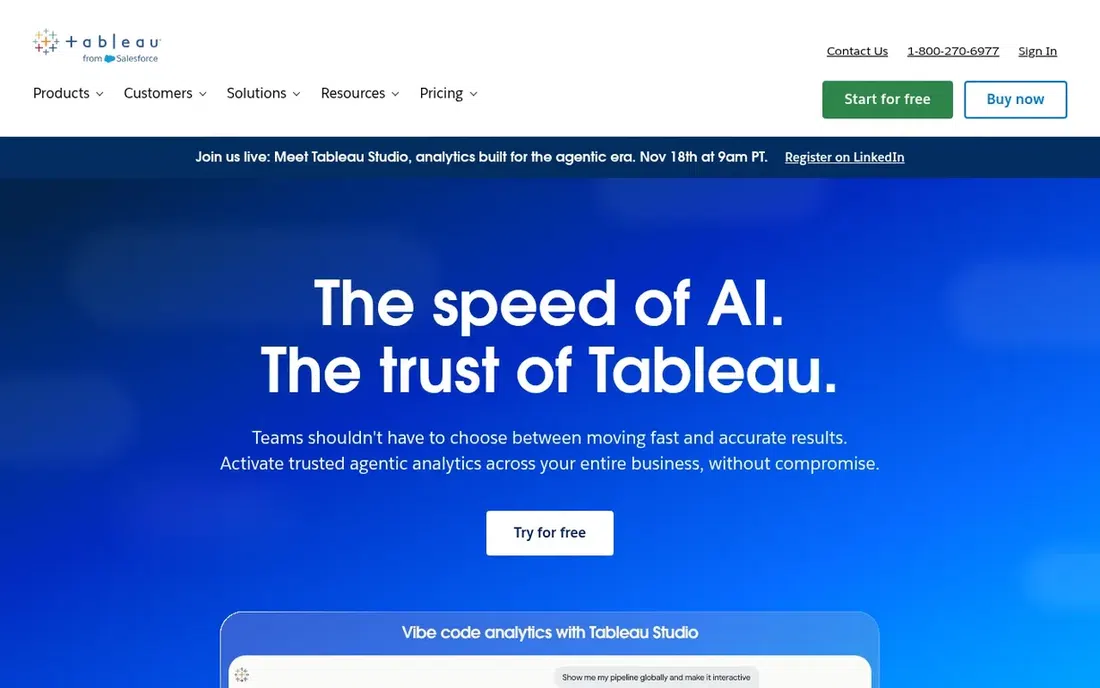
Tableau is a good fit for visual analytics and dashboards. Tableau is a business intelligence and analytics software that helps users see and understand their data through drag-and-drop visualizations. It links to almost any database and permits sharing with a click.
From a buyer's view, Tableau's strength in visualization comes at the cost of advanced agentic features. For startups that prioritize visual analytics and interactive dashboards, Tableau remains a strong choice, though it is not primarily an agentic analytics system. On cost, Tableau starts like this: $15 per user per month. Tableau includes a free tier.
Where it falls short: Can be expensive for small teams.
- Feature-rich visualization capabilities
- Links to almost any database
- Less concentrated on agentic AI
How the list was put together
Pricing pages, product documentation and feature lists were the main sources, and every entry carries at least one honest drawback. Seat minimums, billing terms and add-ons can move the real cost, so the starting prices here are a guide and not a quote. Tools are placed by general fit for agentic analytics software for startups, with price clarity and free access as tie-breakers. A different team can reasonably rank them differently.
Things to verify first
- Get a written quote from Sigma Computing, Google Looker, Databricks and Qlik; the list shows no starting price for them.
- Test the free plan from Tableau against your real workload before relying on it.
- Use real work to test the free trial from Sigma Computing and ThoughtSpot, rather than a demo project.
- Before choosing Sigma Computing, weigh its main limit: needs a data warehouse.
- Add up seats, add-ons and usage charges for Sigma Computing before comparing it with cheaper entries.
- Pick one real project and run it in Databricks first; a small pilot shows fit faster than a checklist.
FAQ
How are the tools for agentic analytics software for startups ordered?
Sigma Computing sits first and Tableau last because the order follows typical fit for agentic analytics software for startups, then price clarity and free access. It is a judgement call, so read each profile for fit and limits.
Which options for agentic analytics software for startups have a free plan?
Tableau is the only tool in this list with a free plan. Free plans usually cap users, projects or features, so check the limits on the vendor page. Several others offer a trial instead. For the full picture, the cards above cover all 6 entries of this agentic analytics software for startups list, including price, free plan and limits.
Which tool is a good match for startups new to analytics?
The first pick on this list is Sigma Computing, because it suits AI apps on warehouse data. ThoughtSpot is better for AI-driven insights and agents, and Google Looker for semantic layer and embedded analytics. Check price and limits against your own needs before choosing.
What is the cheapest option for agentic analytics software for startups in this list?
On published monthly entry prices, Tableau is the lowest here at $15 per user per month. Entry price is only part of the cost, because seats, add-ons and billing terms can change the total. Prices, free plan details and limits for all 6 tools in this agentic analytics software for startups roundup sit on the individual cards above.
What is agentic analytics?
Agentic analytics refers to analytics products that use AI agents to automate insights, answer questions, and take actions based on data. These agents can proactively surface trends and anomalies, reducing the need for manual analysis.
How do I choose between Databricks and ThoughtSpot?
Databricks is a unified data and AI product a strong match for startups with data engineering needs and large-scale AI projects. Choose based on whether you need a full data product or a specialized analytics tool.
Sources
- https://www.sigmacomputing.com
- https://www.thoughtspot.com
- https://cloud.google.com/looker
- https://www.databricks.com
- https://www.qlik.com
- https://www.tableau.com