Best Adaptable Lending Platform in 2026: 8 Platforms Compared
Compare the best adaptable lending platform options for banks, credit unions and fintechs, with configurability, APIs and pricing notes explained in 2026.
- Editor's choice
 Blend
US mortgage and consumer lending
Starts atSee websiteVisit blend.comFull review - Great alternative
 nCino
Bank lending and onboarding
Starts atSee websiteVisit ncino.comFull review - Also consider
 Mambu
Composable cloud lending
Starts atSee websiteVisit mambu.comFull review
TL;DR:
- Blend and nCino suit US mortgage and commercial lenders that need a configurable origination workflow.
- Mambu and Temenos fit firms that want a composable core, where lending products can be built from parts.
- Finastra and LoanPro help lenders that need deep servicing, loan management and product flexibility.
- TurnKey Lender and LendFoundry suit smaller and non-bank lenders that need a faster, adaptable start.
- Adaptable means configurable without a full rebuild, so test product, pricing and workflow changes in a demo.
Quick comparison
| Tool | Best for | Starts at | Free plan? | |
|---|---|---|---|---|
| Blend | US mortgage and consumer lending | See website | No | Visit |
| nCino | Bank lending and onboarding | See website | No | Visit |
| Mambu | Composable cloud lending | See website | No | Visit |
 Temenos | Global composable banking | See website | No | Visit |
 Finastra | Enterprise lending and servicing | See website | No | Visit |
 LoanPro | Flexible loan servicing | See website | No | Visit |
 TurnKey Lender | Smaller lenders needing speed | See website | Free trial | Visit |
 LendFoundry | Non-bank and alternative lenders | See website | No | Visit |
The best adaptable lending platform
An adaptable lending platform lets a lender change products, pricing, workflows and rules without rebuilding the system each time. That flexibility matters when rates move, regulations change, or a new loan product must launch in weeks. The platforms below offer configuration, APIs and modular parts that help banks, credit unions and fintechs adapt, with different strengths by lender type.

Blend is a digital lending platform for banks, credit unions and mortgage lenders, covering application, verification, underwriting support and closing workflows. Borrowers can apply online, upload documents and track progress, while lenders configure workflows, rules and integrations for different loan types. That configurability helps a lender adapt a mortgage journey for purchase, refinance or home equity without a separate system for each.
Recent AI-assisted origination features aim to automate parts of execution and reduce manual work, though a lender should test accuracy and audit trails during a pilot. Blend fits a US lender that wants a polished borrower experience and a configurable origination platform. It is less of a fit for a global commercial lender or a firm that needs a full core banking system.
- Digital application and origination for mortgage and consumer loans
- Configurable workflows for lenders
- Strong integrations with credit, pricing and closing tools
- Quote-only pricing
- US mortgage focus limits fit for other lending types
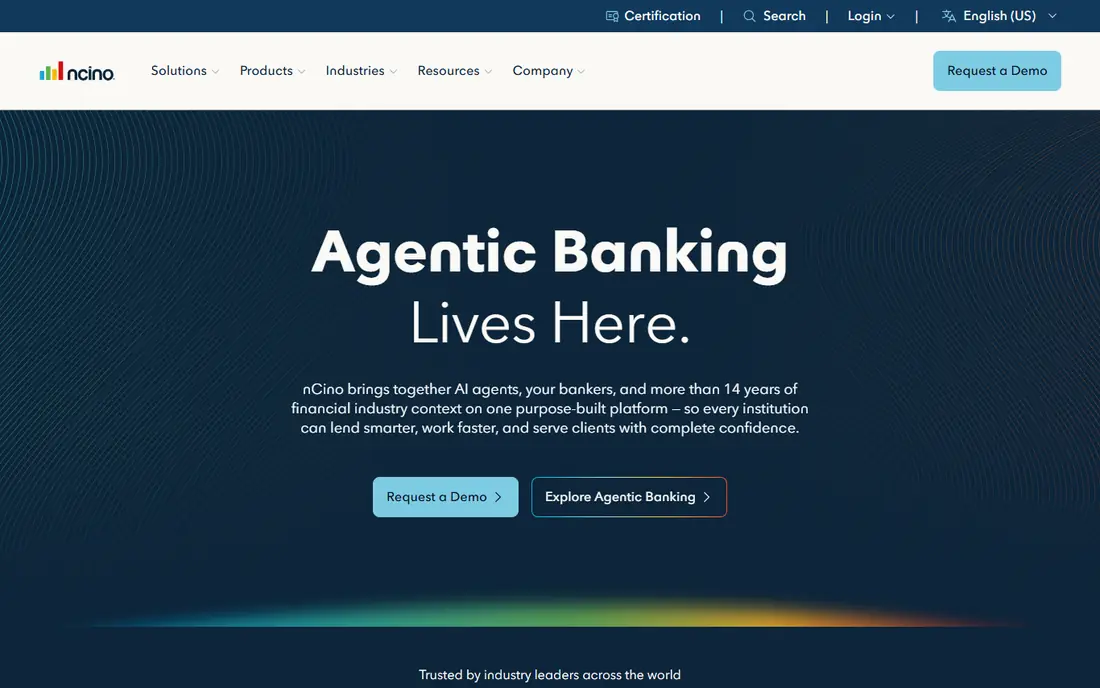
nCino is a cloud banking platform built on Salesforce, covering client onboarding, loan origination, account opening and portfolio management. Banks and credit unions can configure workflows, credit rules and document handling for commercial, small business and mortgage lending, while keeping customer data in a familiar Salesforce-based system. That platform choice helps firms that already use Salesforce for CRM.
Adaptability comes from workflow configuration and Salesforce extensibility, though deeper custom work benefits from Salesforce skills in-house or through a partner. nCino fits a bank or credit union that wants one onboarding and lending platform, with room to adapt processes by product and segment. Smaller non-bank lenders may find it more platform than they need at first.
- Built on Salesforce, with a familiar platform for banks
- Covers onboarding, origination and portfolio management
- Configurable workflows for commercial and mortgage lending
- Quote-only pricing
- Salesforce expertise helps for full customisation
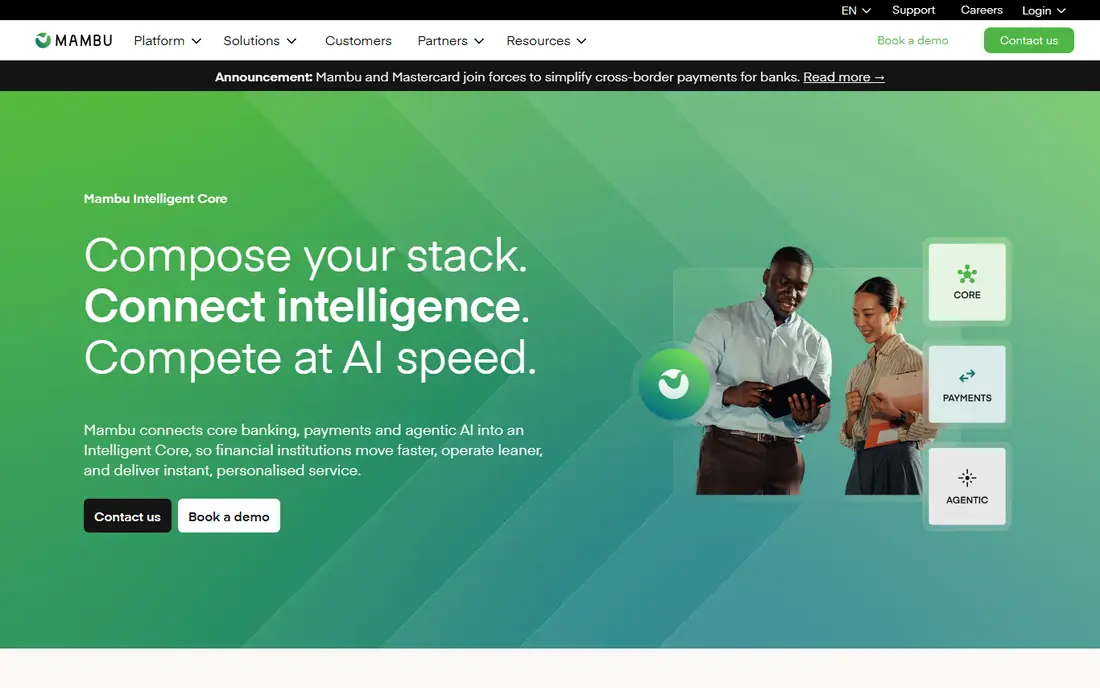
Mambu is a cloud-native core banking platform with lending products that firms can compose from parts. A fintech, neobank or lender can configure loan products, terms, schedules and fees through APIs and product builders, then connect payments, KYC and other services around the core. That composable model is why Mambu is often cited for adaptability: a new product does not require a core replacement.
The trade-off is integration scope. Mambu is a core, not a complete bank in a box, so a firm still needs partners for payments, cards, compliance and channels. Pricing is by quote and scales with use. Mambu fits a fintech or bank that wants to launch and adapt lending products quickly on a cloud core, with an engineering team to build around it.
- Cloud-native, composable core for lending
- APIs let firms build products from parts
- Fast product launch for fintechs and neobanks
- Pricing is quote-based and enterprise-grade
- Needs integration work for a full banking stack
Temenos offers composable banking capabilities, including retail lending, where a bank can define loan products, terms, payment schedules and fees, and enable or disable features per product. Events and APIs support integration with analytics, channels and other systems, which helps a bank adapt a product for a new market without rebuilding the core. Multi-country compliance support suits global banks and large regional firms.
The platform is enterprise-grade, with quote-based pricing and a phased implementation. A buyer should scope which capabilities it needs, because the full Temenos suite is broad. Temenos fits a global or large regional bank that wants composable lending, strong compliance coverage and room to adapt products by country and segment.
- Composable retail lending capabilities
- Flexible product terms, pricing and schedules
- Global compliance and multi-country support
- Enterprise pricing and implementation
- Suite breadth needs careful scoping
Finastra covers a wide range of financial software, with lending solutions for commercial, mortgage, consumer and syndicated lending, plus servicing. A large bank can use Finastra for origination, servicing and portfolio management, with configuration for product terms, workflows and reporting. That breadth helps when a bank lends across several segments and wants a vendor with depth in each.
Because Finastra is a portfolio, not a single product, a buyer must confirm which module fits its lending type, whether that is Loan IQ, Fusion Mortgagebot or another product. Pricing is by quote and implementations are enterprise projects. Finastra fits a large bank or lender that needs proven lending depth and is ready to scope the right module for its segment.
- Broad lending portfolio, including commercial and mortgage
- Loan servicing and syndicated lending depth
- Large bank and partner ecosystem
- Quote-only pricing
- Product scope varies, so confirm the exact lending module
LoanPro is a loan servicing and management platform built for flexibility. Lenders can configure loan terms, payment schedules, fees and servicing workflows, and use APIs to connect LoanPro to origination, payments and CRM tools. That configurability helps specialty lenders, such as auto, consumer and small business lenders, adapt servicing to product rules that do not fit a standard bank core.
The focus is servicing, so a firm that also needs full origination may pair LoanPro with an origination tool. That pairing is common and works well when APIs are used cleanly, but it adds integration work. LoanPro fits a lender that wants control over servicing, clear APIs and room to adapt loan products without a rigid core.
- Configurable loan servicing and management
- APIs support custom workflows and integrations
- Suits non-bank and specialty lenders
- Pricing is quote-based
- Servicing focus means origination may need a partner tool
TurnKey Lender offers an AI-assisted lending platform for banks, credit unions, fintechs and non-bank lenders, covering origination, decisioning and servicing in one system. A smaller lender can configure products, credit rules and workflows, launch faster than with an enterprise core, and test a new product without a long project. That speed is the main appeal for a firm that needs to adapt quickly on a smaller budget.
The trade-off is depth at very large scale. A global bank with complex syndicated or multi-country needs may need a larger core, while a smaller lender will find TurnKey Lender more practical. Check compliance, reporting and integration fit for your market during a trial, because lending rules vary by product and region. TurnKey Lender fits a smaller lender that values speed and configurability over enterprise breadth.
- Faster setup than enterprise cores
- Configurable workflows for consumer and business lending
- Decisioning and servicing tools in one place
- Less depth than large enterprise cores
- Scale and compliance needs vary by lender type
LendFoundry is a cloud lending platform for alternative lenders, fintechs and non-bank firms, covering origination, decisioning and loan management. Workflows, product rules and borrower journeys can be configured for consumer, business and specialty lending, which helps a lender adapt to a niche product or a new channel. API connections support payments, credit data and other services around the core workflow.
The platform is less known than Mambu, Temenos or Finastra, so a buyer should check references for its specific lending type and region. That smaller footprint is also a reason some niche lenders prefer it: the product is built for their model, not adapted from a large bank core. LendFoundry fits a non-bank or alternative lender that wants a configurable, cloud-first lending platform without an enterprise core project.
- Built for alternative and non-bank lenders
- Configurable origination and servicing workflows
- Cloud platform with API connections
- Smaller brand presence than large cores
- Enterprise bank fit varies by use case
How we picked these
We compared official product pages, pricing pages and public reviews for lending platforms that describe configurability, APIs or composable design. We kept platforms that let a lender change products, workflows or rules without a full rebuild, and that are actively sold in 2026. We left out single-product point tools with no lending workflow, because they do not meet the adaptable platform test in this guide.
What to check before you buy
Test adaptability in a demo, not only on a slide. Ask the vendor to change a loan term, add a fee rule, change an approval step and launch a test product, then time how long each change takes and who can make it. If only the vendor can make a simple change, the platform is less adaptable than it claims.
Confirm compliance and audit trails
Lending is regulated, so check how the platform handles credit checks, disclosures, document storage and audit trails. Ask how rule changes are versioned, who approved them, and how a regulator or auditor can trace a decision. A flexible platform that loses audit history is a risk, not a benefit.
Check integration and data ownership
Confirm APIs for credit bureaus, payments, KYC, CRM and accounting, and how data exports if you leave. A platform with open APIs and clear data export gives you more freedom to adapt later. A closed platform may lock you into one vendor even if product needs change.
Plan for servicing, not only origination
Many demos focus on a smooth application, but servicing is where a loan lives for years. Test payment handling, late fees, forbearance, reporting and borrower communication during evaluation. A platform that originates well but services poorly will create manual work for your team after launch.
FAQ
What does adaptable mean for a lending platform?
Adaptable means you can change loan products, terms, pricing rules, workflows and approval steps through configuration, without rebuilding the system. It also means APIs and modular parts let you add services, such as payments or KYC, as needs change. The test is how fast a business user, not only a developer, can make a safe change.
Is a composable core the same as a lending platform?
Not exactly. A composable core, such as Mambu or Temenos, provides lending building blocks that a firm assembles into products. A lending platform, such as Blend or nCino, provides a fuller origination workflow for a specific lender type. Some firms use both: a core for products and a platform for origination and servicing.
How long does it take to launch a new loan product?
It depends on the platform and the product. A configurable platform can launch a simple product variant in weeks, while a new regulated product with integrations and compliance review can take months. Ask vendors for a realistic timeline for your product type, including compliance and testing time.
Do small lenders need an enterprise platform?
Not usually. Smaller lenders often do better with TurnKey Lender, LendFoundry or LoanPro, which launch faster and cost less to run. Enterprise cores suit large banks with complex, multi-country or multi-segment needs. Match platform size to loan volume, product complexity and team skill.
What should I ask about pricing?
Ask whether pricing is per loan, per user, per volume or a flat subscription, and what implementation, integration and support cost. Lending platforms in this group mostly price by quote, so get a total cost for your expected loan volume and user count, not only a platform fee.
How do I avoid vendor lock-in?
Choose a platform with open APIs, clear data export and documented product configuration. Keep integrations modular, so payments, credit and CRM can change without replacing the core. Review contract terms for data access, exit help and how long you can access records after termination.