Best Accounting Software for Multiple Entities in 2026: 10 Compared
Best accounting software for multiple entities compared: we review 10 systems for multi-company books, consolidations and intercompany accounting in 2026.
- Editor's choice
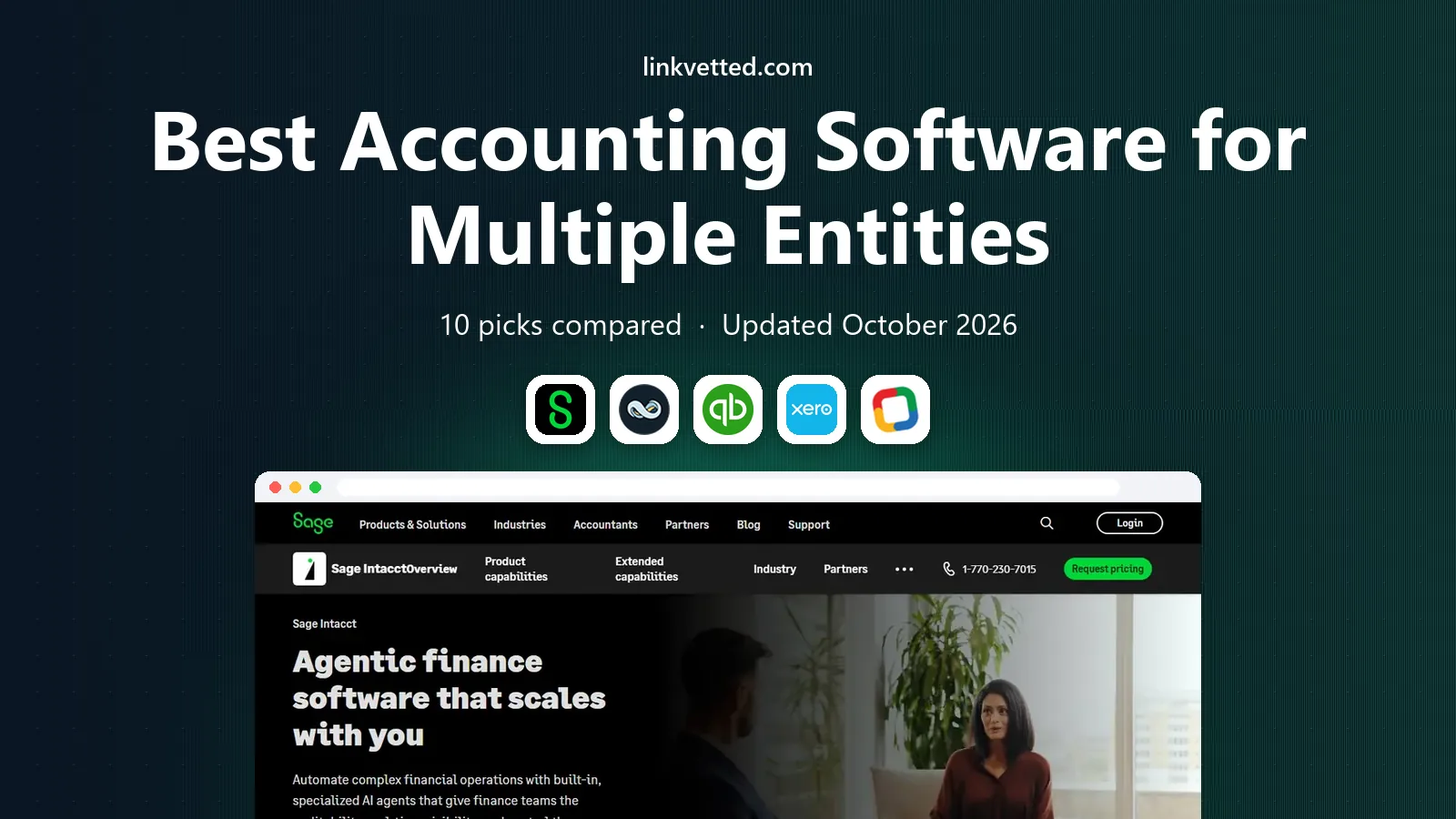
 Sage Intacct
Native multi-entity finance
Starts atSee websiteVisit sageintacct.comFull review - Great alternative
 NetSuite OneWorld
Global multi-subsidiary ERP
Starts atSee websiteVisit netsuite.comFull review - Also consider
 QuickBooks Online Advanced
Small multi-entity groups
Starts at$340 per monthVisit quickbooks.intuit.comFull review
TL;DR:
- Sage Intacct and NetSuite OneWorld are the strongest native multi-entity systems, with automated consolidations and intercompany accounting in 2026.
- QuickBooks Online Advanced suits 2 to 3 entities, but each entity is a separate file, so consolidation reporting needs care.
- Xero and Zoho Books work for small multi-business owners who keep entities separate and simple.
- Budget jumps sharply between tiers: a few hundred dollars a month for small tools, versus tens of thousands a year for mid-market ERP.
- Test intercompany transactions, eliminations, and multi-currency handling with your own chart of accounts before you buy.
Quick comparison
| Tool | Best for | Starts at | Free plan? | |
|---|---|---|---|---|
| Sage Intacct | Native multi-entity finance | See website | No | Visit |
| NetSuite OneWorld | Global multi-subsidiary ERP | See website | No | Visit |
| QuickBooks Online Advanced | Small multi-entity groups | $340 per month | Free trial | Visit |
 Xero | Small businesses, many users | $27 per month | Free trial | Visit |
 Zoho Books | Low cost multi-organization | Free | Yes | Visit |
 Acumatica | Consumption based ERP | See website | No | Visit |
 Dynamics 365 Business Central | Microsoft based groups | $70 per user per month | Free trial | Visit |
 FreshBooks | Multiple business profiles | $23 per month | Free trial | Visit |
 Odoo | Modular multi-company ERP | See website | Free trial | Visit |
 QuickBooks Desktop Enterprise | Desktop multi-company files | See website | No | Visit |
The best accounting software for multiple entities
Multi-entity accounting is not just running several companies side by side. The best accounting software for multiple businesses handles shared charts of accounts, intercompany due-to and due-from entries, eliminations, and consolidated reports without hours of spreadsheet work. We compared official pricing and feature pages for the systems below.

Sage Intacct is built for finance teams that manage several entities, locations, or departments. Its dimensional general ledger lets you tag transactions by entity, department, and project, then report across entities or consolidated without rebuilding the books. Intercompany transactions and eliminations are handled inside the system, which is the main reason finance teams move to Intacct.
Pricing is quote based, with entry deployments often cited around $10,000 to $15,000 per year and larger deployments far higher, plus implementation. That puts Intacct in a different budget class from QuickBooks or Xero. For 3 to 25 entities with an audit on the horizon, Intacct is our first pick.
- Native multi-entity consolidations
- Dimensional reporting
- Strong audit and revenue recognition tools
- Quote based pricing
- Implementation often costs as much as the subscription
- Learning curve for new users
NetSuite OneWorld is Oracle's multi-subsidiary ERP, and it suits global groups that need consolidation, multi-currency, and operations in one system. Subsidiaries can use local currencies and accounting rules, while headquarters sees consolidated financials in real time. Inventory, orders, and fulfillment sit alongside finance, which matters when entities trade stock with each other.
Cost is the barrier. Base licenses are often cited from $999 per month plus user fees, with total contracts far higher, and implementations commonly run into six figures. For a global group with many subsidiaries, NetSuite is the strongest fit here. For a domestic group of a few entities, Sage Intacct or even QuickBooks will cost far less.
- Consolidation across up to 250 subsidiaries
- 190 plus currencies
- Finance plus inventory and orders in one system
- High cost and long implementation
- Licensing is complex
- Overkill for small groups

QuickBooks Online Advanced lists at $340 per month, with a 30-day free trial, and it is the most accessible option for small multi-entity groups. Each business still has its own QuickBooks file, but Advanced adds workflow automation, advanced reporting, and tools that help accountants manage several clients or entities from one login.
The limit is structure. Intercompany accounting is manual compared with Intacct, and dimensions are limited to classes and locations. That works for 2 to 3 domestic entities with low volume, especially when an accountant handles consolidation. Beyond that, the spreadsheet work grows fast, and a native system becomes cheaper in staff time.
- Familiar interface
- Large app marketplace
- Consolidation reporting across QuickBooks files
- Each entity is a separate file
- Only classes and locations for dimensions
- Limited for complex groups
Xero plans start at $27 per month for Early, $59 for Growing, and $97 for Established, with a 30-day free trial. Unlimited users make it attractive for agencies and small groups where many people need access. Each business is a separate Xero organization, so owners with several small businesses can manage them from one login.
Xero is not a native multi-entity consolidation system. Consolidated reporting needs add-ons or spreadsheets, and intercompany entries are manual. That is acceptable for separate small businesses that do not trade with each other, but not for a group that needs true consolidation. Xero fits owners with several simple businesses, not a parent company with subsidiaries.
- Unlimited users on all plans
- Clean interface
- Large integration library
- Per-organization pricing
- Weak native multi-entity consolidation
- Each organization is separate
- Less suited to complex groups
Zoho Books offers a free plan for businesses with yearly revenue below $50,000, with paid plans from $15 per organization per month billed annually, up to $240 for Ultimate. Multiple organizations can sit under one Zoho account, which helps owners who run several small businesses and want low costs.
Like Xero, Zoho Books treats each organization separately, so group consolidation is not native. Higher tiers add features such as custom workflows and advanced reporting, but they do not turn Zoho Books into Sage Intacct. For low cost, separate small entities, Zoho Books is the cheapest credible option here.
- Free plan for small businesses
- Per-organization pricing
- Good for multiple small entities
- Multi-entity consolidation is limited
- Advanced features sit on higher tiers
Acumatica Cloud ERP supports multiple companies and branches, with intercompany accounting and consolidated reporting. Its consumption based licensing charges for resources used rather than per user, which can help groups with many occasional users. Manufacturing and distribution companies often choose Acumatica for operations as well as finance.
Pricing is quote based, with monthly costs often cited from $1,500 to $5,000 for mid-size deployments. Implementation through a partner adds cost and time. Acumatica suits mid-size groups that need ERP breadth beyond accounting, especially where many staff need occasional access without per-user fees stacking up.
- Multi-company and multi-branch support
- Consumption based licensing
- Strong distribution and manufacturing fit
- Quote based pricing
- Implementation needs a partner
- Accounting depth varies by edition
Microsoft Dynamics 365 Business Central supports multiple companies, with consolidated reporting and intercompany transactions, plus links to Office 365 and Power BI. Per-user pricing starts around $70 per month in recent guides, with a free trial available. Microsoft shops benefit from a familiar interface and a large partner network.
Business Central is a general ERP, so multi-entity depth depends on configuration and add-ons. Complex global consolidation may still favor NetSuite OneWorld. For a Microsoft based group with several domestic entities, Business Central is a strong middle option between QuickBooks and full ERP.
- Multi-company support
- Familiar Microsoft tools
- Power BI reporting
- Strong partner network
- Consolidation needs setup and sometimes add-ons
- Per-user licensing adds up
FreshBooks lets users manage multiple business profiles from a single login, with plans from $23 per month for Lite, $43 for Plus, and $70 for Premium, plus a custom Select plan, all with a 30-day free trial. It suits freelancers and service businesses that run two or three small ventures and need invoicing, expenses, and time tracking.
FreshBooks is not built for consolidated group reporting or complex intercompany accounting in 2026. Each profile stays separate, and accounting depth is lighter than QuickBooks or Xero. Use FreshBooks for separate small service businesses, not for a group that needs audited consolidations.
- Multiple business profiles under one login
- Simple invoicing and expenses
- Good for service businesses
- Not a true multi-entity consolidation system
- Limited for inventory and complex accounting
Odoo is a modular ERP with accounting, sales, inventory, and project apps, and it supports multiple companies in one database. That modular design lets a group start with accounting and add inventory or manufacturing later, without changing systems. An open source community edition exists, though hosted and enterprise versions are the practical choice for most businesses.
The trade off is setup. Odoo needs careful configuration for charts of accounts, intercompany rules, and tax settings, and that work often needs a partner. Pricing varies by apps and users, so get a full quote. Odoo suits technical teams and growing groups that want flexibility and modular growth.
- Multi-company support across apps
- Modular design
- Open source option available
- Configuration effort is high
- Accounting setup needs care
- Pricing varies by apps and users
QuickBooks Desktop Enterprise remains in use for businesses that prefer desktop software or need advanced inventory and reporting that online plans handle differently. Each company is a separate file, and accountants often manage several files for one owner. That structure is familiar, but it is not native multi-entity consolidation.
Desktop Enterprise suits businesses with a strong reason to stay on desktop, such as offline work or specific inventory needs. Most growing multi-entity groups will find QuickBooks Online Advanced or Sage Intacct easier to manage, since cloud access and reporting are simpler. Confirm current pricing with Intuit, since Desktop licensing has changed in recent years.
- Separate company files with strong desktop accounting
- Advanced inventory and reporting
- Familiar to many accountants
- Desktop based, not cloud native
- Each company is a separate file
- Consolidation needs extra work
How we picked these
We compared official pricing pages, multi-entity guides, and vendor feature lists for accounting systems available in October 2026. We favored systems that genuinely support more than one entity, whether through native consolidation or through separate organizations under one login, and we were clear about which type each system offers. Where pricing was quote based, we said so rather than presenting an estimate as a list price.
How to choose accounting software for multiple entities
Start by counting entities and how they relate. Separate businesses that never trade with each other can use Xero, Zoho Books, or FreshBooks. A parent with subsidiaries that trade, share costs, or need consolidated accounts needs Sage Intacct, NetSuite OneWorld, Acumatica, or Business Central.
Test consolidation, not just bookkeeping
Ask each vendor to show a consolidated profit and loss, a balance sheet, and an intercompany elimination using your entities. Check multi-currency handling if any subsidiary uses another currency, and check audit trails and permissions by entity. A system that books well but consolidates poorly will cost you at month end.
Budget the full cost
Subscription cost is only part of the bill. Add implementation, data migration, training, and any consolidation add-ons. For mid-market systems, implementation often runs from $15,000 to $75,000 and takes 3 to 6 months. For small tools, the cost is mainly staff time for manual consolidation, which is easy to underestimate.
FAQ
What is the best accounting software for multiple businesses?
Sage Intacct is the best accounting software for multiple entities for most growing groups because it consolidates natively and handles intercompany accounting in 2026. NetSuite OneWorld is better for global groups, and QuickBooks Online Advanced is better for small groups with 2 to 3 entities.
What is the best multi company accounting software on a budget?
Zoho Books and Xero are the best multi company accounting software options on a budget, since both let owners manage several organizations from one login at low monthly prices. They suit separate small businesses, not groups that need audited consolidations.
Does QuickBooks handle multiple entities?
QuickBooks Online Advanced handles multiple entities through separate files and consolidation reporting, but it is not a native multi-entity system like Sage Intacct. That works for small domestic groups, but complex groups will outgrow it.
What is intercompany accounting?
Intercompany accounting records transactions between entities in the same group, such as loans, shared costs, or stock transfers. A good multi-entity system tracks due-to and due-from balances and eliminates them on consolidation, so group accounts do not double count internal activity.
How many entities can NetSuite handle?
NetSuite OneWorld supports consolidation across many subsidiaries, with guides citing up to 250 subsidiaries and more than 190 currencies. That scale suits global groups, though smaller groups will find NetSuite expensive and complex.
Should small businesses use ERP for multiple entities?
Not always. A small business with 2 to 3 simple entities can stay on QuickBooks, Xero, or Zoho Books and handle consolidation with an accountant. Move to ERP when entity count, transaction volume, audit needs, or intercompany complexity make manual consolidation slow or risky.