Best Wide Column Database Software for Enterprise (2026): 6 Picks Checked on Vendor Pages
Compare 6 picks for the best wide column database software for enterprise, with prices, free plans and who each fits. Every entry states what it lacks.
- Editor's choiceAerospike
Live AI and high-throughput apps
Starts atSee websiteVisit aerospike.comFull review - Great alternative
 Azure Cosmos DB
Globally distributed multi-model apps on Azure
Starts atSee websiteVisit azure.microsoft.comFull review - Also considerGoogle Cloud Bigtable
Managed HBase-compatible workloads on Google Cloud
Starts atSee websiteVisit cloud.google.comFull review
Direct answer
Start with Aerospike if you need live AI and high-throughput apps. Listed starting prices: DataStax Astra DB from $1.00 per resource unit. Alternatives: Azure Cosmos DB for globally distributed multi-model apps on Azure, and Google Cloud Bigtable for managed HBase-compatible workloads on Google Cloud. Details, prices and limits for the rest of the 6 tools are below.
TL;DR:
- The list opens with Aerospike, aimed at live AI and high-throughput apps.
- ScyllaDB is the one to check for low-latency live workloads.
- Neither Aerospike nor ScyllaDB, nor any of the other 4 tools, has a permanent free plan; trials and quotes are the norm.
- Pricing for Aerospike, Azure Cosmos DB, Google Cloud Bigtable and others is quote-based, which adds a sales step before you can compare cost.
- What to know about Azure Cosmos DB first: cost can scale with throughput.
Last checked November 2026. Prices and plan details were read from the vendors' own pages in November 2026; vendors change plans often, so confirm the current price on the vendor site before you buy.
Quick comparison
| Tool | Best for | Starts at | Free plan? | |
|---|---|---|---|---|
| Aerospike | Live AI and high-throughput apps | See website | Not stated | Visit |
| Azure Cosmos DB | Globally distributed multi-model apps on Azure | See website | Not stated | Visit |
| Google Cloud Bigtable | Managed HBase-compatible workloads on Google Cloud | See website | Not stated | Visit |
 Apache Cassandra | Open source scale-out deployments | See website | Not stated | Visit |
 DataStax Astra DB | Managed Cassandra-compatible cloud service | $1.00 per resource unit | Free trial | Visit |
| ScyllaDB | Low-latency live workloads | See website | Free trial | Visit |
6 options for wide column database software for enterprise in detail
This LinkVetted guide covers 6 options for wide column database software for enterprise. Each profile lists a starting price, free plan details, strengths and drawbacks, so you can drop poor fits quickly.
Aerospike
Best for: Live AI and high-throughput apps
Aerospike serves live AI and high-throughput apps. If your workload is primarily analytical or you need wide SQL support, other choices may be more suitable.
Where it is weaker: Less general-purpose.
It uses a hybrid memory architecture to deliver predictable performance at scale and is frequently chosen for ad tech, fraud detection, and recommendation engines. This comparison lists no price for Aerospike; ask the vendor. Trial and free access: Not stated.
- Hybrid memory architecture
- Real-time performance focus
- Specialized skill set needed
Pick Azure Cosmos DB if this describes you: globally distributed multi-model apps on Azure. If you need a pure broad column store with more straightforward cost control, compare dedicated choices.
Azure Cosmos DB is a completely managed, serverless NoSQL and vector database offering high availability, scalability, and low latency for modern applications. Azure Cosmos DB does not show a starting price in this comparison, so check the vendor site for current pricing. Trial and free access: Not stated.
Trade-offs to know: Complicated pricing model.
- Several APIs including Cassandra
- Completely managed and serverless choices
- Cost can scale with throughput
Google Cloud Bigtable
Best for: Managed HBase-compatible workloads on Google Cloud
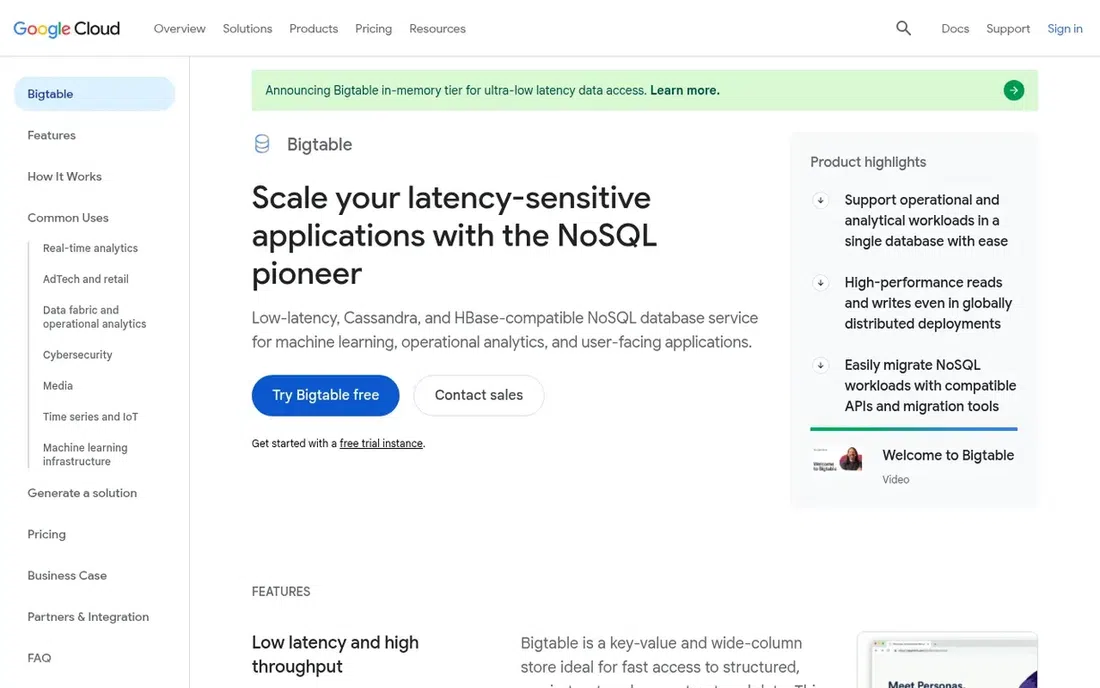
Where Google Cloud Bigtable fits: managed HBase-compatible workloads on Google Cloud. Bigtable is only available on Google Cloud, so multi-cloud or on-premises requirements may rule it out.
The main drawbacks: Restricted to broad column model.
Its data model is narrow compared with general-purpose databases, and costs can grow with heavy usage, so confirm fit and pricing details on the vendor site. Google Cloud Bigtable does not show a starting price in this comparison, so check the vendor site for current pricing. Free options: Not stated.
- HBase and Cassandra compatible
- Sub-millisecond latency design
- Tied to Google Cloud
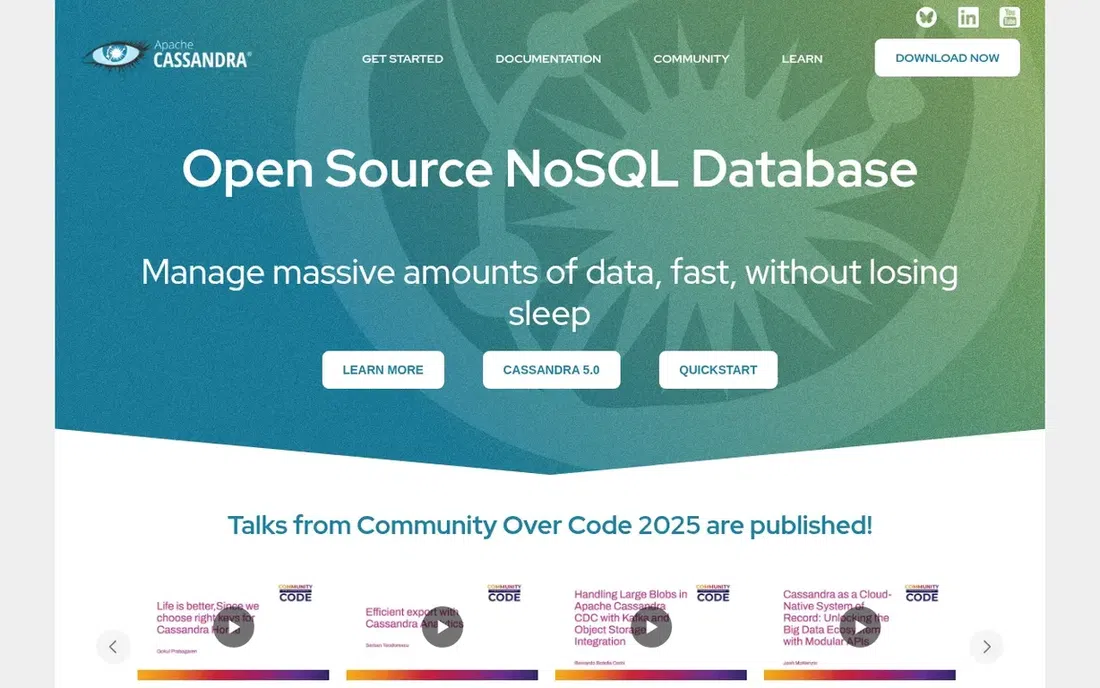
In short, Apache Cassandra is for open source scale-out deployments. Apache Cassandra is an open source NoSQL database built to handle massive amounts of data rapidly and steadily.
Honest limits: Restricted ad hoc query adaptability.
On top of that, if you need a completely managed service or more solid consistency controls out of the box, consider a managed offering or a different broad column database. Apache Cassandra shows no starting price here, so confirm the cost on the vendor site. On free options: Not stated.
- Made for massive data volumes
- Broad community and ecosystem
- Operational complexity
DataStax Astra DB works best for managed Cassandra-compatible cloud service. If full control over the deployment stack is essential, consider open source Cassandra or another self-hosted choice.
Downsides: Vendor-dependent management.
In practice, DataStax Astra DB is a managed database service built on Apache Cassandra, offered by DataStax, now part of IBM. The starting price for DataStax Astra DB: $1.00 per resource unit. Trial and free access: Free trial.
- Managed service based on Cassandra
- Vector search capabilities
- Fewer deployment choices
ScyllaDB
Best for: Low-latency live workloads

ScyllaDB is a good fit for low-latency live workloads. ScyllaDB has a smaller community and ecosystem than Apache Cassandra, and achieving its performance benefits still needs careful tuning and operational knowledge. If your team prefers a completely managed cloud service or needs wide third-party tooling, evaluate other choices.
The main drawbacks: Smaller ecosystem than Cassandra.
For everyday use, ScyllaDB is a broad column database engineered for unbreakable low latency and high throughput, targeted at live AI and other demanding workloads. It is compatible with Cassandra drivers and query language, which eases migration for teams already familiar with that model. Check the vendor site for ScyllaDB pricing; none is listed in this comparison. Trial and free access: Free trial.
- Cassandra-compatible API
- High throughput design
- Tuning still required
What went into this list
Pricing pages, product documentation and feature lists were the main sources, and every entry carries at least one honest drawback. Where a vendor does not publish a price, the entry says quote. Where a price depends on seats or billing term, the entry says so. Tools are placed by general fit for wide column database software for enterprise, with price clarity and free access as tie-breakers. A different team can reasonably rank them differently.
Questions to settle before buying
- Confirm the entry price on the vendor page. For Aerospike, Azure Cosmos DB, Google Cloud Bigtable and others that means a quote rather than a fixed price.
- Use real work to test the free trial from DataStax Astra DB and ScyllaDB, rather than a demo project.
- Read the limits listed for Aerospike first: specialized skill set needed.
- Before you load data into DataStax Astra DB, check what an export looks like and who can run it.
- Confirm the exact Azure Cosmos DB plan that includes your must-have features.
FAQ
Do these tools publish their prices?
Not all of them. Aerospike, Azure Cosmos DB, Google Cloud Bigtable and others publish no starting price, so expect a quote request for those. The rest, DataStax Astra DB included, show a starting price, though seats and billing terms still change the final cost.
What should I check before choosing a broad column database for enterprise use?
Confirm deployment model, API compatibility, latency and consistency guarantees, regional availability, and support choices. Also evaluate your team's operational skills and long-term vendor roadmap to avoid surprises.
Does any tool for wide column database software for enterprise here have a free plan?
A permanent free plan is not offered by Aerospike, ScyllaDB or the other tools here. DataStax Astra DB, ScyllaDB offer a trial. Plan a short evaluation period instead.
What is a broad column database and when should enterprises use one?
A broad column database keeps data in tables with adaptable columns, optimized for large volumes and high write throughput. Enterprises use them for time-series data, messaging, personalization, and other scale-out workloads where relational databases struggle.
Is Aerospike the right pick for everyone comparing wide column database software for enterprise?
No single tool suits every team. Aerospike comes first because it fits real-time AI and high-throughput apps, while Azure Cosmos DB suits globally distributed multi-model apps on Azure and Google Cloud Bigtable suits managed HBase-compatible workloads on Google Cloud. Match the tool to your own size, budget and workflow before deciding.
Can I migrate from Cassandra to ScyllaDB or Astra DB?
ScyllaDB and Astra DB are built to be compatible with Cassandra drivers and query language, which can ease migration. That said, you should test application behavior and review feature differences before moving production workloads.
Sources
- https://aerospike.com
- https://azure.microsoft.com/en-us/products/cosmos-db
- https://cloud.google.com/bigtable
- https://cassandra.apache.org
- https://www.datastax.com/products/datastax-astra
- https://www.scylladb.com