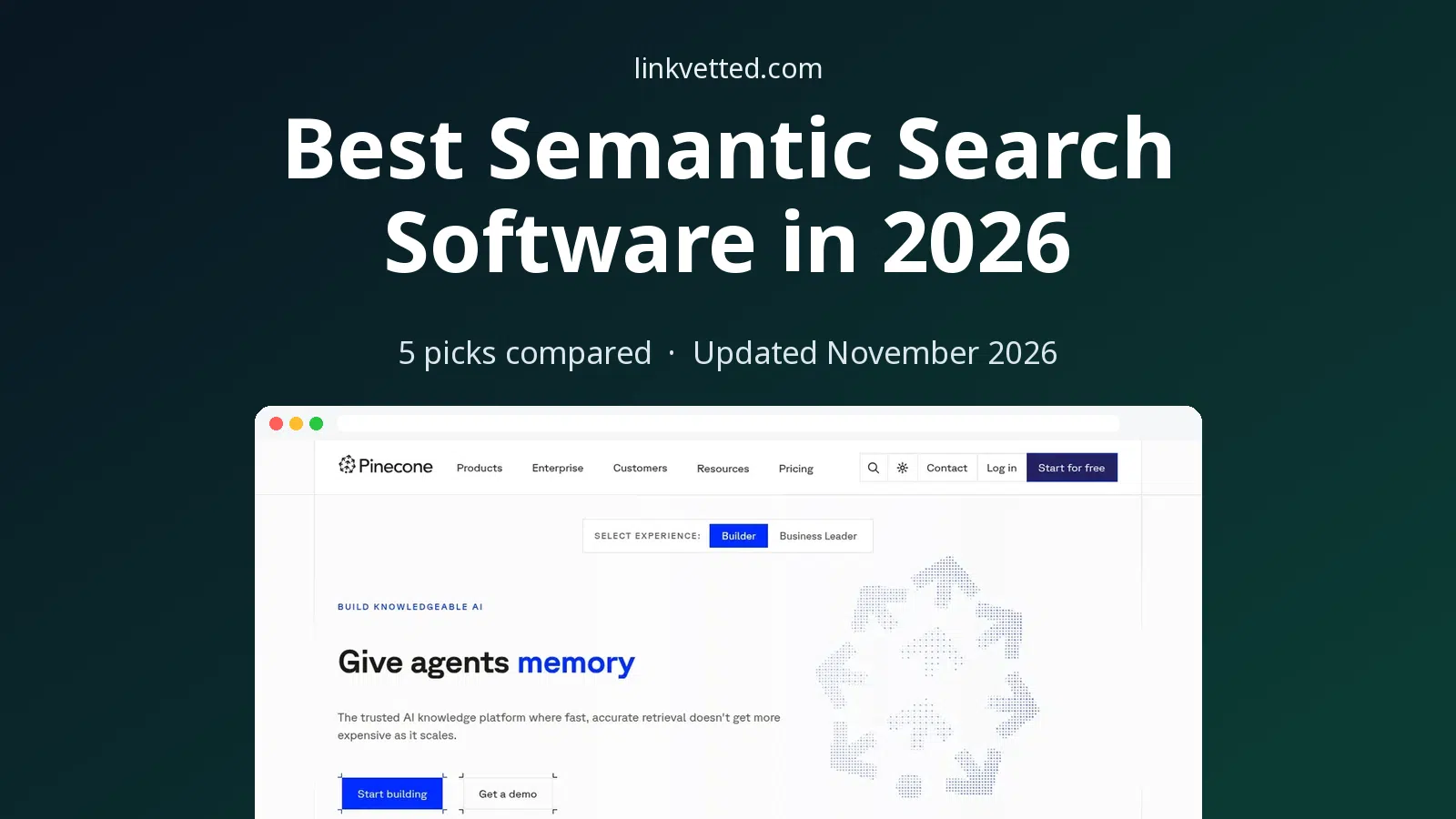
Best Semantic Search Software in 2026: 5 Tools Compared
Weighing the best semantic search software? We lined up 5 products by cost, free access and fit. Every tool lists pros and cons. Skim the table first.
- Editor's choiceAzure AI Search
Enterprise retrieval on Microsoft Azure
Starts atSee websiteVisit azure.microsoft.comFull review - Great alternative
 Pinecone
Vector database for AI knowledge
Starts at$20 a monthVisit pinecone.ioFull review - Also consider
 Weaviate
AI-native applications with less lock-in
Starts at$45 a monthVisit weaviate.ioFull review
Direct answer
This list puts Azure AI Search first for enterprise retrieval on Microsoft Azure. Listed starting prices: Pinecone from $20 a month and Weaviate from $45 a month. Alternatives: Pinecone for vector database for AI knowledge, and Weaviate for AI-native applications with less lock-in. Prices, free plans and limits for all 5 tools follow.
TL;DR:
- The list opens with Azure AI Search, aimed at enterprise retrieval on Microsoft Azure.
- Pinecone is the lowest-priced starter here at $20 per month.
- Weaviate comes with a trade-off: needs familiarity with vector concepts.
- Elasticsearch is the one to check for distributed search and analytics at scale.
Last checked November 2026. Prices and plan details were read from the vendors' own pages in November 2026; vendors change plans often, so confirm the current price on the vendor site before you buy.
Quick comparison
| Tool | Best for | Starts at | Free plan? | |
|---|---|---|---|---|
| Azure AI Search | Enterprise retrieval on Microsoft Azure | See website | Not stated | Visit |
| Pinecone | Vector database for AI knowledge | $20 a month | Free trial | Visit |
| Weaviate | AI-native applications with less lock-in | $45 a month | Yes | Visit |
 Qdrant | Open-source vector similarity search | See website | Yes | Visit |
 Elasticsearch | Distributed search and analytics at scale | See website | Not stated | Visit |
5 options for semantic search software in detail
This LinkVetted guide covers 5 options for semantic search software. Each profile lists a starting price, free plan details, strengths and drawbacks, so you can drop poor fits quickly.
Azure AI Search
Best for: Enterprise retrieval on Microsoft Azure
Pick Azure AI Search if this describes you: enterprise retrieval on Microsoft Azure. Azure AI Search, referenced on Microsoft's page as the foundation for Foundry IQ, is pitched at unlocking enterprise data, enabling secure agentic retrieval and boosting AI agent performance.
Worth adding: since it is an Azure service, teams on other clouds or with strict self-hosting requirements may find it less suitable. In daily use, confirm regional availability and feature parity against your workload before standardizing on it. No starting price is listed for Azure AI Search here; confirm pricing on the vendor site. Free plan details: Not stated.
Where it falls short: Feature set tied to Azure ecosystem.
- Unlocks enterprise data for AI
- Designed for secure agentic retrieval
- Cloud-specific deployment model
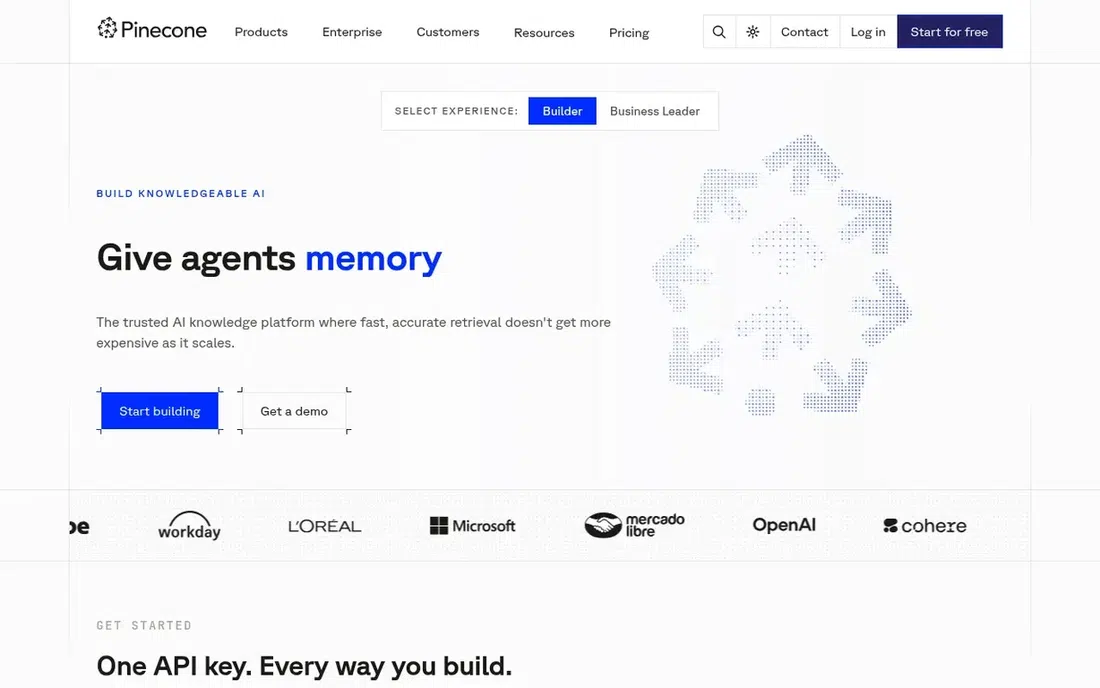
Pinecone makes the most sense for vector database for AI knowledge. Pinecone describes itself as an AI knowledge company with a system built around a vector database, Nexus and a marketplace.
Points against: Narrower than full-text search engines.
As for the details, Pinecone is vector-first, so teams that require rich text analysis, aggregations or complicated filtering across numerous fields may have to combine it with another search system. More specifically, evaluate whether your workload is primarily embedding retrieval before committing. What you pay to start with Pinecone: $20 per month. Free access: Free trial.
- Pitched at AI application developers
- Made for quick vector retrieval
- Vector-first model requires planning
Think of Weaviate for AI-native applications with less lock-in. Weaviate is presented as an AI database for bringing AI-native applications to life with less hallucination, data leakage and vendor lock-in.
What you pay to start with Weaviate: $45 per month. You can start on Weaviate without paying.
Honest limits: Operational choices rely on deployment.
- AI-native database design
- Aims to cut hallucination and leakage
- Needs familiarity with vector concepts
Qdrant is a good fit for open-source vector similarity search. It suits teams that want a focused vector database for semantic search, recommendation or retrieval-augmented generation workloads and value open-source adaptability.
Trade-offs to know: Self-managed operations possible.
Qdrant is purpose-built for vectors, so full-text search, analytics and complicated aggregations are not its primary focus. Check the vendor site for Qdrant pricing; none is listed in this comparison. Qdrant offers a free plan.
- Open-source vector search engine
- Written in Rust for performance
- Centred on vector workloads
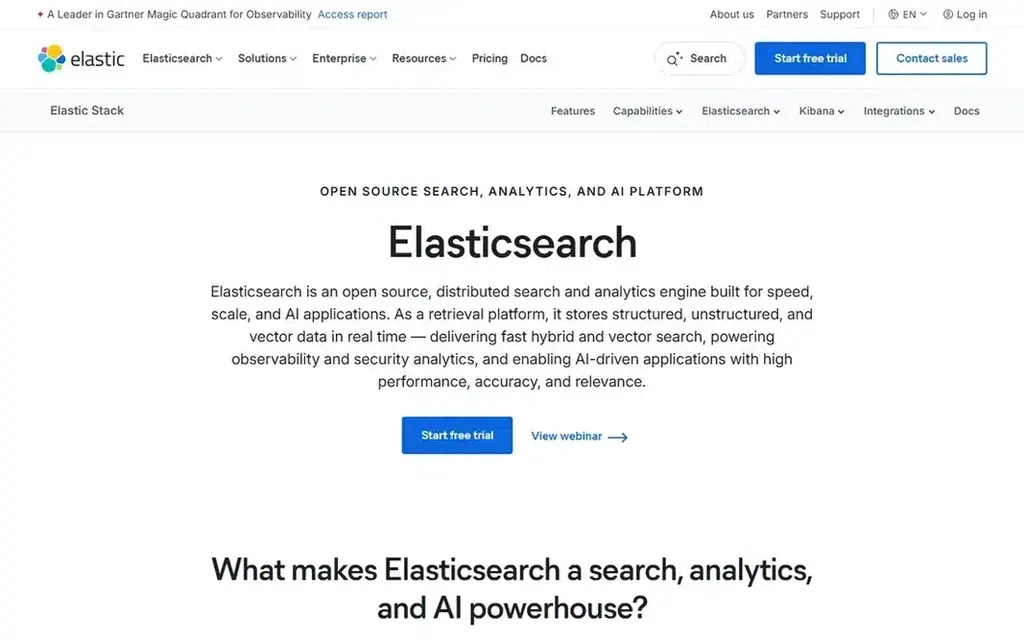
Think of Elasticsearch for distributed search and analytics at scale. Elasticsearch is a distributed, RESTful search and analytics engine built for speed, horizontal scalability and reliability.
Also, if you want a completely hosted experience with less operational work, a managed search service or a vector-first database may be a better fit. No starting price is listed for Elasticsearch here; confirm pricing on the vendor site. On free options: Not stated.
Honest limits: Resource footprint grows with scale.
- RESTful distributed search engine
- Open source with wide ecosystem
- Operational tuning can be involved
How we compared the tools
LinkVetted looked at what each vendor publishes: pricing, plan limits, feature coverage for semantic search software and stated drawbacks. No hands-on testing is claimed. Figures are shown as the vendors publish them. Billing terms, seat minimums and add-ons can change the real cost. The ranking is editorial: typical fit first, then clear pricing, then free access. If your needs are unusual, read the profiles rather than relying on position.
Things to verify first
- Ask Azure AI Search, Qdrant and Elasticsearch for a written quote, since no starting price is shown.
- Look at free plan limits closely: Weaviate and Qdrant have one, and the caps decide whether it is usable for real work.
- Use real work to test the free trial from Pinecone, rather than a demo project.
- Before choosing Azure AI Search, weigh its main limit: cloud-specific deployment model.
- Compare total cost, not headline price: for Elasticsearch, add extra seats, add-ons and any usage-based charges.
- Look at the help docs and support options for Azure AI Search before you commit.
FAQ
Do these tools publish their prices?
Not all of them. Azure AI Search, Qdrant and Elasticsearch publish no starting price, so expect a quote request for those. The rest, Pinecone included, show a starting price, though seats and billing terms still change the final cost.
Is Azure AI Search the right pick for everyone comparing semantic search software?
No single tool suits every team. Azure AI Search comes first because it fits enterprise retrieval on Microsoft Azure, while Pinecone suits vector database for AI knowledge and Weaviate suits AI-native applications with less lock-in. Match the tool to your own size, budget and workflow before deciding.
Should I choose a managed or self-hosted option?
Managed services cut operational overhead and suit teams that want to focus on application logic. Self-hosted or open-source engines offer more control and portability but need capacity planning and maintenance, so weigh team resources before deciding.
How are the tools for semantic search software ordered?
The order follows typical fit for semantic search software, with Azure AI Search first and Elasticsearch last, then price clarity and free access. It is editorial judgement, not a score, so another team could rank the tools differently.
What is the cheapest option for semantic search software in this list?
On published monthly entry prices, Pinecone is the lowest here at $20 per month. Entry price is only part of the cost, because seats, add-ons and billing terms can change the total. All 5 picks in this semantic search software comparison list a starting price, free plan details and the main limits on their cards above.
Sources
- https://azure.microsoft.com/en-us/products/ai-services/ai-search
- https://www.pinecone.io
- https://weaviate.io
- https://qdrant.tech
- https://www.elastic.co/elasticsearch