RAG LLM Platforms for Production in 2026: The 6 Best Options Side by Side
Best RAG LLM platforms for production: 6 contenders ranked by fit, with entry costs and free tiers. Every tool lists pros and cons. Last reviewed November 2026.
- Editor's choice
 Google Vertex AI
Developer product for agents
Starts atSee websiteVisit cloud.google.comFull review - Great alternative
 Qdrant
Open-source vector search engine
Starts atSee websiteVisit qdrant.techFull review - Also consider
 Weaviate
AI-native applications with less lock-in
Starts at$45 per monthVisit weaviate.ioFull review
Direct answer
Google Vertex AI leads the list, best for developer product for agents. Listed starting prices: Weaviate from $45 per month and Pinecone from $20 a month. Qdrant is the stronger choice for open-source vector search engine, while Weaviate suits AI-native applications with less lock-in. The full list of 6 tools follows, with prices and free plan facts.
TL;DR:
- Google Vertex AI takes the first slot, best suited to developer system for agents.
- The cheapest monthly starting price in the list is $20 per month, offered by Pinecone.
- Google Vertex AI comes with a trade-off: wide scope can mean a ramp-up time.
- Only 2 of the 6 tools have a free plan (Qdrant, Weaviate), so check the caps.
- Pinecone fits dedicated AI knowledge platform.
Last checked November 2026. Prices and plan details were read from the vendors' own pages in November 2026; vendors change plans often, so confirm the current price on the vendor site before you buy.
Quick comparison
| Tool | Best for | Starts at | Free plan? | |
|---|---|---|---|---|
| Google Vertex AI | Developer product for agents | See website | Not stated | Visit |
| Qdrant | Open-source vector search engine | See website | Yes | Visit |
| Weaviate | AI-native applications with less lock-in | $45 per month | Yes | Visit |
 Databricks | Unified data and AI product | See website | Not stated | Visit |
 Amazon Bedrock | Managed generative AI at production scale | See website | Not stated | Visit |
 Pinecone | Dedicated AI knowledge product | $20 a month | Free trial | Visit |
The best RAG LLM platforms for production
Short on time? The summary and table above give the quick view of 6 tools for RAG LLM platforms for production, and the profiles that follow give the detail behind each entry.
Choose Google Vertex AI for developer system for agents. It supports the full lifecycle of agent development, which can include retrieval-augmented generation workflows.
Downsides: Most comfortable for Google Cloud users.
On top of that, the product's breadth may need dedicated setup and expertise. On top of that, if your priority is a straightforward vector store instead of a full agent system, a dedicated database may be more straightforward. Google Vertex AI does not show a starting price in this comparison, so check the vendor site for current pricing. Free options: Not stated.
- Thorough system for developers
- Optimize agents
- Wide scope can mean a ramp-up time
Qdrant was built for open-source vector search engine. Qdrant deals with vector search but not model hosting or orchestration, so it must be combined with a LLM product. From a buyer's view, self-managed deployments can add operational overhead compared to managed services.
Qdrant is an open-source vector search engine written in Rust, supplying quick and scalable vector similarity search with a convenient API. It serves as a retrieval component for RAG pipelines and fits teams that prefer open-source tooling and want to integrate vector search into their own stack. Qdrant shows no starting price here, so confirm the cost on the vendor site. Qdrant has a free plan.
What to check first: Not a full LLM system.
- Open-source and written in Rust
- Fast and scalable similarity search
- Self-hosting may need operational effort
Weaviate works best for AI-native applications with less lock-in. As a database, Weaviate does not offer the LLM itself, so you will have to link it to a model system.
On cost, Weaviate starts like this: $45 per month. Free access exists with Weaviate.
Watch-outs: May need integration with a separate LLM system.
- Avoids vendor lock-in
- Aimed at AI-native applications
- Needs operational knowledge of vector databases
For unified data and AI system, Databricks is a natural candidate. The product is wide, so teams may need time to configure components for a focused RAG pipeline. It may be more than necessary for small projects that only need vector search.
Databricks supplies a unified platform for data, analytics, and AI, built around a data-centric approach. It eases ETL, data warehousing, governance, and AI on the Data + AI Platform. This makes it a fit for organizations that want to keep data preparation, retrieval, and model deployment close together, particularly those with existing data engineering workflows. More specifically, consider a dedicated vector database if your central requirement is light similarity search. Databricks shows no starting price here, so confirm the cost on the vendor site. Free access: Not stated.
Drawbacks to consider: Wide system may need configuration.
- Eases ETL, warehousing, governance
- Data-centric approach to building AI
- Most useful for teams already in the data ecosystem
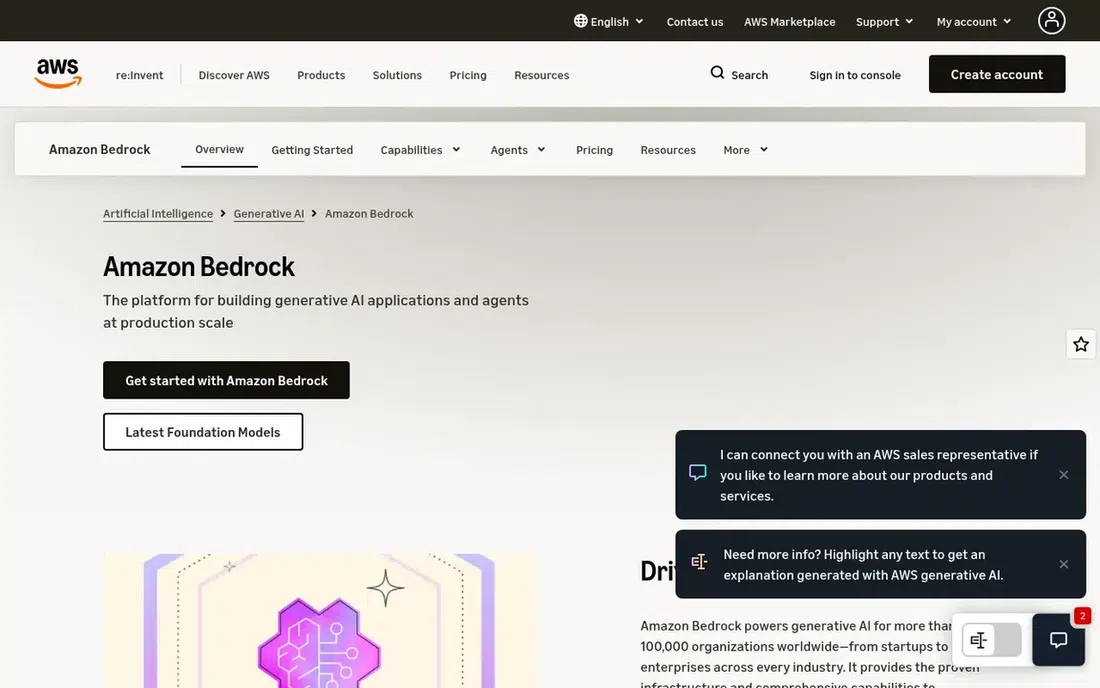
Amazon Bedrock is designed for managed generative AI at production scale. Since Bedrock is an AWS service, teams outside that ecosystem may face integration overhead. Evaluate whether your retrieval layer should be separate from the model system.
The main drawbacks: Tied to the AWS ecosystem.
Amazon Bedrock is positioned as the system for building generative AI applications and agents at production scale. It offers managed access to foundation models and agent capabilities, which can ease the operational side of RAG systems. This comparison lists no price for Amazon Bedrock; ask the vendor. Trial and free access: Not stated.
- Built for production scale
- Builds generative AI applications and agents
- Needs familiarity with AWS services
Pinecone was built for dedicated AI knowledge platform. Pinecone is the trusted AI knowledge company, offering an AI knowledge system that bundles Database, Nexus, and Marketplace.
It may be redundant if your cloud provider already comes with a suitable search service. Pinecone pricing: $20 per month. As for free access: Free trial.
What to check first: Specialized in vector search instead of full LLM hosting.
- AI knowledge system with Database and Nexus
- Economical AI knowledge
- May duplicate features if you already have a search stack
How we built this list
LinkVetted used vendor pricing pages and product documentation as the base, then compared plans, free access and documented limits for 6 tools. Seat minimums, billing terms and add-ons can move the real cost, so the starting prices here are a guide and not a quote. Tools are placed by general fit for RAG LLM platforms for production, with price clarity and free access as tie-breakers. A different team can reasonably rank them differently.
What to check before you buy
- Get a written quote from Google Vertex AI, Qdrant, Databricks and Amazon Bedrock; the list shows no starting price for them.
- Check what the free option really includes: Qdrant and Weaviate offer a free plan, and usage caps differ.
- Take the trial from Pinecone and push a live task through it before you pay.
- Read the limits listed for Google Vertex AI first: wide scope can mean a ramp-up time.
- Compare total cost, not headline price: for Qdrant, add extra seats, add-ons and any usage-based charges.
- Test the integrations you rely on with Weaviate before committing; some connectors sit on upper tiers.
FAQ
Can I combine several tools from this list?
Numerous production RAG architectures pair a vector database like Pinecone, Weaviate, or Qdrant with a model product like Amazon Bedrock or Google Vertex AI. This lets you use the best retrieval and generation components for your needs.
Which options for RAG LLM platforms for production have a free plan?
On this list, Qdrant and Weaviate include a free plan. Caps on seats, usage or features are common, so test the free plan against your real workload. One other tool offers a trial instead.
Can I try these tools before paying?
Often, yes. Qdrant and Weaviate have a free plan and Pinecone offers a free trial. Use your own data and a real task during the test, and check what the free tier or trial limits before you rely on it.
Is Google Vertex AI the right pick for everyone comparing RAG LLM platforms for production?
No single tool suits every team. Google Vertex AI comes first because it fits developer platform for agents, while Qdrant suits open-source vector search engine and Weaviate suits AI-native applications with less lock-in. Match the tool to your own size, budget and workflow before deciding.
Do these tools publish their prices?
Not all of them. Google Vertex AI, Qdrant, Databricks and Amazon Bedrock publish no starting price, so expect a quote request for those. The rest, Weaviate included, show a starting price, though seats and billing terms still change the final cost.
What should I look for in a production RAG system?
Look for dependable retrieval, integration with your data sources, and clear governance. Also consider how the product handles scaling and whether it suits your existing cloud or on-premises environment.
Sources
- https://cloud.google.com/vertex-ai
- https://qdrant.tech
- https://weaviate.io
- https://www.databricks.com
- https://aws.amazon.com/bedrock
- https://www.pinecone.io