Product Listing Tools for Marketplace Sellers in 2026: The 5 Best Options Side by Side
Best product listing tools for marketplace sellers in 2026: 5 contenders with entry costs and free tiers. Concise write-ups of every option. Pick by budget.
- Editor's choice
 Linnworks
Multichannel inventory and order control
Starts atSee websiteVisit linnworks.comFull review - Great alternative
 Sellbrite
Listing products on major marketplaces
Starts atSee websiteVisit sellbrite.comFull review - Also consider
 Cin7
Inventory management and small business ERP
Starts at$349 a monthVisit cin7.comFull review
Direct answer
Our first pick is Linnworks, best for multichannel inventory and order control. Listed starting prices: Cin7 from $349 a month and Shopify from $19 a month. Sellbrite is the stronger choice for listing products on major marketplaces, while Cin7 suits Inventory management and small business ERP. Prices, free plans and limits for all 5 tools follow.
TL;DR:
- The list opens with Linnworks, aimed at multichannel inventory and order control.
- A free plan is available from 2 of the 5 tools: Sellbrite, Katana.
- Katana comes with a trade-off: production focus may not suit pure resellers.
- Shopify is the lowest-priced starter here at $19 per month.
- Shopify suits sellers wanting storefront plus channel tools.
Last checked November 2026. Prices and plan details were read from the vendors' own pages in November 2026; vendors change plans often, so confirm the current price on the vendor site before you buy.
Quick comparison
| Tool | Best for | Starts at | Free plan? | |
|---|---|---|---|---|
| Linnworks | Multichannel inventory and order control | See website | Not stated | Visit |
| Sellbrite | Listing products on major marketplaces | See website | Yes | Visit |
| Cin7 | Inventory management and small business ERP | $349 a month | No | Visit |
 Katana | Live stock, orders and production | See website | Yes | Visit |
 Shopify | Sellers wanting storefront plus channel tools | $19 a month | Free trial | Visit |
Tool-by-tool breakdown
If you are comparing product listing tools for marketplace sellers, this page covers 5 tools in one place: what each is best for, what it costs to start, whether it has a free plan, and the main limit to know about.
Linnworks works best for multichannel inventory and order control. If you only have to publish listings and nothing more, a listing-focused tool may be more straightforward. Linnworks is multichannel inventory and order management software for small and midsize companies.
Its homepage describes simplifying inventory across plenty of marketplaces in live, automating order routing and helping expanding ecommerce firms scale operations. That breadth means setup and process design take attention. No starting price is listed for Linnworks here; confirm pricing on the vendor site. Trial and free access: Not stated.
Watch-outs: Operational setup takes effort.
- Automatic order routing
- Live inventory across numerous marketplaces
- Inventory-first instead of listing-first

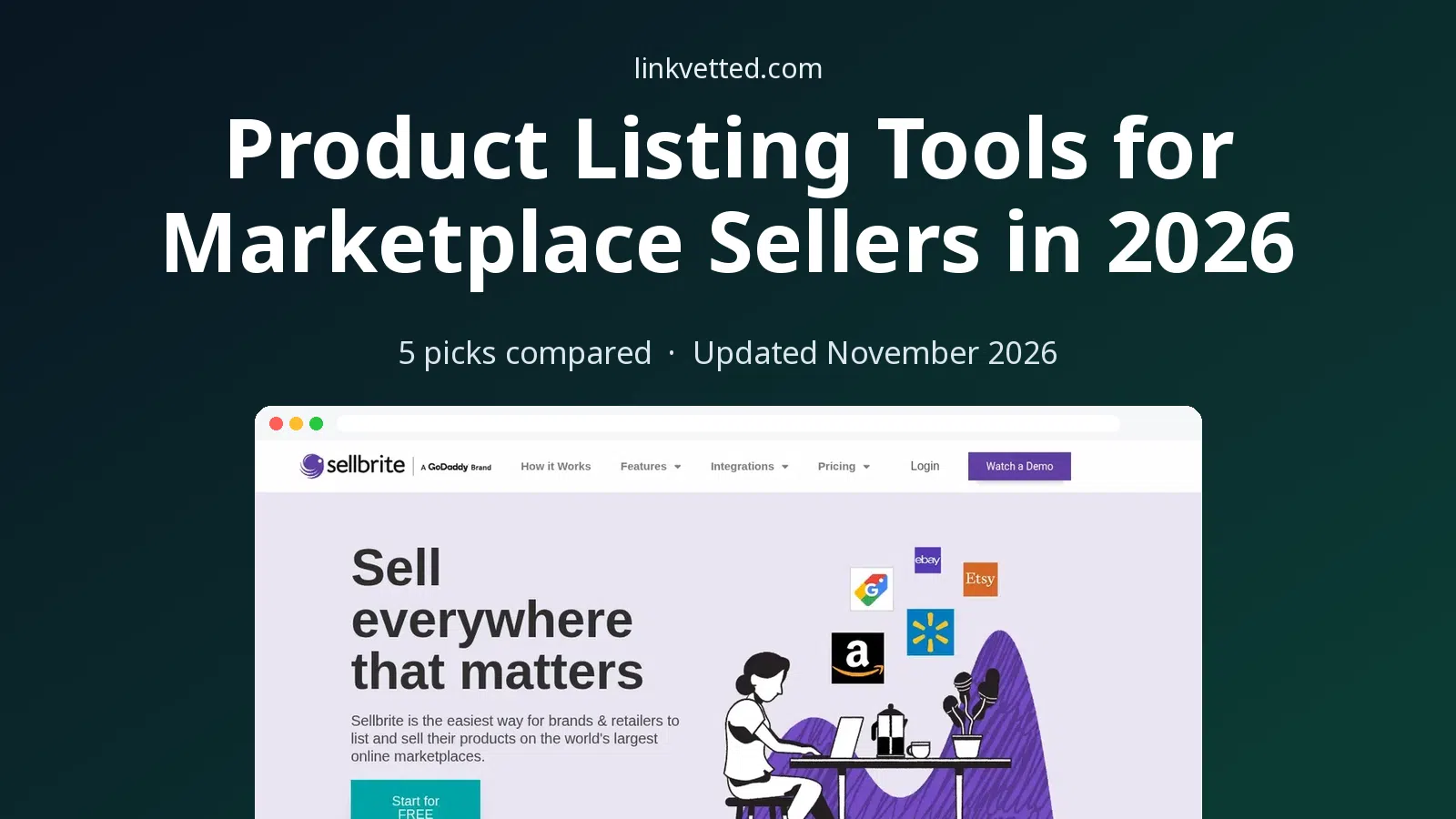
Sellbrite was built for listing products on major marketplaces. Its homepage names Amazon, Walmart, Etsy and others, which makes it a direct fit for sellers whose central job is getting catalog items live across channels.
Where it is weaker: Narrower scope than full operations systems.
This comparison lists no price for Sellbrite; ask the vendor. A free plan is available with Sellbrite.
- Concentrated on getting products listed
- Etsy and more
- Deeper inventory needs may need another tool
Cin7 is aimed squarely at Inventory management and small business ERP. Cin7 is inventory management software with a small business ERP angle, positioned around simplifying inventory management. Consider it when inventory accuracy is the primary problem to solve.
Points against: Listing is not the headline feature.
Sellers wanting a listing-first tool may find the ERP framing broader than necessary. From a buyer's view, for marketplace sellers, it serves as the stock and operations layer behind listings, which helps when products move across multiple sales channels. Entry price for Cin7: $349 per month. Cin7 has no free tier.
- Inventory management focus
- Aims to simplify stock control
- ERP scope may exceed small sellers' needs
In short, Katana is for live stock, orders and production. Choose it when live stock and production control matter more than listing breadth.
This comparison lists no price for Katana; ask the vendor. Katana includes a free tier.
Trade-offs to know: Listing is not the core promise. What users get: Set up around how you work.
- Stock
- Cloud inventory management
- Production focus may not suit pure resellers

Shopify is aimed squarely at sellers wanting storefront plus channel tools. Shopify is an all-in-one commerce product for building and expanding a business, with tools that go beyond entry-level ecommerce software. In daily use, pick something else if your priority is purely multi-channel listing without a storefront.
For marketplace sellers, it works as a central hub where a storefront and the operational pieces around it live together. Its marketplace reach also relies on the apps and integrations you add. Shopify starts at: $19 per month. Free options: Free trial.
Limits to weigh: Wide system may be more than listing-only sellers need.
- Tools to run numerous parts of a business
- Built-in AI features for building and expanding
- Marketplace listing depth relies on integrations
How we compared the tools
LinkVetted used vendor pricing pages and product documentation as the base, then compared plans, free access and documented limits for 5 tools. Where a price is missing, the vendor does not list one publicly or ties it to a quote. Always confirm before budgeting. Tools are placed by general fit for product listing tools for marketplace sellers, with price clarity and free access as tie-breakers. A different team can reasonably rank them differently.
A buyer's checklist
- Ask Linnworks, Sellbrite and Katana for a written quote, since no starting price is shown.
- Read the fine print on the free plans from Sellbrite and Katana; seat, project and feature caps differ.
- Take the trial from Shopify and push a live task through it before you pay.
- Before choosing Linnworks, weigh its main limit: Inventory-first rather than listing-first.
- Confirm the exact Katana plan that includes your must-have features.
- Add up seats, add-ons and usage charges for Linnworks before comparing it with cheaper entries.
FAQ
How are the tools for product listing tools for marketplace sellers ordered?
Linnworks sits first and Shopify last because the order follows typical fit for product listing tools for marketplace sellers, then price clarity and free access. It is a judgement call, so read each profile for fit and limits.
Do these tools publish their prices?
Not all of them. Linnworks, Sellbrite and Katana publish no starting price, so expect a quote request for those. The rest, Cin7 included, show a starting price, though seats and billing terms still change the final cost.
Is Linnworks the right pick for everyone comparing product listing tools for marketplace sellers?
No single tool suits every team. Linnworks comes first because it fits multichannel inventory and order control, while Sellbrite suits listing products on major marketplaces and Cin7 suits Inventory management and small business ERP. Match the tool to your own size, budget and workflow before deciding.
Which options for product listing tools for marketplace sellers have a free plan?
Sellbrite and Katana offer a free plan in this list. Free plans usually cap users, projects or features, so check the limits on the vendor page. One other tool offers a trial instead.
When does a full commerce product make sense?
A system like Shopify makes sense when you want a storefront and business management in one place alongside channel selling. If your only goal is listing on marketplaces, a focused listing tool may be a more straightforward choice.
Sources
- https://www.linnworks.com
- https://www.sellbrite.com
- https://www.cin7.com
- https://katanamrp.com
- https://www.shopify.com