Best Interactive Product Demo Software in 2026: 8 Tools Compared
Compare the best interactive product demo software in 2026, from Storylane and Navattic to Walnut and Supademo, with pricing, demo types, and the right fit.

- Editor's choice
 Storylane
All-round sales and marketing demos
Starts at$40 per monthVisit storylane.ioFull review - Great alternative
 Supademo
Budget cross-team demos
Starts at$38 per creator per monthVisit supademo.comFull review - Also consider
 Navattic
HTML demos for marketing teams
Starts at$500 per monthVisit navattic.comFull review
TL;DR:
- Storylane and Supademo are the most accessible all-rounders, with free plans and clear starting prices.
- Navattic and Walnut lead for HTML-first and enterprise sales demos, but their paid plans start much higher.
- Screenshot demos are fast to build, while HTML and sandbox demos feel more real and cost more to run.
- Demo analytics matter as much as creation, because they show which steps buyers actually complete.
- Enterprise sandbox platforms such as Demostack and Reprise suit complex products, not simple tours.
Quick comparison
| Tool | Best for | Starts at | Free plan? | |
|---|---|---|---|---|
| Storylane | All-round sales and marketing demos | $40 per month | Yes | Visit |
| Supademo | Budget cross-team demos | $38 per creator per month | Yes | Visit |
| Navattic | HTML demos for marketing teams | $500 per month | Yes | Visit |
 Walnut | Enterprise sales personalisation | $575 per month | No | Visit |
 Arcade | Polished product storytelling | $32 per user per month | Yes | Visit |
 Guideflow | Granular demo pricing steps | $35 per month | Yes | Visit |
 Tourial | Demo centres for buyers | See website | No | Visit |
 Demostack | Full product cloning for enterprise | See website | No | Visit |
The best interactive product demo software
Interactive demos let a buyer click through a product on their own, instead of watching a video or sitting through a live call. The tools below differ in how the demo is built, whether from screenshots, HTML capture, video, or a full product clone, and in how much personalisation and analytics they offer.

Storylane is the easiest all-rounder to recommend. Starter costs 40 dollars a month billed yearly, Growth is listed at 500 dollars a month, and Premium at 1,200 dollars a month, with Enterprise quoted. That ladder lets a small team start with a simple tour and grow into HTML editing, deal intelligence, and presenter demos without switching vendors.
The gating is the part to check. If you need HTML demo editing, you need Growth, not Starter, and if you need single sign-on, you need Premium. For most sales and marketing teams, Storylane's balance of creation, sharing, and analytics is the best starting point.
- Screenshot, HTML, and video demos in one editor
- Free plan to start
- Sales features such as offline and presenter demos on paid tiers
- HTML editing is gated to Growth
- SSO is on Premium
- Pricing climbs quickly for larger teams

Supademo starts at 38 dollars per creator a month billed yearly for Scale, with Business at 199 dollars a month for one creator and Growth at 350 dollars a month for five creators. The free plan includes five demos, which is enough to test a real use case before paying. It also covers more teams than most rivals, with demos for onboarding, support, and training as well as sales.
The value is breadth at a lower price. Guided HTML demos arrive on Business, and sandbox demos on Growth, so check which tier your use case needs. For a cross-functional demo library on a budget, Supademo is the strongest value pick here.
- Free plan with five demos
- Screenshot, HTML, video, and Figma capture
- Good fit for sales, onboarding, support, and training
- Guided HTML demos start on Business
- Sandbox demos need Growth
- Per-creator pricing adds up for large teams
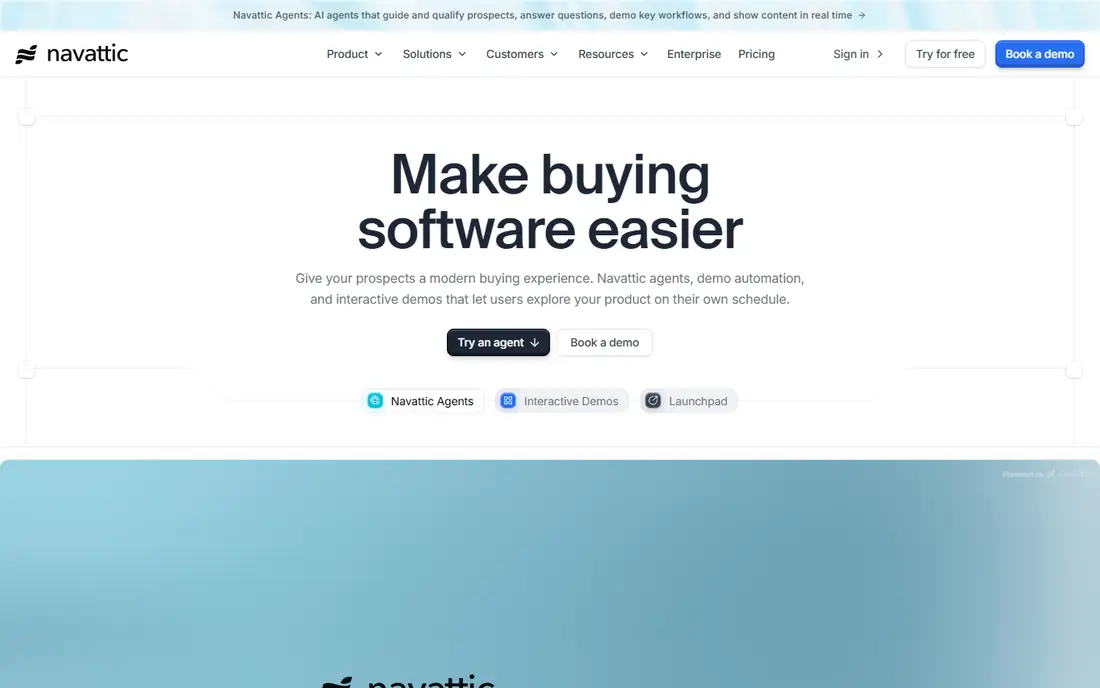
Navattic is built around HTML demos, which capture your actual product interface rather than screenshots. That makes demos feel real, with working menus, search, and navigation, and it suits marketing pages where a buyer should experience the product, not just look at pictures of it. Base is listed at 500 dollars a month, Growth at 1,200 dollars a month, and Enterprise is quoted.
The cost is the barrier. Navattic is not a budget tool, and sandbox demos sit on Growth. For a marketing team that can justify the price with pipeline, the HTML quality is a real advantage. For a small team, Storylane or Supademo will cover most needs for far less.
- HTML capture feels like the real product
- Launchpad for sales
- Free Starter plan with one demo
- Paid plans are billed yearly and start at 500 dollars a month
- Sandbox demos need Growth
- Pricing is less transparent than rivals
Walnut starts at 575 dollars a month billed yearly for Ignite, with Accelerate at 1,550 dollars a month and Scale quoted. Its strength is personalisation: a sales team can tailor a demo to a named prospect, present it live, and leave a version behind, with analytics on what the buyer viewed. Digital Sales Rooms and Salesforce-centric workflows extend that into the full deal cycle.
That focus comes with enterprise pricing and no free plan. Walnut suits sales and presales teams at larger companies, where personalisation and governance matter more than a low starting price. Smaller teams should look at Storylane or Supademo first.
- Strong personalisation for named prospects
- Presenter and leave-behind demos
- Digital Sales Rooms and Salesforce workflows
- No free plan
- Sandbox demos need Accelerate at 1,550 dollars a month
- Enterprise-first pricing and setup
Arcade is the storytelling tool on this list. One capture can become a click-through demo and an AI-generated video, which suits product launches, changelog posts, and marketing pages where polish matters. Starting pricing is reported from around 32 dollars per user a month, with a free plan for three demos, though some comparisons list higher Growth pricing for teams.
Arcade is lighter on presales workflow than Walnut or Navattic, with fewer deal-room and sandbox features. For marketing-led demos that need to look excellent quickly, it is a strong pick. For complex enterprise evaluations, a sandbox platform is a better fit.
- Fast capture that turns into a polished tour and video
- Free plan with three demos
- Good for launches and marketing pages
- HTML on Growth and above in some comparisons
- SSO and custom domain gated to Enterprise
- Lighter on presales workflow than Walnut
Guideflow offers a clear pricing ladder: free, Solo at 35 dollars a month, Growth at 499 dollars a month, Advanced at 1,499 dollars a month, and Enterprise quoted, all on yearly billing in recent comparisons. That granularity helps a team pay only for the demo type it needs, rather than jumping straight to an enterprise tier.
The catch is the same as with other tools: the advanced demo types sit on higher tiers. HTML capture starts on Growth, and sandbox demos on Advanced. For a solo creator or a small team that mainly needs screenshot tours, Guideflow's Solo plan is good value.
- Five tiers from a 35 dollar Solo plan upward
- Free plan to start
- Sandbox and offline demos on Advanced
- HTML capture starts at 499 dollars a month
- Sandbox needs Advanced at 1,499 dollars a month
- Smaller brand than Storylane
Tourial focuses on the demo centre: a branded hub where buyers can explore tours by role, use case, or product area, without booking a call. That suits companies whose website is a major sales channel and whose buyers want to self-educate before talking to sales.
Pricing is quoted, with recent comparisons placing Tourial around 500 dollars a month, so it sits in the mid-market tier. Teams that only need a single tour for a landing page will find cheaper options here. Teams that want a full self-serve demo centre will get more from Tourial's structure.
- Demo centres that group tours by persona or use case
- Good for website visitors who want to self-serve
- Analytics on buyer journeys
- Pricing is quoted, not published as a simple starting price
- No free plan in recent comparisons
- Less suited to one-off tours
Demostack clones your actual product into a sandbox demo, so a prospect can use realistic data and workflows rather than a guided tour. That depth matters for complex products where a screenshot tour cannot show the real value, such as platforms with deep configuration or integrations.
The price reflects that depth, with comparisons placing Demostack around 55,000 dollars a year and up. It also needs a team to own demo operations, data, and updates. For enterprise presales with complex evaluations, it is a serious tool. For simple tours, it is far more than you need.
- Full product clones for realistic evaluations
- Sandbox environments for complex products
- Strong for enterprise presales
- Enterprise pricing around 55,000 dollars a year in comparisons
- No free plan
- Implementation and demo operations need ownership
How we picked these
We compared official pricing pages, product documentation, and independent interactive demo comparisons published in 2026, focusing on tools that let buyers click through a product themselves. We kept only tools that are actively sold and that support guided tours, HTML demos, or sandbox demos. We mixed budget, mid-market, and enterprise options, because the right demo tool depends on product complexity and deal size.
How to build a demo buyers actually finish
Start with one job, not your whole product. Pick the task a buyer cares about most, such as setting up a first project or running a first report, and build a tour that completes that job in under five minutes. Long tours that show every feature lose buyers before the value lands.
Then watch the analytics. If most buyers drop off at the same step, that step is either confusing, too long, or not relevant to their role. Shorten it, split the tour by persona, or add a hint. A demo that 60 percent of buyers finish is worth more than a longer demo that only 10 percent finish, however complete it looks internally.
FAQ
What is interactive product demo software?
It is software that lets buyers click through a guided, interactive version of your product on their own, instead of watching a video or waiting for a live demo. Demos can be built from screenshots, HTML capture, video, or a full product clone.
What is the difference between a screenshot demo and an HTML demo?
A screenshot demo is a guided tour built from images of your product, which is fast to build and easy to update. An HTML demo captures the real product interface, so menus and navigation work, which feels more realistic but costs more and needs a higher tier on most platforms.
How much does Storylane cost?
Storylane offers a free plan, with Starter at 40 dollars a month billed yearly, Growth at 500 dollars a month, and Premium at 1,200 dollars a month in recent comparisons, plus a quoted Enterprise plan. HTML editing is gated to Growth.
Do interactive demos replace live demos?
No, they usually shorten live demos rather than replace them. Buyers self-educate with an interactive tour, then a live call focuses on their specific questions, data, and buying process, which makes the call shorter and more useful.
Which demo tool is best for a small startup?
Supademo and Storylane are the best starts for a small startup, because both offer free plans and clear low starting prices. Supademo is the better value for cross-team use, while Storylane is the stronger all-rounder for sales and marketing.
What is a sandbox demo?
A sandbox demo is a working copy of your product, often with sample data, that a prospect can explore freely rather than following a fixed tour. It suits complex products and enterprise evaluations, and it usually sits on higher-priced tiers.