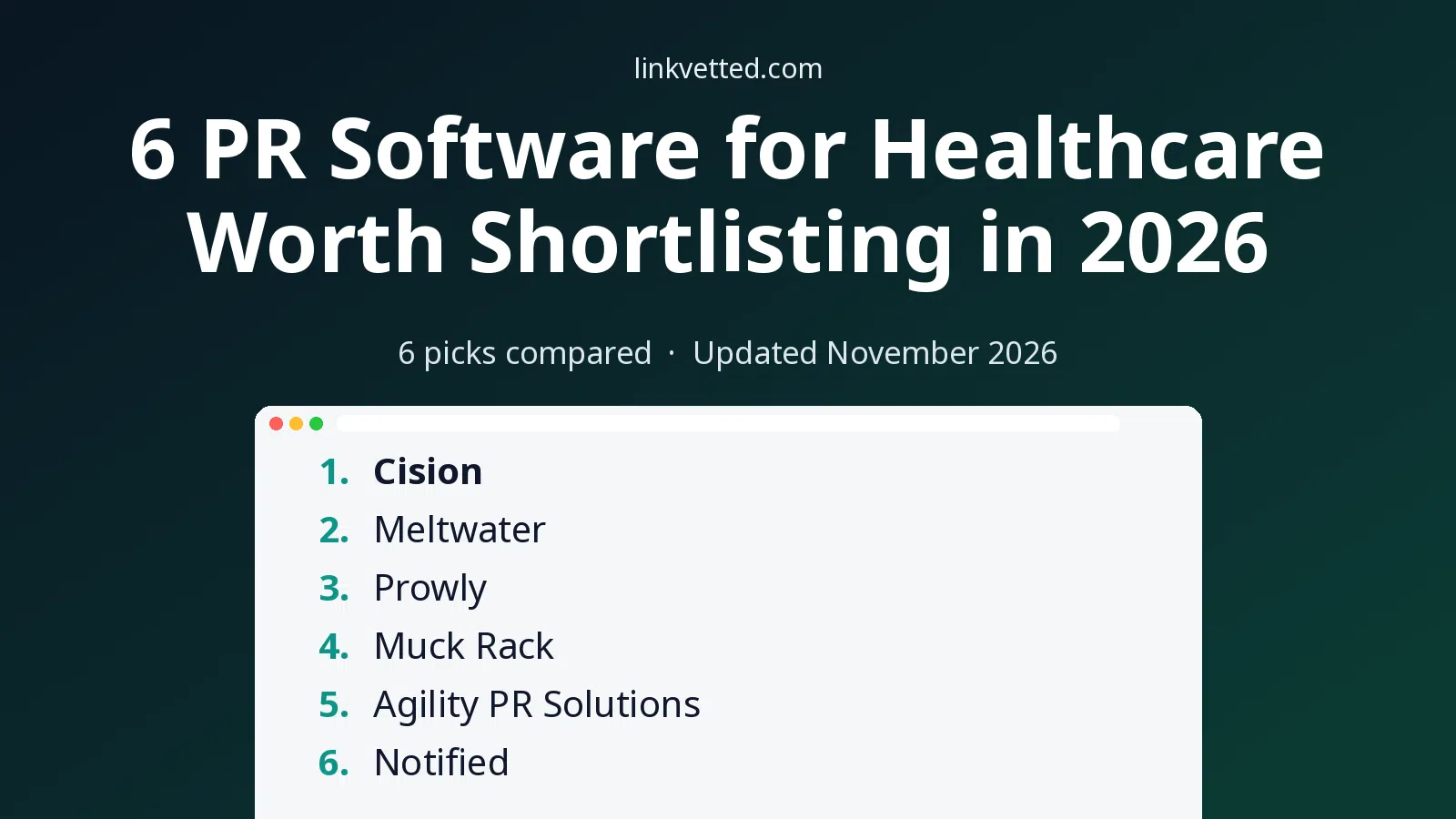
6 PR Software for Healthcare Worth Shortlisting in 2026
A practical guide to the best PR software for healthcare, comparing media databases, monitoring tools and newsrooms from vendor documentation.
- Editor's choice
 Cision
Full-service healthcare PR teams
Starts atSee websiteVisit cision.comFull review - Great alternative
 Meltwater
Monitoring-led communications teams
Starts atSee websiteVisit meltwater.comFull review - Also consider
 Prowly
Small healthcare teams and agencies
Starts atSee websiteVisit prowly.comFull review
Direct answer
My top pick is Cision, because its media database and monitoring cover the trade press, national health reporters and broadcast outlets that healthcare PR teams pitch every week. For teams that mainly need monitoring and measurement, Meltwater is the other strong option. If your focus is a clean, compliant press room and straightforward distribution, Prowly fits smaller healthcare teams and agencies that do not need a large media database.
TL;DR:
- Healthcare PR has extra constraints around patient privacy, regulated claims and approval chains, so pick software your compliance team can review.
- A media database is only useful if it covers health, medical and life science journalists, not just general newsrooms.
- Monitoring matters as much as outreach, because you need to catch inaccurate coverage and regulatory mentions quickly.
- Press release distribution tools differ in how they handle embargoes and corrections, which matters for clinical and product news.
- Budget for training and process, not just the subscription, because healthcare approvals slow down publishing.
Last checked November 2026. Plan prices are not quoted in this guide because they change often; see each vendor's own pricing page for current figures before you buy.
Quick comparison
| Tool | Best for | Starts at | Free plan? | |
|---|---|---|---|---|
| Cision | Full-service healthcare PR teams | See website | Not stated | Visit |
| Meltwater | Monitoring-led communications teams | See website | Not stated | Visit |
| Prowly | Small healthcare teams and agencies | See website | Free trial | Visit |
 Muck Rack | Teams that value journalist profiles | See website | Not stated | Visit |
 Agility PR Solutions | Mid-size healthcare organisations | See website | Not stated | Visit |
| Notified | Regulated announcement workflows | See website | Not stated | Visit |
The best PR software for healthcare compared
I put this comparison together from vendor documentation, public product pages and published help material. I did not run hands-on tests of these platforms, and I have not used them inside a healthcare client account. The notes below describe what each vendor says it does and where the fit with healthcare communications looks strongest or weakest.
Cision is one of the longest-running media intelligence platforms, and it combines a journalist database, monitoring, press release distribution and reporting. For a hospital group, health insurer or medical device company, the appeal is having outreach and coverage tracking in one system. It suits teams with a dedicated communications staff and a budget to match.
For healthcare work, the useful part is the ability to build lists around health, science and policy beats, then track coverage of a condition, product or executive. You can set up monitoring for your organisation and for topics like clinical trial results or regulatory decisions, and route alerts to the right people. Distribution handles embargoes, which matters when news is tied to a publication date.
The limits are practical. It is a big platform, so a small team may pay for features it never uses. If you only need a press room and occasional distribution, a lighter tool is easier to justify.
- Broad media database with health and trade press
- monitoring across print, broadcast and online
- distribution and reporting in one place
- Large platform that takes time to learn
- pricing is not published
Meltwater is a media monitoring and social listening platform with outreach and press release tools attached. It fits communications teams that spend more time tracking coverage and sentiment than building large media lists. Health organisations often fall into this group, because reputation and issue monitoring matter as much as pitching.
The monitoring side lets you follow a condition, a drug name, a hospital or an executive across news and social channels, then send digests to clinical and communications leads. Outreach tools help you find journalists and manage pitches, and the reporting views are useful when you need to show a board what coverage looks like over time. Social listening helps catch patient questions and complaints early.
The main caution is coverage. Media database depth differs by country and by niche, so ask for a demo using your own health reporters before you commit. Smaller teams may also find the platform more than they need.
- Strong media monitoring and social listening
- journalist outreach tools included
- reporting dashboards for stakeholders
- Database depth varies by market
- setup requires a clear brief
Prowly is a PR platform built around a press room, media database, distribution and simple reporting. It is aimed at small and mid-size teams and agencies, which makes it a reasonable fit for a clinic, a health tech startup or a boutique agency handling healthcare accounts. The interface is easier to pick up than the large enterprise suites.
For healthcare, the press room builder is the standout. You can publish releases, background material and spokesperson details in a branded space, which helps journalists find accurate information without emailing your team. Contact management keeps your health and trade press list in one place, and distribution covers the basics without a long setup. Reporting is simple but enough for a small team.
The trade-off is scale. The media database is smaller than Cision or Meltwater, and monitoring is lighter. If your work depends on catching every mention across many markets, look at a monitoring-first platform instead.
- Clean press room builder
- simple distribution and contact management
- easier to learn than enterprise tools
- Smaller media database
- fewer advanced monitoring features
Muck Rack is a PR platform known for its journalist profiles, which pull together articles, beats and contact details. It also offers monitoring, alerts and reporting. It fits communications teams that want to research reporters properly before pitching, which is useful in healthcare where a misplaced pitch to a general news desk rarely lands.
In practice, you can search for reporters who cover health policy, medical research or the life sciences, read their recent work, and build lists around them. Monitoring tracks coverage and mentions, and reporting shows which pitches led to coverage. For a team that pitches specialist health media, the profile data is the main reason to choose it.
The caution is cost and fit. It is built for professional teams rather than solo practitioners, and pricing is not published. If you mainly need distribution, a lighter tool covers that.
- Detailed journalist profiles and portfolios
- media monitoring and alerts
- reporting on outreach and coverage
- Pricing aimed at larger teams
- less suited to very small budgets
Agility PR Solutions combines a media database, monitoring, distribution and measurement, with analyst support for reporting. It suits mid-size organisations that want one vendor for outreach and coverage tracking without the scale of the largest suites. Hospitals, health systems and medical associations are a natural fit.
The healthcare use case is straightforward. You build lists of health and trade journalists, send releases, then track coverage and mentions. The measurement side includes reporting support, which helps when you need to explain communications value to a leadership team that is not familiar with PR metrics. Monitoring covers news and social channels.
The drawbacks are mostly about experience. Some users describe the interface as dated, and the platform is not the cheapest route if you only need a press room. Ask for a demo with your own list of health reporters before deciding.
- Media database, monitoring and distribution in one platform
- analyst support included
- measurement reporting
- Interface feels dated in places
- not the cheapest option
Notified
Best for: Regulated announcement workflows
Notified is a press release distribution and newsroom platform, formerly known for GlobeNewswire distribution. It fits organisations that publish a steady stream of formal announcements, which describes many healthcare companies around results, regulatory decisions, trials and leadership changes.
For healthcare, the value is in structured distribution. You can send a release with multimedia, host it in a newsroom and track how it performs. Distribution reaches journalists and, through wire partners, a wider audience. For companies with a compliance review process, the release workflow is easy to explain to legal and regulatory affairs because it is a defined sequence.
The limit is scope. Notified is not a media relations database in the way Cision or Muck Rack are, so pitching and journalist research happen elsewhere. If you rarely issue formal releases, a press room tool may be enough.
- Press release distribution with multimedia
- newsroom hosting
- reporting on release performance
- Built around releases more than media relations
- less useful if you rarely distribute
How I chose
I started from vendor documentation: product pages, help centres, published feature lists and public statements about who each platform serves. I then looked at how those features map to healthcare communications work, where approvals, embargoes, patient privacy and regulated claims shape what a team can publish and when. I did not run hands-on tests, and I have not verified pricing or feature details inside a live account, so treat the notes as a starting point for your own demo.
The second filter was fit and limits. A tool that is strong for a large hospital group may be overkill for a clinic, and a monitoring-first platform may not solve a distribution problem. I also left out vendors whose public information was too thin to describe accurately. Where a feature is described differently across vendor pages, I have kept the description general rather than guess at specifics.
What to check before you buy
- Ask whether the media database covers health, medical, life science and policy journalists in your markets, and test it with your own list.
- Confirm how the tool handles embargoes, corrections and updates, because clinical and product news often has a fixed publish time.
- Check data handling and privacy terms with your compliance or legal team before loading contact lists or patient-adjacent information.
- Ask how monitoring alerts are routed and whether you can set separate alerts for your organisation, your executives and your therapy areas.
- Confirm what reporting looks like out of the box and whether you can export it for board or regulator updates.
- Ask about onboarding and training, since healthcare approval chains mean your team needs to be productive quickly.
FAQ
Do healthcare PR teams need a media database?
Not always. If your team pitches a small, stable list of health and trade reporters, a contact manager and press room may be enough. A media database earns its cost when you need to find new journalists across beats and markets, or when several people build lists and you need one source of truth.
Can PR software help with regulated announcements?
It can support the process, but it does not replace your compliance review. Look for tools with clear release workflows, embargo handling and version control, then keep legal and regulatory sign-off outside the tool. The software should make an approved announcement easier to publish, not decide what is approved.
How do I compare monitoring coverage between vendors?
Ask each vendor for a demo using your own terms: your organisation name, your executives, your therapy areas and a few known mentions. Check whether those mentions appear, how quickly, and in which markets. Coverage differs by country and by outlet type, so a generic demo tells you less than one built around your own list.
Is a press room worth it for a small clinic or health tech startup?
It can be. A press room gives journalists accurate background, spokesperson details and past releases without back-and-forth email. For a small team, that saves time and reduces the risk of an outdated fact being repeated. The trade-off is maintenance, so only build one if someone owns updating it.
What should I ask about data privacy?
Ask where contact and coverage data is stored, who can access it, how long it is retained and whether the vendor uses your data for anything else. For healthcare organisations, also ask how the vendor handles special category data if any patient information could reach the system. Get answers in writing and share them with your compliance lead.
Sources
- https://www.cision.com
- https://www.meltwater.com
- https://prowly.com
- https://muckrack.com
- https://www.agilitypr.com
- https://www.notified.com