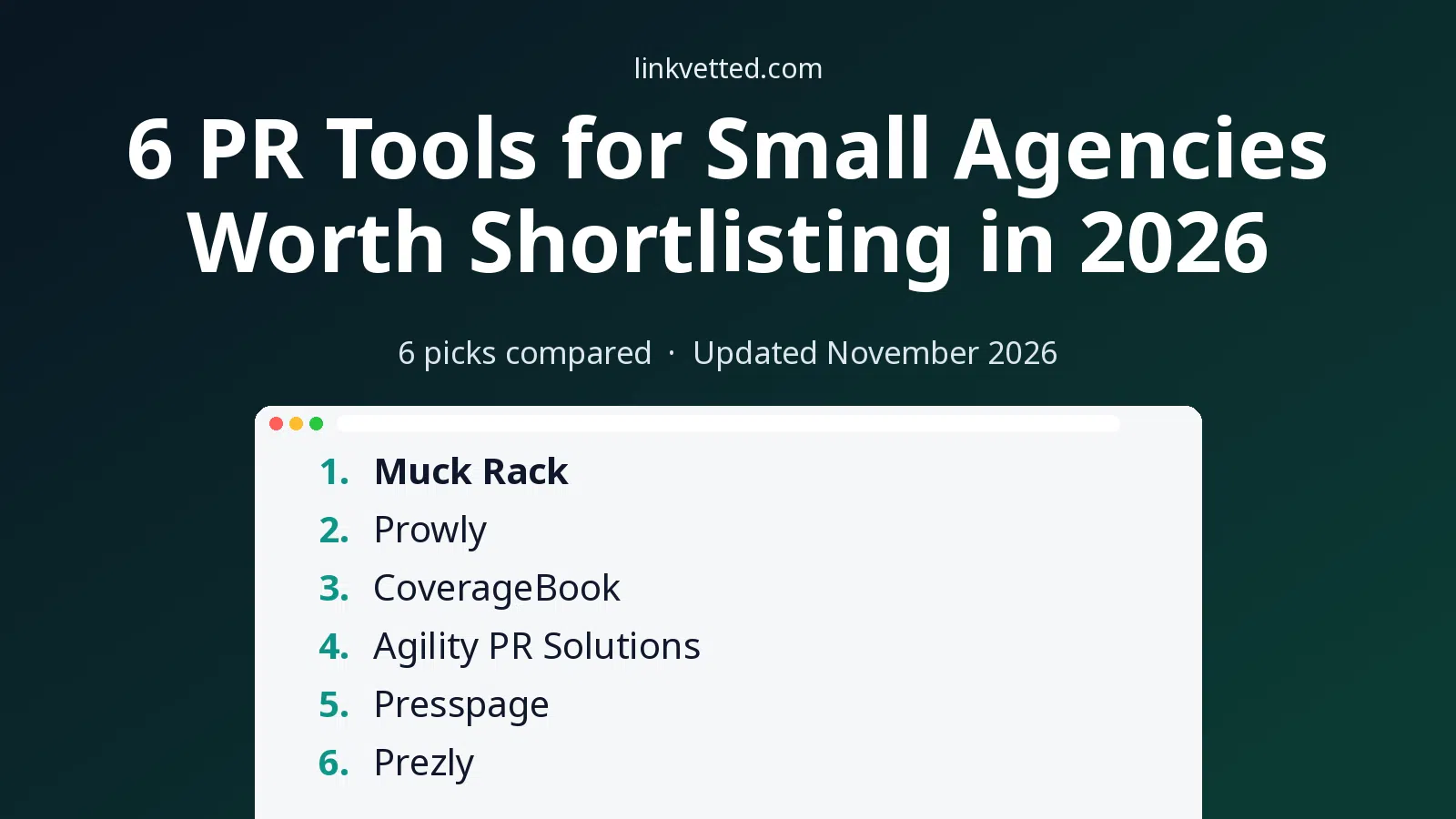
6 PR Tools for Small Agencies Worth Shortlisting in 2026
A practical guide to the best PR tools for small agencies in 2026, comparing six service providers on fit, workflow and limits.
- Editor's choice
 Muck Rack
One platform for contacts, monitoring and reports
Starts atSee websiteVisit muckrack.comFull review - Great alternative
 Prowly
Outreach and reusable media lists
Starts atSee websiteVisit prowly.comFull review - Also consider
 CoverageBook
Fast, clean coverage reports
Starts atSee websiteVisit coveragebook.comFull review
Direct answer
My first pick is Muck Rack, because it combines media database, monitoring and reporting in one place that a small team can run without extra staff. For agencies that mainly need outreach and media list building, Prowly is a sensible second option. If measurement and coverage reporting matter most, CoverageBook fits that job well. This guide covers service providers and platforms that do the heavy lifting for a small agency.
TL;DR:
- A small agency usually needs three jobs covered: finding journalists, sending pitches and proving results.
- Muck Rack suits teams that want one vendor for media contacts, monitoring and reports.
- Prowly is often chosen by agencies that build and reuse media lists across clients.
- CoverageBook is a reporting service, so it works best alongside an outreach tool rather than instead of one.
- Check contract terms and client seat limits before you commit, since small teams feel those costs quickly.
Last checked November 2026. Plan prices are not quoted in this guide because they change often; see each vendor's own pricing page for current figures before you buy.
Quick comparison
| Tool | Best for | Starts at | Free plan? | |
|---|---|---|---|---|
| Muck Rack | One platform for contacts, monitoring and reports | See website | Not stated | Visit |
| Prowly | Outreach and reusable media lists | See website | Free trial | Visit |
| CoverageBook | Fast, clean coverage reports | See website | Free trial | Visit |
 Agility PR Solutions | Monitoring plus a media contact database | See website | Not stated | Visit |
| Presspage | Client newsrooms and owned media | See website | Not stated | Visit |
 Prezly | Publishing and pitching in one workflow | See website | Free trial | Visit |
The best PR tools for small agencies compared
I put this comparison together from vendor documentation and public sources, not from hands-on testing. I looked at what each provider says it does, which tasks it covers and where the limits sit for a small team. Where a vendor does not publish details, I say so rather than guess. The picks below are service providers and platforms that take work off a small agency's plate.
Muck Rack is a PR platform built around a media database of journalists and outlets, with monitoring and reporting attached. For a small agency it is the closest thing to a single place to run a client account: you build a list, send pitches, then track what gets published. It fits agencies with a few retainer clients who want one vendor instead of stitching several tools together.
In day-to-day work, the media database is where most of the value sits. You can search journalists by beat and outlet, save lists per client, and keep coverage in the same account. That matters for a small agency because it cuts the time spent rebuilding lists and copying links into reports. Monitoring also helps when a client asks what was said about them this month.
The limit is scope. A solo operator may find the platform larger than needed and pay for features they rarely open. Agencies that only send a handful of pitches a month should look at a lighter outreach tool first.
- Combines media database, monitoring and reporting
- journalist profiles with public contact details
- coverage tracking in one place
- Wide feature set can be more than a tiny team needs
- pricing needs a direct quote
Prowly is a PR platform with a media database, outreach tools and a newsroom builder. It suits small agencies that send regular pitches and want to keep media lists organised per client. The workflow is built around creating a list, writing a pitch and tracking opens and replies, which is the routine most small PR teams repeat every week.
For a small agency, the useful part is reuse. You can keep separate contact groups for each client and pull from them when a new story breaks. Templates help when several people send pitches in the same house style. Reporting on opens and coverage gives the account lead something concrete to show at review time.
The main limit is coverage of the media database. In some markets the contact data is thinner, so you may still spend time finding local journalists by hand. Agencies that work mostly in smaller regional markets should check database coverage before committing.
- Media database with contact details
- pitch templates and list management
- newsroom and reporting features included
- Database depth differs by country
- smaller markets may need manual list building
CoverageBook is a reporting service that takes coverage links and builds a shareable report with metrics attached. It is not an outreach tool, so it sits at the end of the workflow. For a small agency, that is often the weakest part of the process: someone spends a Friday afternoon copying links into a slide deck. This service removes most of that work.
The way it helps is simple. You add the links, the service pulls in the details and formats a report you can send to the client. For an agency with several retainers, that consistency matters, because every client gets a report in the same shape. It also makes it easier to hand reporting to a junior team member without a long briefing.
Skip it if your problem is finding journalists or sending pitches. CoverageBook does not solve that, and buying it alone will not fix an outreach bottleneck.
- Turns coverage links into a formatted report
- Pulls in metrics for each piece of coverage
- Reports can be shared with clients directly
- Reporting only, no outreach tools
- Needs coverage to exist before it adds value
Agility PR Solutions is a PR service covering media contacts, monitoring and analysis. It fits small agencies that want monitoring and a contact database from one provider, rather than buying them separately. The service is aimed at teams that need to watch coverage across outlets and keep a contact list in the same place.
For a small agency, the monitoring side is the practical draw. You can follow client names and topics, then pull the results into a report. The contact database supports outreach, so the same account covers finding people and tracking what they write. That reduces the number of logins a small team juggles.
The trade-off is setup. Monitoring needs keywords and outlets configured properly, and that takes time before the results are useful. Agencies that want something running on day one should plan for that work or skip it.
- Media contact database and monitoring in one service
- Coverage tracking and analysis
- Suits agencies managing several accounts
- Setup takes time to configure
- Pricing needs a direct quote
Presspage
Best for: Client newsrooms and owned media
Presspage is a newsroom platform that agencies use to build and run press pages for clients. It fits small agencies that manage owned media as part of a retainer, such as a client blog, press page or news hub. The work is publishing and organising content, not pitching journalists.
For a small agency, the value is in offering newsroom management as a service without building a site from scratch. You can publish releases and updates on a client's press page and keep the archive tidy. That gives the client a link to share with journalists and a place to point coverage back to.
The limit is clear: it does not find journalists or send pitches. If your retainer is mostly outreach, this is not the tool for that job. It fits agencies that already run client newsrooms or plan to add that service.
- Newsroom platform built for publishing
- Supports owned media and press pages
- Useful for agencies running client newsrooms
- Not an outreach or media database tool
- Less useful if clients do not publish news
Prezly is a PR platform that combines story publishing with contact management and pitching. It fits small agencies that publish client stories and want to pitch them from the same place. Instead of writing a release in one tool and pitching in another, the workflow stays in one account.
For a small agency, that saves the step of moving content between systems. You publish a story to a client newsroom, then pitch it to contacts stored in the same platform. Coverage and contact history stay together, which helps when a new team member picks up an account.
Skip it if your work is mostly media relations without publishing. Agencies that only send pitches will find the publishing side unused, and a lighter outreach tool may fit better.
- Combines story publishing with contact management
- Newsroom and pitch tools together
- Suits agencies that publish client stories
- Less useful for pure outreach agencies
- Feature set is built around publishing
How I chose
I chose these six by reading vendor documentation and public sources, then matching each provider to the jobs a small agency actually does: finding journalists, sending pitches, monitoring coverage, reporting and running client newsrooms. I did not run hands-on tests, so I am not claiming performance results. Where a vendor does not publish details such as pricing or a free plan, I marked it as not stated rather than filling the gap with a guess.
The second filter was fit for a small team. A large enterprise platform can be excellent and still be the wrong buy for an agency with a handful of retainers, because setup time and unused features cost real hours. I also looked at limits: which tasks each provider does not cover, and whether it needs another tool alongside it. That is why the list mixes outreach platforms, a reporting service and a newsroom tool instead of six near-identical products. The aim is to help you pick by the job you need done, not by feature count.
What to check before you buy
- Confirm which jobs the provider covers and which it does not, so you know if you still need a separate outreach or reporting tool.
- Ask how many user seats are included and what extra seats cost, since small teams grow and shrink.
- Check media database coverage in the countries and languages your clients work in.
- Ask how coverage data is collected and whether it can be exported to your own reporting.
- Request a trial or demo with your own client account, not a generic sample.
- Read the contract length and cancellation terms before you commit to an annual plan.
FAQ
What is the best PR tool for a very small agency?
It depends on the bottleneck. If finding journalists and tracking coverage is the problem, Muck Rack covers both in one account. If reporting eats your Fridays, CoverageBook removes most of that work. Start with the task that costs you the most hours, then add tools only when a second job becomes a real problem.
Do I need a media database if I already have good contacts?
Not always. If your agency works in a narrow beat and already knows the journalists, a lighter outreach tool with list management may be enough. A media database earns its place when you take on new clients in unfamiliar sectors or markets, because rebuilding contacts by hand is slow.
Can a reporting tool replace an outreach platform?
No. A reporting service like CoverageBook starts working after coverage exists. It does not find journalists or send pitches. Most small agencies end up with one outreach tool and one reporting tool, or a single platform that does both, depending on budget and how much reporting they do.
How should a small agency choose between a platform and a service?
A platform gives your team control and a login to work in. A service does more of the work for you, which suits agencies without a dedicated PR operator. Look at who will actually use it each week. If nobody owns the tool internally, a service is usually the better fit.
Are free trials enough to judge a PR tool?
A trial helps you check the interface and database coverage for your market, but it rarely shows how the tool behaves across several client accounts. Use the trial to test one real client list and one real report, then ask the vendor how multi-client setups work before you sign.
Sources
- https://muckrack.com
- https://prowly.com
- https://coveragebook.com
- https://www.agilitypr.com
- https://www.presspage.com
- https://www.prezly.com