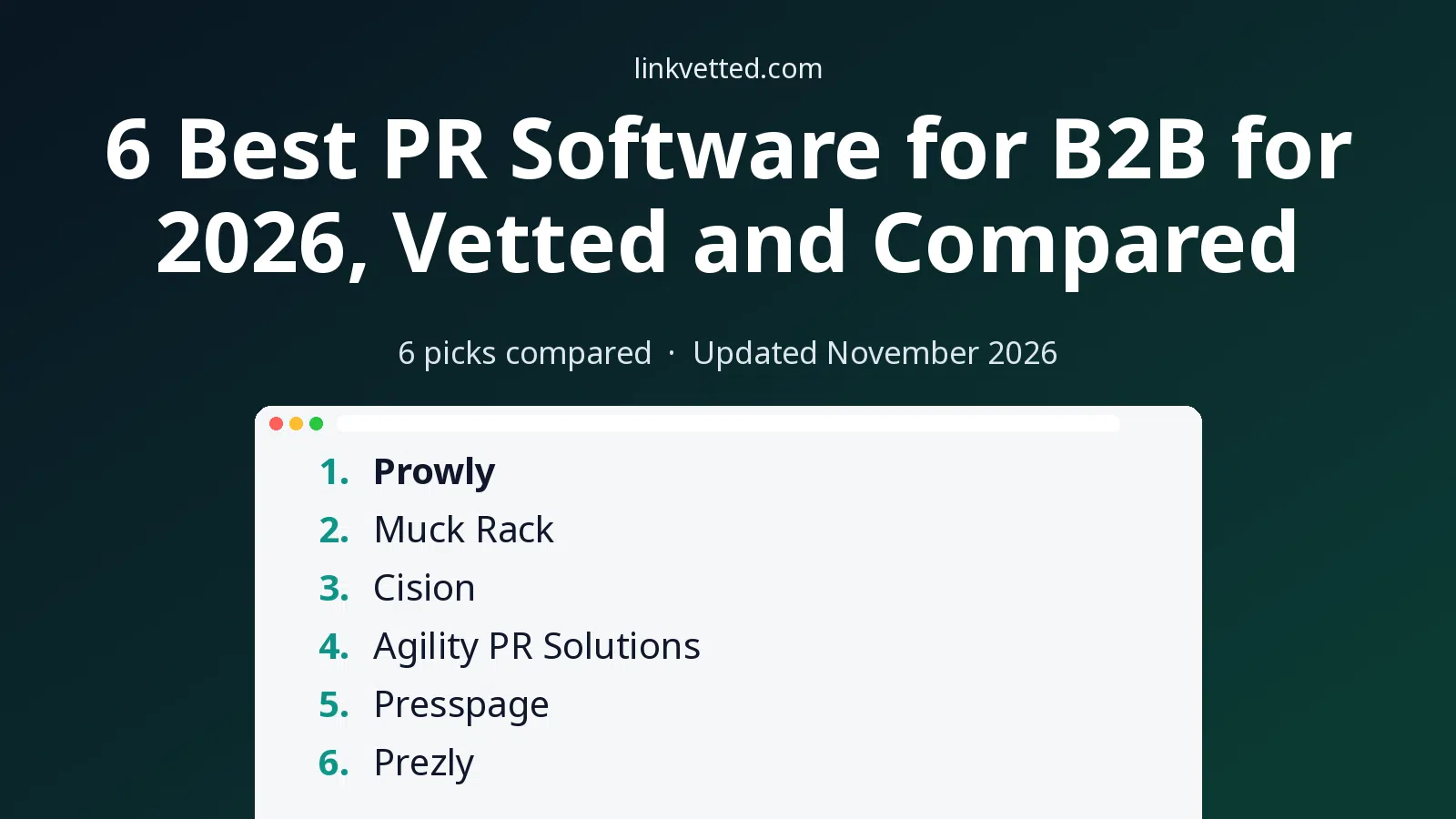
6 Best PR Software for B2B for 2026, Vetted and Compared
A practical guide to the best PR software for B2B in 2026, compared from vendor documentation and public sources, with limits and fit for each tool.
- Editor's choice
 Prowly
All-in-one B2B PR workflow
Starts atSee websiteVisit prowly.comFull review - Great alternative
 Muck Rack
Coverage monitoring and reporting
Starts atSee websiteVisit muckrack.comFull review - Also consider
 Cision
Enterprise media relations programs
Starts atSee websiteVisit cision.comFull review
Direct answer
My top pick for most B2B teams is Prowly, because it combines media database, release distribution and a newsroom in one place. If your priority is monitoring coverage and measuring share of voice, Muck Rack fits better. If you mainly need to send releases and track pickups at a lower entry point, Presspage and similar tools are worth a look. The right choice depends on whether your bottleneck is finding journalists, sending pitches, or reporting results.
TL;DR:
- B2B PR software usually splits into three jobs: media lists, outreach and distribution, and coverage measurement, and few tools do all three equally well.
- A media database is only useful if its coverage matches your vertical, so check the regions and industries it lists before you commit.
- Coverage monitoring and reporting matter more for B2B teams that must show pipeline influence to sales and finance.
- Newsroom and release hosting tools help with SEO and journalist self-service, but they are not a substitute for outreach.
- Pricing is usually quote-based, so ask for a written scope that lists contacts, users, releases and monitoring limits.
Last checked November 2026. Plan prices are not quoted in this guide because they change often; see each vendor's own pricing page for current figures before you buy.
Quick comparison
| Tool | Best for | Starts at | Free plan? | |
|---|---|---|---|---|
| Prowly | All-in-one B2B PR workflow | See website | Free trial | Visit |
| Muck Rack | Coverage monitoring and reporting | See website | No free plan | Visit |
| Cision | Enterprise media relations programs | See website | Not stated | Visit |
 Agility PR Solutions | Monitoring plus distribution | See website | Not stated | Visit |
| Presspage | Newsroom and release hosting | See website | Not stated | Visit |
 Prezly | Content-led PR and newsrooms | See website | Free trial | Visit |
The best PR software for B2B compared
I put this list together from vendor documentation, public product pages and published feature lists. I did not run hands-on tests, and I have not measured results for any vendor. Treat this as a starting shortlist to check against your own workflow, regions and budget.
Prowly is a PR platform aimed at teams that want media lists, pitching, release distribution and a branded newsroom under one login. For B2B companies that send a steady stream of product and partnership news, that combination removes the handoff between a spreadsheet of contacts and a separate email tool. It suits small and mid-sized teams more than large agencies with complex approval chains.
In a B2B workflow, you build a list from the database, filter by beat and region, send a pitch from the same interface, and then watch opens and coverage in the reporting view. The newsroom gives journalists a place to find releases and assets without emailing you. That matters when a reporter is on deadline and needs a logo or a quote fast.
The limit is database coverage. If most of your targets are trade press in a narrow industry or a smaller market, check that those outlets and contacts are listed before you buy. Teams that only need monitoring should skip it.
- Media database plus outreach in one tool
- Built-in newsroom and release publishing
- Coverage monitoring with reports
- Database depth varies by country
- Full features need a paid plan
Muck Rack is a media relations platform built around a journalist database, monitoring and reporting. It fits B2B teams that need to show what coverage was published, who wrote it and what it said, and then turn that into a monthly update for leadership. It is common in companies where PR reports into marketing and has to justify spend.
The workflow starts with monitoring: you add keywords, competitors and spokespeople, and the tool collects mentions. From there you build reports and share them. The journalist profiles help you check what a reporter covers before you pitch, which reduces wasted emails in niche B2B sectors like logistics software or industrial equipment.
The drawback is commitment. Pricing is quote-based and the platform is built for teams that will use monitoring regularly. A very small team that mainly sends the occasional release may find it more than it needs.
- Strong media monitoring and alerts
- Journalist profiles with public activity
- Reporting suited to stakeholder updates
- Quote-based pricing
- Less useful if you only need release distribution
Cision is one of the long-established PR software providers, covering media databases, press release distribution, monitoring and analytics. It fits larger B2B organizations with several markets, multiple spokespeople and a need for consistent reporting across regions. It is also common in agencies that manage several B2B accounts at once.
For B2B use, the value is in reach and consistency. You can build lists across markets, distribute releases through a known network, and pull coverage into reports. That structure helps when several people pitch the same industry and you need one view of who was contacted and what was published.
The limits are practical. Large platforms take time to set up, and contracts are usually annual. A small B2B team with one spokesperson and a handful of trade targets should look at lighter tools first.
- Large media database and distribution network
- Monitoring and analytics included
- Widely used by larger organizations
- Setup and contracts suit bigger teams
- Can be heavy for a solo PR person
Agility PR Solutions is a media monitoring and PR management platform with a database, distribution and analytics. It fits B2B teams that want monitoring and release sending from one vendor without moving to a large enterprise contract. It is often considered by mid-sized companies and agencies.
In practice, you use it to build media lists, send releases, and track mentions and sentiment over time. For B2B, sentiment tracking is useful around product launches and industry reports, where a trade outlet's framing can shape how buyers see your announcement. Reports can be exported for stakeholder updates.
The main caution is the interface. Some teams find it less modern than newer tools, so ask for a demo and click through the parts you will use daily. Teams that only need a newsroom should look elsewhere.
- Media database and monitoring in one platform
- Release distribution included
- Reporting for coverage and sentiment
- Interface can feel dated
- Pricing needs a quote
Presspage
Best for: Newsroom and release hosting
Presspage is a newsroom platform. It hosts press releases, media assets and brand news on a page you control, with structured pages that search engines can read. It fits B2B companies that publish frequent announcements, such as funding, hires, product updates and event news, and want one consistent home for them.
For B2B, a newsroom helps in two ways. Journalists can find releases and assets without asking, and your announcement pages can rank for brand and product terms. You can run several newsrooms for different markets or brands, which suits companies operating in more than one country.
The limit is scope. Presspage is not a media database or a pitching tool, so you still need a way to find and contact journalists. Teams that want one vendor for everything should pair it with outreach software or choose an all-in-one platform.
- Branded newsroom with structured release pages
- Good for SEO-friendly announcement hosting
- Supports multi-market newsrooms
- Not a full media database
- Outreach needs another tool
Prezly is a PR platform that combines a newsroom, story publishing, contact management and pitching. It fits B2B teams that treat announcements as content, with images, quotes and context, rather than plain release text. It suits companies that want their news to look good on the web and be easy to share.
In a B2B workflow, you publish a story, add contacts and pitch from the same place, then track who opened and clicked. That link between the published page and the pitch is useful when a journalist asks for more detail, because you can send one URL instead of attachments.
The limit is database size. If your targets are spread across many countries and niche trade titles, check coverage first. Teams that need deep monitoring and share-of-voice reporting should compare it with Muck Rack or Agility.
- Newsroom and story pages built for reading
- Contact management and pitching included
- Good fit for visual announcements
- Smaller media database than large vendors
- Less suited to heavy monitoring needs
How I chose
I compared these tools using vendor documentation, public product pages and published feature descriptions. I looked at four things: whether the tool covers media lists, outreach, distribution and monitoring; how clearly the vendor describes limits such as database coverage by region; whether the workflow fits a B2B team that sends regular announcements; and what kind of team each product is built for. I did not run hands-on tests, and I have not measured results for any vendor.
I also left out tools where the public information was too thin to describe honestly, and I avoided ranking by price because most PR platforms are quote-based. Where a tool is strong in one area, such as newsroom hosting, I noted what it does not do so you can pair it with another product. The shortlist is meant to be checked with a demo and a trial where one is offered.
What to check before you buy
- Ask for a list of media contacts in your specific vertical and region, and check that the trade titles you target are included.
- Confirm how many users, releases and monitored keywords the quoted plan covers, and what happens when you go over.
- Check whether coverage monitoring covers print, online, broadcast and social, and how far back the archive goes.
- Ask how reports are exported, because B2B teams often need to paste coverage into a board or sales deck.
- Confirm whether the newsroom is hosted on your domain or a subdomain, and who owns the content if you leave.
- Ask about onboarding and training time, since a large platform can take weeks before a small team is productive.
FAQ
What is the best PR software for B2B overall?
For most B2B teams, Prowly is the best starting point because it covers media lists, outreach, release publishing and a newsroom in one place. If reporting and monitoring are the priority, Muck Rack is the stronger fit. If you mainly need a newsroom, Presspage or Prezly are more focused choices.
Do I need a media database if I already have a contact list?
A database helps when you enter a new market or beat and your list runs dry. If your B2B niche is small and you already know the main trade reporters, a lighter tool with contact management may be enough. Check database coverage for your region before paying for one.
How is B2B PR software different from general PR software?
B2B PR usually involves fewer, more specialised outlets and longer sales cycles, so coverage quality matters more than volume. Tools that track sentiment and share of voice in trade press, and that let you report coverage against accounts or campaigns, tend to fit better than consumer-focused platforms.
Can PR software replace an agency?
No. Software handles lists, sending, hosting and monitoring, but it does not write your story, build relationships or decide what to pitch. Many B2B teams use software to run outreach in-house and bring in an agency for strategy or launches. The tool is the plumbing, not the strategy.
How long does it take to set up B2B PR software?
Smaller tools can be running in days if your contact lists and brand assets are ready. Larger platforms with monitoring, multiple markets and custom reports often take several weeks, including onboarding calls and report setup. Ask the vendor for a setup plan before you sign.
Sources
- https://prowly.com
- https://muckrack.com
- https://www.cision.com
- https://www.agilitypr.com
- https://www.presspage.com
- https://www.prezly.com