Best Podcast Monitoring Tools for 2026: Our 6 Vetted Picks
A practical guide to the best podcast monitoring tools in 2026, compared from vendor documentation and public sources, with limits and fit for each.
- Editor's choiceListen Notes
Searching podcasts and episodes for mentions
Starts atSee websiteVisit listennotes.comFull review - Great alternative
 Meltwater
Cross-channel media monitoring including podcasts
Starts atSee websiteVisit meltwater.comFull review - Also considerPodchaser
Podcast data, reviews and show tracking
Starts atSee websiteVisit podchaser.comFull review
Direct answer
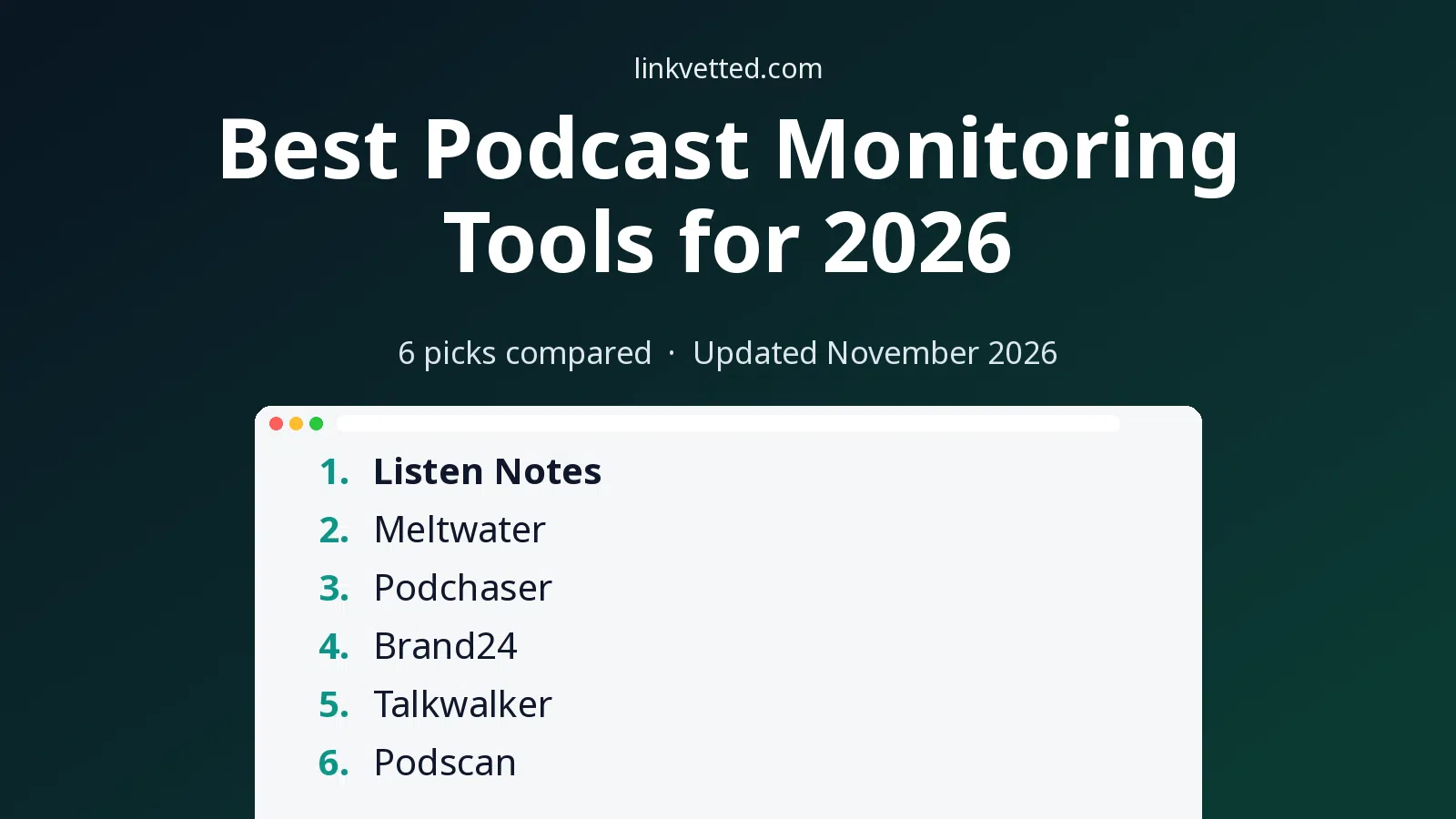
My first pick is Listen Notes, because its public podcast and episode search gives you a quick way to see where a brand, guest or topic is mentioned across shows. For teams that want media monitoring across podcasts and other channels, Meltwater is the broader option. For tracking your own show's reviews and rankings, Podchaser is a sensible third choice. I compared these from vendor documentation and public sources, not hands-on tests.
TL;DR:
- Podcast monitoring covers two different jobs: finding mentions of a brand or topic across shows, and tracking how your own podcast performs.
- Listen Notes is the most direct starting point for searching podcast transcripts and episode metadata at scale.
- Meltwater and similar media intelligence platforms suit teams that need podcast mentions alongside news, social and broadcast coverage.
- Podchaser focuses on podcast and episode data, including reviews, which helps when you monitor your own show.
- No single tool covers every monitoring need, so most teams combine a search tool with a media monitoring or analytics platform.
Last checked November 2026. Plan prices are not quoted in this guide because they change often; see each vendor's own pricing page for current figures before you buy.
Quick comparison
| Tool | Best for | Starts at | Free plan? | |
|---|---|---|---|---|
| Listen Notes | Searching podcasts and episodes for mentions | See website | Free plan | Visit |
| Meltwater | Cross-channel media monitoring including podcasts | See website | Not stated | Visit |
| Podchaser | Podcast data, reviews and show tracking | See website | Free plan | Visit |
 Brand24 | Social and web mention monitoring | See website | Free trial | Visit |
 Talkwalker | Enterprise media listening and analytics | See website | Not stated | Visit |
| Podscan | Transcript-based podcast mention monitoring | See website | Free trial | Visit |
The best podcast monitoring tools compared
I put this list together from vendor documentation and public sources, including each product's own feature pages and help content. I did not run hands-on tests, so treat this as a starting comparison rather than a lab review. The picks below cover different jobs: searching podcasts for mentions, monitoring your own show, and watching podcasts alongside other media.
Listen Notes
Best for: Searching podcasts and episodes for mentions
Listen Notes is a podcast search engine and database. It indexes a large number of shows and episodes, and you can search by keyword to find where a name, brand or topic comes up. It fits PR teams, SEOs and researchers who want a focused podcast search rather than a full media monitoring suite.
For podcast monitoring, the workflow is simple: search a brand or spokesperson name, review the matching episodes, and note the shows that mention it. The API lets you build a recurring search if you want to check for new mentions on a schedule. That makes it useful for link building outreach too, since a show that mentioned a topic may be a reasonable pitch target.
The limit is depth. Transcript availability depends on what each show publishes, so some mentions will not surface. If you need coverage across news, social and broadcast as well, this is not the tool for that job.
- Large public podcast and episode index
- keyword search across shows and episodes
- API access for building custom monitoring
- Transcript coverage varies by show
- limited media monitoring outside podcasts
Meltwater is a media intelligence platform used by PR and communications teams. It monitors news, social media, broadcast and other sources, and podcasts sit within that wider coverage. It fits organisations that want one place to track mentions rather than a podcast-only tool.
For podcast monitoring, the value is context. You can see a podcast mention next to press coverage and social discussion of the same topic, which helps when you report on a campaign. Alerts and reporting features support a recurring monitoring routine, and the platform is built for teams that need to share findings.
The main limit is fit. It is designed for larger communications teams, and a small agency or solo SEO may find it more than needed. If your only goal is podcast search, a narrower tool is easier to justify.
- Broad media monitoring across channels
- Media intelligence and reporting
- Established platform with support
- Priced for larger teams
- Podcast coverage is one part of a bigger suite
Podchaser
Best for: Podcast data, reviews and show tracking
Podchaser is a podcast database with show and episode information, plus reviews and ratings. It is useful for podcasters and teams that want to track how their own show is received, and for researchers who need structured podcast data.
For monitoring, Podchaser helps you follow your show's reviews and episode listings, and it gives you a way to check how a show is described across the directory. If you run outreach to podcasts, the database also helps you check a show's activity before you pitch. It is a reference tool as much as a monitoring one.
The limit is scope. Podchaser is built around podcast data, not news or social listening, so it will not replace a media monitoring platform. Teams that need broad mention tracking should pair it with something else.
- Detailed podcast and episode database
- Reviews and ratings for shows
- Useful for tracking your own podcast
- Not a full media monitoring platform
- Mention discovery is less central than show data
Brand24 is an online mention monitoring tool. It tracks mentions across social media, forums, news and other web sources, and it is often used by small teams that want a straightforward listening setup. It fits agencies and brands that need a daily mention feed.
Podcasts are not the core of Brand24, but the tool can pick up podcast pages and related web mentions when they are indexed. For a team already using it for social listening, adding podcast-related keywords is a low-effort way to widen coverage. Alerts help you catch new mentions without checking manually.
The limit is podcast depth. If your main need is searching transcripts for spoken mentions, Brand24 is not built for that. It works best as one part of a wider monitoring stack.
- Simple mention monitoring dashboard
- Alerts for new mentions
- Sentiment analysis on mentions
- Podcast coverage is narrower than social coverage
- Less suited to deep podcast transcript search
Talkwalker is a media listening and analytics platform. It covers social, news, blogs and other sources, and it is used by larger brands and agencies that need wide coverage and reporting. Podcasts are part of a broader listening picture rather than the whole product.
For podcast monitoring, Talkwalker helps when you want to see podcast discussion alongside other channels in one report. You can build queries around a brand or campaign and review the results over time. The analytics side is the draw for teams that need to present findings to stakeholders.
The limit is complexity. Building useful queries takes time, and the platform is aimed at organisations with a monitoring workflow already in place. A small team may not need that depth.
- Broad media listening coverage
- Visual and image recognition features
- Analytics and reporting for large teams
- Setup takes time for complex queries
- Aimed at larger organisations
Podscan
Best for: Transcript-based podcast mention monitoring
Podscan is a podcast monitoring service built around transcripts. It lets you search spoken content in podcasts and set up alerts for keywords, which is closer to what many teams actually want when they monitor podcasts for brand mentions.
The workflow is direct: add the terms you care about, let the service scan episodes, and review matches. That suits PR teams tracking spokesperson mentions and SEOs looking for shows that discuss a topic. Alerts reduce the need for manual searching.
The limit is maturity. It is a newer product, so you should check current coverage and features on the site before committing. Teams that need broad media monitoring should still look at a larger platform.
- Focused on podcast transcripts
- Keyword alerts for mentions
- Built specifically for podcast monitoring
- Newer platform with a smaller track record
- Coverage depends on transcript availability
How I chose
I started from each vendor's own documentation and public sources, then checked what job each tool is actually built for. Podcast monitoring is not one task. Searching transcripts for a brand mention is different from tracking your own show's reviews, and both are different from watching podcasts alongside news and social coverage. I grouped the tools by that fit rather than by feature count.
I also looked at limits. A tool that is excellent for podcast search may be weak on reporting, and a media intelligence platform may be more than a small team needs. Where I was unsure about a detail such as free plan availability, I noted it rather than guessing. This comparison is based on vendor documentation and public sources, not on hands-on testing, so verify current features and terms on each site before you decide.
What to check before you buy
- Confirm whether the tool searches transcripts or only episode titles and descriptions, since that changes what mentions you can find.
- Check how often the index updates, because a slow refresh means you may miss recent episodes.
- Ask whether you can set recurring alerts for keywords rather than running searches manually.
- Test coverage for the shows and languages you care about, since podcast indexes vary.
- Check what reporting and export options exist if you need to share findings with a client or team.
- Confirm the current plan terms on the vendor site, because free plan and trial details change.
FAQ
What are podcast monitoring tools used for?
They are used to find and track mentions of a brand, person or topic across podcasts, and to follow how your own show is reviewed and listed. Some tools focus on transcript search, while others monitor podcasts as part of wider media coverage across news and social channels.
Can I monitor podcasts for free?
Some tools offer a free plan or trial, but limits vary. Listen Notes and Podchaser have free options, and Podscan lists a free trial. Check each vendor's current terms, because free plan details change and may restrict searches, alerts or export.
Do these tools search what is said in an episode?
It depends on the tool. Services built around transcripts, such as Podscan, are designed to search spoken content. Others rely on episode titles, descriptions and show notes, so a spoken mention may not appear unless the show publishes a transcript.
How is podcast monitoring different from social listening?
Social listening tracks mentions on social platforms, forums and news. Podcast monitoring focuses on audio shows and their episode data. Many teams use both, and media intelligence platforms such as Meltwater and Talkwalker cover podcasts alongside other channels in one place.
Which tool is best for a small SEO agency?
For a small agency, a focused search tool such as Listen Notes is often the easiest starting point for finding shows that discuss a topic. If you also need social and web mentions, a simpler listening tool may fit better than a large enterprise platform.
Sources
- https://www.listennotes.com
- https://www.meltwater.com
- https://www.podchaser.com
- https://brand24.com
- https://www.talkwalker.com
- https://podscan.fm
Related guides
- 5 Best API Monitoring Tools for Third-Party Integrations for 2026, Vetted and Compared
- The 5 Best API Observability Tools for Monitoring in 2026, Ranked
- Best Application Monitoring Service in 2026: 8 Platforms Compared
- Application Performance Monitoring for SaaS Startups in 2026: The 6 Best Options Side by Side