The 6 Best Podcast Guest Booking Services in 2026, Ranked
A practical guide to the best podcast guest booking services in 2026, compared from vendor documentation and public sources for outreach and PR teams.
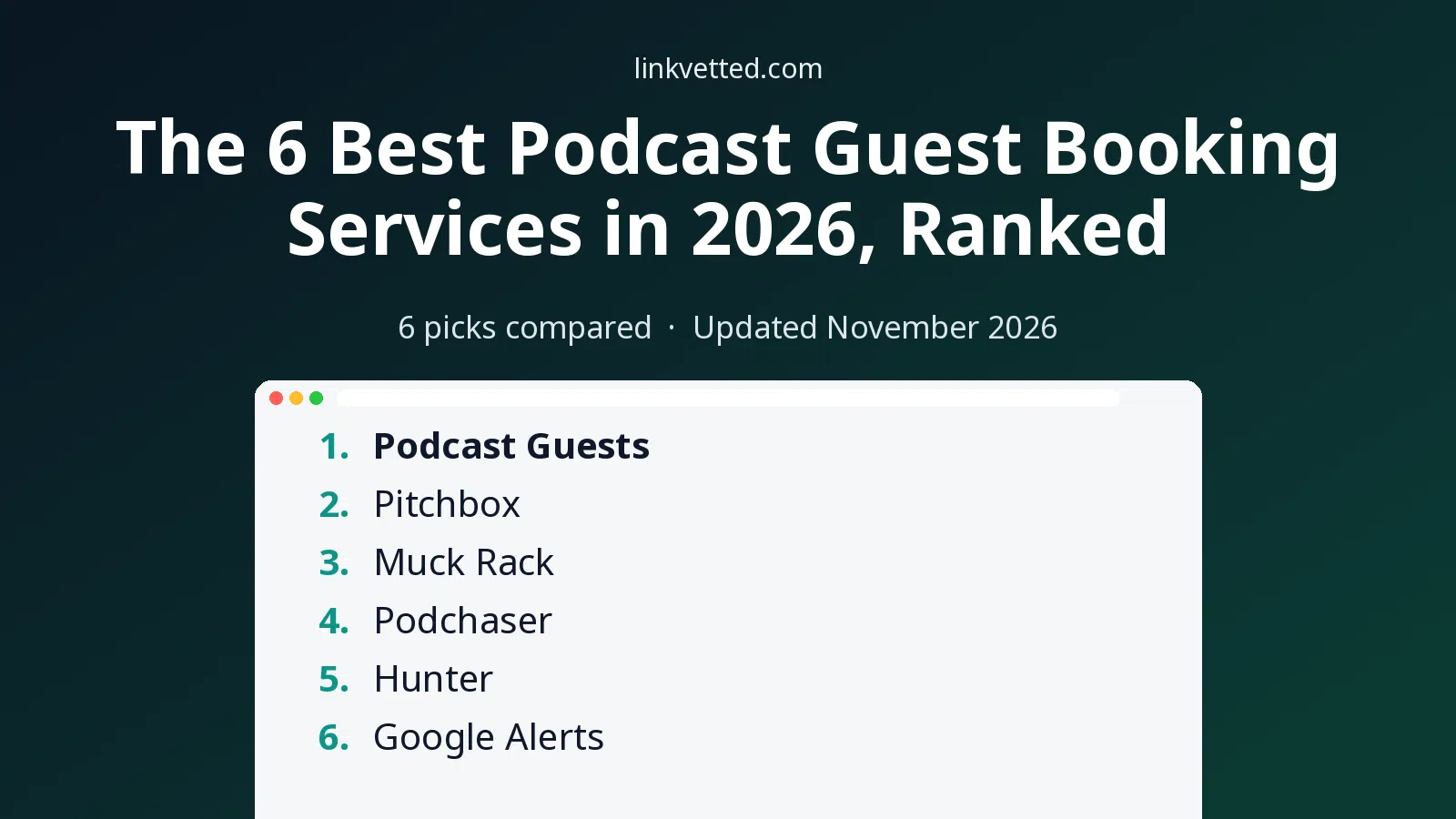
- Editor's choicePodcast Guests
Matching guests with podcast hosts
Starts atSee websiteVisit podcastguests.comFull review - Great alternative
 Pitchbox
Running outbound host outreach at scale
Starts atSee websiteVisit pitchbox.comFull review - Also consider
 Muck Rack
Finding journalists and podcast hosts
Starts atSee websiteVisit muckrack.comFull review
Direct answer
My top pick is Podcast Guests, because it is built around matching show bookers with guests and gives both sides a place to manage requests. For teams that want to run their own outreach at scale, Pitchbox fits better. If your focus is finding journalists and podcast hosts through media databases, Muck Rack is the stronger option. Each suits a different workflow, so match the tool to how you actually book.
TL;DR:
- Guest-matching marketplaces and outreach platforms solve different problems, so decide first whether you want inbound requests or outbound pitching.
- Most tools here charge by subscription or per booking, so check the current pricing page rather than relying on older figures.
- A booking tool only helps if your pitch and guest one-sheet are ready before you start sending requests.
- Media databases are useful for finding hosts and producers, but they are not a full booking workflow on their own.
- Always confirm how each vendor handles contact data and outreach limits before you commit.
Last checked November 2026. Plan prices are not quoted in this guide because they change often; see each vendor's own pricing page for current figures before you buy.
Quick comparison
| Tool | Best for | Starts at | Free plan? | |
|---|---|---|---|---|
| Podcast Guests | Matching guests with podcast hosts | See website | Not stated | Visit |
| Pitchbox | Running outbound host outreach at scale | See website | Not stated | Visit |
| Muck Rack | Finding journalists and podcast hosts | See website | No free plan | Visit |
| Podchaser | Researching shows, hosts and episodes | See website | Free plan | Visit |
 Hunter | Finding and verifying producer emails | See website | Free plan | Visit |
| Google Alerts | Monitoring new podcast episodes | See website | Free plan | Visit |
The best podcast guest booking services compared
I put this comparison together from vendor documentation and public sources, and I did not run hands-on tests of any tool. The picks below reflect how each product describes its own workflow and where it tends to fit. Treat it as a starting point for your own trial.
Podcast Guests
Best for: Matching guests with podcast hosts
Podcast Guests is a marketplace where podcast hosts look for guests and guests make themselves available to shows. It fits people who want to be discovered rather than pitch cold, and it also suits hosts who need a steady flow of interview candidates. You create a profile, describe your expertise, and let bookers find you.
The workflow is closer to a directory than a campaign tool. You list what you can talk about, shows browse and send requests, and you respond from the platform. For link building and digital PR teams, that means less manual list building but also less control over which shows approach you. It works best when your guest has a clear, specific topic.
The limit is coverage. A niche marketplace only helps if enough relevant shows use it. If your topic is narrow or you need a fixed number of bookings per month, pair it with your own outreach rather than relying on it alone.
- Two-sided guest and host matching
- profile-based discovery
- request management in one place
- Marketplace coverage depends on your topic
- less control than direct outreach
Pitchbox is an outreach platform used for blogger, journalist and partner campaigns. I include it here because podcast booking is fundamentally outreach: you find hosts, send a pitch, follow up, and track replies. If your team already runs link building campaigns, adding podcast pitching to the same system keeps everything in one place.
You build a list of shows and producers, load it into a campaign, and run templated sequences with follow-ups. Replies and statuses are tracked per prospect, so you can see who has responded and who needs a nudge. The tool does not supply podcast contacts, so the quality of your list still decides the outcome.
Skip it if you only book a handful of shows a year, since a full outreach platform is more than that job needs. It also assumes someone on your team owns list building and copywriting.
- Campaign and sequence management
- prospect tracking
- team collaboration features
- Not podcast-specific
- needs your own prospect list
Muck Rack is a media database and PR platform. It is widely used to find journalists, and many podcast hosts and producers appear in its profiles alongside their other media work. For digital PR teams, that overlap is useful: the same person who writes for a publication may also run a show.
You can search by beat, outlet and keyword, build lists, and track coverage. For podcast booking, the practical use is finding the right producer or host and getting a verified contact route. It does not manage guest requests or show calendars, so it feeds your outreach rather than replacing it.
The main limit is fit. It is built for communications teams and priced accordingly, so a solo podcaster or a very small agency may find it heavier than needed. Check the current plans before assuming it covers your use case.
- Large media contact database
- monitoring and alerts
- pitch and coverage tracking
- Aimed at PR teams
- podcast booking is one use among many
Podchaser
Best for: Researching shows, hosts and episodes
Podchaser is a podcast database with show pages, host profiles and episode listings. I use it as a research layer: before pitching a show, you can check recent episodes, see whether they run guest interviews, and understand the host's angle. That reduces wasted pitches.
It is not a booking service in the strict sense. You still need to find a contact route and send the pitch yourself, often through the show's website or social profiles. Its value is in choosing the right shows and tailoring each pitch to what the host actually covers.
Skip it if you want an all-in-one booking workflow. It is best paired with an outreach tool or a simple spreadsheet and email setup.
- Large podcast database
- host and show profiles
- episode-level search
- Limited booking workflow
- contact details are not always available
Hunter finds and verifies email addresses associated with a domain. In podcast booking, that is often the missing step: you know the show's website but not the producer's address. You enter the domain, review the suggested addresses, and verify before sending.
It is a narrow utility, and that is the point. It does not tell you which shows to pitch or manage replies. Used alongside a show database and an outreach tool, it fills the gap between research and sending. Keep your outreach polite and relevant, and follow the rules that apply in your region.
The limit is accuracy. Not every producer has a public address, and guessed patterns can be wrong. Always verify, and be ready to use a contact form when no address is available.
- Email discovery by domain
- verification to reduce bounces
- simple interface
- No podcast database
- results depend on public data
Google Alerts
Best for: Monitoring new podcast episodes
Google Alerts is a free monitoring tool, not a booking service. I include it because timing matters in podcast outreach: a show that just published an episode on your topic is a warmer pitch than one you found in an old list. Alerts on your keywords, competitors and target shows can surface those moments.
Set alerts for show names, host names and topic phrases, then route the results into your research list. It costs nothing and takes minutes to configure. The trade-off is noise: broad alerts return a lot of irrelevant results, so keep queries specific.
Do not expect it to find contacts or manage outreach. It is a cheap early-warning system that feeds the rest of your stack.
- Free to use
- simple setup
- catches new mentions and episodes
- No contact data
- noisy results need filtering
How I chose
I selected these tools by reading vendor documentation and public sources, then judging each one against the job of booking podcast guests. I looked at what the product actually does, whether it supplies contacts or only manages them, and where its stated use case overlaps with podcast outreach. I did not run hands-on tests, and I have not measured results for any vendor.
The second filter was fit and limits. A media database, an outreach platform and a guest marketplace are not interchangeable, so I placed each tool where it does the most useful work and noted where it stops. I avoided tools I could not confirm are operating, and I left out anything that depends on spam tactics or bulk unsolicited pitching. Pricing changes often, so I point you to each vendor's site instead of quoting figures.
What to check before you buy
- Confirm whether the tool supplies podcast contacts or expects you to build your own list.
- Check how the vendor defines acceptable outreach and whether it enforces sending limits.
- Ask whether guest requests, replies and statuses are tracked in one place or spread across email.
- Review data-protection terms if you store contact details for people in the EU or UK.
- Test the search quality for your specific topic before committing to an annual plan.
- Check whether the tool covers the shows you actually want, not just the total database size.
FAQ
Do I need a paid tool to book podcast guests?
No. You can research shows manually, find contacts through show websites, and track pitches in a spreadsheet. Paid tools save time on list building, contact discovery and follow-up tracking. Start manual, then add a tool when the volume of outreach makes spreadsheets hard to manage.
What is the difference between a guest marketplace and an outreach tool?
A guest marketplace, like Podcast Guests, lets hosts find you and send requests. An outreach tool, like Pitchbox, helps you find hosts and pitch them yourself. Marketplaces reduce manual work but give you less control; outreach tools give you control but require a solid list and good pitches.
Can I use these tools for digital PR, not just podcasts?
Yes. Several tools here, including Muck Rack and Pitchbox, are used mainly for media and blogger outreach. Podcast booking fits the same workflow: research, contact, pitch, follow up. If your team already runs digital PR campaigns, adding podcast pitching to the same system is usually simpler than buying a separate tool.
How do I find the right contact for a podcast?
Start with the show's website and recent episodes, which often name the host and producer. A tool like Hunter can help find and verify an email on the show's domain. If no address is public, use the show's contact form or a professional social profile, and keep the message short and specific.
Are free plans enough for regular booking?
For low-volume work, yes. Podchaser, Hunter and Google Alerts all offer free options that cover research and contact discovery at a small scale. Free plans usually limit searches or features, so teams booking regularly will likely outgrow them. Check current limits on each vendor's site before you rely on a free tier.
Sources
- https://podcastguests.com
- https://pitchbox.com
- https://muckrack.com
- https://www.podchaser.com
- https://hunter.io
- https://www.google.com/alerts