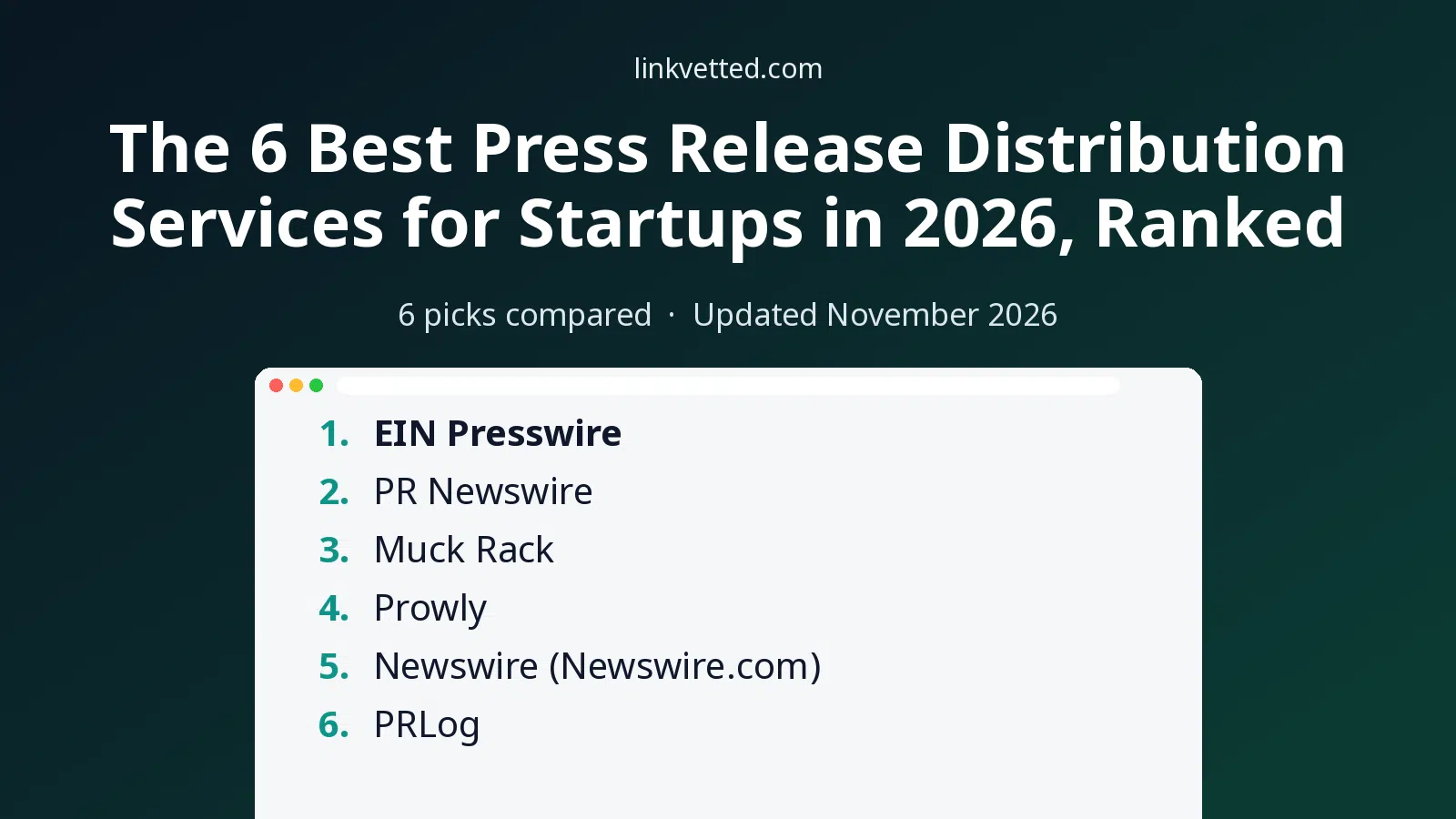
The 6 Best Press Release Distribution Services for Startups in 2026, Ranked
A practical guide to the best press release distribution services for startups in 2026, compared from vendor documentation and public sources.
- Editor's choice
 EIN Presswire
Affordable newswire distribution
Starts atSee websiteVisit einpresswire.comFull review - Great alternative
 PR Newswire
Established, broad syndication
Starts atSee websiteVisit prnewswire.comFull review - Also consider
 Muck Rack
Journalist research and pitching
Starts atSee websiteVisit muckrack.comFull review
Direct answer
My first pick is EIN Presswire, because it is built around affordable, straightforward newswire distribution and is easy for a small team to use. For startups that want a journalist-facing pitch layer on top of distribution, I suggest Muck Rack. For teams that need a full PR workflow with media databases and monitoring, Prowly is a reasonable third option. I compared these from vendor documentation and public sources, not hands-on tests.
TL;DR:
- A distribution service only places your release; the story, targeting and follow-up still decide whether journalists cover it.
- Newswire-style services such as EIN Presswire and PR Newswire suit announcements you want indexed and syndicated quickly.
- Media database and workflow tools such as Muck Rack and Prowly help you pitch specific journalists rather than blast a release.
- Check what each plan includes for multimedia, targeting and reporting before you commit, since these vary by tier.
- For most early-stage startups, one affordable newswire plus a short, targeted media list covers the basics.
Last checked November 2026. Plan prices are not quoted in this guide because they change often; see each vendor's own pricing page for current figures before you buy.
Quick comparison
| Tool | Best for | Starts at | Free plan? | |
|---|---|---|---|---|
| EIN Presswire | Affordable newswire distribution | See website | Not stated | Visit |
| PR Newswire | Established, broad syndication | See website | Not stated | Visit |
| Muck Rack | Journalist research and pitching | See website | Not stated | Visit |
 Prowly | All-in-one PR workflow | See website | Free trial | Visit |
| Newswire (Newswire.com) | Distribution with media tools | See website | Not stated | Visit |
| PRLog | Free basic distribution | See website | Free plan | Visit |
The best press release distribution services for startups compared
I put this list together from each vendor's own documentation and public sources such as their help pages and published feature lists. I did not run hands-on tests of these services, and I have not measured results for any of them. The notes below describe what each tool is for and where it tends to fall short, so you can match one to your startup's stage and budget.
EIN Presswire is a press release distribution service operated by EIN News. It is aimed at small businesses, startups and organisations that want a release syndicated to news outlets and search engines without the cost of a top-tier wire. For a startup with a modest budget, it is one of the more accessible ways to get an announcement out.
In practice, you write the release, choose a category and any targeting options, and submit it through the platform. The service then distributes it across its network. For startups, the appeal is speed and simplicity: you do not need a PR agency to file a release, and you can handle a funding announcement or product launch yourself.
The main limit is that distribution is not the same as coverage. A wire places your release; it does not guarantee a journalist will write about it. If you need guaranteed placements in specific publications, this is not the tool for that, and you should look at targeted pitching instead.
- Straightforward release submission
- broad syndication network
- useful for small budgets
- Less editorial filtering than premium wires
- results depend on your release quality
PR Newswire is one of the oldest and best-known press release distribution networks. It is used by public companies, agencies and larger organisations, and it offers a range of distribution packages that include national, regional and industry-specific options. For a startup, it represents the premium end of the newswire market.
The service handles syndication to a large set of media outlets and supports multimedia assets such as images and video on relevant plans. If your startup has a genuinely newsworthy announcement and you want it to appear across a wide set of outlets, this is the kind of network people consider. You can also add targeting and measurement options.
The trade-off is cost and complexity. Packages are quoted, and the entry point can be steep for a pre-seed or seed-stage company. If your budget is tight, a lower-cost wire is usually the more sensible first step, and you can move up to PR Newswire once announcements justify it.
- Long-established network
- wide reach across outlets
- multimedia support on plans
- Costs can be high for startups
- pricing needs a quote
Muck Rack is a PR software platform centred on a database of journalists and media outlets. Rather than only distributing a release, it helps you find the right reporters, build media lists and track coverage. For startups that want to pitch specific journalists instead of relying on a wire, it is a common choice.
The workflow is research-first: you search for journalists by beat, outlet or recent coverage, assemble a list, and pitch. It also offers monitoring so you can see when your startup or competitors are mentioned. For a founder doing their own PR, this supports a targeted approach rather than a broad blast.
One limit: it is built for PR teams and agencies, and the pricing reflects that. A solo founder sending one release may find it more than they need. It also does not replace a newswire if your goal is wide syndication, so many teams use both.
- Large journalist database
- media monitoring features
- helps build targeted lists
- Priced for PR teams
- overkill for a one-off release
Prowly, part of the Semrush family, is a PR platform that combines a media database, press release creation, distribution and coverage monitoring in one place. It is aimed at in-house PR teams and agencies that want to manage contacts and campaigns together rather than juggling separate tools.
For a startup, the appeal is having your media list, release builder and monitoring in a single dashboard. You can draft a release, attach assets, send it to selected contacts and then track opens and coverage. That structure helps a small team stay organised as announcements accumulate.
The limitation is that the full feature set sits behind paid plans, and the free trial is time-limited. If you only send one or two releases a year, the setup effort may not pay off. It suits startups that plan a steady cadence of announcements and want a repeatable process.
- Media database plus release creation
- coverage monitoring
- contact management
- Paid plans needed for full use
- learning curve for new users
Newswire (Newswire.com)
Best for: Distribution with media tools
Newswire, at Newswire.com, is a press release distribution platform that also offers media database and monitoring features on some plans. It positions itself for small and mid-sized businesses as well as agencies, and it provides templates and guidance for writing releases.
For startups, it can work as a step up from the most basic wires: you get distribution plus optional tools for finding journalists and tracking results. The platform supports targeting by industry and location, which helps when your announcement matters to a specific niche rather than a general audience.
The main drawback is transparency. Pricing is often discussed with sales, and the range of plans can be confusing for a first-time buyer. If you want a clear self-serve price before you commit, compare it against simpler wires first.
- Distribution plus media database options
- press release templates
- targeting choices
- Pricing detail needs a sales conversation
- plans vary widely
PRLog
Best for: Free basic distribution
PRLog is a free press release distribution site. You can publish a release at no cost, and it offers paid options for wider distribution. It is often used by small businesses and startups that want a low-risk way to put an announcement online and see how it performs.
For a startup, the free tier is a reasonable way to learn the format and get a release indexed without spending. You write the release, pick a category and publish. If you later want broader reach, you can consider paid distribution or a dedicated wire.
The limits are clear: free distribution is basic, reach is narrower than paid networks, and you should not expect media pickup from it alone. Treat it as a starting point or a supplement, not the centrepiece of a launch.
- Free tier available
- simple submission
- useful for testing the waters
- Basic free distribution
- limited reach versus paid wires
How I chose
I built this list from vendor documentation and public sources, including each company's own product pages, help centres and published feature descriptions. I did not run hands-on tests, and I have not measured results or coverage for any of these services. Where a vendor does not publish clear pricing, I say so rather than guessing.
I weighed a few things: whether the service fits a startup budget and team size, how clear its workflow is for someone without a PR background, and what it actually does versus what it leaves to you. I also looked at the limits, because a tool that suits an agency is not always right for a two-person startup. The goal is to help you match a service to your stage, not to crown a single winner for everyone.
What to check before you buy
- Confirm what the entry plan includes for targeting, multimedia and reporting, since these often sit in higher tiers.
- Ask whether distribution is guaranteed placement or simply syndication, and set expectations with your team accordingly.
- Check whether the service indexes releases for search and how long they stay live.
- Look at the cancellation and refund terms before you commit to an annual plan.
- Decide whether you need a media database and pitching tools or just distribution, and avoid paying for features you will not use.
- Read a sample of recent releases the service has distributed to judge whether its audience matches your industry.
FAQ
Do startups need a press release distribution service at all?
Not always. If you have a genuine announcement and a short list of relevant journalists, direct pitching can work well. A distribution service helps when you want the release syndicated and indexed quickly, or when you do not have media contacts yet. Many startups use a low-cost wire alongside targeted outreach rather than relying on one alone.
What is the difference between a newswire and a PR platform?
A newswire distributes your release across a network of outlets. A PR platform such as Muck Rack or Prowly focuses on finding journalists, managing contacts and tracking coverage. Some services combine both. For startups, the choice depends on whether your priority is broad syndication or targeted pitching to specific reporters.
How much should a startup budget for press release distribution?
I am not going to quote figures, because pricing changes and varies by plan and targeting. Instead, check each vendor's current pricing page or ask for a quote, and compare what the entry tier actually includes. Start with the lowest tier that covers your needs, and only upgrade once you have a cadence of announcements that justifies it.
Can a press release improve my search rankings?
A release can help your announcement get indexed and can earn links if journalists or bloggers choose to cover it. It is not a ranking tactic on its own, and I would not treat distribution as an SEO shortcut. Focus on a newsworthy story and on building genuine relationships with the outlets that matter to your niche.
How do I write a release that journalists will actually use?
Lead with the news in the headline and first paragraph, keep it factual, include a quote and clear contact details, and avoid hype. Make sure the announcement is genuinely relevant to the outlet's audience. A well-targeted pitch to a few journalists usually beats a broad blast of a weak release.
Sources
- https://www.einpresswire.com
- https://www.prnewswire.com
- https://muckrack.com
- https://prowly.com
- https://www.newswire.com
- https://www.prlog.org