Choosing Partner Recruitment Tools in 2026: 6 Options Compared
A practical look at the best partner recruitment tools for 2026, compared from vendor documentation and public sources, with limits and buying checks.
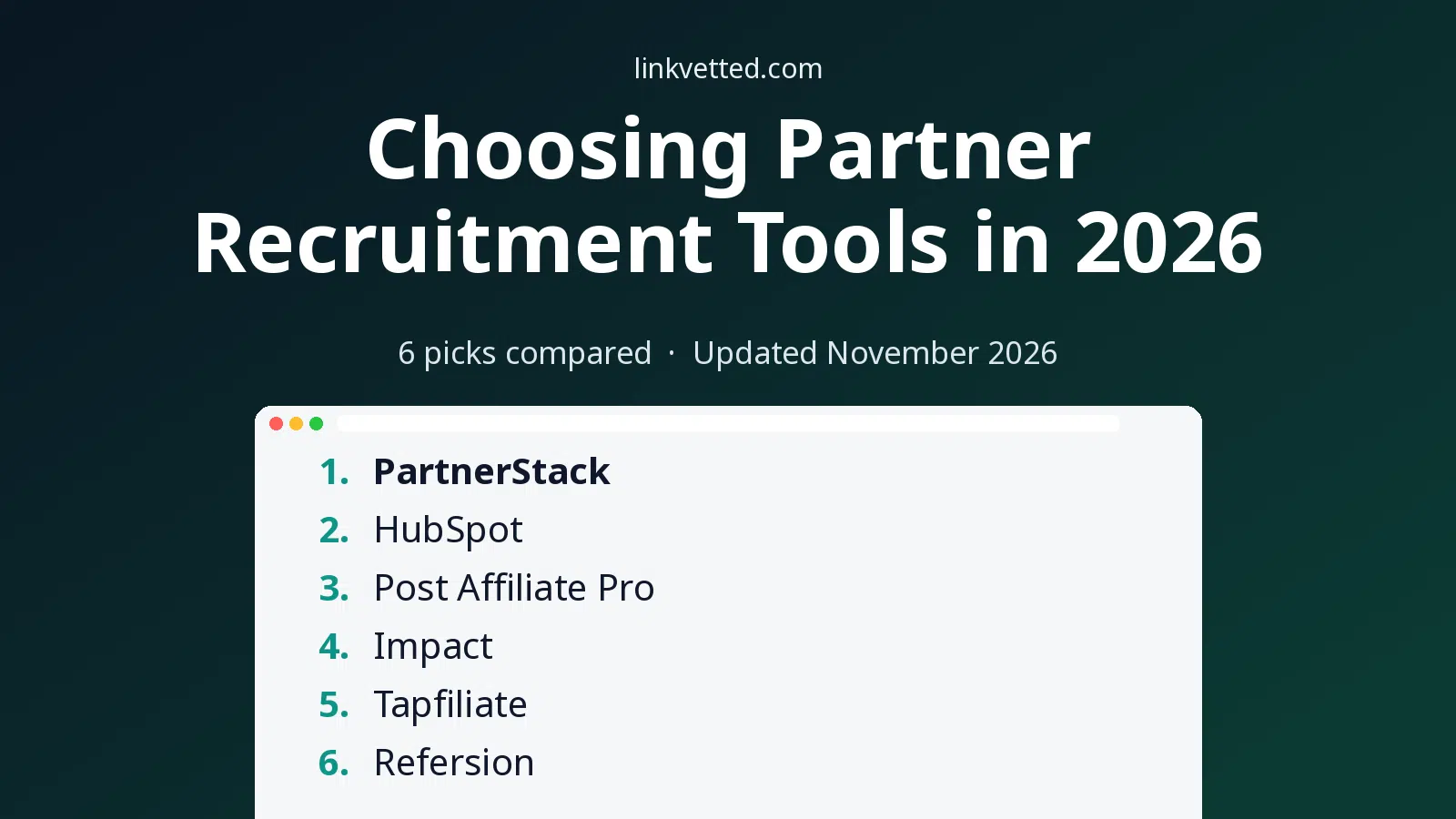
- Editor's choice
 PartnerStack
Software partner program management
Starts atSee websiteVisit partnerstack.comFull review - Great alternative
 HubSpot
Partner management inside a CRM
Starts atSee websiteVisit hubspot.comFull review - Also consider
 Post Affiliate Pro
Affiliate and referral tracking
Starts atSee websiteVisit postaffiliatepro.comFull review
Direct answer
My top pick is PartnerStack, because it is built around running a partner program end to end, from recruiting and onboarding to tracking referrals. For teams that want a broader CRM to manage partner relationships alongside sales, I point to HubSpot. For affiliate and partner tracking with flexible commission rules, Post Affiliate Pro is a solid third option. These picks come from vendor documentation and public sources, not hands-on testing.
TL;DR:
- Partner recruitment tools differ mainly in whether they focus on partner programs, affiliate tracking, or a general CRM.
- A tool that recruits partners well may still be weak at onboarding, reporting, or paying commissions, so check the whole workflow.
- Most platforms here publish their features openly, but you should confirm current details on the vendor site before committing.
- Fit matters more than feature count: a small agency and a large SaaS company rarely need the same setup.
- Free plans and trials vary widely, so treat any free tier as a way to check fit, not as a long-term plan.
Last checked November 2026. Plan prices are not quoted in this guide because they change often; see each vendor's own pricing page for current figures before you buy.
Quick comparison
| Tool | Best for | Starts at | Free plan? | |
|---|---|---|---|---|
| PartnerStack | Software partner program management | See website | Not stated | Visit |
| HubSpot | Partner management inside a CRM | See website | Free plan | Visit |
| Post Affiliate Pro | Affiliate and referral tracking | See website | Free trial | Visit |
 Impact | Larger partnership programs | See website | Not stated | Visit |
 Tapfiliate | Small affiliate and partner programs | See website | Free trial | Visit |
 Refersion | Ecommerce affiliate and partner tracking | See website | Free trial | Visit |
The best partner recruitment tools compared
I compared these tools by reading vendor documentation and public sources, then weighing each one against common partner recruitment needs. I did not run hands-on tests, so treat this as a starting point for your own evaluation. The order reflects how well each tool fits partner recruitment specifically, not a general ranking of software quality.
PartnerStack is a platform for running a partner program, aimed mainly at software and SaaS companies. It brings recruiting, onboarding, and partner tracking into one place, which suits teams that want a single system for their partner channel. If your partners are resellers, affiliates, or integration partners in software, this is the kind of tool built for that model.
For partner recruitment, the value is in managing the pipeline of potential partners alongside the ones already active. You can list partners, track their status, and connect their activity to referrals or deals. That keeps recruiting and program management in the same tool rather than spread across spreadsheets and email. The workflow fits teams that expect partner volume to grow.
The limit is fit. If your partners are not software-related, or you only need simple referral tracking, a full partner platform may be more than you need. Check the current feature list and terms on the vendor site before deciding, since details change.
- Built around partner programs
- covers recruiting through tracking
- designed for software companies
- Narrower fit outside software
- details need checking on the vendor site
HubSpot is a CRM platform with sales, marketing, and service tools, and it can be used to manage partner relationships too. For teams already running their sales pipeline in HubSpot, adding partners as contacts and deals keeps everything in one place. It is not a dedicated partner program platform, but it can cover recruiting and relationship tracking.
For partner recruitment, you would use lists, pipelines, and email to track prospects and move them through stages. That works well when partner recruiting looks like a sales process. The trade-off is that you are adapting a general CRM to a partner use case, so you may need to set up custom properties and stages yourself.
Skip it if you want a tool built only for partner programs, or if you already have a CRM you are happy with. The free plan is useful for checking fit, but confirm what it includes on the vendor site.
- Broad CRM to manage partner contacts
- free plan to start
- many teams already use it
- Partner features are part of a larger system
- can be heavy for small programs
Post Affiliate Pro is an affiliate and referral tracking platform. It handles tracking links, commissions, and reporting for partners who refer customers. If your partner recruitment is mostly about affiliates and referrers, this is a practical fit, and it covers the tracking side that many teams struggle to build themselves.
For recruitment, you would still handle outreach and onboarding, but the tool manages how partners are tracked once they join. It supports different commission structures, which helps when partners have different deals. That makes it useful for programs where payouts vary by partner type.
The limit is scope. It is not a full partner relationship platform, so if you need recruiting pipelines, partner portals, and co-marketing features, look at a dedicated tool. Confirm current features and trial terms on the vendor site.
- Focused on affiliate and referral tracking
- flexible commission setup
- suits partner-style programs
- Affiliate focus rather than full partner management
- needs setup to match your program
Impact is a partnership management platform used by larger brands to run affiliate, influencer, and other partner programs. It covers recruiting, tracking, and reporting across partner types, which suits teams that manage several kinds of partnerships at once. It is built for scale rather than for a first small program.
For partner recruitment, it gives you a place to find and manage partners alongside the tracking that shows what they contribute. That combination helps when you need to justify partner spend and compare partner types. The workflow assumes you have people to run the program, not just a tool.
The limit is size. Smaller teams may find it more than they need, and setup takes effort. Check current details on the vendor site, since offerings change.
- Covers partnership management and tracking
- suits bigger programs
- handles multiple partner types
- Aimed at larger teams
- setup can be involved
Tapfiliate is an affiliate tracking tool aimed at small and mid-sized programs. It handles tracking links, commissions, and basic reporting, which fits teams that want to start a partner or affiliate program without a large platform. It is simpler than the enterprise options, and that is the point.
For partner recruitment, you would use it to track the partners you bring in and see what they generate. It does not do outreach for you, so recruiting still depends on your own process. But once partners join, the tracking is in place, which is often the harder part to build.
Skip it if you need partner portals, co-marketing, or complex multi-tier programs. Confirm the current feature set and trial details on the vendor site.
- Straightforward affiliate tracking
- suits small programs
- quick to understand
- Fewer features than full partner platforms
- limited for complex programs
Refersion is an affiliate and partner tracking platform built with ecommerce in mind. It connects to online stores and tracks the partners and affiliates who send sales. If you run an online store and want partners to promote products, this is the kind of tool that fits that model.
For recruitment, it helps you manage the partners you sign up and see which ones drive sales. That makes it easier to decide where to put recruiting effort. It is not a general partner relationship platform, so if your partners are resellers or integrators rather than promoters, look elsewhere.
The limit is the ecommerce focus. Non-retail businesses will get less from it. Check current features and trial terms on the vendor site before you commit.
- Built for ecommerce partner tracking
- handles affiliate payouts
- fits online stores
- Ecommerce focus
- less suited to non-retail partners
How I chose
I chose these tools by reading vendor documentation and public sources, then matching each one to common partner recruitment needs. I looked at what each tool is built for, how it handles recruiting and tracking, and where its limits are. I did not run hands-on tests, so this is a comparison of published information, not a lab review. Where a vendor's public material was unclear, I noted that you should confirm details directly.
I also weighed fit over feature count. A tool with fewer features that matches your partner model is usually a better choice than a large platform you will not use fully. I left out tools where the public information was thin or where the product did not clearly support partner recruitment. The result is a short list you can use to start your own evaluation, not a final verdict.
What to check before you buy
- Confirm what kind of partners the tool is built for: affiliates, resellers, integrators, or a mix.
- Check whether recruiting is supported, or whether the tool only tracks partners after they join.
- Ask how onboarding works, since a tool that recruits well may still make onboarding manual.
- Confirm how commissions and payouts are handled if your partners are paid on results.
- Check reporting: you need to see which partners and channels actually bring results.
- Verify current pricing, trial terms, and contract length on the vendor site, since these change.
FAQ
What are partner recruitment tools?
Partner recruitment tools help you find, sign up, and manage partners such as affiliates, resellers, or referral partners. They usually combine recruiting support with tracking and reporting, so you can see what each partner contributes. Some are dedicated partner platforms, while others are affiliate tools or general CRMs adapted to partner use.
Do I need a dedicated partner platform?
Only if your partner program is central to your business and you need recruiting, onboarding, tracking, and payouts in one place. If you mainly need referral tracking, an affiliate tool may be enough. If you already run a CRM, you may be able to manage partners there without adding another system.
Can I start with a free plan or trial?
Some tools here offer a free plan or trial, but terms vary and change. A free tier is useful for checking fit, not for running a program long term. Confirm what the free option includes on the vendor site before you rely on it, and check whether a trial needs a payment method.
How do these tools help with outreach to partners?
Most do not do outreach for you. They give you a place to manage partner prospects, track status, and record what happens after a partner joins. Outreach still depends on your own process, lists, and messages. Some platforms add partner directories or marketplaces, but you should confirm that on the vendor site.
What is the biggest mistake when choosing a partner recruitment tool?
Choosing by feature count instead of fit. A large platform you use partly is usually worse than a smaller tool that matches your partner model. Check the whole workflow, from recruiting to payouts, and confirm current details on the vendor site before you commit.
Sources
- https://partnerstack.com
- https://hubspot.com
- https://www.postaffiliatepro.com
- https://impact.com
- https://tapfiliate.com
- https://www.refersion.com