The 6 Best Outreach Tools for YouTube Creators in 2026, Ranked
A practical guide to the best outreach tools for YouTube creators in 2026, compared from vendor documentation and public sources for collabs and PR.
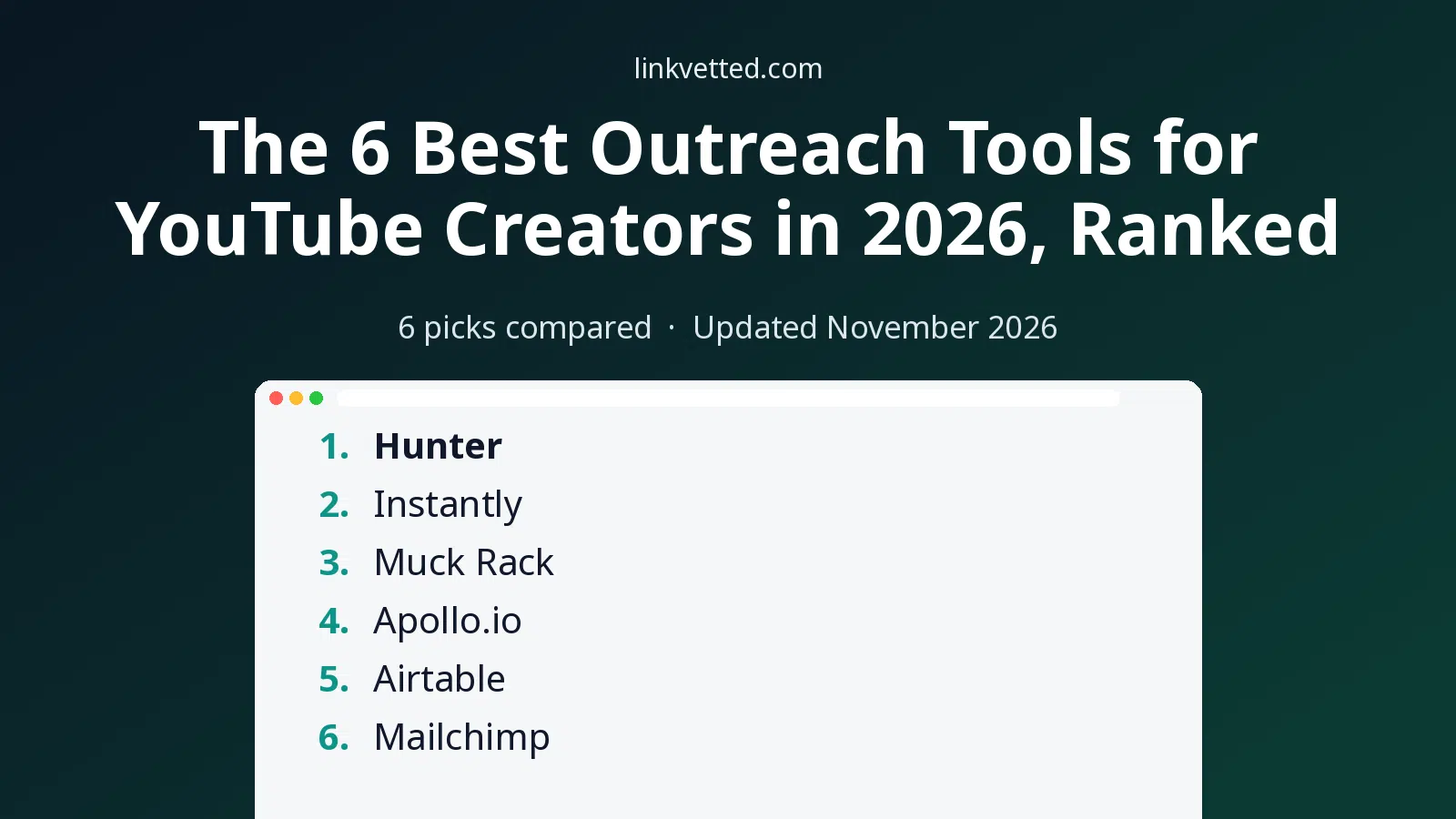
- Editor's choice
 Hunter
Finding and verifying contact emails
Starts atSee websiteVisit hunter.ioFull review - Great alternative
 Instantly
Running multi-step outreach sequences
Starts atSee websiteVisit instantly.aiFull review - Also consider
 Muck Rack
Pitching brands, journalists and media
Starts atSee websiteVisit muckrack.comFull review
Direct answer
My top pick is Hunter for finding and verifying contact emails, because most creator outreach starts with getting a brand or collaborator's address right. For running multi-step follow-up sequences, Instantly fits better. If your outreach is mostly PR and podcast or collab pitching, Muck Rack is the stronger choice. Each one covers a different stage of the same job, so the right tool depends on whether you need contacts, sending, or media relationships.
TL;DR:
- Most YouTube creator outreach fails at the contact step, so email finding and verification tools matter as much as sending tools.
- A dedicated sending tool with sequencing and reply detection saves more time than sending from your normal inbox.
- Media database tools help when you pitch brands, journalists or podcast bookers rather than other creators.
- Spreadsheet-style CRMs keep small creator outreach lists organized without a heavy sales platform.
- Check each vendor's current documentation for limits on sending volume, verification credits and data coverage before you commit.
Last checked November 2026. Plan prices are not quoted in this guide because they change often; see each vendor's own pricing page for current figures before you buy.
Quick comparison
| Tool | Best for | Starts at | Free plan? | |
|---|---|---|---|---|
| Hunter | Finding and verifying contact emails | See website | Free plan | Visit |
| Instantly | Running multi-step outreach sequences | See website | Free trial | Visit |
| Muck Rack | Pitching brands, journalists and media | See website | Not stated | Visit |
 Apollo.io | Contact data plus outreach in one tool | See website | Free plan | Visit |
 Airtable | Organizing outreach lists and status | See website | Free plan | Visit |
 Mailchimp | Newsletters to your existing audience | See website | Free plan | Visit |
The best outreach tools for YouTube creators compared
I put this comparison together from vendor documentation and public sources, not from hands-on testing. I run a small SEO agency, so I read each tool's help docs, pricing pages and public write-ups to judge how it fits the outreach a YouTube creator actually does: finding brand contacts, pitching collabs, and following up without losing track. Treat this as a starting shortlist, then trial the ones that match your workflow.
Hunter is an email discovery and verification tool. You give it a company domain and it returns publicly associated addresses with a confidence score, plus a verifier you can run on any address you already have. For a creator, that means you can look up a brand's partnerships or marketing team before you send a pitch, rather than guessing at a generic inbox.
In a creator outreach workflow, Hunter usually sits at the start. You build a list of brands or channels you want to work with, run each domain through the search, and keep only verified addresses. That cuts the bounce rate on your first send, which protects the reputation of whatever inbox or sending tool you use next. It pairs well with a spreadsheet or CRM where you log who you contacted and when.
The limit is coverage. Smaller brands and individual creators often have no discoverable address, and you will still need to find contacts through a brand's own site or social profiles. Skip it if your outreach is mostly to people you already know.
- Domain search returns likely addresses
- email verifier reduces bounces
- simple browser extension
- Coverage is uneven across small brands
- free searches run out quickly
Instantly is an outreach platform built around sending sequences from your own mailboxes. You load contacts, write a first message and follow-ups, and the tool sends them on a schedule and stops when someone replies. It also includes inbox warmup, which is meant to build sending reputation gradually.
For YouTube creators, this fits the follow-up problem. A single pitch to a brand often gets no reply, and a polite second or third message is where deals happen. Instantly lets you set that up once and run it across a batch of contacts, with replies pulled out so you can answer personally. That is more reliable than remembering to chase people in your sent folder.
The main limit is that the tool does not fix a bad sending domain or a poorly targeted list. If you only pitch a few brands a month, a plain inbox and a reminder is simpler. Skip it if you are not prepared to manage domain reputation.
- Sequence builder with follow-ups
- reply detection
- inbox warmup features
- Deliverability still depends on your domain setup
- overkill for a handful of pitches
Muck Rack is a public relations platform with a media database, monitoring and reporting. It is used by PR teams to find journalists and outlets, build lists, send pitches and track coverage. For a creator, the relevant part is reaching the people who book guests, cover creator partnerships or write about the space you work in.
If your outreach goal is earned media, a podcast appearance or a brand partnership that runs through a PR contact, Muck Rack gives you a structured way to find and track those people. You can build a list, log pitches and see what got covered, which is hard to manage from a spreadsheet once the list grows.
It is heavier than most solo creators need, and the pricing is not listed publicly, so you have to ask. Skip it if your outreach is purely creator-to-creator collabs.
- Large media contact database
- monitoring and coverage tracking
- pitch tracking
- Aimed at PR teams
- pricing is not published openly
Apollo.io combines a contact database with outreach features. You can filter for people by role, company and location, save them to a list, and run email sequences from the same place. It is a sales-oriented tool, but the underlying job, finding the right person at a company and contacting them, maps onto creator brand outreach.
For a YouTube creator, the useful angle is finding the partnerships, marketing or influencer contact at a brand rather than a generic address. You can filter by title, build a list of targets, and start a sequence without exporting to a second tool. That saves a step if you are pitching a lot of brands.
The tradeoff is accuracy. Sales databases go stale, so verify addresses before sending and expect some bounces. Skip it if you want a single-purpose email finder.
- Large contact database
- built-in sequences
- filtering by role and company
- Data accuracy needs checking
- interface is built for sales teams
Airtable is a spreadsheet-database hybrid. You build tables with fields, attach files, group records into views and link tables together. It is not an outreach tool in the sending sense, but it is where a lot of creators keep their outreach pipeline.
For creator outreach, a simple base with columns for brand, contact, channel, pitch date, follow-up date and status keeps the whole process visible. You can filter to see who needs a follow-up this week, and link a contacts table to a deals table so you know which brand is at which stage. That structure matters once you are juggling more than a dozen conversations.
The limit is that it does not send email or find contacts. You pair it with a finder and a sender, or use it purely as a tracker. Skip it if you already have a CRM you like.
- Flexible tables and views
- easy to track status and dates
- works with many other tools
- No native email sending
- setup takes some planning
Mailchimp is an email marketing platform for newsletters and audience messaging. It is not a cold outreach tool, and using it that way would risk your account. But it belongs in a creator's outreach stack for a different reason: the audience you already have is the warmest outreach list you will ever own.
When you want to promote a collab, announce a series or ask subscribers for guest suggestions, Mailchimp handles that cleanly. You can segment your list, send a targeted note and see who opened it. That keeps your owned audience in the loop while your cold outreach runs elsewhere.
The limit is that it is for permission-based email only. Do not import scraped addresses. Skip it if you have no newsletter and no plans to start one.
- Familiar newsletter builder
- audience segmentation
- automation for subscribers
- Not built for cold outreach
- contact limits on lower tiers
How I chose
I built this list by reading vendor documentation, pricing pages and public descriptions of each tool, then matching them to the outreach tasks a YouTube creator actually does. That means finding a contact, sending a pitch, following up, and keeping track of who is at which stage. I did not run hands-on tests, so I am judging fit and stated capability rather than measured results. Where a vendor does not publish pricing or plan details, I say so instead of guessing.
I also weighed limits. A tool that finds emails but has thin coverage, or a sender that depends on your own domain reputation, is only useful if you know the catch. I left out tools that are built purely for cold blasting at volume, because that approach tends to hurt a creator's reputation more than it helps. The result is a shortlist you can trial against your own workflow, not a ranking.
What to check before you buy
- Whether the tool finds contacts at the specific brands or channels you want to reach, not just large companies.
- How email verification works and whether it is included or a separate cost.
- Sending limits and whether the tool requires you to set up a separate domain for outreach.
- Whether reply detection stops a sequence automatically, so you do not send a follow-up after someone answers.
- Export options, so you are not locked in if you move to a different CRM later.
- Current terms on data use and permission-based email, especially if you plan to contact people you have not met.
FAQ
What is the best outreach tool for a YouTube creator just starting out?
Start with an email finder and a simple tracker. Hunter covers finding and verifying addresses, and Airtable or a plain spreadsheet keeps your list organized. Add a sending tool only when you are pitching enough people that manual follow-up becomes the bottleneck. That keeps cost and complexity low while you learn what gets replies.
Do I need a paid tool to pitch brands for collabs?
No. A small number of well-researched pitches sent from your normal inbox can work fine. Paid tools help when you need to find contacts at scale, verify addresses, or run consistent follow-ups. Decide based on volume and how much time you lose to admin, not on whether a tool looks more professional.
Can I use a newsletter tool like Mailchimp for cold outreach?
No. Newsletter platforms are for people who opted in, and using them for cold email can get your account restricted. Keep cold pitches in a dedicated sending tool or your own inbox, and use Mailchimp for your subscribers. Mixing the two puts your audience list at risk.
How do I avoid emails bouncing when I pitch brands?
Verify addresses before you send, and prefer named contacts over generic inboxes where you can find them. Send in small batches at first, keep your domain setup clean, and remove hard bounces from your list immediately. A finder like Hunter plus a sender with reply detection covers most of this.
Is a media database like Muck Rack worth it for creators?
It depends on your goal. If you are pitching journalists, podcast bookers or brand PR contacts, a media database gives you structure that a spreadsheet cannot. If your outreach is mostly creator-to-creator collabs or direct brand deals, it is more than you need. Check the pricing directly with the vendor before deciding.
Sources
- https://hunter.io
- https://instantly.ai
- https://muckrack.com
- https://apollo.io
- https://airtable.com
- https://mailchimp.com