5 MLOps Platforms Worth Shortlisting in 2026
5 products for the best MLOps platforms, ranked by fit, with starting costs and free tiers. The weak spots sit next to the strengths. Updated for 2026.
- Editor's choice
 Kubeflow
DIY MLOps on Kubernetes
Starts at$0 (open source)Visit kubeflow.orgFull review - Great alternative
 MLflow
Open-source experiment tracking and model registry
Starts at$0 (open source)Visit mlflow.orgFull review - Also considerWeights & Biases
Collaborative experiment tracking
Starts atSee websiteVisit wandb.aiFull review
Direct answer
Kubeflow is the first pick on this list for DIY MLOps on Kubernetes. Listed starting prices: Kubeflow from $0 (open source), MLflow from $0 (open source) and ClearML from $15/user/month (Pro). For a different need, MLflow covers open-source experiment tracking and model registry and Weights & Biases covers collaborative experiment tracking. The other 2 tools in the list cover narrower or pricier cases.
TL;DR:
- This list starts with Kubeflow, which is built for DIY MLOps on Kubernetes.
- Free plans exist at 4 of 5 tools (Kubeflow, MLflow, Weights & Biases, ClearML).
- For the cheapest start, look at ClearML: $15/user/month.
- Kubeflow comes with a trade-off: needs real Kubernetes expertise.
- ClearML suits open-core full-lifecycle MLOps.
Last checked November 2026. Prices and plan details were read from the vendors' own pages in November 2026; vendors change plans often, so confirm the current price on the vendor site before you buy.
Quick comparison
| Tool | Best for | Starts at | Free plan? | |
|---|---|---|---|---|
| Kubeflow | DIY MLOps on Kubernetes | $0 (open source) | Yes | Visit |
| MLflow | Open-source experiment tracking and model registry | $0 (open source) | Yes | Visit |
| Weights & Biases | Collaborative experiment tracking | See website | Yes | Visit |
 Amazon SageMaker | End-to-end ML on AWS | See website | Free trial | Visit |
| ClearML | Open-core full-lifecycle MLOps | $15/user/month (Pro) | Yes | Visit |
Our 5 MLOps platforms
This LinkVetted guide covers 5 MLOps platforms. Each profile lists a starting price, free plan details, strengths and drawbacks, so you can drop poor fits quickly.
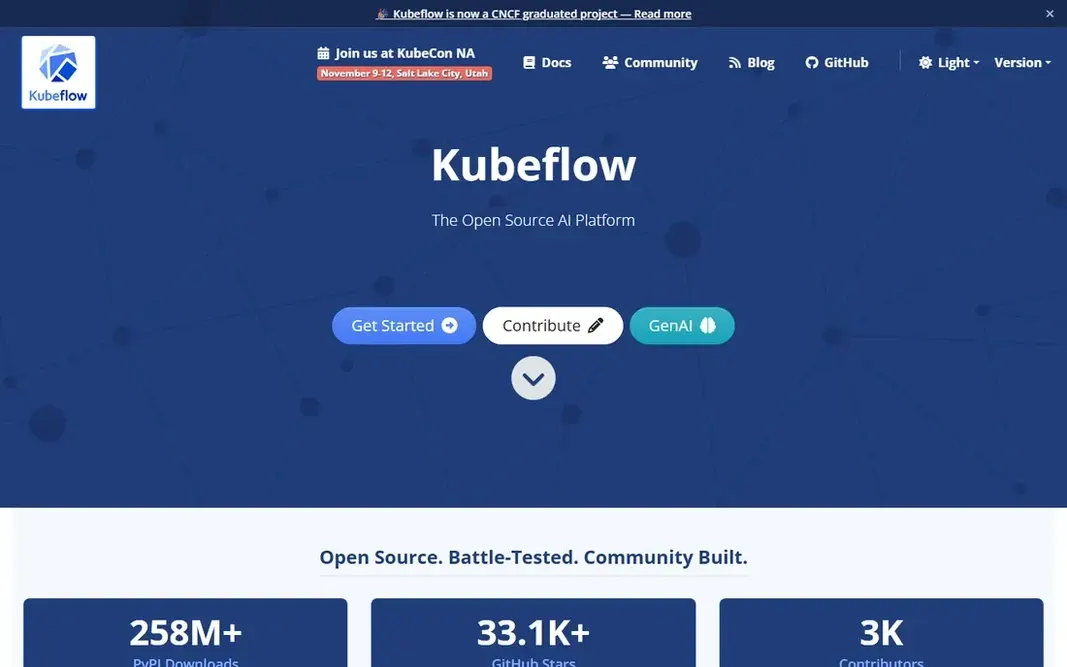
Kubeflow targets DIY MLOps on Kubernetes. The modular design is a genuine advantage. Worth adding: for a small team without product engineers, the ramp-up time and maintenance work can exceed the value.
Limits to weigh: Needs real Kubernetes expertise.
It shines for organizations already standardized on Kubernetes, not as a first MLOps step. As for the details, you do not have to adopt everything; a team can start with Kubeflow Pipelines for workflow automation and add Katib for hyperparameter tuning later. Kubeflow is not a product you buy. It is an open-source toolkit you assemble on Kubernetes, with modular components for notebooks, training, pipelines, hyperparameter tuning, serving, and a model registry. On cost, Kubeflow starts like this: $0. Kubeflow offers a free plan.
- Vendor-neutral CNCF graduated project
- Portable across clouds and on-prem
- Installation can be rough
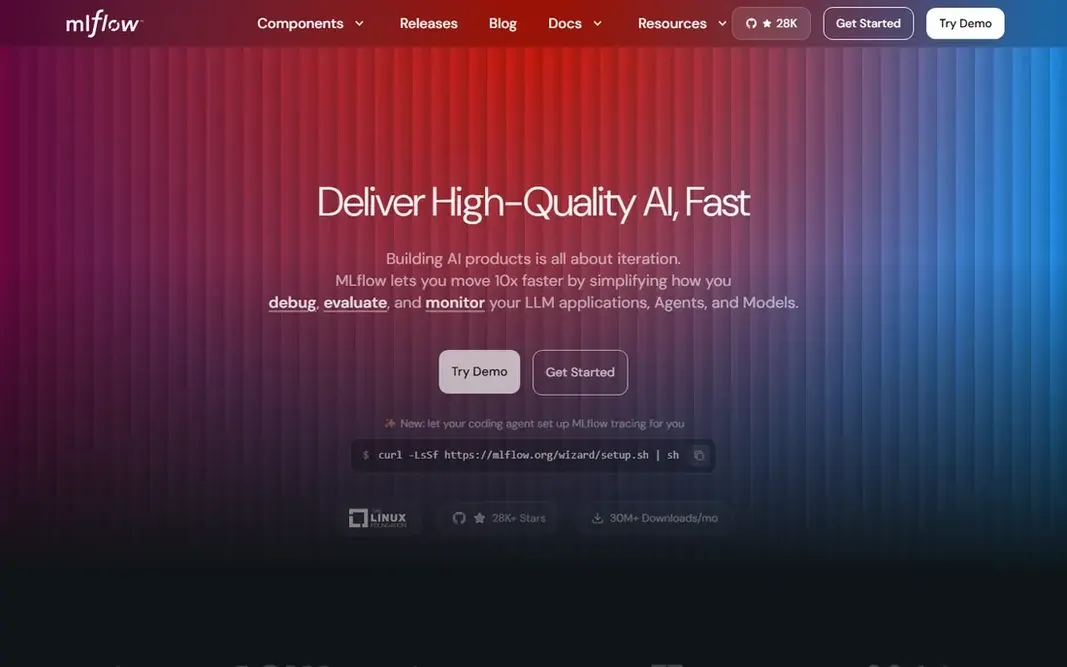
MLflow is designed for open-source experiment tracking and model registry. You can log parameters, metrics, and artifacts with a few lines of Python, then browse runs in a local or self-hosted interface. The honest catch is operational.
It spans experiment tracking, a model registry, and model deployment metadata under one Apache-licensed roof. The ecosystem is MLflow's real strength. Beyond that, since it is open source, there is no seat licensing, no usage metering, and no vendor lock-in. More specifically, nearly every framework, cloud vendor, and external tool plugs into it, and Databricks supplies a managed MLflow as part of its system if you later want hosting without building it yourself. What you pay to start with MLflow: $0. A free plan is available with MLflow.
Watch-outs: Entry-level interface compared to commercial tools.
- Deployment in one
- Enormous community and integration ecosystem
- Collaboration features are thin
Weights & Biases
Best for: Collaborative experiment tracking

Where Weights & Biases fits: collaborative experiment tracking. If your data scientists already know one name in this space, it is probably Weights & Biases. On top of that, Sweeps, the built-in hyperparameter search, is a capable differentiator.
Drawbacks to consider: Free tier has usage limits.
It turns a weekend of manual grid search into a scheduled sweep with visualization of which parameters matter. Model registry features let you promote winning versions to staging and production with an audit trail. Weights & Biases shows no starting price here, so confirm the cost on the vendor site. You can start on Weights & Biases without paying.
- Refined dashboards and run comparison
- Deep integrations with widely used frameworks
- Advanced governance costs more
For end-to-end ML on AWS, Amazon SageMaker is a natural candidate. When your infrastructure already lives in AWS, SageMaker is the path of least resistance. It handles data preparation, training, tuning, deployment, and monitoring without leaving the AWS ecosystem.
Downsides: Solid AWS lock-in.
From a buyer's view, SageMaker bills by instance-hours and feature usage across numerous services, which makes costs hard to predict and simple to overshoot. It also ties your ML workflow to AWS. The managed angle is the real selling point. Amazon SageMaker does not show a starting price in this comparison, so check the vendor site for current pricing. On free options: Free trial.
- Other AWS services
- Full lifecycle inside one AWS service
- Overkill for teams with straightforward needs
ClearML
Best for: Open-core full-lifecycle MLOps
ClearML is aimed squarely at open-core full-lifecycle MLOps. ClearML goes further than tracking. It is an open-core system that aims to run your entire AI workflow: experiment management, pipeline orchestration, data versioning, remote execution, and model serving.
ClearML is capable but not straightforward, and its breadth means there is more to learn than with a pure tracker. On top of that, if your complaint is that tracking alone does not get models to production, ClearML is aimed at exactly that gap. Beyond that, the honest catch is complexity. Worth adding: the open-source core means you can self-host without paying. The hosted cloud plan stays free for up to three team members with 100GB of storage. On cost, ClearML starts like this: $15/user/month. A free plan is available with ClearML.
Watch-outs: Documentation at times lags new features.
- Not just tracking
- Includes orchestration, serving, data
- Hosted plan prices extras separately
What went into this list
We compared the tools on published pricing, free plan or trial availability, feature coverage for MLOps platforms, and the limits each vendor documents. Seat minimums, billing terms and add-ons can move the real cost, so the starting prices here are a guide and not a quote. The sequence is a judgement call: typical use case first, then pricing transparency, then free access. Use the profiles to check fit.
Questions to settle before buying
- Ask Weights & Biases and Amazon SageMaker for a written quote, since no starting price is shown.
- Look at free plan limits closely: Kubeflow, MLflow, Weights & Biases and ClearML have one, and the caps decide whether it is usable for real work.
- Take the trial from Amazon SageMaker and push a live task through it before you pay.
- Read the limits listed for Kubeflow first: needs real Kubernetes expertise.
- Find out what support MLflow includes on your plan, and whether onboarding help costs extra.
- Check the integration list for Amazon SageMaker against the tools you run today, and note which ones need a higher plan.
FAQ
Do I need Kubernetes to do MLOps?
Managed trackers and hyperscaler systems abstract the infrastructure away entirely. As for the details, only choose the Kubernetes route if your team already operates clusters.
Is Kubeflow the right pick for everyone comparing MLOps platforms?
No single tool suits every team. Kubeflow comes first because it fits DIY MLOps on Kubernetes, while MLflow suits open-source experiment tracking and model registry and Weights & Biases suits collaborative experiment tracking. Match the tool to your own size, budget and workflow before deciding.
Can I try these options before paying?
Often, yes. Kubeflow, MLflow, Weights & Biases and ClearML have a free plan and Amazon SageMaker offers a free trial. Use your own data and a real task during the test, and check what the free tier or trial limits before you rely on it.
Which MLOps system is a good match for generative AI and LLM work?
This list starts with Kubeflow, which fits DIY MLOps on Kubernetes. For other needs, MLflow is aimed at open-source experiment tracking and model registry, and Weights & Biases at collaborative experiment tracking. Check each tool's price and main limit first.
Should I choose open source or a managed product?
Choose managed if you want to start quickly and would rather pay a bill than maintain infrastructure. Numerous teams start managed, then move parts in-house as their usage grows.
Which options for MLOps platforms have a free plan?
On this list, Kubeflow, MLflow, Weights & Biases and ClearML include a free plan. Caps on seats, usage or features are common, so test the free plan against your real workload. One other tool offers a trial instead.
Sources
- https://www.kubeflow.org/
- https://mlflow.org/
- https://wandb.ai/site
- https://aws.amazon.com/sagemaker/
- https://clear.ml/