The 6 Best Link Building Services for EdTech Companies in 2026, Ranked
A practical guide to the best link building services for edtech companies in 2026, compared from vendor documentation and public sources.
- Editor's choice
 uSERP
Managed outreach for SaaS and edtech
Starts atSee websiteVisit userp.ioFull review - Great alternative
 Pitchbox
In-house outreach campaigns at scale
Starts atSee websiteVisit pitchbox.comFull review - Also consider
 Muck Rack
Digital PR and journalist outreach
Starts atSee websiteVisit muckrack.comFull review
Direct answer
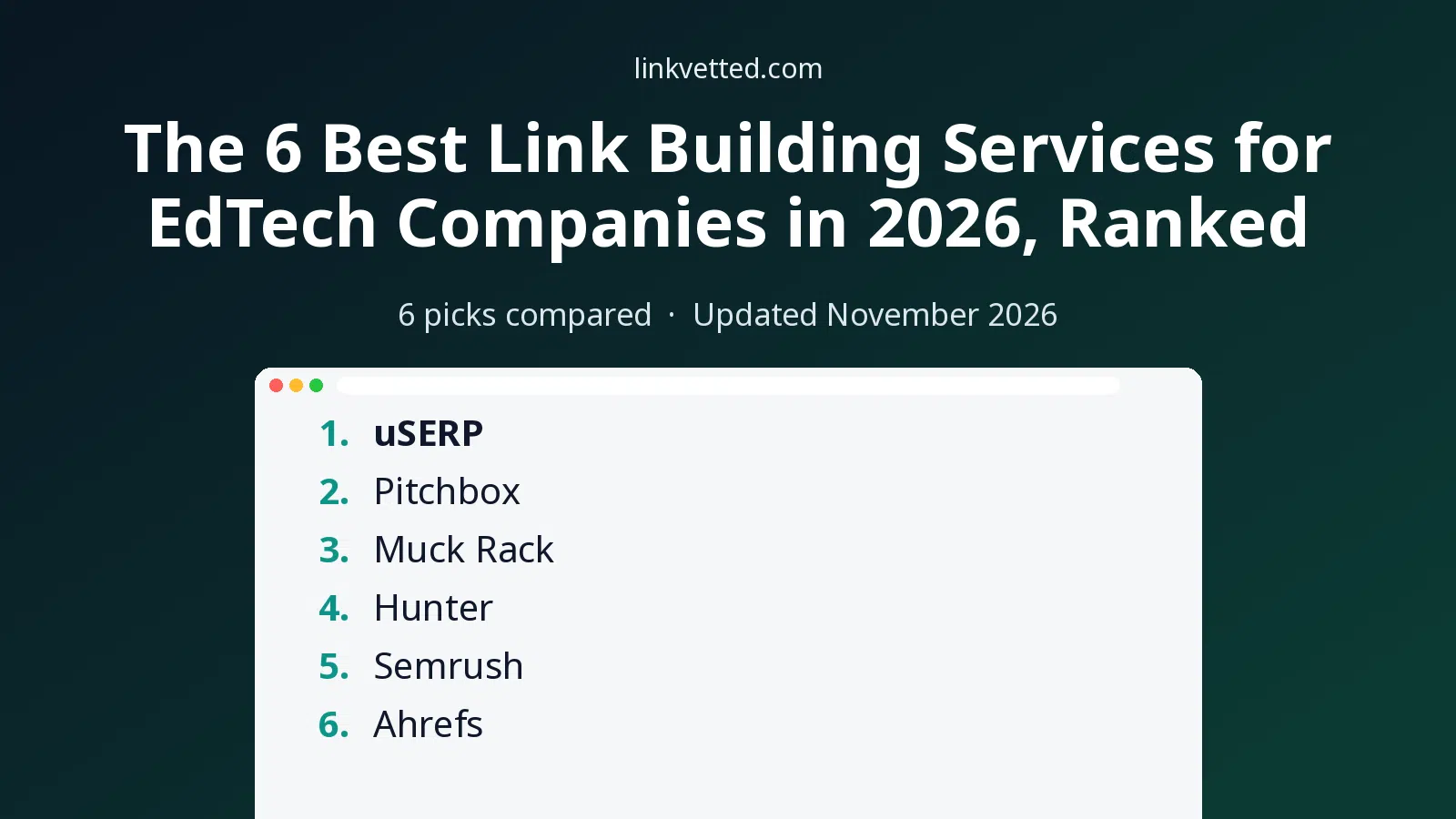
My first pick is uSERP for most edtech companies, because it focuses on editorial placements and outreach that suit education and SaaS sites. For teams that want to run outreach themselves with a database, Pitchbox is a strong second. If you need digital PR and journalist relationships, Muck Rack fits that job. I compared these from vendor documentation and public sources, not hands-on tests.
TL;DR:
- Edtech link building works best when placements come from education, SaaS and technology publications rather than generic directories.
- A managed service saves time, but you still need to review targets and approve placements before they go live.
- Outreach software makes sense when you have a writer or SEO who can run campaigns week to week.
- Digital PR tools help when your story is about learning outcomes, product launches or research, not just product pages.
- Ask every vendor how they vet sites and whether they allow you to reject placements.
Last checked November 2026. Plan prices are not quoted in this guide because they change often; see each vendor's own pricing page for current figures before you buy.
Quick comparison
| Tool | Best for | Starts at | Free plan? | |
|---|---|---|---|---|
| uSERP | Managed outreach for SaaS and edtech | See website | Not stated | Visit |
| Pitchbox | In-house outreach campaigns at scale | See website | Not stated | Visit |
| Muck Rack | Digital PR and journalist outreach | See website | Not stated | Visit |
 Hunter | Finding contact emails for prospects | See website | Free plan | Visit |
 Semrush | SEO data plus outreach support | See website | Not stated | Visit |
 Ahrefs | Backlink research and prospect discovery | See website | Not stated | Visit |
The best link building services for edtech companies compared
I put this list together from vendor documentation and public sources, including each company's own product pages and help docs. I did not run hands-on tests of these tools, and I have not used every one of them on client work. The aim is to help you shortlist services that fit how edtech companies actually earn links: through education publications, SaaS blogs, research coverage and product stories.
uSERP is a link building agency that works mainly with SaaS and technology companies. For an edtech company selling to schools, districts or training providers, that focus matters because the sites in its network tend to be software and business publications rather than random general blogs. It suits teams that do not have an in-house outreach person and want a managed process.
In practice, a managed service like this handles prospecting, outreach and placement, while you review the target list and approve or reject sites. For edtech, I would ask them to prioritise education technology publications, learning science blogs and SaaS review sites. The workflow usually starts with a kickoff call, then a proposed list, then placements over the following months.
The limit is control. You are trusting their vetting, and pricing is quoted per project, so smaller edtech startups may find it hard to budget. Skip it if you want to run outreach yourself or if you need placements on very specific education publications that are not in their inventory.
- Focus on editorial placements
- outreach handled by a team
- fits SaaS and technology niches
- Pricing is not public
- you depend on their target list
Pitchbox is outreach software rather than a done-for-you service. You use it to find prospects, manage email sequences and track replies. For an edtech company with a content marketer or SEO who can run campaigns, it gives you a repeatable process instead of a spreadsheet.
The way it helps with edtech link building is by letting you build lists of education journalists, edtech bloggers and school district communications pages, then run personalised pitches from one place. You still write the pitches and decide which sites fit. The tool handles the sending, follow-ups and reporting.
The main limit is that it is software, not a service. If nobody on your team has time to run outreach every week, the subscription will sit unused. Skip it if you want someone else to do the work.
- Prospect database and outreach workflow
- campaign automation
- works with your own writer
- Requires someone to run it
- results depend on your pitch quality
Muck Rack is a public relations platform used to find journalists, monitor coverage and manage media relationships. For edtech companies, it fits when your link building depends on earned media: a new product, a research report, or a comment on education policy.
The link building value comes from coverage in education and business publications, which often link to the company or the report. You use it to find the right reporter, pitch a story and track what gets published. That is different from buying placements, and it takes more effort, but the links tend to be more natural.
The limit is that it is a PR tool, not an SEO link service. It does not promise links, and you need a story worth covering. Skip it if you have no news or research to pitch and just want placement links.
- Journalist database and media monitoring
- helps build relationships
- good for story-led campaigns
- Not built for SEO link metrics
- needs a real story to pitch
Hunter is an email finding tool. You give it a domain and it helps you find likely email addresses for people at that company. For edtech link building, it is a small but useful piece of the workflow: you build a list of education sites, then use Hunter to find the editor or writer to contact.
It fits teams that already have a prospect list and a writer who can send pitches. It does not send emails for you, and it does not place links. It is a helper tool, not a full service.
The limit is scope. If you want a managed link building service or a full outreach platform, Hunter is not that. Skip it if you need automation or placement guarantees.
- Simple email finding
- works with your own prospect list
- useful for small teams
- No outreach automation
- no link placement service
Semrush is an SEO platform with backlink analysis, keyword research and a set of content and outreach tools. For edtech companies, it helps you see who links to competitors, find education sites that cover your topics and plan content that earns links.
The link building part is mostly research and workflow support. You can find prospects, compare backlink profiles and track new links. It does not do outreach for you, so you still need a person to run campaigns.
The limit is that it is a broad platform, and you may pay for many features you do not use. Skip it if you only want a managed link building service.
- Backlink data and competitor research
- content and outreach tools in one suite
- useful for planning
- Large suite with a learning curve
- link building is one part of it
Ahrefs is an SEO toolset known for backlink data. For edtech link building, it is useful for finding sites that link to similar companies, checking whether a prospect site looks legitimate and tracking your own link growth over time.
It fits teams that want to do the research themselves and then run outreach with a separate tool or service. It does not contact sites or place links, so it is a research layer, not a service.
The limit is that it requires SEO knowledge to use well, and it does not replace outreach. Skip it if you want a done-for-you link building service.
- Strong backlink index
- competitor link analysis
- useful for finding education sites
- No outreach service
- needs a separate process for contacting sites
How I chose
I chose these tools by reading vendor documentation and public sources, including product pages, help centres and published feature lists. I looked at how each one fits the way edtech companies earn links: editorial placements, outreach campaigns, digital PR and backlink research. I did not run hands-on tests, and I am not claiming to have used every tool on client work. The comparison is about fit and limits, not about which tool is objectively best.
I also weighed practical constraints. A small edtech startup may not have the budget for a managed agency, while a larger company may not have the time to run outreach in-house. That is why the list includes both services and software. I left out anything that looked like a link scheme or a directory-only service, because those do not fit a long-term approach for education brands. Where pricing was not public, I noted it rather than guessing.
What to check before you buy
- Ask whether the vendor has placed links on education, SaaS or technology publications before, and request example sites.
- Confirm that you can review and reject target sites before outreach starts.
- Check whether placements are editorial or paid, and how the vendor labels sponsored content.
- Ask how they handle nofollow and sponsored attributes, and whether they match your compliance needs.
- Find out what happens if a link is removed, and whether there is any replacement policy.
- Make sure the contract states deliverables in writing, including the number of placements and the review process.
FAQ
What makes link building different for edtech companies?
Edtech companies often sell to schools, districts and training providers, so links from education publications, learning science blogs and SaaS review sites carry more relevance than generic directories. The audience is specific, and editors in this space tend to want evidence, product details or research rather than broad marketing claims.
Should I use a managed service or do outreach myself?
It depends on time and skills. A managed service suits teams without an outreach person, while software suits teams with a writer who can run campaigns. Many edtech companies start with research tools, then move to a managed service once they know which publications they want.
Can I get links from education publications without paying for placements?
Yes, but it takes work. You can pitch stories, share research, offer expert comment or build resources that editors find useful. Paid placements exist, but they should be labelled correctly. A digital PR approach is slower but often fits education brands better.
How do I check whether a link building service is legitimate?
Ask for example placements, check whether the sites look like real publications with real audiences, and confirm that you can review targets. Avoid anyone who promises a set number of links on specific domains without review, or who offers links from private blog networks.
Do these tools guarantee rankings?
No. None of these tools or services guarantee rankings, and I would not trust anyone who does. Links are one part of SEO, and results depend on your content, technical setup and competition. Use these services to build relevant links, not as a ranking promise.
Sources
- https://userp.io
- https://pitchbox.com
- https://muckrack.com
- https://hunter.io
- https://www.semrush.com
- https://ahrefs.com