The 5 Best Infographic Outreach Services in 2026, Ranked
A practical look at the best infographic outreach services in 2026, how they differ, what to check before you buy, and who each one fits.
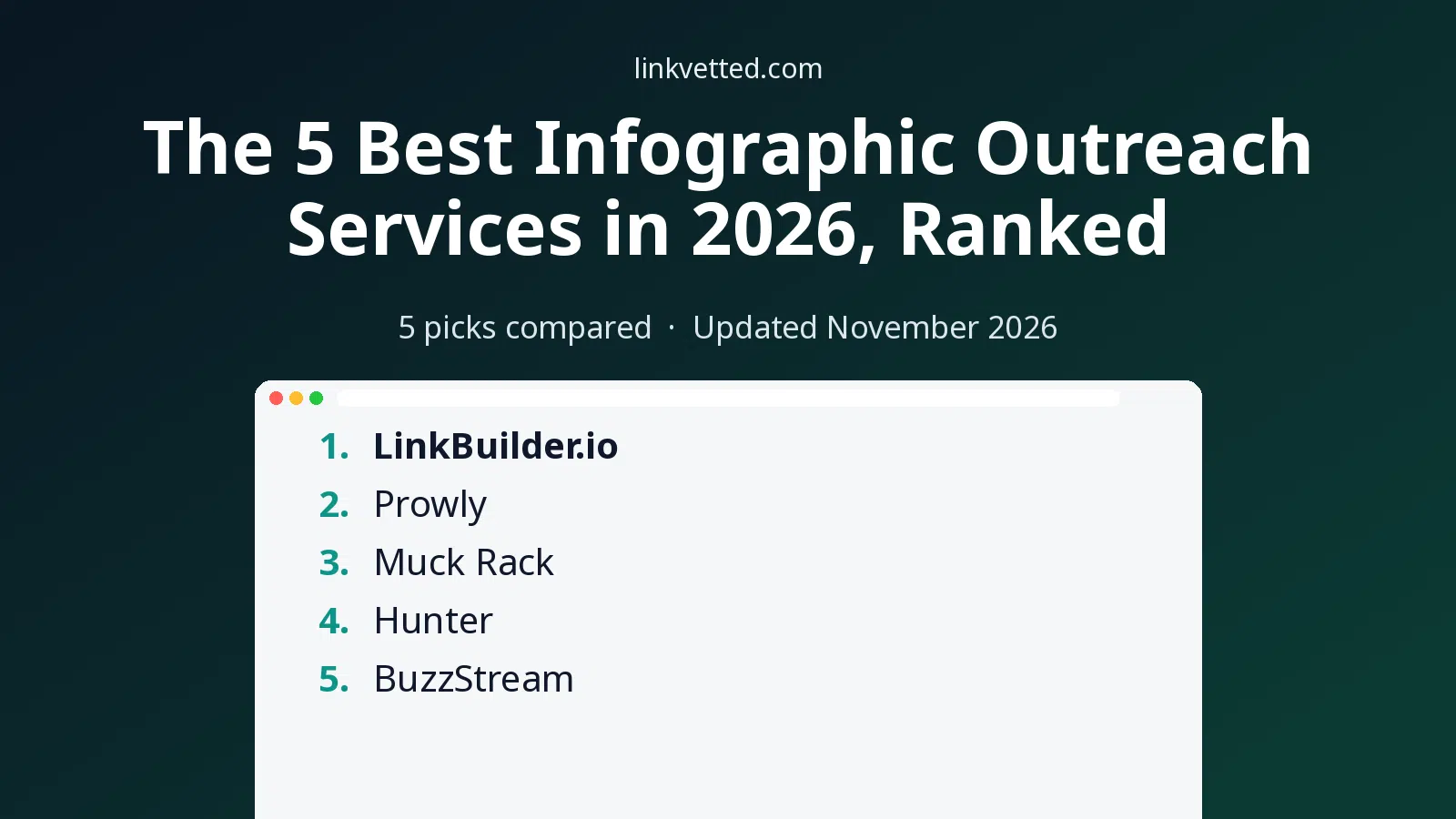
- Editor's choiceLinkBuilder.io
Managed editorial link building
Starts atSee websiteVisit linkbuilder.ioFull review - Great alternative
 Prowly
Running outreach in-house
Starts atSee websiteVisit prowly.comFull review - Also consider
 Muck Rack
PR teams with media monitoring
Starts atSee websiteVisit muckrack.comFull review
Direct answer
My top pick is LinkBuilder.io, a link building agency that runs editorial outreach and can place infographic-led content as part of a broader campaign. For agencies that want to run outreach themselves with a media database, Prowly works well. I based this on vendor documentation and public sources, not hands-on tests.
TL;DR:
- Infographic outreach is a service, not a single tool, so the right pick depends on whether you want done-for-you placements or software to run your own campaigns.
- A good provider should be able to explain how it finds publishers, how it pitches, and what happens when a placement falls through.
- Ask whether the service includes the infographic design and the outreach, or only one of the two.
- Editorial placements on relevant sites are the goal; directory links and bulk guest posts on unrelated blogs are not the same thing.
- Pricing is rarely public, so expect to request a quote and compare the scope of work rather than a headline number.
Last checked November 2026. Plan prices are not quoted in this guide because they change often; see each vendor's own pricing page for current figures before you buy.
Quick comparison
| Tool | Best for | Starts at | Free plan? | |
|---|---|---|---|---|
| LinkBuilder.io | Managed editorial link building | See website | Not stated | Visit |
| Prowly | Running outreach in-house | See website | Free trial | Visit |
| Muck Rack | PR teams with media monitoring | See website | No free plan | Visit |
 Hunter | Finding and verifying contacts | See website | Free plan | Visit |
 BuzzStream | Lightweight outreach CRM | See website | Free trial | Visit |
The best infographic outreach services compared
I put this list together from vendor documentation, public product pages and published service descriptions. I did not run hands-on tests of these providers, and I do not have client results to share, so treat this as a starting point for your own evaluation rather than a lab report.
LinkBuilder.io
Best for: Managed editorial link building
LinkBuilder.io is a link building agency that positions itself around editorial placements rather than bulk link sales. That matters for infographic outreach because the value of an infographic is usually the editorial context it earns, not the raw link count. It suits brands and agencies that want someone else to handle prospecting, pitching and placement while they supply or approve the creative.
In practice, an infographic campaign with a managed provider means you brief the topic, they identify publishers who cover that subject, and they pitch the asset as something worth writing about. The infographic becomes the hook for a story rather than a standalone upload. If you already have a design team, you can supply the graphic; if not, ask whether design is included.
The limit is transparency. You will not see a public price list, and the quality of placements depends on the network behind the service. If you need to control every publisher personally, a marketplace or self-serve tool may suit you better.
- Editorial outreach focus
- can work infographic assets into campaigns
- agency-style managed service
- No public pricing
- you depend on their publisher network
Prowly is a PR platform with a media database, pitch composer and press release tools. For infographic outreach, its value is the contact layer: you can build lists of journalists and bloggers who cover your topic and send them a pitch that links to the graphic. It suits in-house teams and agencies that want to run campaigns themselves.
The visual side is relevant here. Prowly supports multimedia in releases, which helps when the asset is an infographic rather than a text announcement. You still need to do the research on which publications actually run infographics in your niche.
The drawback is that it is a general PR tool. It will not tell you which sites are good link targets, and it will not place anything for you. If you want a managed service, look elsewhere.
- Media database and pitch tools in one place
- visual press release support
- good for repeat campaigns
- General PR tool, not infographic-specific
- you still write and send pitches
Muck Rack is a PR software platform built around a journalist database, media monitoring and coverage reporting. For infographic outreach, it helps you find the right reporters and track whether your graphic gets mentioned. It is a reasonable fit for a PR-led team that already runs media relations.
The platform is broader than link building. If your goal is purely to earn links with an infographic, you may find it heavier than you need, and the pricing reflects that. It is not a placement service and does not design graphics.
Small SEO agencies should probably skip it unless they already do PR work. The feature set is built for communications teams with ongoing media relationships.
- Large media database
- monitoring and reporting
- useful for tracking coverage
- Aimed at PR teams
- no free plan
- overkill for a small agency
Hunter is an email discovery and verification tool. In an infographic outreach workflow, it sits near the start: you identify a publication, find the right editor or writer, and verify the address before you pitch. It is a practical utility rather than a campaign platform.
It does not write pitches, send sequences or place content. You pair it with a CRM or outreach tool and your own research. That makes it cheap to try but limited on its own.
If you expect a service to handle the whole campaign, Hunter is not that. It is a contact-finding step, and you should budget for the rest of the workflow separately.
- Email discovery and verification
- simple interface
- useful as a first step in outreach
- No outreach or placement features
- results depend on public data
BuzzStream is an outreach CRM for link builders and PR teams. For infographic campaigns, it helps you keep track of who you contacted, what you sent and when to follow up. It suits small teams that run their own outreach and want a record of every conversation.
The tool does not find publishers for you or guarantee placements. Its value is organisation, which matters when an infographic pitch goes to dozens of editors and replies trickle in over weeks.
Skip it if you want a managed service or if your outreach volume is very low. For a handful of pitches, a spreadsheet may be enough.
- Contact and outreach tracking
- good for small teams
- keeps follow-ups organised
- You do all pitching yourself
- not a placement service
How I chose
I compared these providers using their public documentation, product pages and published service descriptions. I did not run hands-on tests, and I have not included client results or performance statistics. The aim was to show what each provider actually offers so you can judge fit against your own campaign.
The main criteria were whether the service covers outreach, whether it can handle a visual asset like an infographic, and whether it is a managed service or software you run yourself. I also looked at limits: some tools are general PR platforms, some are contact finders, and some are full agencies. Mixing those categories up is the most common mistake when buying.
Where pricing was not public, I marked it as "See website" rather than guessing. You should request a quote and ask what is included before committing.
What to check before you buy
- Ask whether the infographic design is included or whether you must supply the finished asset.
- Confirm how publishers are selected and whether you can approve each site before a placement goes live.
- Ask what happens if a pitch is rejected or a placement is removed later.
- Check whether the service reports on the pages that actually published the graphic, not just links built.
- Clarify whether outreach is one-off or includes follow-ups and a set number of attempts.
- Request examples of infographic campaigns the provider has run in your topic area.
FAQ
What are infographic outreach services?
They are services that pitch an infographic to publishers, editors and bloggers in the hope of earning editorial coverage and links. Some providers design the graphic as well; others only handle the outreach. They differ from general link building because the asset is visual and the pitch depends on whether a publication covers that subject.
Do I need a design team to use these services?
Not always. Some managed providers include design, while marketplaces and software tools assume you already have the graphic. Ask before you buy. If design is not included, budget for a designer or use an in-house template, and make sure the final file is easy for publishers to embed.
Can I run infographic outreach myself?
Yes. You can research publishers, find contacts with a tool like Hunter, and track pitches in BuzzStream or a spreadsheet. It takes time and consistent follow-up. Self-run campaigns suit teams with a clear topic focus and someone who can write pitches that do not read like mass mail.
How is this different from guest posting?
Guest posting usually means writing an article for someone else's site. Infographic outreach is about getting a publication to feature your graphic, often with a short write-up. The best results come when the graphic contains original data or a clear visual explanation that the publisher's audience would actually want to share.
Why is pricing not listed?
Many agencies and PR platforms quote per project or per seat, so a public price would be misleading. Ask for a quote that states the scope: number of pitches, whether design is included, and how placements are reported. Compare quotes on scope rather than on a single number.
Sources
- https://linkbuilder.io
- https://prowly.com
- https://muckrack.com
- https://hunter.io
- https://www.buzzstream.com