5 Best Image Recognition Software for Startups for 2026, Vetted and Compared
Best image recognition software for startups: 5 tools compared on price, free plans and fit. With pricing notes and limits. Reviewed in November 2026.
- Editor's choice
 Scale AI
Data, evaluations, and outcomes
Starts atSee websiteVisit scale.comFull review - Great alternative
 Nanonets
Document processing automation
Starts at$100 per monthVisit nanonets.comFull review - Also consider
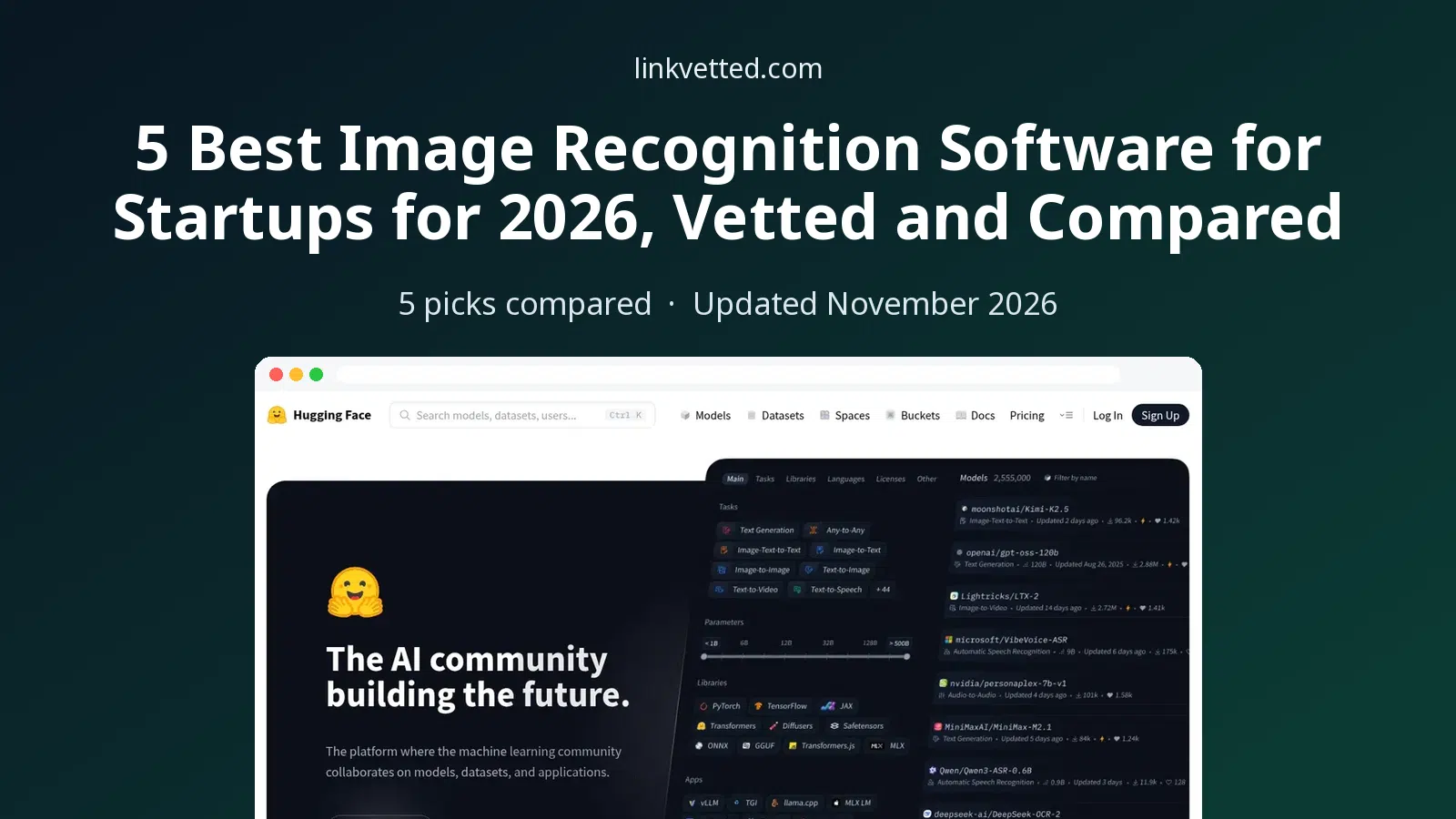
 Hugging Face
Open-source model experimentation
Starts at$9 a monthVisit huggingface.coFull review
Direct answer
Start with Scale AI if you need data, evaluations, and outcomes. Listed starting prices: Nanonets from $100 per month, Hugging Face from $9 a month and Roboflow from $39 per month. Look at Nanonets for document processing automation, and at Hugging Face for open-source model experimentation. Details, prices and limits for the rest of the 5 tools are below.
TL;DR:
- The list opens with Scale AI, aimed at data, evaluations, and outcomes.
- Hugging Face, Roboflow: these are the 2 tools out of 5 that offer a free plan.
- The lowest published monthly entry price here is $9 per month, from Hugging Face.
- Before buying Scale AI, weigh this: pitched at large organizations.
Last checked November 2026. Prices and plan details were read from the vendors' own pages in November 2026; vendors change plans often, so confirm the current price on the vendor site before you buy.
Quick comparison
| Tool | Best for | Starts at | Free plan? | |
|---|---|---|---|---|
| Scale AI | Data, evaluations, and outcomes | See website | Not stated | Visit |
| Nanonets | Document processing automation | $100 per month | Free trial | Visit |
| Hugging Face | Open-source model experimentation | $9 a month | Yes | Visit |
 Roboflow | End-to-end vision model building | $39 per month | Yes | Visit |
 Labelbox | Data labeling and expert data | See website | Not stated | Visit |
Every option for image recognition software for startups explained
This LinkVetted guide covers 5 image recognition software for startups. Each profile lists a starting price, free plan details, strengths and drawbacks, so you can drop poor fits quickly.
In short, Scale AI is for data, evaluations, and outcomes. For startups, its relevance lies in access to high-quality training data and evaluation services that support critical decisions.
Teams building image recognition models that need rigorous evaluation or specialized data may consider Scale when their needs outgrow self-serve tools and they want a partner-oriented approach. Scale AI shows no starting price here, so confirm the cost on the vendor site. As for free access: Not stated.
Points against: Less self-serve for small teams.
- Focus on dependable AI systems
- Data and evaluation services
- Geared toward large organizations
Think of Nanonets for document processing automation. Nanonets provides AI agents for enterprise data processing, automating manual processes like accounts payable, claims processing, and order management, and delivering clean data to systems like SAP and Salesforce.
Worth adding: choose Nanonets when your primary challenge is extracting structured information from documents and feeding it into business systems. Startups working with camera feeds or sensor data should look elsewhere. The starting price for Nanonets: $100 per month. Free access: Free trial.
Limits to weigh: Primarily document-focused.
- Automates accounts payable and claims
- Links to systems of record
- Less suited to general image recognition

Hugging Face serves open-source model experimentation. Hugging Face is a community product for open-source AI, offering access to models, datasets, and tools that support experimentation.
The system is wide and community-driven, so it does not supply a managed end-to-end pipeline for image recognition from day one. Startups with machine learning engineers can use it to prototype image recognition rapidly and adapt open models to their own data. Hugging Face cost at the entry level: $9 per month. Hugging Face offers a free plan.
Watch-outs: Less guidance for production deployment.
- A decent match for rapid prototyping
- Community-driven and open source focused
- Needs ML engineering skills
Pick Roboflow if this describes you: end-to-end vision model building. Since Roboflow spans plenty of capabilities, teams new to computer vision may face a ramp-up time before they are productive.
Drawbacks to consider: Advanced features need technical setup.
Startups with very straightforward needs, for example entry-level image classification, might find a lighter tool quicker to adopt. Worth adding: Roboflow is a vision AI system that turns images, videos, and streams into intelligence. Roboflow starts at: $39 per month. A free plan is available with Roboflow.
- Built for physical-world vision use cases
- Manages images, videos, streams
- Wide system may overwhelm beginners
Labelbox is built with data labeling and expert data in mind. Labelbox supplies environments where AI learns to do real work, with frontier AI labs training on its products and expert data. It is made for engineering and research teams that require to run labeling and data curation for demanding model training.
Early-stage teams with small datasets may prefer a more straightforward tool. Consider it when data quality and expert annotation are central to your product and you have the team to handle a more involved setup. Labelbox is oriented toward frontier labs and research teams, which can make it heavier than a startup needs for straightforward image labeling. Labelbox shows no starting price here, so confirm the cost on the vendor site. On free options: Not stated.
Where it falls short: May be complicated for early-stage teams.
- Used by AI labs and research teams
- Supports expert data workflows
- Geared toward bigger research efforts
How we built this list
Selection started from tools commonly considered for image recognition software for startups, then narrowed to 5 that have clear pricing information or a clear quote process. Figures are shown as the vendors publish them. Billing terms, seat minimums and add-ons can change the real cost. The sequence is a judgement call: typical use case first, then pricing transparency, then free access. Use the profiles to check fit.
A buyer's checklist
- Confirm the entry price on the vendor page. For Scale AI and Labelbox that means a quote rather than a fixed price.
- Check what the free option really includes: Hugging Face and Roboflow offer a free plan, and usage caps differ.
- Take the trial from Nanonets and push a live task through it before you pay.
- Read the limits listed for Scale AI first: pitched at large organizations.
- Confirm the exact Scale AI plan that includes your must-have features.
- Ask Roboflow whether prices are locked for the first term and what happens at renewal.
FAQ
Which options for image recognition software for startups have a free plan?
Hugging Face and Roboflow offer a free plan in this list. Free plans usually cap users, projects or features, so check the limits on the vendor page. One other tool offers a trial instead.
Can I try these tools before paying?
Often, yes. Hugging Face and Roboflow have a free plan and Nanonets offers a free trial. Use your own data and a real task during the test, and check what the free tier or trial limits before you rely on it.
Is Scale AI the right pick for everyone comparing image recognition software for startups?
No single tool suits every team. Scale AI comes first because it fits data, evaluations, and outcomes, while Nanonets suits document processing automation and Hugging Face suits open-source model experimentation. Match the tool to your own size, budget and workflow before deciding.
How are the tools for image recognition software for startups ordered?
Scale AI sits first and Labelbox last because the order follows typical fit for image recognition software for startups, then price clarity and free access. It is a judgement call, so read each profile for fit and limits.
What should a startup look for in image recognition software?
Startups should prioritize ease of setup, coverage of the full workflow from data labeling to deployment, and fit with their specific data types. Consider whether you need general vision capabilities or document-focused automation, and check that the tool matches your team's technical level.
Is open-source image recognition software a decent choice for startups?
Open-source choices like Hugging Face can be economical and adaptable for teams with machine learning expertise. Startups without in-house ML skills may benefit from a managed product instead.
Sources
- https://scale.com
- https://nanonets.com
- https://huggingface.co
- https://roboflow.com
- https://labelbox.com