Choosing Guest Posting Services for Pet Blogs in 2026: 6 Options Compared
A practical guide to the best guest posting services for pet blogs in 2026, compared from vendor documentation and public sources, with limits and fit notes.
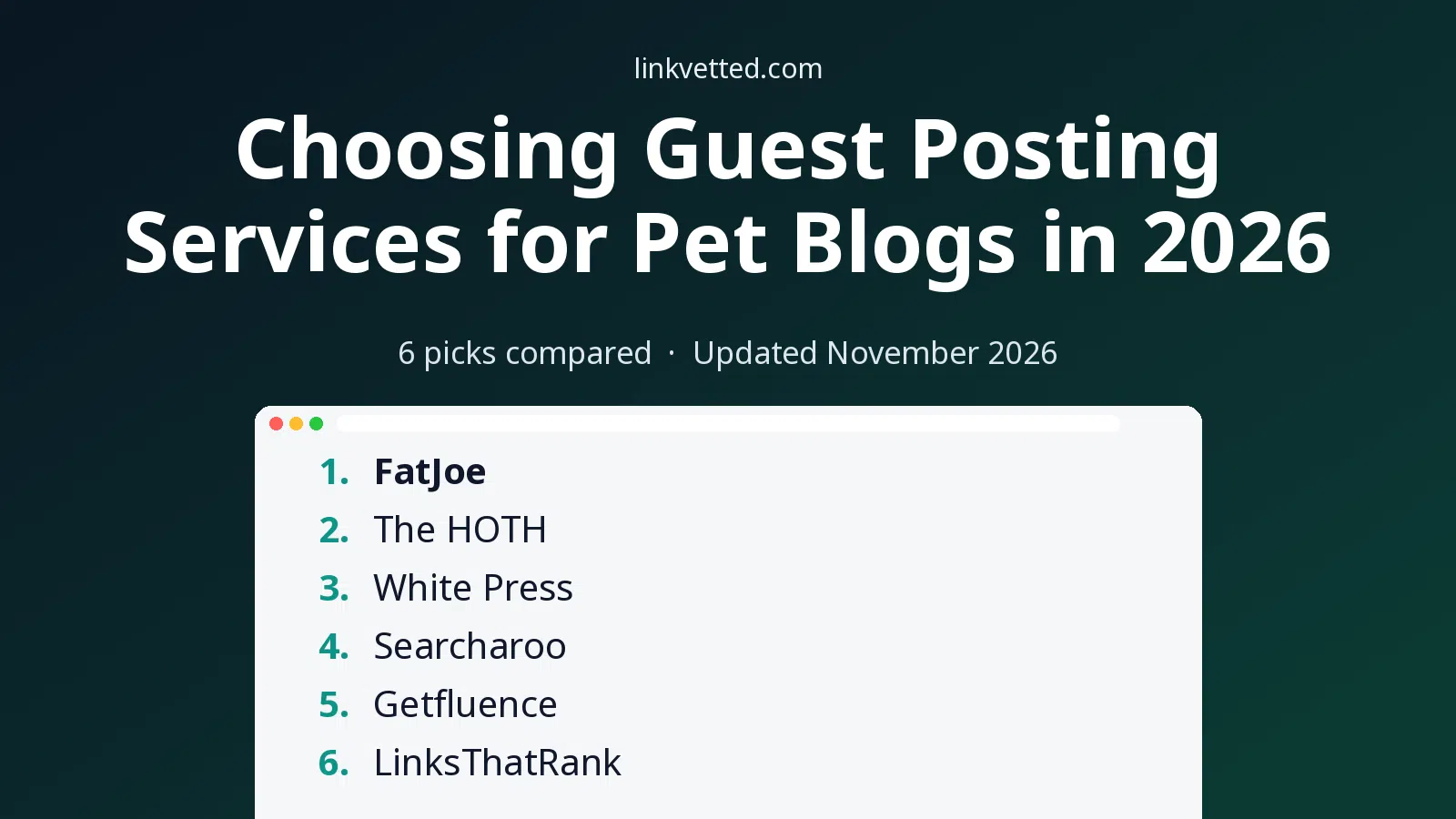
- Editor's choice
 FatJoe
Niche blogger outreach with content
Starts atSee websiteVisit fatjoe.comFull review - Great alternative
 The HOTH
Managed content and link packages
Starts atSee websiteVisit thehoth.comFull review - Also considerWhite Press
Editorial placements in real publications
Starts atSee websiteVisit whitepress.comFull review
Direct answer
My first pick is FatJoe because it publishes its link building and blogger outreach offering openly and works on niche placements rather than generic directories. For pet brands that want content written and pitched for them, The HOTH is a reasonable second option. If you need editorial-style placements with real publications, check White Press, which runs a marketplace of publishers and journalists.
TL;DR:
- Pet blogs sit in a sensitive niche, so placement relevance matters more than raw link counts.
- Ask every provider how they vet pet and animal sites before you pay for a campaign.
- A guest post service is only useful if the target blog accepts outside contributors and keeps an editorial standard.
- Most providers publish little about their publisher lists, so request sample placements before committing.
- Treat any promise of guaranteed rankings or fixed link volumes as a reason to walk away.
Last checked November 2026. Plan prices are not quoted in this guide because they change often; see each vendor's own pricing page for current figures before you buy.
Quick comparison
| Tool | Best for | Starts at | Free plan? | |
|---|---|---|---|---|
| FatJoe | Niche blogger outreach with content | See website | Not stated | Visit |
| The HOTH | Managed content and link packages | See website | Not stated | Visit |
| White Press | Editorial placements in real publications | See website | Not stated | Visit |
| Searcharoo | Simple fixed-scope link orders | See website | Not stated | Visit |
| Getfluence | Brand placements in mainstream media | See website | Not stated | Visit |
| LinksThatRank | Budget outreach with approval steps | See website | Not stated | Visit |
The best guest posting services for pet blogs compared
I compared these providers from their vendor documentation and public sources, not from hands-on tests. I looked at what each one says about its publisher network, how it handles niche relevance, and where its stated scope stops. Pet blogs are a narrow vertical, so I paid attention to whether a provider describes any vetting at all.
FatJoe is a link building and blogger outreach service that markets itself to agencies and in-house teams. It sits in the middle of the market: you describe the niche and the kind of site you want, and the team sources placements. For a pet blog or a pet brand, that means you can ask for animal, veterinary and pet lifestyle sites rather than general blogs.
The workflow is straightforward. You submit a brief, the team proposes sites, and you approve or reject them before anything goes live. Content can be written by the provider, which helps if you do not have a writer who understands pet topics. I would still review every draft, because a generic article about dog food will not pass a real pet editor.
The limit is transparency. FatJoe does not publish its full publisher list, so you are relying on the brief and the approval step. Skip it if you need to see every domain before you start, or if you want a guaranteed number of pet-specific placements in writing.
- Publicly describes blogger outreach and link building
- offers content writing alongside placements
- accepts niche targeting requests
- Publisher list is not fully public
- pet-specific inventory is not guaranteed
The HOTH is one of the better-known names in managed SEO services. It sells link building, content and related products as packages, which makes budgeting simpler than a custom campaign. For pet blogs, the useful part is that you can pair a guest post package with written content rather than supplying your own drafts.
In practice you choose a package, give the team your topic and niche, and they handle outreach and publishing. The approval step exists but is less granular than a fully custom service. That suits a small pet business that wants the work handled end to end and does not want to manage spreadsheets of prospects.
The drawback is consistency. The HOTH runs several product lines, and the quality of a placement depends on which one you buy. Read the description of each product carefully, and do not assume a pet-relevant site is included unless the package says so. Skip it if you want to hand-pick every domain.
- Productised packages are easy to scope
- content writing is included in some products
- long-running public presence
- Quality varies across its product lines
- pet niche fit depends on the package you choose
White Press
Best for: Editorial placements in real publications
White Press runs a marketplace where you can browse publishers and journalists and buy placements. It is closer to digital PR than to bulk guest posting, which matters for pet brands: a placement in a recognised pet or lifestyle publication carries more weight with readers than a link on an unknown blog.
The process is browse, select, publish. You see the publication before you commit, which is the opposite of blind outreach. For a pet blog owner who wants a byline in a visible outlet, that visibility is the main reason to use it.
The downside is that cost and fit. Media placements are priced accordingly, and not every outlet in the marketplace will take a pet topic. It is the wrong tool if you want dozens of small blog links; it is the right one if you want a handful of placements you can point to.
- Large publisher marketplace
- placements in media outlets rather than link farms
- clear publishing model
- Priced for PR budgets
- not every publisher accepts pet content
Searcharoo
Best for: Simple fixed-scope link orders
Searcharoo is a UK-oriented link building service that sells guest posts and related placements through a simple order flow. It suits a small pet business that wants to test a channel without a long contract. You pick a package, describe your site, and the team sources placements.
For pet blogs, the value is in the UK publisher base. If your audience is UK pet owners, a placement on a UK lifestyle or animal site is more relevant than a link from an unrelated country. The ordering process is less bespoke than FatJoe, so expect less back-and-forth on individual domains.
The limits are scale and transparency. The publisher pool is smaller than the largest marketplaces, and the site publishes limited detail on how domains are screened. Ask for example placements in the pet space before you order, and skip it if you need a large volume of pet-specific sites.
- Straightforward ordering process
- UK-focused publisher base
- content options available
- Smaller publisher pool
- less detail published about vetting
Getfluence
Best for: Brand placements in mainstream media
Getfluence is a marketplace for branded content and placements in media outlets. You browse publications, see their audience and terms, and book a placement. It is a PR-style tool, and the publishers skew towards mainstream and business media rather than pet blogs.
That makes it a fit for a pet brand with a consumer product and a story worth telling, not for a small pet blog chasing links. A placement in a general lifestyle outlet can still help if the article is genuinely about pets, but you should expect to write something a general editor will accept.
The limit is relevance. Pet-specific inventory is thin, and the pricing model suits brands with a marketing budget. Skip it if your goal is a set of niche pet blog links rather than wider brand coverage.
- Marketplace of media brands
- transparent publisher profiles
- useful for brand visibility
- Not built for small pet blogs
- budgets suit larger brands
LinksThatRank
Best for: Budget outreach with approval steps
LinksThatRank is a link building service that sells guest posts and niche edits with an approval step. You send a brief, the team proposes sites, and you approve before anything is published. That structure is the minimum I would expect from any provider in a sensitive niche like pets.
For pet blogs, the approval step is where you do the real work. Check that each proposed site actually covers animals or pet ownership, that it has recent posts, and that it accepts outside contributors. A provider can source sites, but only you can judge whether a pet editor would publish there.
The limit is information. The site publishes less about its screening process than larger competitors, and it is a smaller operation. Ask direct questions about how domains are checked, and skip it if you need a large, well-documented publisher network.
- Approval step before publishing
- content writing offered
- simple brief process
- Limited public detail on publisher vetting
- smaller operation
How I chose
I built this list from vendor documentation and public sources: each provider's own site, its published product descriptions, and what it says about its publisher network and approval process. I did not run hands-on tests, did not buy placements, and did not measure results. Where a provider publishes little, I say so rather than filling the gap with a guess.
The second filter was fit for pet content. Pet blogs are a narrow vertical, and a provider that cannot describe how it vets animal and lifestyle sites is a weak choice regardless of size. I also weighed limits: pricing model, approval steps, and whether the publisher list is visible before you commit. Providers that promise rankings or fixed link volumes were left out.
What to check before you buy
- Ask for two or three example placements in the pet, animal or veterinary space, with live URLs.
- Confirm the target blog accepts guest contributors and has published outside posts recently.
- Check whether you approve each domain before publishing, or whether the provider decides.
- Ask who writes the article and whether you can review the draft before it goes live.
- Confirm the provider does not place links on sites that publish unrelated sponsored content in bulk.
- Get the policy on removals in writing, including what happens if a placement disappears.
FAQ
Are guest posts on pet blogs worth it?
They can be, if the blog has a real audience and an editorial standard. A link from a pet site that readers trust is more useful than several links from unrelated blogs. The value comes from relevance and from the article being good enough that the editor would publish it without payment.
How do I know a pet blog is legitimate?
Look for recent posts by named authors, a clear about page, and comments or social activity. Check whether the site publishes sponsored posts in every category, which usually signals a link farm. A real pet blog has a point of view about animals, not just a stream of generic articles.
Can I write the guest post myself?
Yes, and for pet topics it often helps. You know your subject and can write something a pet editor will accept. Most providers allow you to supply the draft, though some prefer their own writers. If you supply it, keep it specific and avoid stuffing keywords into the opening paragraph.
Do these services guarantee rankings?
No legitimate provider can guarantee rankings, and you should be wary of any that do. A guest post is one input among many. Treat placements as a way to reach readers and earn relevant links, and judge them on whether the site is one you would be happy to be published on.
What should I avoid when buying guest posts for a pet blog?
Avoid networks of unrelated sites, bulk placements with no approval step, and any offer of a fixed number of links for a flat fee with no site list. Avoid articles that read as generic filler. If a provider will not show you example placements before you pay, look elsewhere.
Sources
- https://fatjoe.com
- https://www.thehoth.com
- https://www.whitepress.com
- https://searcharoo.com
- https://getfluence.com
- https://linksthatrank.com