Top 6 Error Tracking Tools for Microservices for 2026 (Prices and Free Plans)
Searching for the best error tracking tools for microservices? Here are 6 options with prices and free plans. Hidden costs and gaps are flagged. Pick by budget.
- Editor's choiceRaygun
User-experience-centered issue detection
Starts at$40 per 100,000 errors a monthVisit raygun.comFull review - Great alternativeRollbar
Error workflows tied to fixes
Starts atSee websiteVisit rollbar.comFull review - Also consider
 New Relic
Correlating telemetry across the full stack
Starts at$10 per user per monthVisit newrelic.comFull review
Direct answer
Raygun is the first pick on this list for user-experience-centered issue detection. Listed starting prices: Raygun from $40 per 100,000 errors a month, New Relic from $10 per user per month and Sentry from $26 per month. Rollbar fits Error workflows tied to fixes; New Relic fits correlating telemetry across the full stack. The remaining 3 options are covered below with prices and limits.
TL;DR:
- Raygun is the opening pick, best for user-experience-centered issue detection.
- Airbrake suits straightforward error monitoring.
- 4 of 6 tools offer a free plan: Rollbar, New Relic, Sentry, Honeybadger.
- A fair warning about Raygun: Microservice tracing is not the central message.
- New Relic is the lowest-priced starter here at $10 per user per month.
Last checked November 2026. Prices and plan details were read from the vendors' own pages in November 2026; vendors change plans often, so confirm the current price on the vendor site before you buy.
Quick comparison
| Tool | Best for | Starts at | Free plan? | |
|---|---|---|---|---|
| Raygun | User-experience-centered issue detection | $40 per 100,000 errors a month | Free trial | Visit |
| Rollbar | Error workflows tied to fixes | See website | Yes | Visit |
| New Relic | Correlating telemetry across the full stack | $10 per user per month | Yes | Visit |
 Sentry | Combined error and performance monitoring | $26 per month | Yes | Visit |
| Honeybadger | Framework-focused error tracking and monitoring | $26 per month | Yes | Visit |
| Airbrake | Straightforward error monitoring | $17 a month | Free trial | Visit |
Our 6 error tracking tools for microservices
If you are comparing error tracking tools for microservices, this page covers 6 tools in one place: what each is best for, what it costs to start, whether it has a free plan, and the main limit to know about.
Raygun
Best for: User-experience-centered issue detection
Raygun was built for user-experience-centered issue detection. Raygun describes itself as application monitoring for web and mobile apps, giving a window into how users really experience software. It spots, diagnoses and resolves issues affecting end users.
Pick Raygun when end-user impact is how you prioritize which errors to fix. For everyday use, because the emphasis is on application and user experience monitoring, teams wanting deep service-to-service tracing may need extra tooling. Raygun starts at: $40 per 100,000 errors per month. As for free access: Free trial.
Where it falls short: Microservice tracing is not the central message.
- Monitoring for web and mobile applications
- Concentrates on issues affecting end users
- May need pairing with backend telemetry tools
Rollbar
Best for: Error workflows tied to fixes
Rollbar makes the most sense for Error workflows tied to fixes. Its homepage flags features for example Resolve, which opens a tested fix, and Rollbar Lines, which helps teams work through a backlog on their own systems.
The workflow features pay off most when teams follow consistent triage practices. Rollbar centres on errors instead of being a full observability suite, so deep infrastructure and performance analysis may need other tools. No starting price is listed for Rollbar here; confirm pricing on the vendor site. You can start on Rollbar without paying.
Watch-outs: Less of a full observability suite.
- Homepage flags workflows that help resolve errors
- Error monitoring geared toward software teams
- Advanced automation needs setup and process discipline
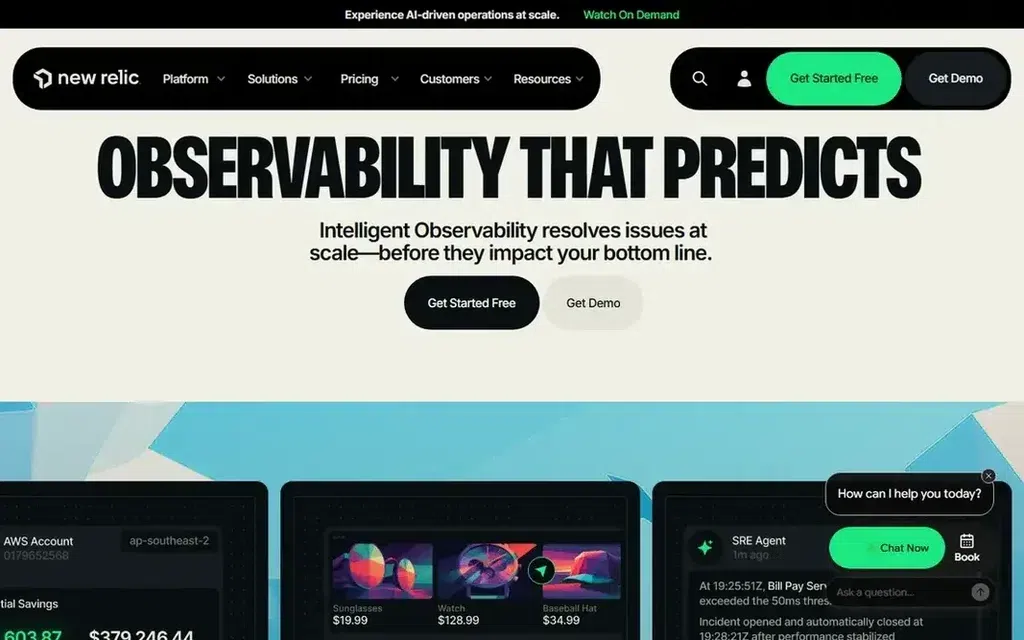
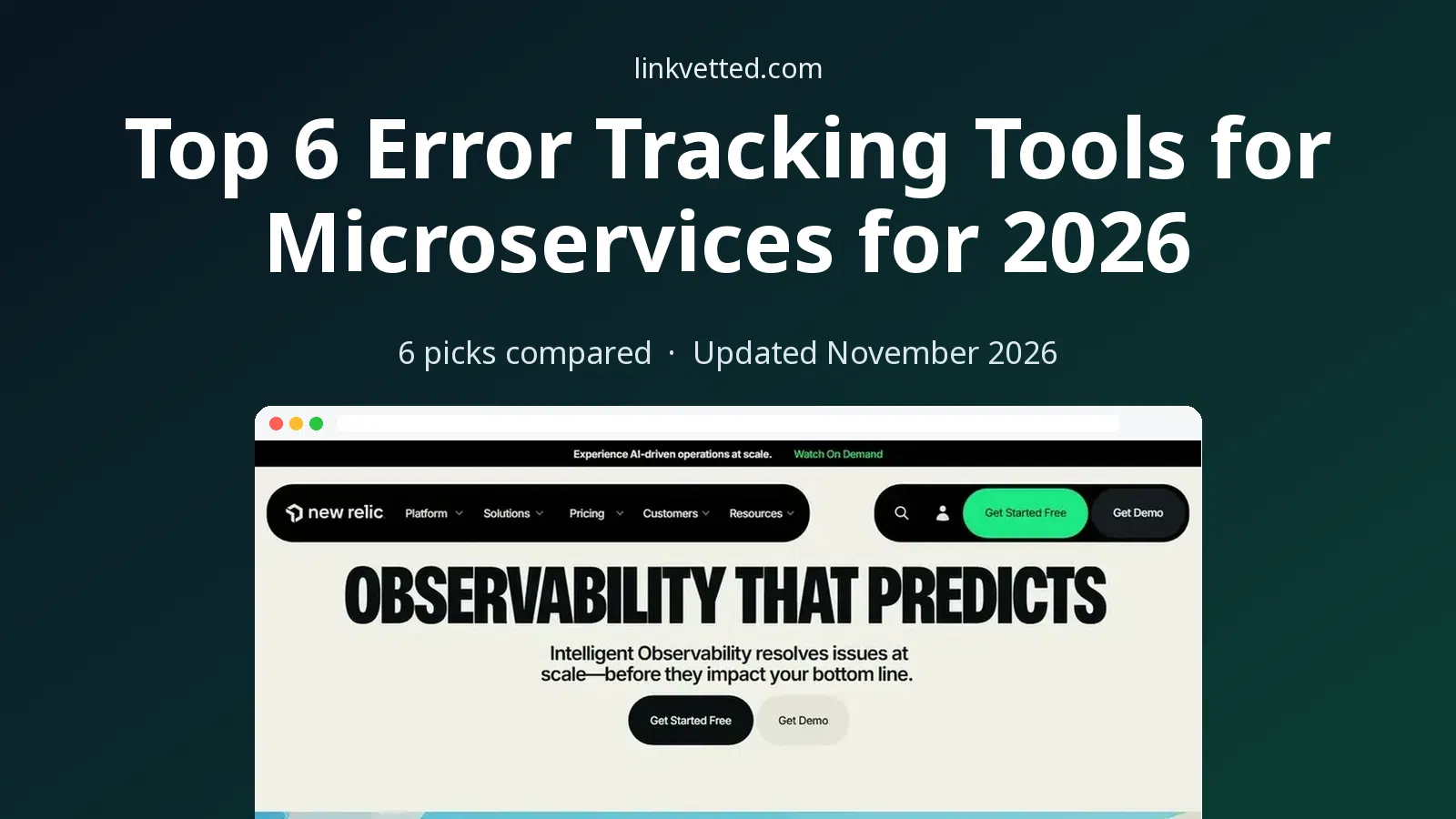
New Relic works best for correlating telemetry across the full stack. New Relic describes itself as an AI-powered observability product that correlates telemetry across the entire stack so teams can isolate root cause and cut mean time to resolution. From a buyer's view, pick New Relic when root-cause analysis across the entire stack is the priority.
Drawbacks to consider: Full product adoption needs onboarding effort.
Since it is a wide product, teams should expect onboarding work and some complexity in instrumenting plenty of services. Groups that only need error grouping and alerts may prefer a more focused tool. The starting price for New Relic: $10 per user per month. You can start on New Relic without paying.
- Concentrates on isolating root cause and reducing MTTR
- Correlates telemetry across the stack
- Error workflows are one part of a bigger product
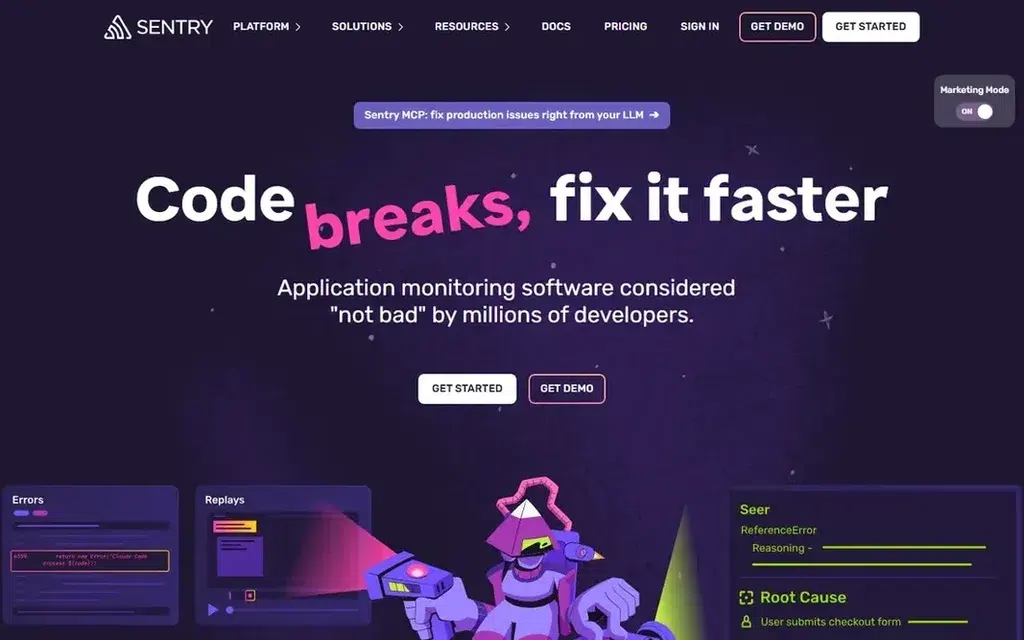
Sentry targets combined error and performance monitoring. If your organization already standardizes on a different observability vendor for all telemetry, consolidating there may be more straightforward. The breadth of the system means initial setup and service instrumentation can take effort, and smaller teams may find more capability than they need.
Watch-outs: Wide feature set can take time to configure.
Its homepage stresses seeing errors clearer, solving issues quicker and continuous learning. Beyond that, for microservices, that combination matters since a single user request can touch multiple services, and pairing error context with performance data helps teams follow a failure across boundaries. Sentry pricing: $26 per month. Sentry has a free plan.
- Error tracking alongside application performance monitoring
- Aims at helping developers see errors and solve issues quicker
- Distributed tracing setup needs planning across services
Honeybadger
Best for: Framework-focused error tracking and monitoring
Think of Honeybadger for framework-focused error tracking and monitoring. The product is oriented toward developers who want quick, practical error visibility instead of an all-in-one observability suite.
From a buyer's view, consider Honeybadger when your services use its supported stacks and you want focused error tracking. What you pay to start with Honeybadger: $26 per month. Honeybadger includes a free tier.
Limits to weigh: Advanced cross-service tracing is not the primary focus.
- PHP and Python
- Spans stacks for example Rails, Elixir
- Less suited to teams wanting one wide observability suite
Airbrake
Best for: Straightforward error monitoring
Choose Airbrake for straightforward error monitoring. Airbrake is a long-standing error monitoring tool that records exceptions and errors from applications and surfaces them for developers to review and fix. Worth adding: evaluate it against your service count and workflow needs.
Also, for microservices, it can serve as a focused way to collect errors from each service without adopting a large observability product. From a buyer's view, compared to broader systems, Airbrake gives you fewer adjacent capabilities for example full performance or infrastructure monitoring. So teams may have to combine it with other tools. It is a reasonable choice when error capture is the primary requirement and product consolidation is not a priority. Starting cost for Airbrake: $17 per month. As for free access: Free trial.
The main drawbacks: Fewer adjacent observability features.
- Straightforward concept centered on capturing application errors
- Well known as a dedicated error monitoring tool
- Less suited to teams wanting a full system
How the list was put together
For each of the 6 tools we noted price, free plan or trial, fit for error tracking tools for microservices and the main limit, using vendor pages and documentation. Prices and plan limits come from vendor pages and can change, so confirm them on the vendor site before you buy. Position on the page reflects fit for a typical buyer first, with price clarity and free access breaking ties. Treat it as a guide, not a ruling.
Questions to settle before buying
- Confirm the entry price on the vendor page. For Rollbar that means a quote rather than a fixed price.
- Look at free plan limits closely: Rollbar, New Relic, Sentry and Honeybadger have one, and the caps decide whether it is usable for real work.
- Take the trial from Raygun and Airbrake and push a live task through it before you pay.
- Read the limits listed for Raygun first: Microservice tracing is not the central message.
- Map your must-have features to a specific Honeybadger plan before you compare prices.
- Total up the real monthly cost of Rollbar, including add-ons, extra users and usage-based fees.
FAQ
How do I evaluate a tool before committing?
Start with the languages and frameworks your services use, then check grouping, alerting and integration with your existing tooling. Run a small pilot with a handful of services to see how noisy the error stream is and whether the workflow matches how your team triages issues.
What is the cheapest option for error tracking tools for microservices in this list?
On published monthly entry prices, New Relic is the lowest here at $10 per user per month. Entry price is only part of the cost, because seats, add-ons and billing terms can change the total. Prices, free plan details and limits for all 6 tools in this error tracking tools for Microservices roundup sit on the individual cards above.
Which options for error tracking tools for microservices have a free plan?
On this list, Rollbar, New Relic, Sentry and Honeybadger include a free plan. Caps on seats, usage or features are common, so test the free plan against your real workload. Several others offer a trial instead.
Should error tracking be part of a larger observability product?
It relies on how much telemetry you already centralize. Products like Datadog and New Relic let you view errors next to metrics and traces, which can speed root-cause analysis.
Do these tools publish their prices?
Not all of them. Rollbar publishes no starting price, so expect a quote request for it. The rest, Raygun included, show a starting price, though seats and billing terms still change the final cost. Each of the 6 options in this error tracking tools for Microservices guide has its own card above with the price, free plan and limits.
How are the tools for error tracking tools for microservices ordered?
Raygun sits first and Airbrake last because the order follows typical fit for error tracking tools for microservices, then price clarity and free access. It is a judgement call, so read each profile for fit and limits.
Sources
- https://raygun.com
- https://rollbar.com
- https://newrelic.com
- https://sentry.io
- https://www.honeybadger.io
- https://www.airbrake.io