Best Entity Management Software in 2026: 8 Platforms Compared
Compare the best entity management software for subsidiaries, filings and compliance calendars, with features, limits and pricing notes for legal teams.
- Editor's choice
 Athennian
Modern legal teams and law firms
Starts atSee websiteVisit athennian.comFull review - Great alternative
 CSC Entity Management
Large legal departments
Starts atSee websiteVisit cscglobal.comFull review - Also consider
 Diligent Entities
Governance teams already using Diligent
Starts atSee websiteVisit diligent.comFull review
TL;DR:
- Athennian and Diligent Entities are strong choices for legal teams that need clean corporate records, org charts and compliance calendars in one place.
- CSC Entity Management and CT Corporation suit companies that also want filing and registered agent services tied directly to their entity data.
- EntityKeeper, MinuteBox and Filejet offer more approachable options for smaller portfolios, though they differ on filing support and jurisdiction coverage.
- Most pricing in this category is quote based, so ask for the total cost by entity count, users and filing services before you compare vendors.
- A demo with your own org chart and a sample filing calendar will reveal more than a feature list, because data structure and reporting vary widely.
Quick comparison
| Tool | Best for | Starts at | Free plan? | |
|---|---|---|---|---|
| Athennian | Modern legal teams and law firms | See website | Free trial | Visit |
| CSC Entity Management | Large legal departments | See website | No | Visit |
| Diligent Entities | Governance teams already using Diligent | See website | No | Visit |
 EntityKeeper | Smaller portfolios and deadline tracking | See website | No | Visit |
 MinuteBox | Canadian and US minute books | See website | No | Visit |
 Filejet | Filing automation for growing portfolios | See website | No | Visit |
 Harbor Compliance | Compliance plus filing services | See website | No | Visit |
 CT Corporation | Registered agent plus entity data | See website | No | Visit |
The best entity management software
Entity management software keeps the corporate record straight: who owns what, who sits on each board, when each filing is due and where the signed documents live. We compared record structure, org charts, compliance calendars, filing services and reporting across eight platforms.
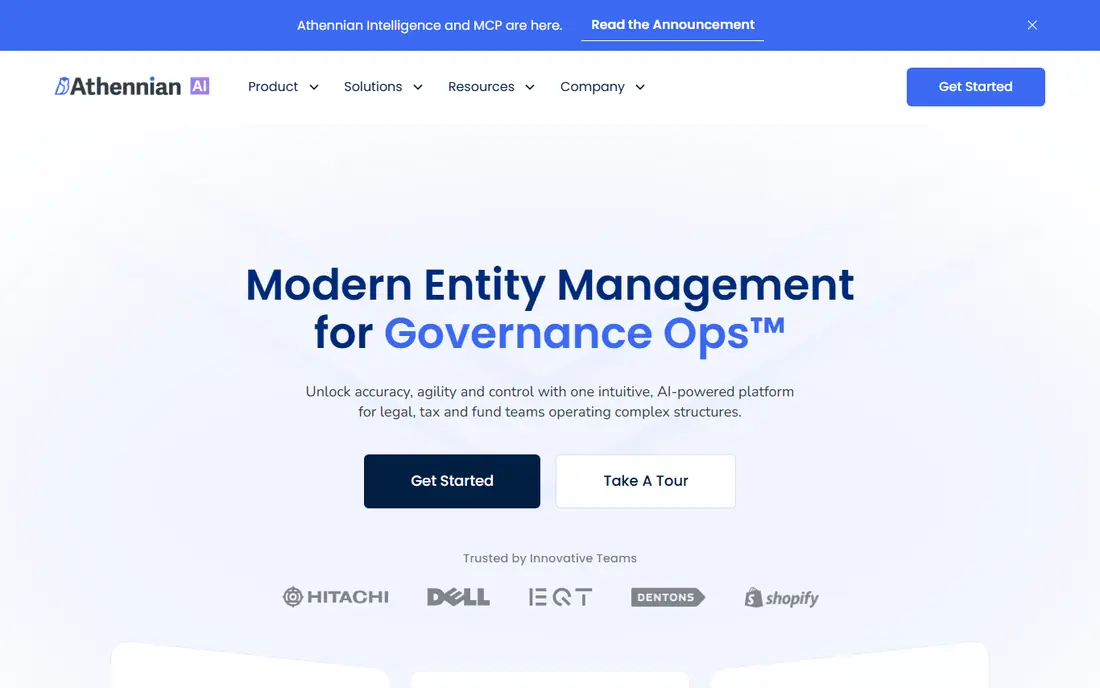
Athennian is built for legal, tax and compliance teams that manage many entities and want one current record instead of scattered spreadsheets and folders. Its core strength is structure: entities, officers, directors, shareholders and documents sit in a single system, and org charts update as that data changes. Automated document generation and compliance workflows reduce the manual work of preparing routine corporate documents, which is where errors often creep in when teams are busy.
The platform is cloud based and designed for collaboration, so law firms and in-house teams can work from the same records with role-based access. That helps when outside counsel, auditors or tax advisers need limited, controlled access rather than a full data dump. The main drawback is cost transparency, since pricing is quoted by portfolio size and plan, so smaller companies should confirm the entry price early. A trial with a real subset of entities is the best way to judge whether the interface fits your team.
- Clean cloud interface
- Automated document generation
- Real-time org charts and ownership views
- Pricing is quote based and can be high for small portfolios
- Advanced needs may require higher tiers
- Migration from spreadsheets takes planning
CSC Entity Management is aimed at corporate legal departments and compliance teams with large, complex portfolios. Its advantage is the link between the software and CSC services: when CSC handles a formation, annual report or dissolution, the resulting data and documents can flow into the entity record automatically. That reduces double entry and keeps the portfolio current without a separate reconciliation step. The compliance view shows status and upcoming obligations across entities, which helps teams spot problems before a deadline passes.
The platform is less of a self-serve purchase than a relationship with a major service provider, so expect a sales process and quoted pricing rather than a simple monthly rate. Teams that only need a record-keeping tool, without filing services, may find it heavier than they need. For a large company already using CSC for registered agent or filing work, however, the combined record and service model is a practical reason to choose it.
- Deep filing and registered agent integration
- Portfolio-wide compliance view
- Long track record with large companies
- Quote based pricing
- Interface feels more corporate than modern rivals
- Smaller teams may not need its full depth
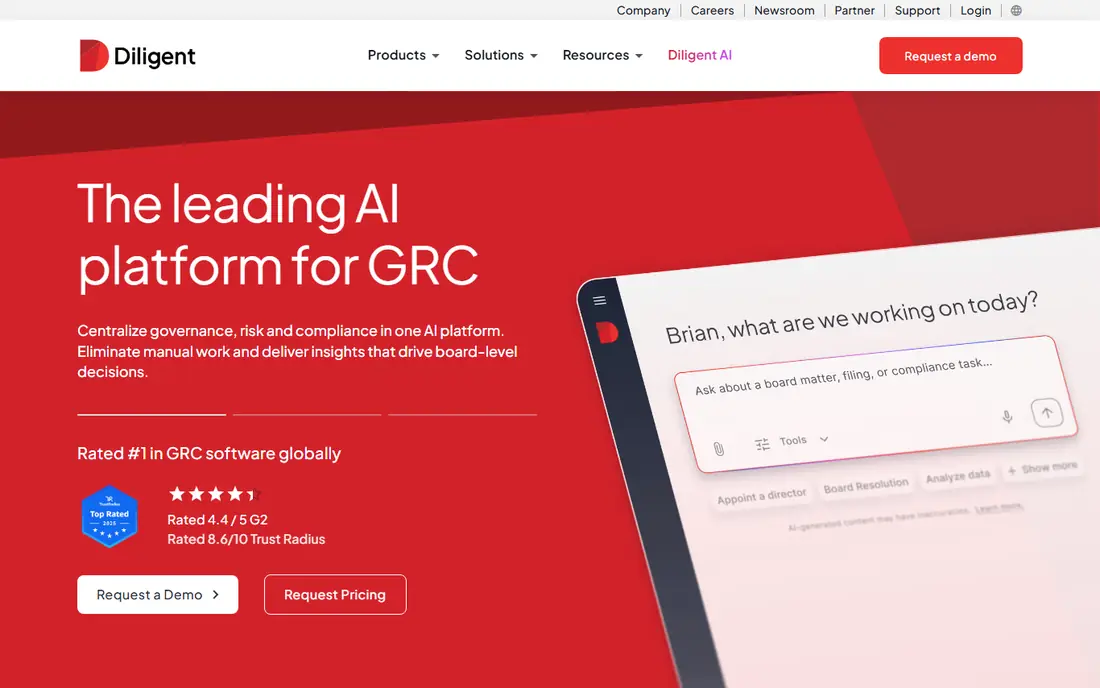
Diligent Entities centralizes subsidiary data, documents and organizational charts so governance teams work from one source of truth. Compliance calendars and reminders help teams track filing dates and routine obligations, while reporting tools surface governance and compliance information for leadership and auditors. For companies that already use Diligent for board or governance work, keeping entity data in the same family of tools can simplify access control and reporting.
The catch is that Diligent is an enterprise platform, so pricing and implementation reflect that. A small company with a handful of entities will likely find a lighter tool faster and cheaper. Diligent makes most sense when entity governance sits alongside board management, risk or compliance work and when consistent reporting across those areas matters. Ask for a demo that covers your reporting needs, not just record entry, because reporting is where enterprise tools either earn their price or frustrate users.
- Central corporate record with documents and charts
- Compliance calendars and reminders
- Fits wider Diligent governance tools
- Pricing is quote based
- Best value comes inside a wider Diligent setup
- Onboarding can take time for large portfolios
EntityKeeper is a more approachable option for companies that need reliable entity records without enterprise complexity. It lets teams store entity details, customize fields, build org charts and set reminders for filing and tax dates, which covers the most common reason small and mid-size companies buy this kind of software: missed deadlines. The interface is straightforward, and the ability to add corporate services for formations and annual reports means a team can hand off filing work rather than tracking it alone.
Its limits show at larger scale. It does not match the integration depth or global coverage of the biggest platforms, and pricing requires a conversation with the vendor, so budget planning takes an extra step. For a company with a modest portfolio that mainly needs accurate records, clear charts and reliable reminders, that trade-off is reasonable. Start with your entity count and filing volume, and confirm exactly which filings the service will handle for you.
- Clear org charts and deadline alerts
- Customizable fields
- Corporate services for filings available
- Pricing is not published plainly
- Fewer enterprise integrations than larger rivals
- Filing coverage varies by state and service
MinuteBox is designed around the minute book, the formal record of a company's directors, officers, shareholders and resolutions. For law firms and corporate secretarial teams, that focus is a strength: documents are generated from the entity data, so a change to an officer or share structure flows into the paperwork consistently. The result is a cleaner, more audit-ready record than a set of disconnected Word files and spreadsheets. It supports both Canadian and US entities, which helps firms with cross-border clients.
Operating companies that mainly need filing reminders and a simple entity list may find MinuteBox more specialized than they need, and pricing is quoted rather than published. Before choosing it, confirm that it covers the jurisdictions in your portfolio and that its document templates match your governance style. For firms whose daily work is maintaining client minute books, that specialization is exactly the point.
- Strong minute book and document generation
- Clean entity records
- Useful for law firms managing client entities
- Pricing is quote based
- Focus on minute books may suit firms more than operating companies
- Check US state coverage for your portfolio
Filejet focuses on the part of entity management that causes the most missed deadlines: recurring filings. It tracks due dates across a portfolio and automates annual report filings where the jurisdiction allows, which can save a legal or operations team a large amount of repetitive work. The central dashboard gives a quick view of entity status, so a team can see what is current, what is pending and what needs attention without opening each record.
Automation has limits by jurisdiction, because state and country filing systems differ, so confirm coverage for every state where you have entities before relying on it fully. Pricing is also quote based, tied to entity count and services, which makes quick comparison harder. For a growing company adding entities each year, the filing automation is the feature most likely to pay for itself, provided your jurisdictions are well covered.
- Automates annual reports and filings
- Central entity dashboard
- Deadline tracking across entities
- Pricing is quote based
- Filing automation depends on jurisdiction
- Newer than some established rivals
Harbor Compliance pairs entity and compliance tracking with managed services, which suits companies that want help, not just a dashboard. The platform tracks filings, licenses and deadlines, and the service team can handle registrations and renewals that would otherwise fall to an already busy legal or finance team. That combination is useful for companies expanding into new states, where each new jurisdiction brings its own forms, fees and timelines.
The trade-off is cost and control. A managed service usually costs more than software alone, and some tasks will be handled by staff on a schedule rather than instantly in the software. Companies that prefer to keep all filing work in-house may prefer a purer software tool. For a team that wants a safety net and is willing to pay for it, Harbor Compliance offers a practical blend of tracking and hands-on help.
- Combines software with managed compliance services
- Tracks licenses and filings
- Human support for complex cases
- Pricing is quote based
- Service model may cost more than software alone
- Check how much work is automated versus handled by staff
CT Corporation, part of Wolters Kluwer, is a long-established name in registered agent and corporate compliance services. Its entity management offering ties the corporate record to the services many companies already buy from CT, such as registered agent service, service of process handling and annual report filings. That link matters because documents received as registered agent can be routed and recorded in context, rather than sitting in a separate inbox. US coverage is broad, which helps companies with entities in many states.
The product range is wide, so it takes care to confirm exactly which platform and services are included in a quote. Pricing is quote based, and the experience can feel more like buying professional services than subscribing to a simple app. For a company that already relies on CT for registered agent work, combining that with entity management in one provider can simplify vendor management and keep records consistent.
- Long-established registered agent network
- Entity management tied to service of process and filings
- Broad US coverage
- Pricing is quote based
- Product range can be confusing
- Interface varies across its service lines
How we picked these
We compared official product pages, feature documentation and public reviews, focusing on record structure, org charts, compliance calendars, filing services and reporting. We favored platforms that serve US companies and law firms and that clearly explain whether filing work is included or left to the customer. Pricing in this category is rarely published, so we used See website where vendors quote by portfolio size, rather than repeating third-party estimates as fact. No platform was included for brand name alone; each one had to offer a real entity record, deadline tracking or filing workflow.
What to check before you buy entity management software
Start by counting your entities and listing every jurisdiction, because price and coverage follow those two numbers. Then map your workflow: who enters data, who approves changes, who needs read-only access for audits, and which filings you want the vendor to handle versus track only. A platform that looks simple in a demo can still fail if its permission model does not match your team, or if its org chart cannot show the ownership layers you actually have.
Ask about migration and data export early. Moving years of entity data from spreadsheets or an older system is where projects stall, so ask what import help is included and whether you can export your full record if you leave. Check filing coverage state by state, and ask how the vendor handles a filing that cannot be automated. Finally, run a pilot with a small group of entities and a real filing calendar, because that test will show data quality problems and reporting gaps before you commit the whole portfolio.
FAQ
What is the best entity management software?
The best choice depends on portfolio size and whether you need filing services. Athennian and Diligent Entities suit larger legal and governance teams, while EntityKeeper and Filejet are more approachable for smaller portfolios. Companies that want filing services bundled in should compare CSC Entity Management and CT Corporation closely.
What are the top entity management software solutions for law firms?
Law firms often choose Athennian or MinuteBox, because both handle client entities, document generation and controlled access well. A firm should check template quality, minute book structure and how easily it can separate client data, since those details matter more than a generic feature list.
How much does entity management software cost?
Most vendors in this category price by quote, based on entity count, users and services. Smaller tools may start at a few thousand dollars a year, while enterprise platforms can cost far more once filing services and integrations are included. Always ask for the total annual cost, including implementation, filing fees and support, before comparing vendors.
Does entity management software file annual reports for you?
Some platforms automate or handle filings, while others only track deadlines and leave filing to your team. Filejet and Harbor Compliance lean toward handling filings, while other tools focus on records and reminders. Confirm jurisdiction by jurisdiction, because automation coverage varies and some states still require manual steps.
Can I manage entities in a spreadsheet instead?
A spreadsheet works for one or two entities, but it breaks down as entities, owners and deadlines multiply. Dedicated software adds permission controls, document links, org charts and automated reminders that a spreadsheet cannot maintain reliably. If missed deadlines or messy records are already a problem, software is usually worth the cost.
How long does implementation take?
Implementation ranges from days for a small portfolio to several weeks for a large one with historical data. Migration, template setup and permission design take most of the time, not the software installation itself. Ask the vendor for a realistic timeline based on your entity count and data quality, and plan a pilot before a full rollout.