6 Best Ecommerce Platforms Business Scalability for 2026, Vetted and Compared
Compare 6 picks for the best ecommerce platforms business scalability, with prices, free plans and who each fits. Details on cost, catches and fit. Start here.
- Editor's choice
 Adobe Commerce
Enterprise B2B and B2C personalization
Starts atSee websiteVisit business.adobe.comFull review - Great alternative
 Salesforce Commerce Cloud
Commerce within the Salesforce ecosystem
Starts atSee websiteVisit salesforce.comFull review - Also consider
 Shopify
All-in-one commerce growth
Starts at$19 per monthVisit shopify.comFull review
Direct answer
If you need enterprise B2B and B2C personalization, Adobe Commerce is the first tool to look at here. Listed starting prices: Shopify from $19 per month, WooCommerce from $29 a month and Squarespace from $12 per month. Look at Salesforce Commerce Cloud for Commerce within the Salesforce ecosystem, and at Shopify for all-in-one commerce growth. All 6 tools are compared below on price, free plan and limits.
TL;DR:
- This list starts with Adobe Commerce, which is built for enterprise B2B and B2C personalization.
- Adobe Commerce, Squarespace and the 4 others all need a premium plan or a trial, since no free plan is listed.
- One limit worth knowing about WooCommerce: needs more technical upkeep.
- Squarespace is the one to check for design-led websites with commerce.
- Squarespace is the lowest-priced starter here at $12 per month.
Last checked November 2026. Prices and plan details were read from the vendors' own pages in November 2026; vendors change plans often, so confirm the current price on the vendor site before you buy.
Quick comparison
| Tool | Best for | Starts at | Free plan? | |
|---|---|---|---|---|
| Adobe Commerce | Enterprise B2B and B2C personalization | See website | Not stated | Visit |
| Salesforce Commerce Cloud | Commerce within the Salesforce ecosystem | See website | Not stated | Visit |
| Shopify | All-in-one commerce growth | $19 per month | Free trial | Visit |
 WooCommerce | Open-source customization and control | $29 a month | Not stated | Visit |
 Wix | Straightforward website and store setup | See website | Not stated | Visit |
 Squarespace | Design-led websites with commerce | $12 per month | Free trial | Visit |
6 options for ecommerce platforms business scalability in detail
LinkVetted put together this guide to ecommerce platforms business scalability for readers who want a clear shortlist without reading every vendor page. It compares 6 tools on starting price, free plans, who each one suits and where each one falls short.
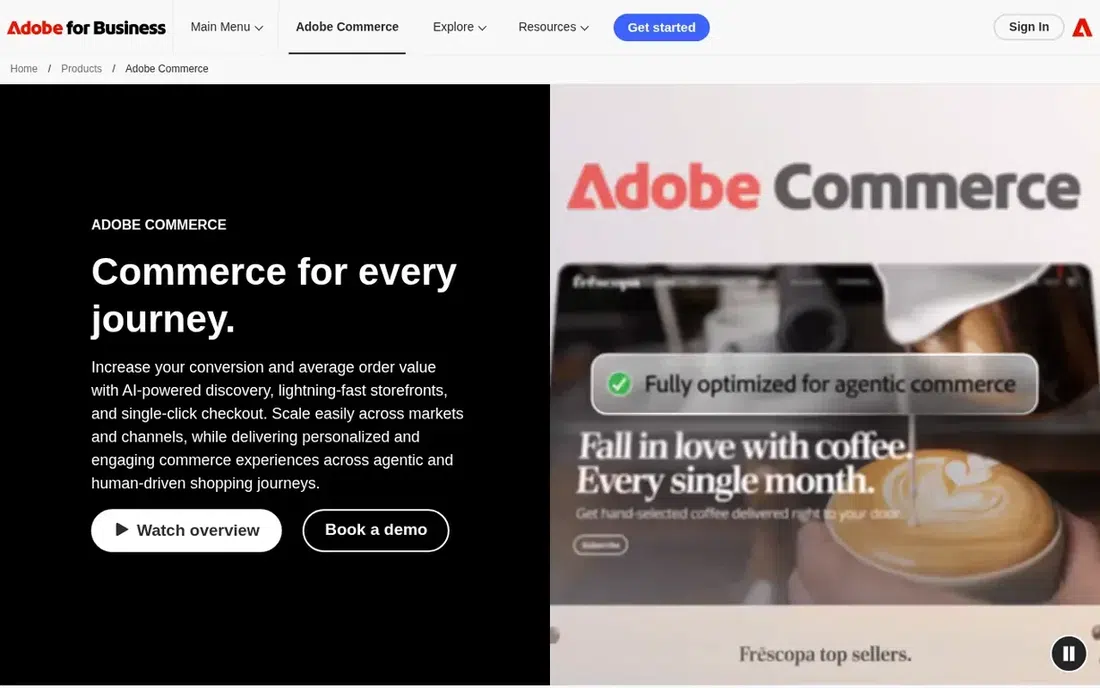
Adobe Commerce targets enterprise B2B and B2C personalization. Smaller merchants frequently find the system heavier than needed. Beyond that, Adobe Commerce, known as Magento, is presented as an AI-powered composable ecommerce product for B2B and B2C firms delivering personalized experiences at global scale.
That adaptability includes implementation and maintenance demands that typically need dedicated developers or partners. Pick Adobe Commerce when enterprise personalization and composable architecture are priorities and internal or partner resources are available. Pricing for Adobe Commerce is not stated here, so ask the vendor for current figures. Free plan details: Not stated.
Drawbacks to consider: Needs significant technical resources.
- AI-powered personalization
- Composable enterprise architecture
- Complicated to implement and maintain
Salesforce Commerce Cloud was built for Commerce within the Salesforce ecosystem. The homepage excerpt provides restricted detail, so buyers should review vendor documentation for current capabilities.
Where it falls short: Restricted public detail on the homepage.
For everyday use, choose Commerce Cloud when tight integration with Salesforce is a core requirement. Otherwise, more straightforward hosted systems may be simpler to adopt. No starting price is listed for Salesforce Commerce Cloud here; confirm pricing on the vendor site. On free options: Not stated.
- Suits organizations already using Salesforce
- Supports commerce experiences
- Implementation usually needs specialist help

In short, Shopify is for all-in-one commerce growth. Shopify presents itself as an all-in-one commerce system for companies, with tools to build or grow rapidly and run numerous parts of the operation. Its homepage flags AI assistance and a scope beyond basic ecommerce software.
Where Shopify stands out: Tools to run the entire business.
Limits to weigh: Advanced customization may need apps or experts.
As for the details, choose Shopify when speed of setup and a wide built-in feature set matter more than low-level customization. Companies with large in-house engineering teams commonly evaluate open-source or composable alternatives. Price to start with Shopify: $19 per month. As for free access: Free trial.
- AI features for building and expanding
- All-in-one commerce product
- Less control over the core codebase
Where WooCommerce fits: open-source customization and control. WooCommerce is the open-source ecommerce product that helps merchants and developers build companies for the long term.
Where it falls short: Performance relies on hosting choices.
Firms without technical support may prefer a completely hosted choice. Since it is open source, teams can extend and adapt the store to specific requirements. Starting cost for WooCommerce: $29 per month. Free plan details: Not stated.
- Built for long-term business building
- Aimed at merchants and developers
- Needs more technical upkeep
In short, Wix is for straightforward website and store setup. Wix gives you a website-building product with hosting, business tools, domains, and marketing built in. Its homepage positions it for companies that want to build an online presence without assembling separate services.
Downsides: Customization restricted by the system.
Wix is generally better suited to straightforward storefronts than to complicated, high-volume commerce operations with intricate catalogs or custom workflows. Companies planning rapid, large-scale expansion may outgrow its constraints. For smaller keeps and firms early in their growth, that integrated approach can ease launching and managing a site. Choose Wix when simplicity and an integrated website plus store matter more than deep commerce customization. Wix does not show a starting price in this comparison, so check the vendor site for current pricing. Free options: Not stated.
- Domains and marketing included
- Hosting and business tools built in
- Less suited to complicated commerce operations
Squarespace works best for design-led websites with commerce. Squarespace usually provides less depth for complicated commerce operations, for example intricate catalogs or advanced multi-channel workflows.
Honest limits: Fewer advanced operational features.
Choose Squarespace when a refined, design-led site with entry-level selling capability matches the business model. Squarespace cost at the entry level: $12 per month. Free options: Free trial.
- Domain and site management in one place
- AI website builder tools
- Commerce depth is restricted for complicated needs
How we built this list
We compared the tools on published pricing, free plan or trial availability, feature coverage for ecommerce platforms business scalability, and the limits each vendor documents. Where a vendor does not publish a price, the entry says quote. Where a price depends on seats or billing term, the entry says so. Position on the page reflects fit for a typical buyer first, with price clarity and free access breaking ties. Treat it as a guide, not a ruling.
A buyer's checklist
- Confirm the entry price on the vendor page. For Adobe Commerce, Salesforce Commerce Cloud and Wix that means a quote rather than a fixed price.
- Take the trial from Shopify and Squarespace and push a live task through it before you pay.
- Before choosing Adobe Commerce, weigh its main limit: needs significant technical resources.
- Involve the people who will use Salesforce Commerce Cloud daily; a short pilot beats a long feature checklist.
- Ask Wix whether prices are locked for the first term and what happens at renewal.
FAQ
Can I try these tools before paying?
Often, yes. Shopify and Squarespace offer a free trial. Use your own data and a real task during the test, and check what the free tier or trial limits before you rely on it. Each of the 6 options in this ecommerce platforms business Scalability guide has its own card above with the price, free plan and limits.
How are the tools for ecommerce platforms business scalability ordered?
The order follows typical fit for ecommerce platforms business scalability, with Adobe Commerce first and Squarespace last, then price clarity and free access. It is editorial judgement, not a score, so another team could rank the tools differently.
Is WooCommerce a decent choice for long-term scalability?
WooCommerce is open source and made for merchants and developers building for the long term, so it gives you capable customization potential. The trade-off is that hosting, maintenance, and performance management fall more on the merchant. It suits teams with development support.
Is Adobe Commerce the right pick for everyone comparing ecommerce platforms business scalability?
No single tool suits every team. Adobe Commerce comes first because it fits enterprise B2B and B2C personalization, while Salesforce Commerce Cloud suits Commerce within the Salesforce ecosystem and Shopify suits all-in-one commerce growth. Match the tool to your own size, budget and workflow before deciding.
How do Wix and Squarespace compare for ecommerce growth?
Wix emphasizes built-in hosting and business tools, whereas Squarespace emphasizes templates and design. Businesses with complicated operational needs commonly evaluate dedicated ecommerce products instead.
Which ecommerce product scales best for an expanding business?
This list starts with Adobe Commerce, which fits enterprise B2B and B2C personalization. For other needs, Salesforce Commerce Cloud is aimed at Commerce within the Salesforce ecosystem, and Shopify at all-in-one commerce growth. Check each tool's price and main limit first.
Sources
- https://business.adobe.com/products/magento/magento-commerce.html
- https://www.salesforce.com/commerce
- https://www.shopify.com
- https://woocommerce.com
- https://www.wix.com
- https://www.squarespace.com