Choosing Digital PR Agencies for Startups in 2026: 6 Options Compared
A practical look at the best digital PR agencies for startups in 2026, compared from vendor documentation and public sources, with fit and limits noted.
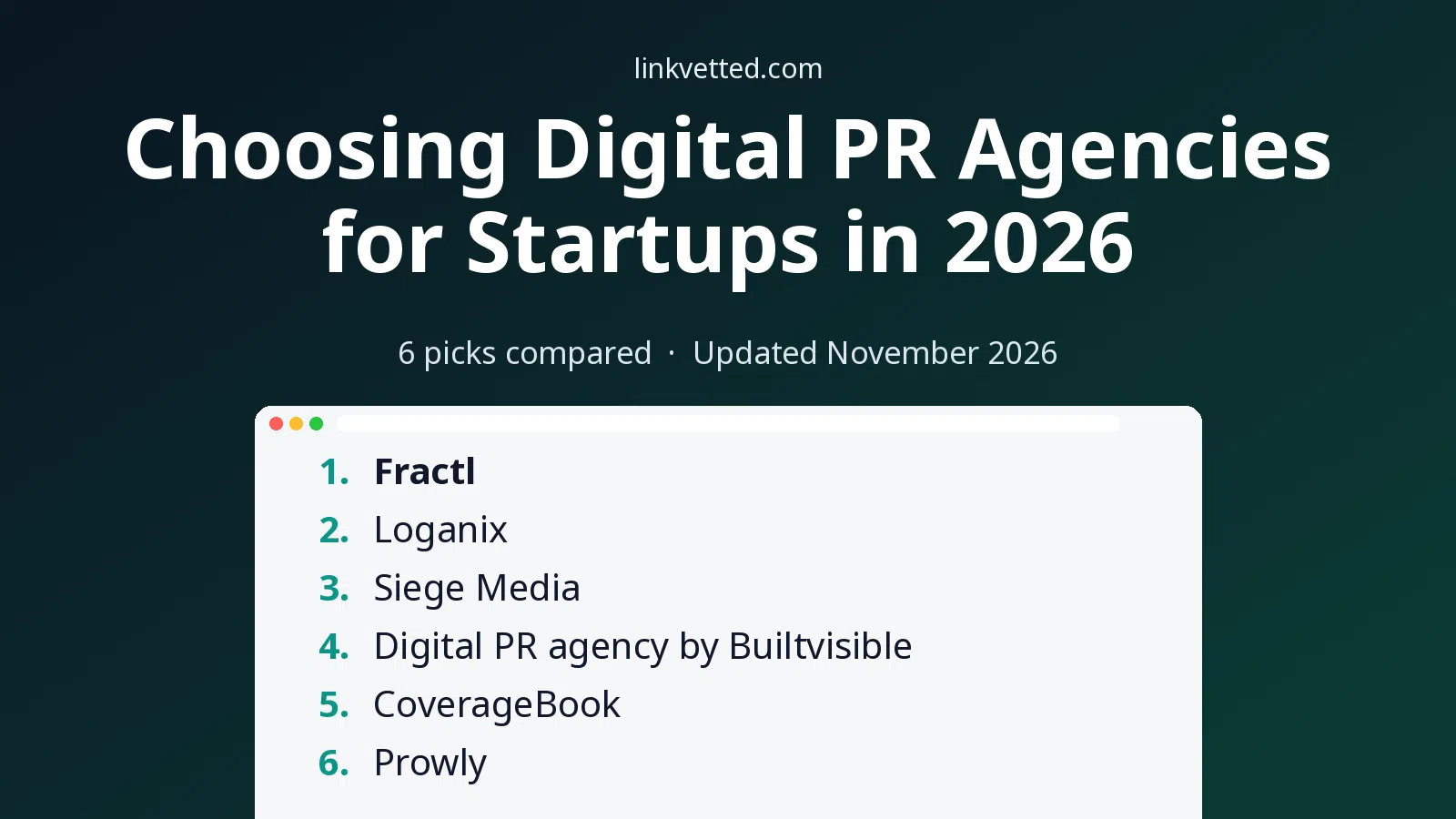
- Editor's choice
 Fractl
Data-led campaigns that earn links
Starts atSee websiteVisit frac.tlFull review - Great alternative
 Loganix
Ordering specific link and content tasks
Starts atSee websiteVisit loganix.comFull review - Also consider
 Siege Media
Content, SEO and digital PR in one
Starts atSee websiteVisit siegemedia.comFull review
Direct answer
My first pick is Fractl, because its public materials focus on data-driven campaigns that earn editorial links, which suits startups that need coverage and referring domains. For lower-cost, self-serve link building I would look at Loganix, and for a broader content and SEO agency that includes digital PR, Siege Media is worth a look. Each fits a different budget and level of hands-on involvement, so match the agency to your team's capacity.
TL;DR:
- Fractl suits startups that can supply a data angle and want campaign-based coverage from publishers.
- Loganix is a better fit when you want to order specific link and content services rather than a retainer.
- Siege Media combines content, SEO and digital PR, which helps startups that need one partner for several channels.
- Agency fit depends on your niche, your internal review capacity and how you measure coverage.
- Ask every agency how it reports links, mentions and referral traffic before you sign.
Last checked November 2026. Plan prices are not quoted in this guide because they change often; see each vendor's own pricing page for current figures before you buy.
Quick comparison
| Tool | Best for | Starts at | Free plan? | |
|---|---|---|---|---|
| Fractl | Data-led campaigns that earn links | See website | Not stated | Visit |
| Loganix | Ordering specific link and content tasks | See website | Not stated | Visit |
| Siege Media | Content, SEO and digital PR in one | See website | Not stated | Visit |
| Digital PR agency by Builtvisible | SEO-led digital PR for growth teams | See website | Not stated | Visit |
 CoverageBook | Reporting on coverage you earn yourself | See website | Free trial | Visit |
 Prowly | Running outreach in-house with a CRM | See website | Free trial | Visit |
The best digital pr agencies for startups compared
I put this list together from vendor documentation and public sources, not from hands-on tests. I run a small SEO agency, so I read each provider's service pages, case study pages and help docs, then judged fit for an early-stage team. Where a provider is software rather than an agency, I say so, because many startups end up doing part of the work in-house.
Fractl is a digital PR agency known for building campaigns around original data, surveys and visual assets, then pitching them to publishers. It fits startups that have something measurable to say, such as usage data, survey results or a novel dataset. If your product generates interesting numbers, this kind of agency can turn that into coverage rather than a generic press release.
For link building, the value is in earning editorial mentions from sites that would not link to a product page. A startup can use those mentions to support category pages and launch content. The workflow usually starts with ideation, then asset production, then outreach, so you need someone internally to approve angles and check facts before anything is pitched.
The limit is that this model depends on a story worth telling. A pre-launch startup with no data and no customers may struggle to get campaigns approved. Skip it if you need fast, predictable link volume rather than a few well-placed campaigns.
- Focus on original research campaigns
- publisher outreach is central to the offer
- public case studies show the process
- Needs a strong data angle
- campaign timelines can be long
Loganix offers link building, content writing and related SEO services that you can order as defined tasks. That suits startups that already know what they need, such as a batch of guest posts or citations, and do not want a long retainer. It is closer to a service marketplace than a PR consultancy, so expect a clear scope rather than a bespoke campaign.
For digital PR, the useful part is the content and placement work that supports outreach. If your founder is doing the pitching, Loganix can handle asset production and some placements. The workflow is usually order, brief, delivery, which keeps things simple for a small team without a dedicated PR hire.
The drawback is that productised services rarely produce the kind of story-driven coverage that earns links from major publications. Skip it if you want an agency to own strategy, media relations and reporting end to end.
- Clear menu of services
- content and link options in one place
- useful for small, defined projects
- Productised approach
- less strategic counsel than a full agency
Siege Media is a content and SEO agency that also runs digital PR and link building. It fits startups that need content production and outreach to work together, for example a blog programme that feeds linkable assets. The public site explains its process in some detail, which helps you judge whether the approach matches your niche.
For a startup, the advantage is fewer vendors to manage. Content, on-page work and outreach can sit with one team, so a campaign asset is built with links in mind from the start. The workflow usually includes strategy, content production, then promotion, with reporting on rankings and links.
The limit is that a combined scope can be more than a very small startup needs. If you only want a handful of press mentions, a narrower PR agency may fit better. Skip it if you want pure media relations with no content production.
- Combines content and outreach
- public process write-ups
- suits startups building organic channels
- Broader scope can mean a bigger commitment
- not a pure PR shop
Digital PR agency by Builtvisible
Best for: SEO-led digital PR for growth teams
Builtvisible is a search and content agency with a digital PR offer. It fits startups that already invest in SEO and want coverage to support organic growth, such as links to category pages or campaign assets. The agency publishes a lot of educational material, so you can read its approach before you talk to anyone.
In practice, digital PR here means building assets and pitching them to relevant publications, then tracking the links and mentions. That works well when your SEO plan already has pages that need authority. The workflow needs a client-side contact who can approve angles and supply subject-matter input.
The drawback is scope. A full-service agency engagement can be larger than an early-stage startup needs, and the work depends on your team's availability. Skip it if you want a small, one-off campaign with no ongoing SEO involvement.
- Digital PR sits alongside technical SEO
- public articles explain the method
- suits startups with an SEO roadmap
- Full-service scope may not suit tiny budgets
- needs internal input to work well
CoverageBook is reporting software for PR teams, not an agency. I include it because many startups do their own outreach and then need a clean way to show what they earned. It collects coverage and presents metrics such as reach and links in a report you can share with founders or investors.
For digital PR, the tool helps you prove value from your own pitching. If you run a small campaign in-house, you can log the coverage and send a report without building a spreadsheet. That keeps the feedback loop short and makes it easier to decide what to pitch next.
The limit is obvious: it does not pitch, write or place anything. Skip it if you want an agency to own outreach. It is only useful once you already have coverage to report.
- Turns coverage into shareable reports
- useful for stakeholder updates
- works with in-house outreach
- Software, not an agency
- does not run outreach for you
Prowly is PR software with a media database, press release tools and outreach features. It fits startups that want to run digital PR themselves but need a system for contacts, pitches and follow-ups. It is not an agency, so the strategy and the pitching remain your job.
For a startup, the value is process. You can build lists, send pitches and track replies in one place, which is easier than juggling spreadsheets and an inbox. That matters when you are testing which angles get responses before you commit to an agency retainer.
The drawback is that software does not create a story or a relationship with a journalist. Skip it if you have no one to run outreach. It works best when a founder or marketer can spend regular time on pitching.
- Media database and outreach tools in one place
- helps small teams stay organised
- useful for repeat campaigns
- Software, not an agency
- results depend on your own pitching
How I chose
I compared these providers from vendor documentation and public sources. That means service pages, help docs, published case studies and the agencies' own articles about their process. I did not run hands-on tests, and I am not claiming client results or statistics. The goal was to judge fit for a startup: what the provider actually does, how the workflow runs, and where the limits are.
I also separated agencies from software, because the question asks for agencies but many startups end up doing part of the work in-house. For each entry I noted the kind of startup it suits and the reason to skip it. Price is not listed because published figures change and often depend on scope, so I point you to the official site and suggest you ask for a written scope before committing.
What to check before you buy
- Ask for a sample campaign brief and a sample report so you can see the actual deliverables.
- Confirm whether the agency pitches to journalists directly or only produces assets for you to pitch.
- Check how links and mentions are reported, including whether they are follow or nofollow.
- Ask which niches and publication types the agency has worked with, and whether your category is a fit.
- Clarify who approves angles and facts internally, because campaign work needs a responsive client contact.
- Get the contract terms in writing, including notice periods and what happens if a campaign underperforms.
FAQ
What do digital PR agencies do for startups?
They build story-led assets, such as data studies or expert commentary, and pitch them to journalists and publishers to earn coverage and links. Some also handle content production and reporting. For a startup, the main value is editorial mentions that support brand awareness and organic search, rather than paid placements.
How is digital PR different from traditional PR?
Traditional PR often focuses on brand reputation and press releases. Digital PR usually aims at online coverage that includes links, which helps search visibility. The methods overlap, but digital PR teams tend to think about referring domains, campaign assets and how coverage supports specific pages on your site.
Can a startup do digital PR in-house?
Yes, especially early on. A founder with subject knowledge can pitch commentary and small data stories. Software for media lists and reporting helps, but it takes regular time. Many startups start in-house to learn which angles land, then bring in an agency once they have a story that works and a budget for scale.
How do I measure digital PR results?
Look at coverage volume, the quality and relevance of the publications, links earned and any referral traffic. Also track branded search and assisted conversions if you can. Avoid judging by a single metric. Ask the agency to define reporting before the campaign starts so you both agree on what success looks like.
Should I choose an agency or a software tool?
Choose an agency if you need strategy, asset production and outreach handled for you. Choose software if you have someone who can pitch consistently and you mainly need organisation and reporting. Some startups use both: software for in-house testing, then an agency for larger campaigns once the approach is proven.
Sources
- https://www.frac.tl
- https://loganix.com
- https://www.siegemedia.com
- https://builtvisible.com
- https://coveragebook.com
- https://prowly.com
Related guides
- Choosing Digital Fundraising Software in 2026: 6 Options Compared
- 6 Best Digital Signature Software for Real Estate for 2026, Vetted and Compared
- Best Digital Signature Software for Real Estate Closings in 2026: 6 Tools Compared
- Best Digital Signing Software for Real Estate Closings for 2026: Our 6 Vetted Picks