Best DeFi Staking Platform in 2026: 9 Platforms Compared
Compare the best defi staking platform in 2026, from Lido and Rocket Pool to Coinbase, Kraken and EigenLayer, with risks, yields, lockup terms and fees.

- Editor's choice
 Lido
Liquid Ethereum staking
Starts atSee websiteVisit lido.fiFull review - Great alternative
 Rocket Pool
Decentralized Ethereum staking
Starts atSee websiteVisit rocketpool.netFull review - Also consider
 Coinbase
Simple exchange staking
Starts atSee websiteVisit coinbase.comFull review
TL;DR:
- Lido and Rocket Pool are the most widely used liquid staking options for Ethereum, with different trade-offs on decentralization and control.
- Centralized exchanges such as Coinbase and Kraken are simpler, but you give up custody and depend on the exchange.
- EigenLayer and Jito add restaking and yield layers that can raise returns and also raise risk.
- Staking yields change with network conditions, fees, and validator performance, so never treat a headline rate as guaranteed.
- This is not financial advice. Staking carries risk of loss, including price falls, slashing, lockups, and smart contract failure.
Quick comparison
| Tool | Best for | Starts at | Free plan? | |
|---|---|---|---|---|
| Lido | Liquid Ethereum staking | See website | No | Visit |
| Rocket Pool | Decentralized Ethereum staking | See website | No | Visit |
| Coinbase | Simple exchange staking | See website | No | Visit |
 Kraken | Exchange staking choice | See website | No | Visit |
 Binance | Wide asset staking | See website | No | Visit |
 EigenLayer | Ethereum restaking | See website | No | Visit |
 Marinade Finance | Solana liquid staking | See website | No | Visit |
 Jito | Solana staking and MEV rewards | See website | No | Visit |
 Figment | Institutional staking | See website | No | Visit |
The best defi staking platform
Staking lets you lock crypto assets to help secure a proof-of-stake network and earn rewards in return. The platforms below differ in custody, asset choice, liquidity, and risk. This is not financial advice, and staking carries risk of loss, so only stake funds you can afford to lose and check current terms before you commit.
Lido is the largest liquid staking protocol for Ethereum. You stake ETH and receive stETH, a token that represents your staked position and can be used in other DeFi apps while your ETH secures the network. That liquidity is the main appeal, since traditional staking locks assets until withdrawal is possible.
The risks are real. Lido charges a protocol fee on rewards, smart contracts can fail, and validator performance affects returns. Concentration is also a concern, since a large share of staked ETH flows through one protocol. For users who want liquid Ethereum staking with broad DeFi support, Lido is the most tested option, but it is not risk-free.
- Liquid staking token for staked ETH
- No minimum for many users
- Wide DeFi integration
- Protocol fees apply
- Smart contract and validator risks remain
- Governance is centralized in practice

Rocket Pool offers a more decentralized route to Ethereum staking. Users can stake ETH and receive rETH, while independent node operators run validators with a mix of their own ETH and pooled ETH. That design spreads control more widely than a single large operator set.
The trade is market and complexity risk. rETH can trade above or below its underlying ETH value, and node operation needs technical skill and collateral. For stakers who value decentralization and are comfortable with DeFi, Rocket Pool is a strong alternative to Lido. For beginners who want the simplest path, an exchange may feel easier.
- More decentralized node operator set
- Liquid rETH token
- Lower entry than running a full validator
- RETH supply can trade at a premium or discount
- Returns vary
- Setup is more complex for node operators
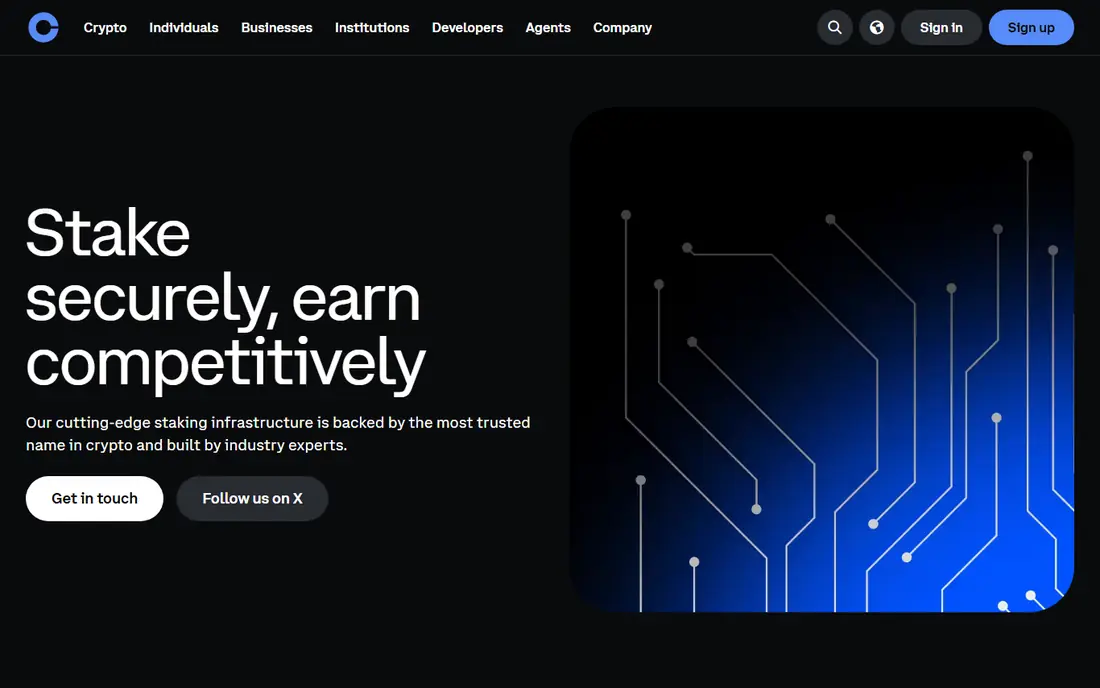
Coinbase staking suits beginners who already hold crypto on the exchange. You can stake supported assets in a few clicks, track rewards in the app, and unstake under the terms shown for each asset. The interface removes wallet setup, validator choice, and technical steps that put many people off DeFi staking.
Custody is the main drawback. Assets staked through Coinbase are held by the exchange, and fees reduce the reward you receive. Some assets and rewards are also restricted by location. For users who prioritize simplicity and a familiar app over self-custody, Coinbase is a practical entry point, but it is not the same as staking directly on-chain.
- Simple interface
- Many supported assets
- Regulated US exchange
- You do not hold your keys
- Fees reduce rewards
- Availability varies by state and asset
Kraken offers staking for a wide range of proof-of-stake assets, with reward estimates and bonding periods shown per asset. The platform has a long history as an exchange, and its staking interface is straightforward for users who already trade there. Bonded and flexible options give some choice over lockup and reward trade-offs.
As with any exchange, you rely on Kraken for custody and operations, and rewards are not guaranteed. US availability also varies, so check whether your asset and state are supported before depositing funds. For traders who want many staking options in one exchange account, Kraken covers more assets than most rivals.
- Wide staking asset list
- Clear reward estimates
- Established exchange
- Custodial staking
- Reward rates change
- US availability varies by asset
Binance offers one of the widest staking ranges, including flexible staking, locked staking, and DeFi staking products across many assets. That breadth suits users who hold many different coins and want to stake them without moving funds to many protocols. Liquidity and product choice are strong.
Complexity and regulation are the downsides. Product terms, lockups, and availability vary by country, and US users use a separate Binance US platform with a different range. Custody also sits with the exchange for most products. For experienced users outside restricted regions, Binance offers breadth, but beginners should read each product term carefully.
- Very wide asset and product range
- Flexible and locked options
- Large liquidity
- Regulatory limits vary by country
- Product complexity can confuse beginners
- Custodial risk
EigenLayer lets users restake ETH, or liquid staking tokens, to secure additional services called actively validated services. In return, restakers may earn extra rewards on top of base Ethereum staking rewards. That extra yield is the reason many DeFi users follow EigenLayer closely.
The added yield comes with added risk. Restaked assets face extra slashing conditions if a service fails or misbehaves, and smart contract risk grows with each layer. Returns are also variable and not guaranteed. EigenLayer suits experienced Ethereum users who understand restaking risk. Beginners should master basic staking first.
- Lets staked ETH secure additional services
- Potential extra yield
- Growing ecosystem
- Added slashing and smart contract risk
- Yields are variable
- Complexity is high
Marinade is a leading liquid staking protocol on Solana. You stake SOL and receive mSOL, which can be used across Solana DeFi while your SOL helps secure the network. Marinade spreads stake across many validators using an automated strategy, which aims to improve decentralization and performance.
Solana price volatility, network outages in the past, and smart contract risk all apply. Fees also reduce rewards, and using mSOL in other DeFi apps adds further protocol risk. For Solana holders who want liquid staking without running a validator, Marinade is a well-established choice, but it should not be treated as a safe savings account.
- Liquid mSOL token
- Automated validator selection
- Solana DeFi integration
- Solana network and price risk
- Protocol fees
- DeFi composability adds risk
Jito offers Solana liquid staking with an extra layer: its validators also earn rewards linked to maximum extractable value, or MEV, which can raise total returns compared with plain staking in some periods. Users receive JitoSOL, a liquid token that can be used in Solana DeFi apps.
MEV rewards are variable and can fall, so total yield is not stable. Jito also adds protocol and validator risk on top of Solana market risk. For Solana users who want liquid staking and are comfortable with a more complex reward model, Jito is a notable option. For users who want the simplest Solana staking, a plain liquid staking token may be easier to understand.
- Liquid JitoSOL token
- Extra MEV-related rewards
- Solana DeFi support
- MEV rewards vary
- Added protocol complexity
- Solana market risk
Figment provides staking infrastructure for institutions, exchanges, wallets, and large holders across many proof-of-stake networks. It offers validator operations, reporting, and custody integrations that suit funds, custodians, and platforms that stake on behalf of clients. Reliability and compliance reporting are central to its pitch.
Retail users with a small holding will find Figment less direct than Lido, Marinade, or an exchange. Pricing is quote-based and minimums may apply. For institutions that need managed staking across networks with reporting, Figment is a serious option. For individual stakers, a consumer platform fits better.
- Institutional-grade staking infrastructure
- Many networks
- Reporting and custody options
- Not built for small retail stakers
- Pricing is quote-based
- Minimums may apply
How we picked these
We compared official protocol and exchange pages, supported assets, custody models, fee structures, and risk disclosures for staking platforms live in 2026. We favored platforms with a clear track record, public documentation, and a range of custody choices, from self-custody DeFi protocols to custodial exchanges and institutional providers. Yields shown on vendor pages change often, so we used See website for pricing and recommend checking the current rate, lockup, and fee terms before staking.
How to weigh staking risk before you stake
Start with custody. Self-custody DeFi staking keeps control with you but puts wallet security and protocol risk on you. Exchange staking is simpler but depends on the exchange staying solvent and honoring withdrawals. Neither route removes market risk, since the staked asset itself can fall in price.
Next, check lockups and liquidity. Liquid staking tokens can be traded, but they can trade at a discount in stressed markets. Locked staking may offer a higher headline rate but leaves you unable to sell during a fall. Read the unstaking period, any early exit penalty, and whether rewards are paid in the same asset or a different token.
Finally, check slashing and smart contract risk. Validators can be penalized for downtime or misbehavior, and protocols can suffer bugs or exploits. Diversifying across validators or protocols can reduce single-point risk, but it does not remove it. Stake only funds you can afford to lose, and keep records for tax reporting.
FAQ
What is DeFi staking?
DeFi staking means locking crypto assets in a decentralized protocol to help secure a proof-of-stake network and earn rewards. Unlike exchange staking, you often interact directly with a smart contract through a wallet.
Is staking crypto safe?
No staking is fully safe. Risks include price falls, validator slashing, smart contract bugs, lockups, and exchange failure for custodial staking. This is not financial advice, and you should research each protocol before staking.
What is liquid staking?
Liquid staking gives you a token, such as stETH or mSOL, that represents your staked asset and can be traded or used in DeFi. It improves liquidity but adds token price and protocol risk.
How are staking rewards taxed?
Tax treatment varies by country and can treat rewards as income when received or when sold. Keep records of amounts, dates, and values, and speak to a tax professional for your situation.
Can I unstake at any time?
It depends on the platform and asset. Some offer flexible unstaking, while others have bonding periods, lockups, or exit queues. Check the unstaking terms before you stake, since they affect how fast you can sell.
Which staking platform is best for beginners?
Coinbase and Kraken are simplest for beginners because they handle wallets and validators for you. Lido and Marinade suit users who are comfortable with DeFi wallets and want liquid staking tokens.