Best Decision Management Software for 2026: Our 5 Vetted Picks
Best decision management software in 2026: 5 tools with starting prices, free plans and limits. Trade-offs are spelled out for each entry. Numbers first.
- Editor's choice
 Appian
AI-powered process orchestration
Starts atSee websiteVisit appian.comFull review - Great alternative
 Camunda
Open agentic orchestration with governance
Starts atSee websiteVisit camunda.comFull review - Also consider
 IBM Operational Decision Manager
Rules-based decision automation at scale
Starts atSee websiteVisit ibm.comFull review
Direct answer
For AI-powered process orchestration, Appian is where this list starts. Listed starting prices: Decisions from $4000 per month. Camunda is better for open agentic orchestration with governance, and IBM Operational Decision Manager is better for rules-based decision automation at scale. The remaining 2 options are covered below with prices and limits.
TL;DR:
- The list opens with Appian, aimed at AI-powered process orchestration.
- For the cheapest start, look at Decisions: $4000 per month.
- None of the 5 tools, from Appian to Decisions, has a free plan, so budget for a subscription or use a trial.
- Decisions is the one to check for workflow automation and AI governance.
- Appian comes with a trade-off: System breadth needs planning.
Last checked November 2026. Prices and plan details were read from the vendors' own pages in November 2026; vendors change plans often, so confirm the current price on the vendor site before you buy.
Quick comparison
| Tool | Best for | Starts at | Free plan? | |
|---|---|---|---|---|
| Appian | AI-powered process orchestration | See website | Not stated | Visit |
| Camunda | Open agentic orchestration with governance | See website | Free trial | Visit |
| IBM Operational Decision Manager | Rules-based decision automation at scale | See website | Not stated | Visit |
 Pega Platform | Orchestrating agents, people, and systems | See website | Not stated | Visit |
| Decisions | Workflow automation and AI governance | $4000 per month | Not stated | Visit |
Decision Management Software, one by one
This LinkVetted guide covers 5 options for decision management software. Each profile lists a starting price, free plan details, strengths and drawbacks, so you can drop poor fits quickly.
Appian makes the most sense for AI-powered process orchestration. As with any wide orchestration product, success relies on thoughtful integration and governance planning. Some organizations may find the system gives you more capability than a single decisioning use case needs.
Where it falls short: May need integration effort.
Appian offers AI automation for critical processes. It orchestrates AI agents, systems, and people on an enterprise product without replacing your existing systems, which fits organizations that require to coordinate decisions across a heterogeneous application landscape. Appian shows no starting price here, so confirm the cost on the vendor site. Trial and free access: Not stated.
- Works without replacing existing systems
- Focus on critical processes
- System breadth requires planning
Pick Camunda if this describes you: open agentic orchestration with governance. Camunda is the open product for agentic orchestration. It coordinates AI agents, people, and systems across end-to-end processes with governance and control, making it a fit for teams that want transparency and adaptability in how decisions and workflows are modeled.
In practice, if you need a completely managed, business-user-first experience, another choice may be more comfortable. Organizations with engineering resources and a preference for open tooling commonly find it a natural choice for process-heavy decision automation. No starting price is listed for Camunda here; confirm pricing on the vendor site. Free access: Free trial.
Watch-outs: Needs technical implementation work.
- Governance and control built in
- Open system for agentic orchestration
- Governance setup needs planning
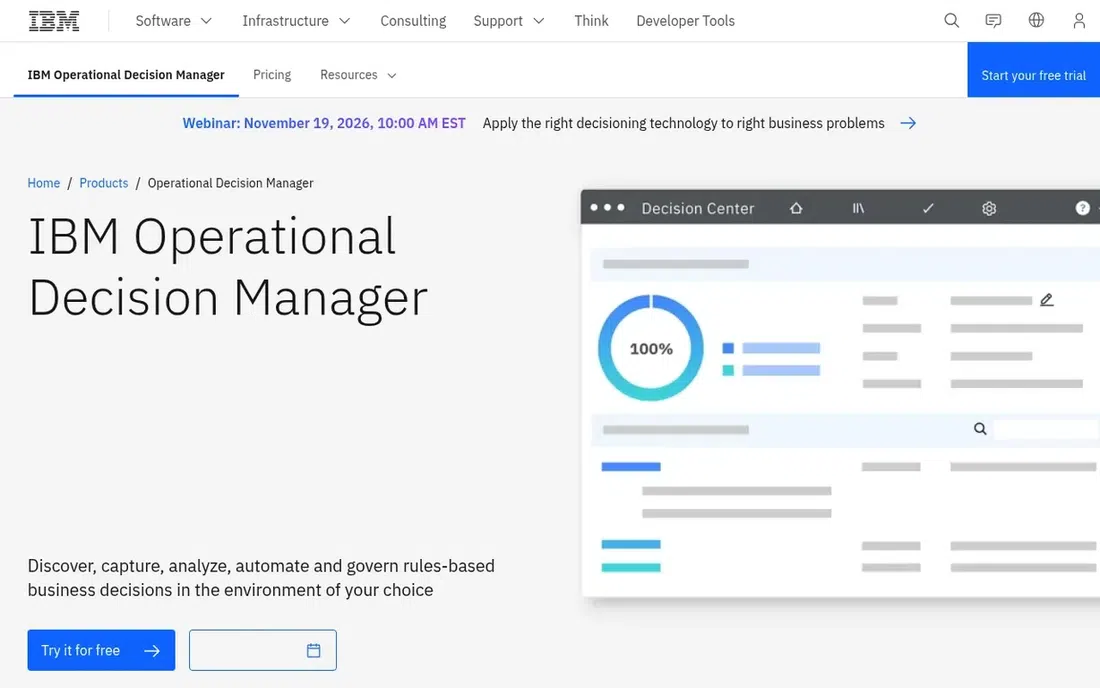
IBM Operational Decision Manager is aimed squarely at rules-based decision automation at scale. IBM Operational Decision Manager is a full decision automation option. It helps teams discover, capture, analyze, automate, and govern rules-based decisions, and it can run on premises or on the cloud.
Beyond that, if your priority is light workflow automation instead of deep rules governance, a process-oriented tool may be a better fit. Beyond that, the product is designed for enterprise-scale governance, so smaller teams may find the setup and administration heavier than they need. Check the vendor site for IBM Operational Decision Manager pricing; none is listed in this comparison. As for free access: Not stated.
The main drawbacks: Enterprise-focused complexity.
- Comprehensive decision automation
- On-premises or cloud deployment
- Can need specialist skills
For orchestrating agents, people, and systems, Pega Platform is a natural candidate. Pega Platform is positioned as a foundation of certainty for orchestrating agents, people, and systems. It is meant to help enterprises coordinate work across automation and human participants on a proven system.
What to check first: Enterprise-oriented configuration.
If your scope is restricted to a single decision service, a more focused tool may get you there with less overhead. Worth adding: the breadth of the system means configuration and administration can be substantial, and teams may need dedicated training. This comparison lists no price for Pega Platform; ask the vendor. Free options: Not stated.
- Orchestrates agents, people, systems
- Proven enterprise product
- Wide product can take time to learn
Decisions
Best for: Workflow automation and AI governance
Decisions is aimed squarely at workflow automation and AI governance. Smaller teams may find the scope bigger than a single decision service needs. If your need is strictly rules authoring, a dedicated rules engine may be a lighter starting point.
Where it falls short: System scope may exceed straightforward needs.
More specifically, Decisions is an AI and process automation product for the enterprise. It automates workflows, governs AI agents, and orchestrates work across your systems, which fits organizations that want a single environment for business process automation and decision governance. What you pay to start with Decisions: $4000 per month. As for free access: Not stated.
- Enterprise process automation focus
- Orchestrates work across systems
- Needs process design effort
Selection criteria
The comparison looks at four things: starting price, free access, how well the feature set matches decision management software, and the main limit of each tool. Figures are shown as the vendors publish them. Billing terms, seat minimums and add-ons can change the real cost. The ranking is editorial: typical fit first, then clear pricing, then free access. If your needs are unusual, read the profiles rather than relying on position.
Questions to settle before buying
- Ask Appian, Camunda, IBM Operational Decision Manager and Pega Platform for a written quote, since no starting price is shown.
- Run a trial of Camunda with real work before paying for a year; your own workflow is the best test.
- Before choosing Appian, weigh its main limit: Product breadth needs planning.
- Ask Camunda which support channels and response times come with the plan you would buy.
- Total up the real monthly cost of IBM Operational Decision Manager, including add-ons, extra users and usage-based fees.
FAQ
Can I try these options before paying?
Often, yes. Camunda offers a free trial. Use your own data and a real task during the test, and check what the free tier or trial limits before you rely on it.
How are the tools for decision management software ordered?
Appian sits first and Decisions last because the order follows typical fit for decision management software, then price clarity and free access. It is a judgement call, so read each profile for fit and limits.
Do these tools publish their prices?
Not all of them. Appian, Camunda, IBM Operational Decision Manager and Pega Platform publish no starting price, so expect a quote request for those. The rest, Decisions included, show a starting price, though seats and billing terms still change the final cost.
Is Appian the right pick for everyone comparing decision management software?
No single tool suits every team. Appian comes first because it fits AI-powered process orchestration, while Camunda suits open agentic orchestration with governance and IBM Operational Decision Manager suits rules-based decision automation at scale. Match the tool to your own size, budget and workflow before deciding.
What should I check before choosing a tool?
Start with how decisions will be authored and changed, then confirm deployment and integration fit. Reviewing vendor documentation for these points helps avoid surprises after purchase.
Sources
- https://appian.com
- https://camunda.com
- https://www.ibm.com/products/operational-decision-manager
- https://www.pega.com/products/platform
- https://decisions.com