DCO Platforms in 2026: A Guide to 7 Tools
Best DCO platforms: 7 tools compared on price, free plans and fit. Adform comes first for European programmatic DCO. Prices and drawbacks included. Start here.
- Editor's choice
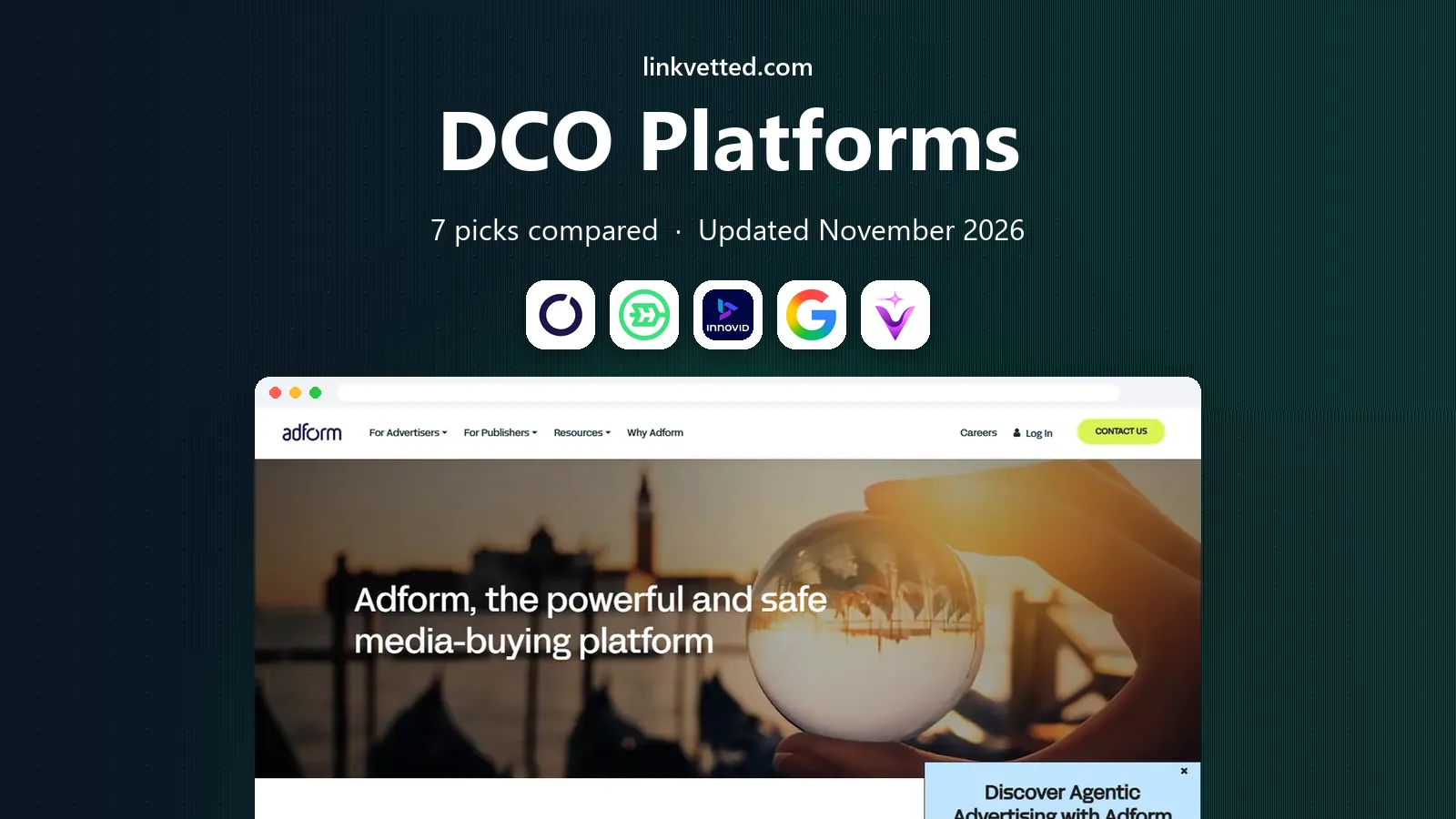
 Adform
European programmatic DCO
Starts atSee websiteVisit site.adform.comFull review - Great alternative
 Hunch
Feed-driven product ads
Starts atSee websiteVisit hunchads.comFull review - Also consider
 Flashtalking
Creative ad serving and DCO
Starts atSee websiteVisit flashtalking.comFull review
TL;DR:
- Number one here is Adform, a fit for European programmatic DCO.
- Bannerflow is the one to check for scaling display creative.
- None of the 7 tools, from Adform to Bannerflow, has a free plan, so budget for a subscription or use a trial.
- Adform, Bannerflow and the 5 others all sell by quote; expect sales conversations before you see a price.
- Check the limits for Hunch before you commit: narrower than full DCO suites.
Direct answer
Start with Adform if you need European programmatic DCO. Hunch fits feed-driven product ads; Flashtalking fits creative ad serving and DCO. Prices, free plans and limits for all 7 tools follow.
Quick comparison
| Tool | Best for | Starts at | Free plan? | |
|---|---|---|---|---|
| Adform | European programmatic DCO | See website | No | Visit |
| Hunch | Feed-driven product ads | See website | No | Visit |
| Flashtalking | Creative ad serving and DCO | See website | No | Visit |
 Display & Video 360 | Google-stack advertisers | See website | No | Visit |
 DaVinci Commerce | Commerce media creative | See website | No | Visit |
 Celtra | Enterprise creative automation | See website | No | Visit |
 Bannerflow | Scaling display creative | See website | No | Visit |
DCO Platforms, one by one
Choosing DCO platforms usually comes down to price, fit and limits. This LinkVetted guide sets 7 tools side by side on those three points, with the facts kept short and checkable.

For European programmatic DCO, Adform is a natural candidate. The system is enterprise-positioned with custom pricing. But the DSP-plus-DCO combination is genuinely convenient: when the same platform buys the media and assembles the creative, optimization loops tighten substantially.
Trade-offs to know: Enterprise positioning.
Worth adding: US advertisers will find a smaller footprint and partner network than domestic alternatives. In practice, for advertisers running programmatic across European markets, the integrated stack eases both buying and creative. Pricing for Adform is not stated here, so ask the vendor for current figures. Adform has no free tier.
- Solid in Europe
- Transparent product
- Smaller US presence
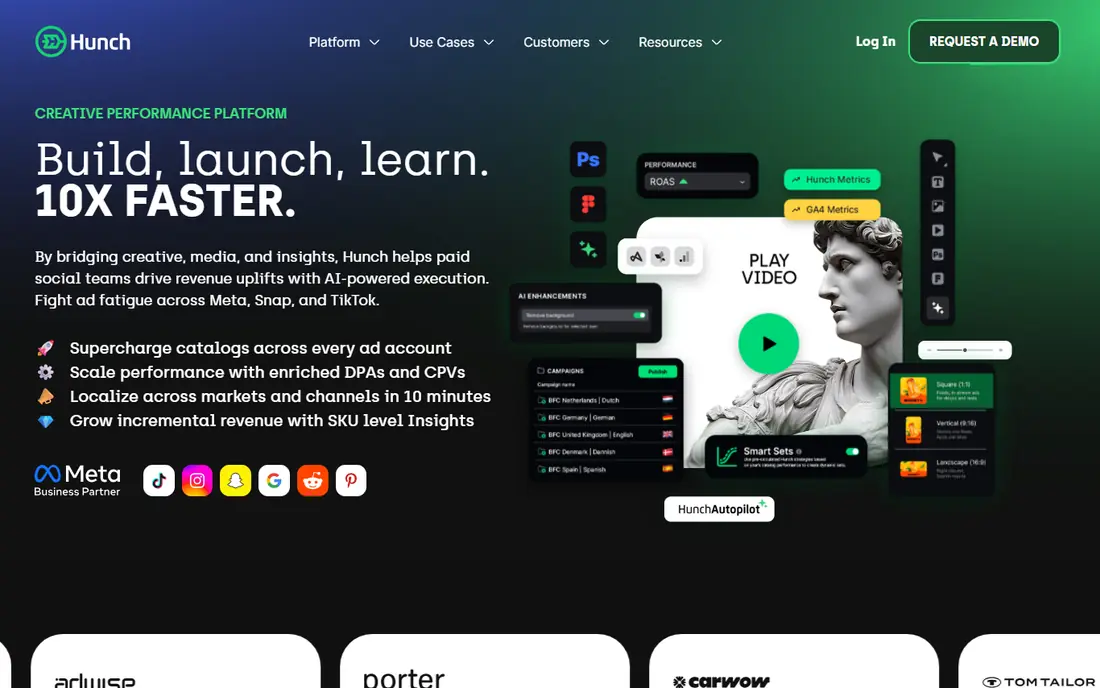
For feed-driven product ads, Hunch is a natural candidate. Hunch concentrates on the most demanding corner of dynamic creative: product catalog ads. It ingests product feeds and produces thousands of on-brand variants for social and programmatic, updating creative automatically as prices, inventory, and promotions change.
Watch-outs: Narrower than full DCO suites.
For everyday use, for retailers and ecommerce advertisers running dynamic product ads at scale, though, a feed-native tool beats a general system trying to include the same ground. The specialization is also the boundary. Ecommerce and retail advertisers get the highest-volume use case for DCO handled by a purpose-built tool. No starting price is listed for Hunch here; confirm pricing on the vendor site. Hunch has no permanent free option.
- Ecommerce focus
- Quick variant generation
- Best for product advertisers
Think of Flashtalking for creative ad serving and DCO. Like most ad-tech infrastructure, it is sold to sophisticated buyers through enterprise channels.
The interface reflects its ad-serving roots instead of modern creative-tool polish. Pricing for Flashtalking is not stated here, so ask the vendor for current figures. Flashtalking has no permanent free option.
Drawbacks to consider: Interface reflects ad-tech heritage.
- Cookieless tracking
- Capable measurement
- Enterprise sales motion
For Google-stack advertisers, Display & Video 360 is a natural candidate. Display & Video 360 pairs with Studio (formerly Google Web Designer workflows) to assemble personalized display and video creative from data feeds, then serves the right variant to each audience.
For advertisers already buying YouTube, Display, and programmatic through Google, the integration removes the usual handoff between creative tools and media buying. On top of that, DV360's DCO performs best with Google inventory and Google data, and pricing reflects enterprise media commitments. Check the vendor site for Display & Video 360 pricing; none is listed in this comparison. There is no free plan with Display & Video 360.
Trade-offs to know: Google-centric.
- Studio for dynamic creative
- Massive reach
- Enterprise pricing and contracts
For Commerce media creative, DaVinci Commerce is a natural candidate. Large consumer brands use it to personalize product ads across retailers and marketplaces.
For everyday use, the product merges creative optimization with rapid activation across retail media networks, promising campaigns that go from creative to live in minutes. Check the vendor site for DaVinci Commerce pricing; none is listed in this comparison. DaVinci Commerce has no permanent free option.
Where it is weaker: Commerce-centric may not fit all advertisers.
- AI-driven commerce creative
- Quick campaign activation
- New brand identity
For enterprise creative automation, Celtra is a natural candidate. Celtra has spent years refining creative automation for large brands. From a buyer's view, the product turns master creative into thousands of on-brand variants for display, social, and video, with rules that keep every version compliant with brand guidelines.
This is enterprise software with enterprise pricing and onboarding. Also, smaller advertisers will find it more than they need. Pricing for Celtra is not stated here, so ask the vendor for current figures. Celtra has no permanent free option.
Points against: Enterprise pricing.
- Brand control features
- Good analytics
- Implementation takes planning
Think of Bannerflow for scaling display creative. Designers build responsive ads in a visual editor, localize them for dozens of markets, and push live updates to running campaigns without re-trafficking.
For advertisers whose media plan is display-heavy, Bannerflow's simplicity and localization workflow are solid advantages. Bannerflow does not show a starting price in this comparison, so check the vendor site for current pricing. No free plan comes with Bannerflow.
Limits to weigh: Display-focused.
- Decent collaboration tools
- Live campaign updates
- Less depth in video and CTV
How we compared the tools
The comparison looks at four things: starting price, free access, how well the feature set matches DCO platforms, and the main limit of each tool. Seat minimums, billing terms and add-ons can move the real cost, so the starting prices here are a guide and not a quote. We ordered the tools by general fit, then by how clearly pricing is shown, then by free access. A buyer with unusual needs may reorder them.
What to confirm before you sign up
- Request quotes from Adform, Bannerflow and the others; the list shows no fixed prices.
- Read the limits listed for Adform first: smaller US presence.
- Check how data leaves Display & Video 360: formats, limits and whether exports are available on every plan.
- See whether Adform offers onboarding or training, and whether it is included in the price.
- Check the integration list for Hunch against the tools you run today, and note which ones need a higher plan.
FAQ
How are the tools for DCO platforms ordered?
Adform sits first and Bannerflow last because the order follows typical fit for DCO platforms, then price clarity and free access. It is a judgement call, so read each profile for fit and limits.
Is Adform the right pick for everyone comparing DCO platforms?
No single tool suits every team. Adform comes first because it fits European programmatic DCO, while Hunch suits feed-driven product ads and Flashtalking suits creative ad serving and DCO. Match the tool to your own size, budget and workflow before deciding.
What budget do I need for DCO to make sense?
DCO pays off with scale: enough impressions for the personalization to matter and enough creative variation to justify automation. As a rough guide, advertisers spending mid-five figures monthly on digital media start seeing returns. Below that, the product cost commonly exceeds the performance lift. More specifically, small advertisers should master entry-level creative testing first.
Does any tool for DCO platforms here have a free plan?
No tool in this list, Adform and Bannerflow included, has a permanent free plan. Trials and quotes are the usual route, so plan a short evaluation period.
Do these tools publish their prices?
No. None of the tools, from Adform to Bannerflow, shows a fixed starting price here, so budget time for quotes.