Best Day Trading Platform Canada in 2026: 8 Brokers Compared
Compare the best day trading platform Canada options in 2026. We review commissions, tools, currency costs and risks for eight Canadian brokers in detail here.
- Editor's choice
 Questrade
Active Canadian traders
Starts atFreeVisit questrade.comFull review - Great alternative
 Wealthsimple Trade
Beginners and simple trading
Starts atFreeVisit wealthsimple.comFull review - Also consider
 Interactive Brokers Canada
Serious global traders
Starts atSee websiteVisit interactivebrokers.caFull review
TL;DR:
- Questrade, Wealthsimple and several bank brokers now offer $0 stock and ETF trades, so commissions alone no longer decide the winner.
- Currency conversion, data fees and margin rates often matter more than the headline commission for active Canadian traders.
- Interactive Brokers suits serious traders who need global markets and low currency costs, while Wealthsimple suits beginners.
- This is not financial advice. Day trading carries a high risk of loss, and most short-term traders lose money over time.
- Use a practice account, a written plan and strict position limits before you risk real money on fast trades.
Quick comparison
| Tool | Best for | Starts at | Free plan? | |
|---|---|---|---|---|
| Questrade | Active Canadian traders | Free | Yes | Visit |
| Wealthsimple Trade | Beginners and simple trading | Free | Yes | Visit |
| Interactive Brokers Canada | Serious global traders | See website | No | Visit |
 Qtrade Direct Investing | Balanced bank-backed trading | Free | Yes | Visit |
 TD Direct Investing | TD customers and research | See website | No | Visit |
 CIBC Investor's Edge | CIBC customers | See website | No | Visit |
 RBC Direct Investing | RBC customers | See website | No | Visit |
 National Bank Direct Brokerage | $0 trades with a bank | Free | Yes | Visit |
The best day trading platform Canada
Day trading in Canada means buying and selling securities within the same day, often many times, to profit from small price moves. The right broker affects your commissions, currency costs, charting tools, data feeds and margin rates, all of which shape results. We compared official pricing pages and platform features for Canadian brokers that support active trading.
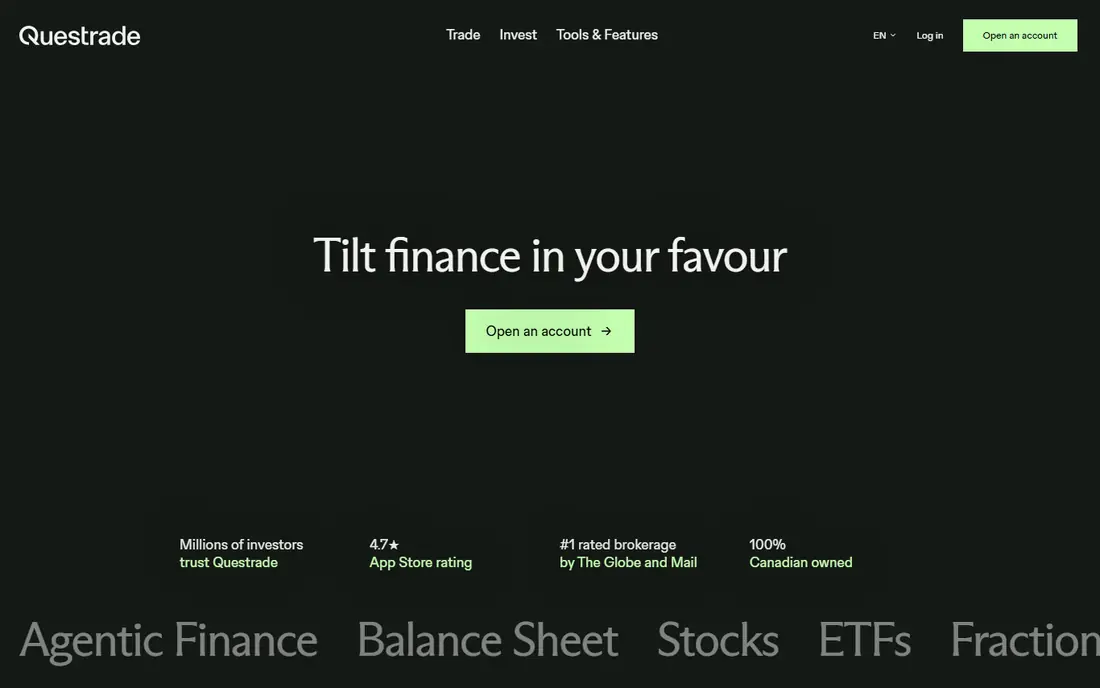
Questrade is a strong default for Canadian day traders because it pairs $0 stock and ETF trades with platforms built for active use. Its desktop and web tools offer charts, watchlists, level 2 data options and order types that short-term traders need, without the higher per-trade fees of many bank brokers. Dual-currency accounts let you hold Canadian and US dollars, which helps if you trade US stocks often.
The main cost to watch is currency. Converting Canadian dollars to US dollars costs 1.5 percent each way unless you use a journaling method, which can eat into small day-trading gains. ECN fees can also apply to some orders. If you trade mostly Canadian stocks or you plan your currency moves carefully, Questrade offers a strong balance of price and tools.
- $0 stock and ETF trades
- Active trader platforms
- Dual-currency accounts
- 1.5 percent currency conversion cost
- ECN fees can apply to some orders

Wealthsimple Trade suits beginners who want to start trading without a complex platform. Its app is clean, account setup is fast, and stock and ETF trades are $0. That simplicity helps new traders focus on learning position sizing and risk control rather than fighting a dense desktop terminal.
Serious day traders will feel the limits. Charting, screening and order types are lighter than Questrade or Interactive Brokers, and real-time data plus a US dollar account may cost extra at lower tiers. Currency conversion also costs 1.5 percent from a Canadian dollar account. Wealthsimple is a good learning platform and a fine broker for simple trades, but active traders usually graduate to a deeper tool.
- $0 stock and ETF trades
- Very easy mobile app
- Simple account setup
- Limited advanced charting and order types
- 1.5 percent currency conversion on CAD accounts

Interactive Brokers Canada is the choice for traders who need more than Canadian and US stocks. It covers many global markets, offers a huge range of order types and algorithmic tools, and charges near-spot currency conversion with a small minimum. That currency edge matters a lot for traders who move between Canadian and US dollars daily.
The platform is not beginner friendly. Trader Workstation has a steep learning curve, and commissions are per share rather than $0 per trade, so small trades can cost more than at Questrade. Margin also carries real risk and interest costs. If you trade actively across markets and you value low currency and margin costs, Interactive Brokers is hard to beat. If you are new, start elsewhere.
- Very low currency conversion cost
- Global markets and order types
- Low margin rates for qualified traders
- Complex platform for beginners
- Per-share commissions instead of $0 flat trades
Qtrade, part of Aviso, gives Canadian traders a balanced mix of $0 stock and ETF trades, a clean platform and bank-backed stability. Its research, screeners and account tools suit investors who trade often but do not need the deepest professional terminal. Options pricing is also competitive for occasional options traders.
The limit for pure day traders is tool depth. Its charts and order features cover most needs, but they do not match the active-trader platforms at Questrade or Interactive Brokers. Data packages may also add cost. Qtrade fits traders who want $0 trades, a tidy platform and a stable firm, without the complexity of a professional terminal.
- $0 stock and ETF trades
- Clean platform and research
- Options at low per-contract cost
- Advanced day-trading tools are lighter than Questrade or Interactive Brokers
- Data add-ons may cost extra
TD Direct Investing suits TD customers who value research, education and an integrated bank and brokerage view. Its platforms offer advanced charting, screeners and market data, and its research library is deeper than most discount rivals. For investors who trade less often but want strong tools, TD is a credible choice.
For day trading, the $9.99 standard commission is the problem. Active traders pay far more per round trip than at $0 brokers, even with a lower rate at very high quarterly volume. That cost compounds fast for small trades. TD makes sense if you already bank with TD, trade less frequently, and value its research. Pure day traders should pick a $0 broker instead.
- Strong research and education
- Advanced trading platforms
- Broad product access
- $9.99 standard stock trade, lower only at high volume
- Higher cost for frequent small trades
CIBC Investor's Edge fits CIBC customers who want investing inside their existing bank relationship. It offers a list of commission-free ETFs, research tools and a single view of banking and investing. For occasional traders and long-term investors, that convenience has real value.
Day traders face the same issue as at TD: standard stock commissions cost more than at $0 brokers, so frequent small trades add up. Its trading tools are solid but not as deep as dedicated active platforms. If you bank with CIBC and trade a few times a month, Investor's Edge is convenient. If you trade daily, a $0 broker will save you far more.
- Low-cost ETF list
- Integrated CIBC banking view
- Solid research tools
- Standard stock trades cost more than $0 rivals
- Advanced trader tools are moderate
RBC Direct Investing suits RBC customers who want one login for banking and investing plus broad research. Its platforms cover stocks, ETFs, options and mutual funds, and its education and practice tools help new investors learn before they trade with real money. That bank integration appeals to many Canadian households.
The $9.95 standard commission makes it costly for day trading, even with some free ETF trades and account-based free trade offers. Frequent traders will pay far more than at Questrade, Wealthsimple or Qtrade. RBC fits best for RBC customers who trade occasionally and value integration. Daily traders should look at $0 options first.
- Integrated RBC banking
- Broad research
- Practice accounts and education
- $9.95 standard stock trade
- Higher cost for frequent trading
National Bank Direct Brokerage gives bank customers $0 stock and ETF trades without leaving a major bank. That combination appeals to traders who want low commissions plus the stability and service of a large bank. Its platform covers the core trading, research and account needs of most active investors.
Two details need checking. An annual administration fee may apply unless you meet a waiver, such as holding enough eligible assets or meeting an age condition. Its tools are also less focused on professional day trading than Questrade or Interactive Brokers. If $0 trades plus a bank relationship matter most, National Bank is a strong pick. If you need the deepest active tools, pair it with a specialist platform comparison.
- $0 stock and ETF trades
- Bank-backed stability
- Broad market access
- Annual administration fee may apply unless waived
- Platform is less active-trader focused
How we picked these
We compared official pricing pages, trading platforms, currency costs, margin rates and account features for Canadian brokers that support active trading. We favored brokers regulated in Canada, with clear pricing and tools for charts, orders and market data. We also weighed bank integration, since many Canadians prefer one firm for banking and investing. Prices change often, so confirm commissions, data fees and margin rates on the broker page before you open an account.
How to choose a day trading platform in Canada
Start with your trading style and your markets. If you trade Canadian stocks in small size, a $0 broker with a good charting platform is enough. If you trade US stocks daily, currency cost becomes a major factor, and Interactive Brokers or a careful journaling method may save more than a $0 commission. If you trade options, futures or global stocks, check product access before you fund an account.
Next, test the platform with a practice account. Check chart speed, order entry, stop and limit orders, level 2 data costs and mobile alerts. A platform that lags during a fast market can cost more than any commission saving. Also check margin rules, interest rates and account minimums, since margin trading can amplify losses fast. Never trade on margin until you understand the interest cost and the risk of a margin call.
Control risk before you chase returns
Day trading carries a high risk of loss, and this article is not financial advice. Set a maximum loss per trade and per day, use stop orders where appropriate, and keep position sizes small relative to your account. Avoid trading with money you need for rent, bills or debt payments, and keep a written log of trades so you can learn from mistakes. If trading causes stress or losses you cannot afford, stop and seek independent financial advice.
Watch taxes and record keeping
In Canada, frequent trading may be treated as business income rather than capital gains, depending on your activity and intent, so keep detailed records of every trade, fee and currency conversion. Talk to a tax professional about your situation before you assume capital gains treatment. Good records also help you review performance honestly, rather than remembering only the wins.
FAQ
What is the best day trading platform in Canada for beginners?
Wealthsimple Trade is the easiest start because of its simple app and $0 stock and ETF trades, while Questrade offers a stronger step up with better active tools at the same $0 commission. Start with a practice account, learn risk control, and move to a deeper platform only when you need its tools.
Is day trading legal in Canada?
Yes, day trading is legal in Canada through regulated brokers, but it carries high risk and may have tax consequences. Brokers must follow Canadian rules, and margin accounts carry extra requirements. Check your broker disclosures, understand margin risk, and never trade with borrowed money you cannot afford to repay.
How much money do I need to day trade in Canada?
Many $0 brokers let you open an account with no minimum, but day trading with a tiny account is risky because fees, spreads and currency costs eat into small trades. A larger account gives you room for position sizing and risk control, but it also means larger potential losses. Start small, learn first, and only add funds you can afford to lose.
Why does currency conversion matter for Canadian day traders?
If you trade US stocks from a Canadian dollar account, a 1.5 percent conversion fee each way can erase small gains fast. Interactive Brokers charges near-spot conversion, while Questrade and Wealthsimple charge 1.5 percent on direct conversions. Using a US dollar account or a journaling method can reduce that cost, but each method has its own fees and delays.
Do Canadian brokers offer practice accounts?
Yes, several brokers offer practice or demo accounts, including RBC Direct Investing and others with paper trading features. A practice account helps you learn order entry, charting and risk control without risking real money. Treat practice results with care, since real trading adds emotion, slippage and fees that a demo may not fully show.