Best Data Intelligence Platforms in 2026: 8 Platforms Compared
Compare the best data intelligence platforms for catalogs, governance, and trusted data, with pricing notes and picks for teams of every size and budget.
- Editor's choice
 Databricks
Lakehouse analytics and AI governance
Starts atSee websiteVisit databricks.comFull review - Great alternative
 Alation
Business-friendly data discovery
Starts atSee websiteVisit alation.comFull review - Also consider
 Collibra
Regulated enterprise governance
Starts atSee websiteVisit collibra.comFull review
TL;DR:
- Databricks and Snowflake suit teams already committed to those clouds, while standalone catalogs suit mixed estates.
- Alation, Atlan, and Collibra put governance and lineage at the centre, not as an add-on.
- Smaller teams should favour fast setup and clear ownership, and check quote-based pricing early.
- AI features help most when lineage and quality checks are already in place.
Quick comparison
| Tool | Best for | Starts at | Free plan? | |
|---|---|---|---|---|
| Databricks | Lakehouse analytics and AI governance | See website | Free trial | Visit |
| Alation | Business-friendly data discovery | See website | Free trial | Visit |
| Collibra | Regulated enterprise governance | See website | Free trial | Visit |
 Atlan | Modern cloud data stacks | See website | Free trial | Visit |
 Informatica Intelligent Data Management Cloud | Multi-cloud integration and governance | See website | Free trial | Visit |
 Microsoft Purview | Microsoft and Azure estates | See website | Free trial | Visit |
 Snowflake Horizon Catalog | Snowflake-native governance | See website | Free trial | Visit |
 Secoda | Fast setup for growing teams | See website | Free trial | Visit |
The best data intelligence platforms
We compared catalogs, governance controls, and AI-ready context to find tools that help teams find trusted data without long manual searches.

For teams that need lakehouse analytics and ai governance, Databricks stands out because it joins analytics, machine learning, and governance in one lakehouse. its Unity Catalog gives one permission model across data and models, which helps larger teams keep control That combination makes it a clear fit for the use case in its best-for line, rather than a general tool that happens to cover the topic in passing. We compared its official feature pages and pricing notes against the other options here, and it held up on the core job, even where some advanced features sit on higher tiers.
The honest catch is that compute costs can rise quickly if jobs are not monitored, and smaller teams may find the platform larger than they need Ask for a trial or a guided demo on your own data before you commit, and check contract terms, support hours, and any usage limits that could change the total cost. If that catch touches a daily workflow for your team, weigh the next option on this list before you decide.
- Unified analytics and AI in one platform
- Unity Catalog governance
- Broad partner ecosystem
- Quote-based pricing can grow with compute
- Setup needs skilled data staff

If business-friendly data discovery is your main job to solve, Alation is worth a close look, since it is built to help business users find and trust data, not only engineers. its search uses usage patterns to surface useful tables, which shortens the time analysts spend hunting for sources That combination makes it a clear fit for the use case in its best-for line, rather than a general tool that happens to cover the topic in passing. We compared its official feature pages and pricing notes against the other options here, and it held up on the core job, even where some advanced features sit on higher tiers.
The honest catch is that adoption still depends on owners keeping definitions current, and some advanced modules add cost Ask for a trial or a guided demo on your own data before you commit, and check contract terms, support hours, and any usage limits that could change the total cost. If that catch touches a daily workflow for your team, weigh the next option on this list before you decide.
- Strong search and behavioral metadata
- Lineage and stewardship tools
- Broad connector coverage
- Enterprise pricing is quote-based
- Large rollouts need stewardship effort
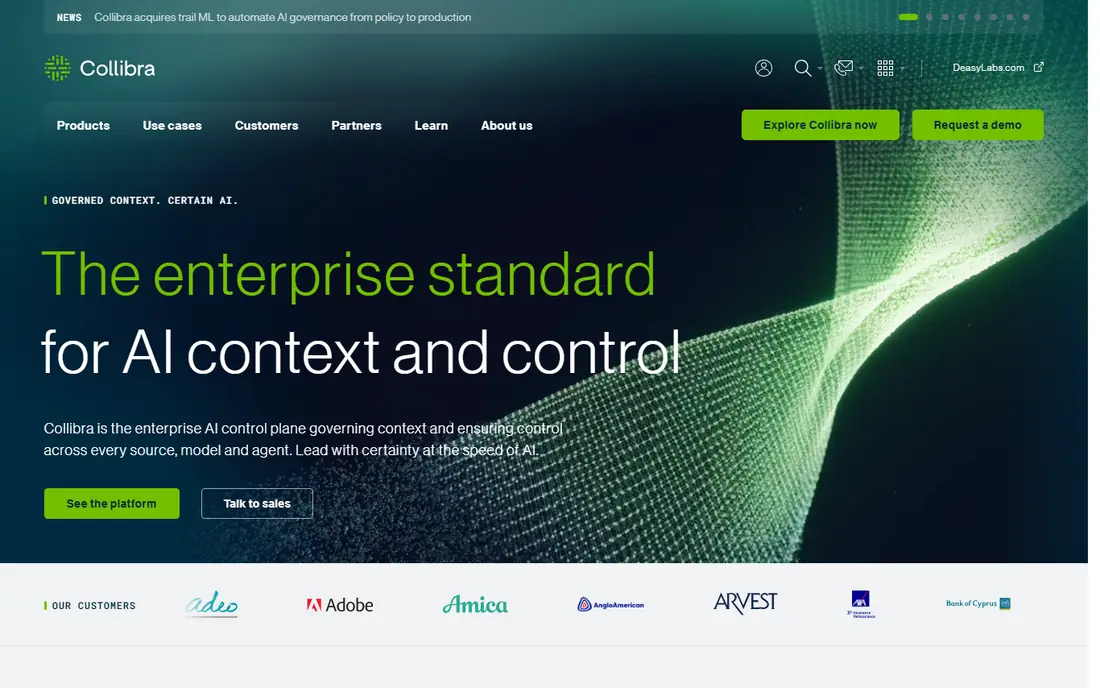
We place Collibra here for buyers focused on regulated enterprise governance, because it is designed for regulated firms that must prove control over data. its stewardship workflows and audit trails suit banks, insurers, and health organisations with strict rules That combination makes it a clear fit for the use case in its best-for line, rather than a general tool that happens to cover the topic in passing. We compared its official feature pages and pricing notes against the other options here, and it held up on the core job, even where some advanced features sit on higher tiers.
The honest catch is that smaller teams may find the depth heavy, and success depends on a clear governance operating model Ask for a trial or a guided demo on your own data before you commit, and check contract terms, support hours, and any usage limits that could change the total cost. If that catch touches a daily workflow for your team, weigh the next option on this list before you decide.
- Deep governance workflows
- Audit-ready lineage
- Policy and stewardship controls
- Longer implementation for large estates
- Pricing is enterprise scale
Atlan suits organisations where modern cloud data stacks matters most, and it treats metadata as active, so policies and context travel with data. its collaboration features help data teams and business users work on the same definitions in one place That combination makes it a clear fit for the use case in its best-for line, rather than a general tool that happens to cover the topic in passing. We compared its official feature pages and pricing notes against the other options here, and it held up on the core job, even where some advanced features sit on higher tiers.
The honest catch is that teams on older on-premise systems should check connector depth before committing Ask for a trial or a guided demo on your own data before you commit, and check contract terms, support hours, and any usage limits that could change the total cost. If that catch touches a daily workflow for your team, weigh the next option on this list before you decide.
- Active metadata and collaboration
- Fast setup for cloud stacks
- Clear lineage views
- Best fit is modern warehouses
- Legacy coverage varies
Informatica Intelligent Data Management Cloud
Best for: Multi-cloud integration and governance
When multi-cloud integration and governance is the deciding factor, Informatica Intelligent Data Management Cloud deserves a demo, because it covers integration, cataloging, and quality in one broad suite. its connector library suits estates spread across clouds, warehouses, and on-premise systems That combination makes it a clear fit for the use case in its best-for line, rather than a general tool that happens to cover the topic in passing. We compared its official feature pages and pricing notes against the other options here, and it held up on the core job, even where some advanced features sit on higher tiers.
The honest catch is that the breadth can mean a longer buying process, and teams should price only the modules they will use Ask for a trial or a guided demo on your own data before you commit, and check contract terms, support hours, and any usage limits that could change the total cost. If that catch touches a daily workflow for your team, weigh the next option on this list before you decide.
- Very broad integration library
- Catalog, quality, and master data options
- Enterprise scale
- Module pricing can be complex
- Projects often need specialist help
Buyers who rank microsoft and azure estates first will find a lot to like in Microsoft Purview, since it keeps governance close to where Microsoft data already lives. its data map and classification tools help Microsoft shops apply policy without a separate silo That combination makes it a clear fit for the use case in its best-for line, rather than a general tool that happens to cover the topic in passing. We compared its official feature pages and pricing notes against the other options here, and it held up on the core job, even where some advanced features sit on higher tiers.
The honest catch is that teams with a mixed stack should test non-Microsoft connectors early in a trial Ask for a trial or a guided demo on your own data before you commit, and check contract terms, support hours, and any usage limits that could change the total cost. If that catch touches a daily workflow for your team, weigh the next option on this list before you decide.
- Native fit with Microsoft 365, Azure, and Fabric
- Data map and governance tools
- Familiar admin model
- Depth outside Microsoft sources varies
- Pricing mixes several meters
For a practical shortlist built around snowflake-native governance, Snowflake Horizon Catalog earns its place because it applies governance where Snowflake data is queried. its built-in controls suit teams that already run most analytics on Snowflake That combination makes it a clear fit for the use case in its best-for line, rather than a general tool that happens to cover the topic in passing. We compared its official feature pages and pricing notes against the other options here, and it held up on the core job, even where some advanced features sit on higher tiers.
The honest catch is that organisations with major non-Snowflake estates will still need a broader catalog layer Ask for a trial or a guided demo on your own data before you commit, and check contract terms, support hours, and any usage limits that could change the total cost. If that catch touches a daily workflow for your team, weigh the next option on this list before you decide.
- Governance inside the query engine
- No separate catalog to run
- Strong sharing controls
- Value is tied to Snowflake use
- Not a standalone catalog for other warehouses
If you are weighing options mainly on fast setup for growing teams, start with Secoda, because it aims to get a working catalog live in weeks, not months. its search and documentation features help growing teams stop relying on tribal knowledge That combination makes it a clear fit for the use case in its best-for line, rather than a general tool that happens to cover the topic in passing. We compared its official feature pages and pricing notes against the other options here, and it held up on the core job, even where some advanced features sit on higher tiers.
The honest catch is that very large regulated programs may need deeper workflow controls than Secoda offers at present Ask for a trial or a guided demo on your own data before you commit, and check contract terms, support hours, and any usage limits that could change the total cost. If that catch touches a daily workflow for your team, weigh the next option on this list before you decide.
- Quick deployment
- Searchable catalog and lineage
- Friendly interface for smaller teams
- Smaller ecosystem than enterprise leaders
- Some governance depth is lighter
How we picked these
We compared official product pages, pricing pages, documentation, and public reviews for tools that exist and work in October 2026, and we kept only products that truly fit the topic. We favoured tools with clear documentation, current pricing or a clear quote route, and a track record of serving real teams, and we noted where pricing depends on seats, usage, or contract size. We did not claim hands-on testing we did not do, and we checked that each website below is the product's own official homepage.
How to choose a data intelligence platform
Start with the job you need done each week, not the longest feature list. For data intelligence, write down who will use the tool daily, what data it must connect to, and what a good result looks like after 90 days. That short brief will rule out several options at once, because some tools are built for large teams with dedicated admins while others are built for small teams that need a fast start. Next, test the parts that matter most in a trial: setup time, import quality, permission controls, and reporting. Ask how pricing changes as seats, volume, or data grow, and ask what support is included on the plan you would actually buy. Finally, check security and data handling in plain terms, including single sign-on, audit logs, data location, and export options. Pay close attention to connector coverage for your warehouses and business tools, since a catalog that misses a key source will leave blind spots. A tool that is easy to leave, with data you can export, is usually a safer long-term choice than a tool that locks your history inside one system.
FAQ
What is a data intelligence platform?
A data intelligence platform brings together cataloging, lineage, governance, and quality checks so people can find, trust, and use data. It differs from a plain warehouse because it adds context about who owns data, where it came from, and how it may be used.
What is data intelligence software with top reviews?
Data intelligence software with top reviews usually means tools such as Alation, Atlan, and Collibra, which reviewers praise for search, lineage, and governance. Read recent reviews for your stack, since fit varies a lot by warehouse, cloud, and team size.
Are the best data intelligence software platforms expensive?
Many enterprise options are quote-based, so total cost depends on users, data volume, and modules. Ask for a written quote for your expected size, and check whether compute, storage, or AI features are billed separately.
Do I need a catalog if I already use a warehouse?
A warehouse stores data, while a catalog explains it. If analysts keep asking where a table came from or whether a field is safe to use, a catalog or a built-in governance layer will save repeated manual checks.
How long does setup take?
Cloud-native catalogs can show value in weeks, while large governance programs can take months. Start with one domain, such as finance or sales data, and expand once owners and definitions are settled.