Best Data Governance Platforms in 2026: 8 Platforms Compared
The best data governance platforms for catalogs, lineage, policy controls and data quality, compared for enterprise and mid-size teams in 2026. - full guide
- Editor's choice
 Collibra
Large enterprises
Starts atSee websiteVisit collibra.comFull review - Great alternative
 Alation
Data-driven enterprises
Starts atSee websiteVisit alation.comFull review - Also consider
 Informatica Cloud Data Governance and Catalog
Enterprises on Informatica
Starts atSee websiteVisit informatica.comFull review
TL;DR:
- Collibra and Informatica suit large enterprises with formal stewardship and compliance needs.
- Atlan and data.world are easier starting points for teams that want adoption fast.
- Microsoft Purview is the natural pick inside a Microsoft and Azure estate.
- Open source DataHub works well for engineering-led teams that can run it themselves.
- Prices and free plans change often, so confirm the current plan, limits and fees on the vendor site before you buy.
Quick comparison
| Tool | Best for | Starts at | Free plan? | |
|---|---|---|---|---|
| Collibra | Large enterprises | See website | Free trial | Visit |
| Alation | Data-driven enterprises | See website | Free trial | Visit |
| Informatica Cloud Data Governance and Catalog | Enterprises on Informatica | See website | Free trial | Visit |
 Atlan | Modern data teams | See website | Free trial | Visit |
 Microsoft Purview | Microsoft and Azure estates | See website | No | Visit |
 IBM watsonx.governance | Enterprises governing AI and data | See website | Free trial | Visit |
 DataHub | Engineering-led teams | Free | Yes | Visit |
 Precisely | Data quality-led governance | See website | Free trial | Visit |
The best data governance platforms
Data governance is about knowing what data you hold, who can use it and whether it can be trusted. We compared platforms on catalogs, lineage, policy workflows and access controls, with a close eye on implementation effort.
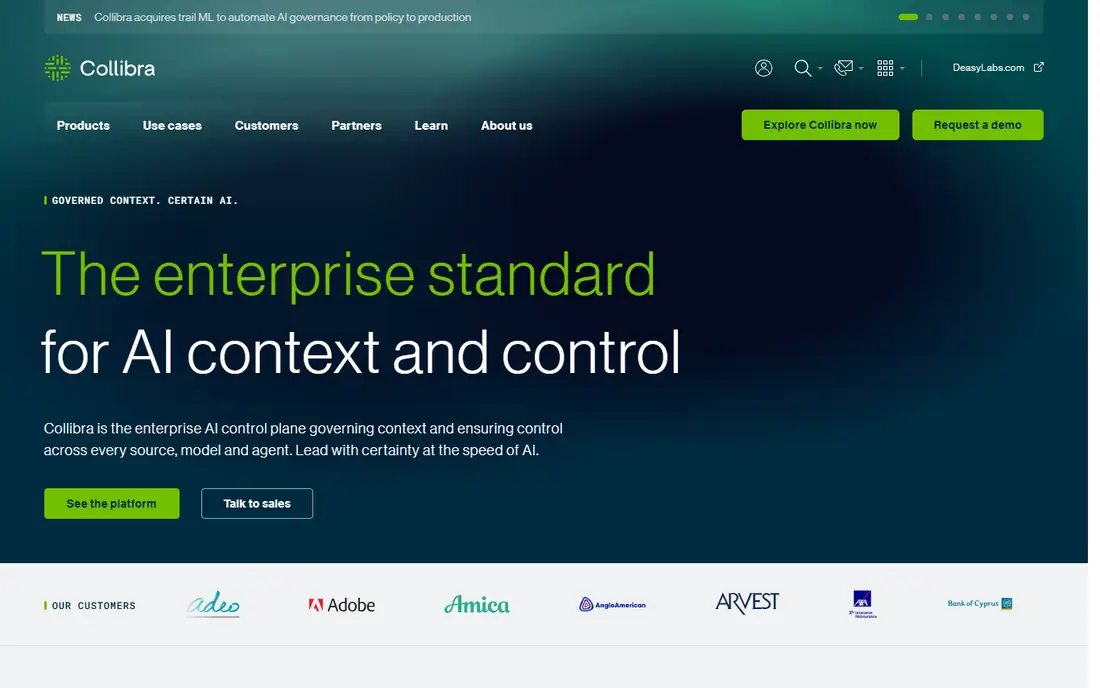
Collibra is the enterprise standard for organisations that need formal governance across many systems.
It combines catalog, lineage, data quality and policy workflows, with clear ownership and approval chains. That depth comes with cost and implementation effort, so it fits teams with a real governance function rather than a single owner.
Before you pay, run a real trial with your own records and confirm the limits on your plan, since headline features often sit on higher tiers. For Collibra, the question to answer in that trial is whether its strengths, including deep catalog, lineage and policy workflows; strong stewardship model; wide connector library, outweigh its drawback, namely quote-based pricing; long implementation for large estates, for the team and budget you actually have.
- Deep catalog, lineage and policy workflows
- Strong stewardship model
- Wide connector library
- Quote-based pricing
- Long implementation for large estates

Alation is a good pick when getting analysts to actually find and trust data is the main goal.
Its search and catalog experience is a strength, with suggestions that help users discover trusted datasets. Policy and workflow features are present, but buyers should check which governance modules are included in their tier.
Before you choose it, test it on the exact job you do most often, and check how it handles errors, exports and support, since those details decide daily value. For Alation, the question to answer in that trial is whether its strengths, including strong search and catalog; machine learning suggestions; broad adoption features, outweigh its drawback, namely quote-based pricing; governance depth varies by tier, for the team and budget you actually have.
- Strong search and catalog
- Machine learning suggestions
- Broad adoption features
- Quote-based pricing
- Governance depth varies by tier
Informatica Cloud Data Governance and Catalog
Best for: Enterprises on Informatica
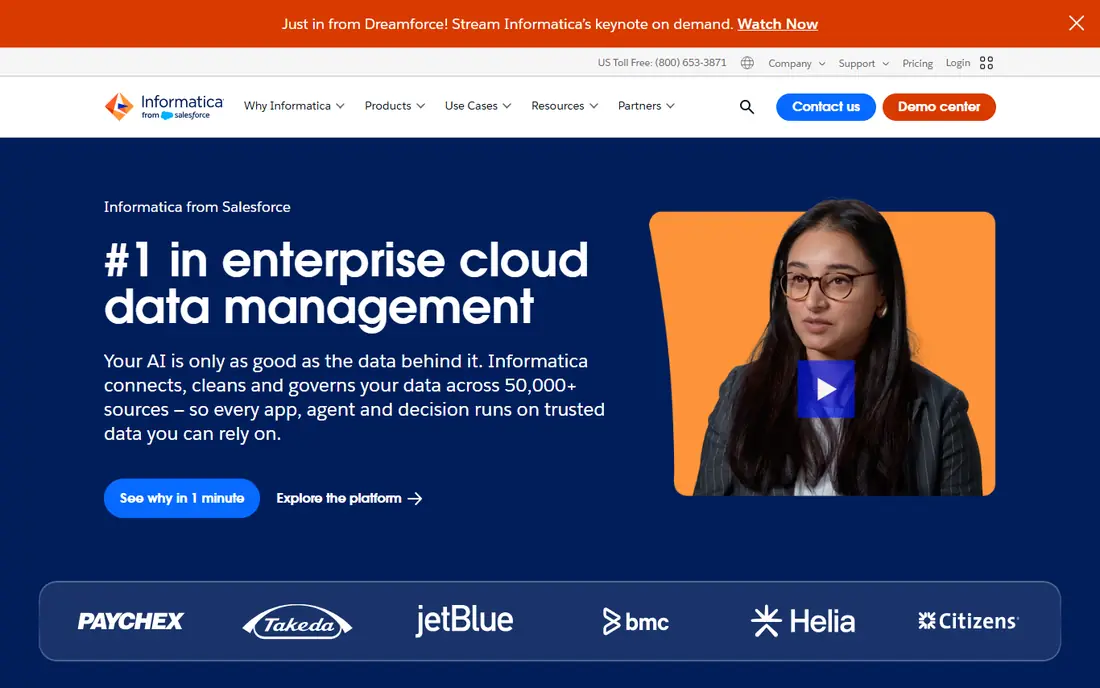
Informatica suits enterprises that already run its integration and quality tools and want governance in the same suite.
Lineage is detailed, and quality checks sit close to governance policies, which helps regulated teams. The suite is broad, so scoping the modules and consumption units you need takes care before you sign.
Before you commit, trial it with your own data and check support response times, because a smooth demo can hide slow help when a live job fails. For Informatica Cloud Data Governance and Catalog, the question to answer in that trial is whether its strengths, including deep lineage; quality and policy in one suite; consumption-based options, outweigh its drawback, namely complex suite; pricing needs careful scoping, for the team and budget you actually have.
- Deep lineage
- Quality and policy in one suite
- Consumption-based options
- Complex suite
- Pricing needs careful scoping
Atlan is the pick for cloud-native teams that want governance to feel like a product people enjoy using.
Its interface and collaboration features help data owners document assets without a heavy process. Setup is faster than the older enterprise suites, though very large regulated estates should test its policy depth in a pilot.
Before you pay, run a real trial with your own records and confirm the limits on your plan, since headline features often sit on higher tiers. For Atlan, the question to answer in that trial is whether its strengths, including modern interface; strong collaboration; fast setup for cloud warehouses, outweigh its drawback, namely quote-based pricing; enterprise controls still maturing in places, for the team and budget you actually have.
- Modern interface
- Strong collaboration
- Fast setup for cloud warehouses
- Quote-based pricing
- Enterprise controls still maturing in places
Microsoft Purview is the obvious first look for any team already standardised on Azure and Microsoft 365.
It maps, classifies and governs data across Azure services and Microsoft apps, with usage-based billing that scales with what you scan. Teams with data mainly outside Microsoft may need a standalone catalog alongside it.
Before you choose it, test it on the exact job you do most often, and check how it handles errors, exports and support, since those details decide daily value. For Microsoft Purview, the question to answer in that trial is whether its strengths, including native azure and microsoft 365 coverage; usage-based pricing; built-in classification, outweigh its drawback, namely less depth outside microsoft sources; governance features vary by tier, for the team and budget you actually have.
- Native Azure and Microsoft 365 coverage
- Usage-based pricing
- Built-in classification
- Less depth outside Microsoft sources
- Governance features vary by tier
IBM watsonx.governance fits enterprises that need to govern AI models as well as the data behind them.
It tracks model facts, monitors risk and ties governance to data assets, which matters as AI use grows. It is a strong fit for IBM customers, while other teams should weigh it against a catalog-first platform.
Before you commit, trial it with your own data and check support response times, because a smooth demo can hide slow help when a live job fails. For IBM watsonx.governance, the question to answer in that trial is whether its strengths, including ai governance focus; model and data oversight; enterprise controls, outweigh its drawback, namely quote-based pricing; best value inside ibm estates, for the team and budget you actually have.
- AI governance focus
- Model and data oversight
- Enterprise controls
- Quote-based pricing
- Best value inside IBM estates
DataHub is the best open source starting point for teams with engineers who can run metadata infrastructure.
It offers a solid catalog, search and lineage without licence fees, and a managed cloud option exists for teams that want support. The catch is operational: you own upgrades, connectors and governance workflows.
Before you pay, run a real trial with your own records and confirm the limits on your plan, since headline features often sit on higher tiers. For DataHub, the question to answer in that trial is whether its strengths, including open source catalog; strong lineage; no licence cost for self-hosting, outweigh its drawback, namely you run and maintain it; governance workflows need building out, for the team and budget you actually have.
- Open source catalog
- Strong lineage
- No licence cost for self-hosting
- You run and maintain it
- Governance workflows need building out
Precisely suits teams whose governance problem starts with data quality and trust.
Its quality, observability and integrity tools help teams prove data is fit for use, which supports governance reporting. Because it is modular, confirm which products are included in your quote before comparing it with an all-in-one suite.
Before you choose it, test it on the exact job you do most often, and check how it handles errors, exports and support, since those details decide daily value. For Precisely, the question to answer in that trial is whether its strengths, including strong data quality and integrity focus; broad data sources; enterprise support, outweigh its drawback, namely modular pricing; catalog experience varies by product, for the team and budget you actually have.
- Strong data quality and integrity focus
- Broad data sources
- Enterprise support
- Modular pricing
- Catalog experience varies by product
How we picked these
We compared official feature pages, pricing pages, app store listings and public reviews for each product, and checked that each one is still offered and working in October 2026. We favoured tools that clearly fit the topic, publish usable pricing or trial information, and have a track record with the audience they claim to serve.
We did not claim hands-on testing we did not do. Instead, we weighed what each vendor documents against what reviewers and users report, and we noted the honest trade-offs, such as quote-based pricing, limited free plans or narrower integrations, so you can shortlist with fewer surprises.
We also checked for signs that a product had changed recently, such as rebrands, closed marketplaces or removed apps, and we left out tools that no longer fit the topic in October 2026. Where a price could not be verified on the vendor site, we wrote See website rather than repeating an old or third-party figure, so the prices you see here are the ones we could stand behind.
How to choose a data governance platform
Governance fails more often on adoption than on features. Pick the platform your data owners will actually use, then check it covers your regulated data.
Start with your worst data problem
If the problem is finding data, prioritise catalog and search. If it is compliance, prioritise policy workflows, lineage and audit trails. Buying both at once is fine, but know which one must work first.
Count the people, not just the licences
Enterprise suites often assume a dedicated governance team. If you have one part-time owner, a lighter platform with strong search and simple workflows will deliver more value in year one.
Check your core sources
Confirm connectors for your warehouse, lakehouse and business tools before you sign. A catalog that misses your main source will sit empty, however good its interface looks.
Set a trial checklist
Write down three tasks your team does every week, then run each one in the trial before you pay. Note how long each task takes, where you get stuck, and what support says when you ask for help. A tool that passes those three tasks is far more likely to survive contact with real work than one that only looked good in a demo.
FAQ
What are the best data governance tools for enterprises?
Collibra, Informatica and Alation are the usual enterprise shortlist, because they cover catalog, lineage, policy and quality in depth. Expect a longer implementation and a dedicated governance team to get full value from them.
What is the difference between a data catalog and data governance software?
A catalog is the inventory of your data: what exists, where it lives and what it means. Governance adds the controls around it, such as ownership, access rules, policies and audit reporting.
Is Microsoft Purview a full data governance platform?
Purview covers data mapping, classification and governance inside Azure and Microsoft 365, and it suits teams already committed to Microsoft. Teams with data spread across many clouds often pair it with, or choose, a standalone platform.
Can open source tools replace commercial governance platforms?
DataHub and similar open source tools can cover the catalog layer well for engineering teams. For compliance workflows, policy enforcement and vendor support, commercial platforms still tend to lead.
How long does implementation take?
Lighter platforms can go live in weeks, while enterprise suites often take several months once stewardship, ownership and policy design are included. Budget time for the people and process work, not just the install.