7 Data Governance Software, Compared by Cost and Features
Best data governance software: 7 contenders ranked by fit, with entry costs and free tiers. Price notes and drawbacks come with each one. Updated November 2026.
- Editor's choice
 data.world
Teams that think in relationships and want a knowledge-graph catalog
Starts atSee website (quote only)Visit data.worldFull review - Great alternative
 BigID
Privacy, security and compliance teams governing sensitive data
Starts atSee website (quote only)Visit bigid.comFull review - Also consider
 Microsoft Purview
Businesses already standardized on Microsoft 365 and Azure
Starts atSee website (usage-based and per-user options)Visit microsoft.comFull review
Direct answer
Start with data.world if you need teams that think in relationships and want a knowledge-graph catalog. BigID is better for privacy, security and compliance teams governing sensitive data, and Microsoft Purview is better for firms already standardized on Microsoft 365 and Azure. The full list of 7 tools follows, with prices and free plan facts.
TL;DR:
- data.world is the opening pick, best for teams that think in relationships and want a knowledge-graph catalog.
- A fair warning about data.world: knowledge-graph modeling is a different skill set from traditional cataloging.
- Informatica IDMC suits large enterprises with hybrid and multi-cloud data estates.
- None of the 7 tools, from data.world to Informatica IDMC, has a free plan, so budget for a subscription or use a trial.
- Every tool from data.world to Informatica IDMC works by quote, with no list price shown.
Quick comparison
| Tool | Best for | Starts at | Free plan? | |
|---|---|---|---|---|
| data.world | Teams that think in relationships and want a knowledge-graph catalog | See website (quote only) | No | Visit |
| BigID | Privacy, security and compliance teams governing sensitive data | See website (quote only) | No | Visit |
| Microsoft Purview | Businesses already standardized on Microsoft 365 and Azure | See website (usage-based and per-user options) | Free trial | Visit |
 Ataccama | Teams that require data quality and governance in one system | See website (quote only) | No | Visit |
 Atlan | Firms building AI-ready governance on active metadata | See website (quote only) | No | Visit |
 Collibra | Regulated enterprises with formal compliance obligations | See website (quote only) | No | Visit |
 Informatica IDMC | Large enterprises with hybrid and multi-cloud data estates | See website (quote only) | No | Visit |
Data Governance Software profiles
Choosing data governance software usually comes down to price, fit and limits. This LinkVetted guide sets 7 tools side by side on those three points, with the facts kept short and checkable.
data.world
Best for: Teams that think in relationships and want a knowledge-graph catalog
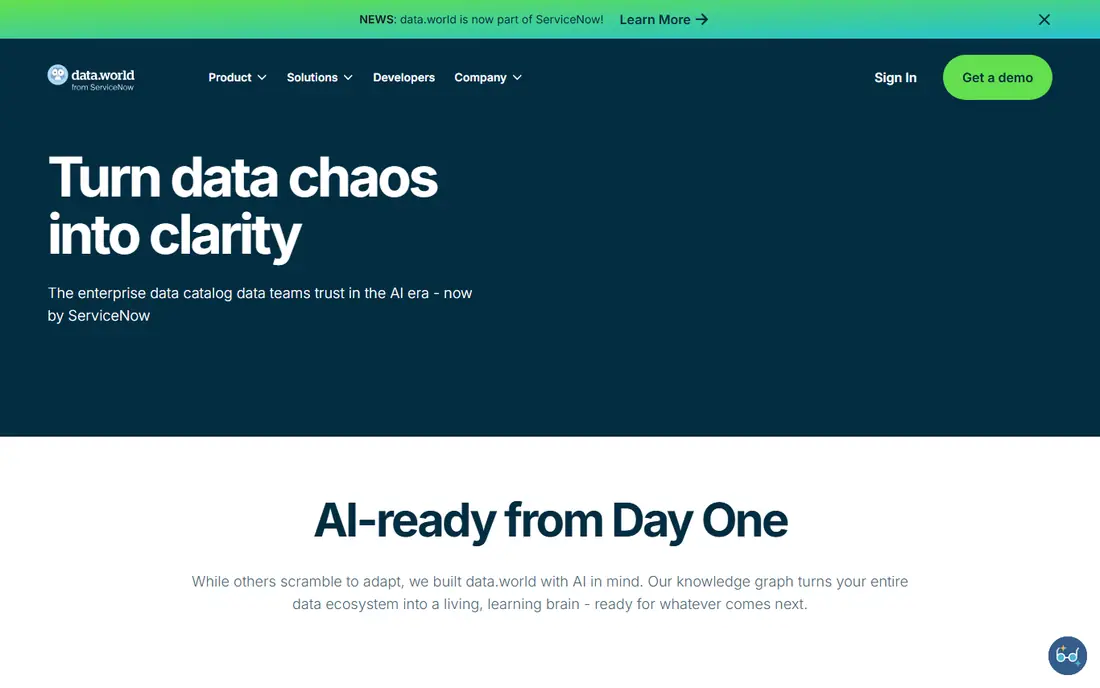
Choose data.world for teams that think in relationships and want a knowledge-graph catalog. For teams doing serious semantic modeling, federated catalogs or AI initiatives that require real context, that graph is a genuine advantage.
Where most catalogs are tables of tables, data.world builds a knowledge graph of your data ecosystem: business terms, their relationships, their lineage, their owners, all connected. data.world does not show a starting price in this comparison, so check the vendor site for current pricing. data.world has no free plan.
Where it falls short: Buying now runs through ServiceNow channels.
- Knowledge-graph architecture models business domains and relationships natively, with SPARQL and linked-data support
- Cloud-native with no infrastructure overhead
- Knowledge-graph modeling is a different skill set from traditional cataloging
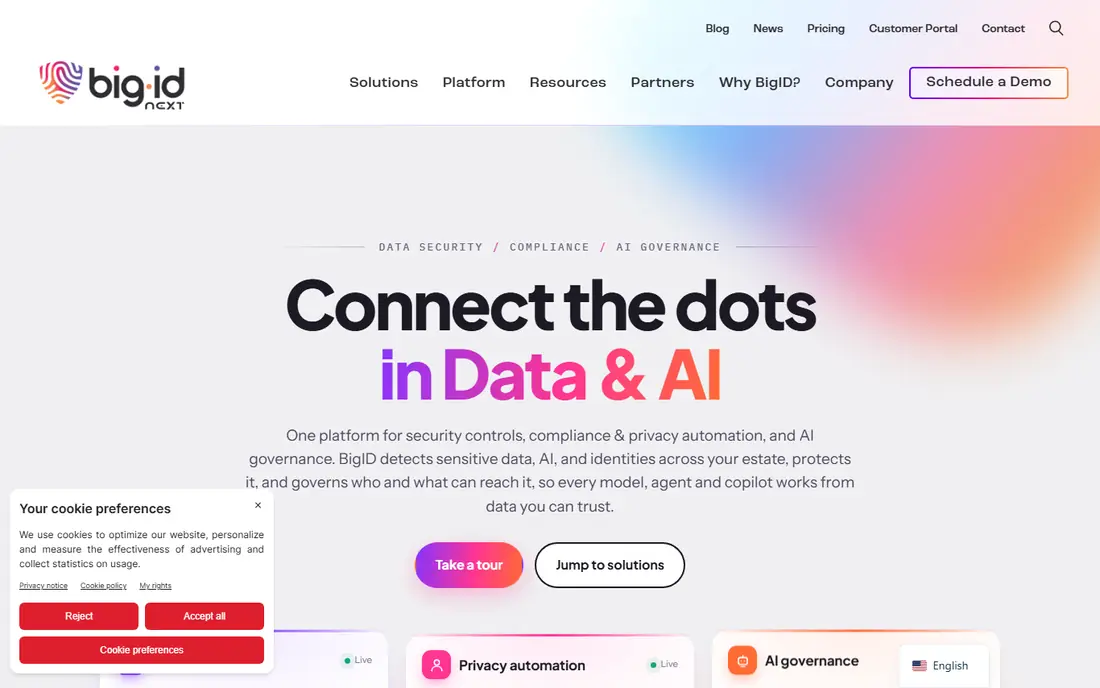
BigID works best for privacy, security and compliance teams governing sensitive data. BigID opens from the data security side of the house. On top of that, for privacy officers and CISOs, this is the natural starting point.
The honest catch is orientation. If your primary need is a business glossary, stewardship workflows and a catalog that analysts love, BigID is not the first pick. But when the governance driver is privacy regulation, data security or AI risk, BigID's discovery depth makes it the most solid fit. It pairs well with a catalog from another vendor. Pricing for BigID is not stated here, so ask the vendor for current figures. BigID has no permanent free option.
Where it falls short: Discovery-first design means the catalog and stewardship layers are thinner than pure governance systems.
- FedRAMP High with agentless deployment
- On-prem and mainframe
- Enterprise pricing without a public entry point
Microsoft Purview
Best for: Businesses already standardized on Microsoft 365 and Azure
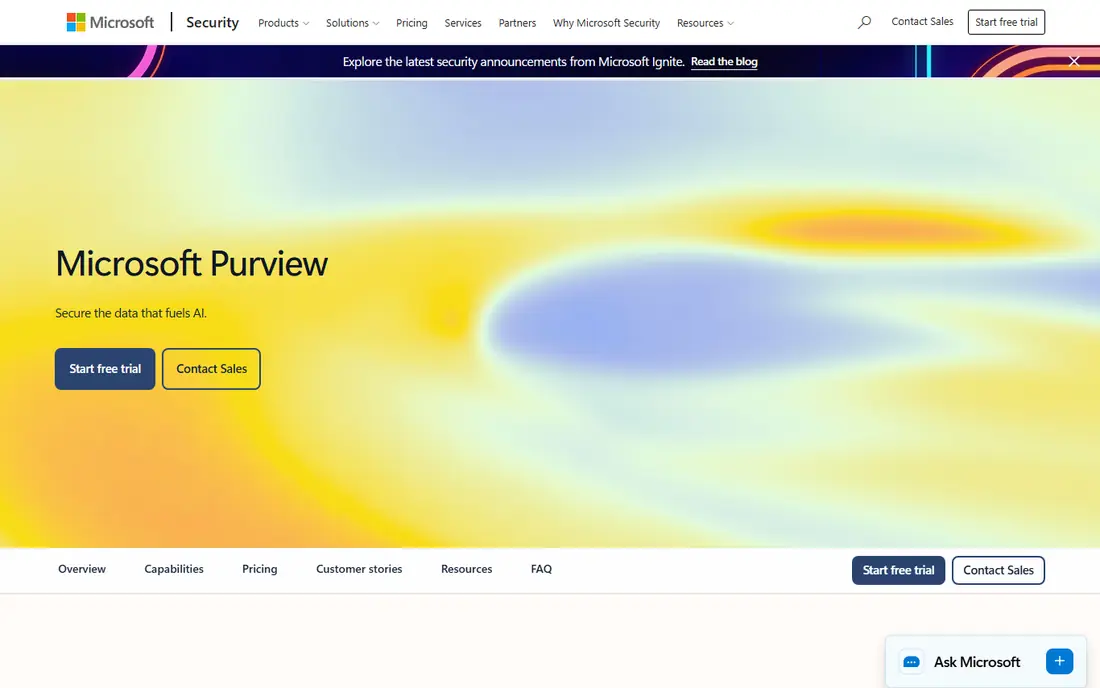
In short, Microsoft Purview is for firms already standardized on Microsoft 365 and Azure. It scans and classifies data across Azure, Microsoft 365 and Power BI, applies sensitivity labels, enforces DLP policies and tracks lineage, all inside the licensing and identity systems you already run.
For a company that lives in Teams, SharePoint and Azure SQL, adding an external catalog is pure overhead. In practice, the honest catch is boundaries. This comparison lists no price for Microsoft Purview; ask the vendor. Free options: Free trial.
What Microsoft Purview does well: DLP and compliance tooling; Azure and Power BI without an external vendor. The main drawbacks: Thinner outside the Microsoft ecosystem.
- Usage-based pricing avoids big upfront commitments
- Native governance for the Microsoft estate
- The product sprawls across plenty of components with overlapping names
Ataccama is designed for teams that require data quality and governance in one system. Ataccama solves the trust problem instead of just the organization problem. The Data Trust Index provides agents a machine-readable signal for whether a dataset is cleared for use.
the main limit is positioning. Teams that lead with "our data is a mess and AI needs it clean" will find Ataccama the fastest route to trustworthy data. This comparison lists no price for Ataccama; ask the vendor. Ataccama has no free tier.
Where it falls short: Pricing is quote-only with enterprise deal sizes.
Where Ataccama stands out: Forrester Wave Leader in data quality with a capable product vision.
- Deep Snowflake and Databricks partnerships
- Unified platform combining data quality, observability, catalog
- Quality-first heritage means pure governance workflow depth lags Collibra
Atlan was built for firms building AI-ready governance on active metadata. Atlan is the modern answer to the governance problem.
On top of that, deployment runs in weeks instead of quarters, which is rare in this category. As for the details, for that buyer, the automation is the point. Check the vendor site for Atlan pricing; none is listed in this comparison. Atlan has no free tier.
Drawbacks to consider: Deepest value presents up in teams with real AI and multi-cloud programs.
- Active metadata architecture automates tag propagation and policy changes across lineage
- Recognized as a Leader in the 2026 Gartner Magic Quadrant for Data and Analytics Governance
- Premium pricing that stretches mid-market budgets
Collibra was built for regulated enterprises with formal compliance obligations. Collibra is the incumbent for a reason: when a bank or healthcare company needs to prove who owns every data asset and which policies apply, Collibra's structured workflows and ontology-based model do the job. Buy it when regulators ask.
Worth adding: eighteen years of ontology engineering presents in the data model. From a buyer's view, do not buy Collibra to answer "whose table is this" across a handful of hundred datasets. From a buyer's view, the main limit is weight. Collibra assumes a dedicated governance team, professional services for implementation, and a six-figure budget. This comparison lists no price for Collibra; ask the vendor. Collibra does not include a free plan.
Trade-offs to know: Among the priciest products here.
- AI agent governance with a live control plane
- Deepest stewardship workflows and policy management in the category, with an ontology-driven model
- Complicated to implement and administer, with long sales and deployment cycles
Informatica IDMC
Best for: Large enterprises with hybrid and multi-cloud data estates
Informatica IDMC was built for large enterprises with hybrid and multi-cloud data estates. IDMC (Intelligent Data Management Cloud) merges cataloging, data quality, master data management, integration and governance in a single system. So a company standardizing its entire data stack gets one throat to choke.
Where Informatica IDMC stands out: Operates inside Salesforce since late 2025.
The connector catalog is the deepest here, and the Salesforce relationship layers on enterprise credibility. Scoping, pricing and implementation all take time, and the product assumes Informatica is central to your data architecture. The main limit is that buying the entire suite for governance alone is like buying a tractor to mow a lawn. Also, if it is not, the narrower tools above will serve you better. No starting price is listed for Informatica IDMC here; confirm pricing on the vendor site. Informatica IDMC has no free plan.
Trade-offs to know: The suite's breadth makes scoping and pricing a project in itself.
- Integration and governance under one roof
- 300-plus connectors
- Overkill except when you use multiple Informatica products
How these tools were picked
Each tool was reviewed on what its vendor publishes: price, plan limits, core features and stated drawbacks. We did not run hands-on tests. Treat prices as a snapshot: vendors change plans often, so check the vendor site for the figure that applies today. Order on the page follows fit for the typical buyer first, then price transparency and free access. Your own requirements should decide the final pick.
Before you commit
- Ask each vendor, from data.world to Informatica IDMC, for a written quote; none of them publishes a starting price.
- Run a trial of Microsoft Purview with real work before paying for a year; your own workflow is the best test.
- Before choosing data.world, weigh its main limit: knowledge-graph modeling is a different skill set from traditional cataloging.
- Read the plan comparison for Informatica IDMC carefully; key features often start on a higher tier.
- Confirm you can export your data from Microsoft Purview, so leaving later does not mean losing records.
FAQ
Can I try these options before paying?
Often, yes. Microsoft Purview offers a free trial. Use your own data and a real task during the test, and check what the free tier or trial limits before you rely on it.
Do these tools publish their prices?
No. None of the tools, from data.world to Informatica IDMC, shows a fixed starting price here, so budget time for quotes.
What is the difference between a data catalog and data governance software?
A data catalog is the inventory: what data exists, where it lives, what it means. Data governance software brings the controls: policies, stewardship workflows, access rules, compliance reporting and enforcement.
How are the tools for data governance software ordered?
data.world sits first and Informatica IDMC last because the order follows typical fit for data governance software, then price clarity and free access. It is a judgement call, so read each profile for fit and limits.
Is data.world the right pick for everyone comparing data governance software?
No single tool suits every team. data.world comes first because it fits teams that think in relationships and want a knowledge-graph catalog, while BigID suits privacy, security and compliance teams governing sensitive data and Microsoft Purview suits companies already standardized on Microsoft 365 and Azure. Match the tool to your own size, budget and workflow before deciding.