Best Board Governance Software in 2026: 9 Platforms Compared
Compare the best board governance software in 2026, with secure board portals, agendas, voting, minutes, e-signatures, and pricing for boards of all sizes.
- Editor's choice
 Diligent Boards
Large public companies
Starts atSee websiteVisit diligent.comFull review - Great alternative
 OnBoard
Mid-market boards
Starts atSee websiteVisit onboardmeetings.comFull review - Also consider
 BoardEffect
Nonprofits and education
Starts atSee websiteVisit boardeffect.comFull review
TL;DR:
- Diligent Boards and Nasdaq Boardvantage remain the enterprise standards for large and public boards with strict compliance needs.
- OnBoard is our pick for most mid-market boards because its interface is easy for directors to adopt and its meeting tools are complete.
- Boardable and BoardPro are the best value picks for small nonprofits and small companies that need published pricing.
- BoardEffect suits nonprofits, schools, and health boards that want a specialist portal without enterprise cost.
- Most enterprise portals are quote-only, so ask for total cost including setup, training, and renewal terms before you sign.
Quick comparison
| Tool | Best for | Starts at | Free plan? | |
|---|---|---|---|---|
| Diligent Boards | Large public companies | See website | No | Visit |
| OnBoard | Mid-market boards | See website | No | Visit |
| BoardEffect | Nonprofits and education | See website | No | Visit |
 Nasdaq Boardvantage | Public company boards | See website | No | Visit |
 Convene | Regulated and global boards | See website | No | Visit |
 Boardable | Small nonprofits on a budget | $20.99 per user per month | Free trial | Visit |
 BoardPro | Small companies, flat pricing | $165 per month | Free trial | Visit |
 Govenda | Governance workflow automation | See website | No | Visit |
 Aprio Board Portal | Small volunteer boards | See website | No | Visit |
The best board governance software
Board governance software, often called a board portal, replaces email attachments and shared drives with a secure place for agendas, board books, votes, minutes, and director messages. The right portal is the one directors actually open before a meeting. Security, mobile access, and simple meeting prep matter more than a long list of modules most boards never use.
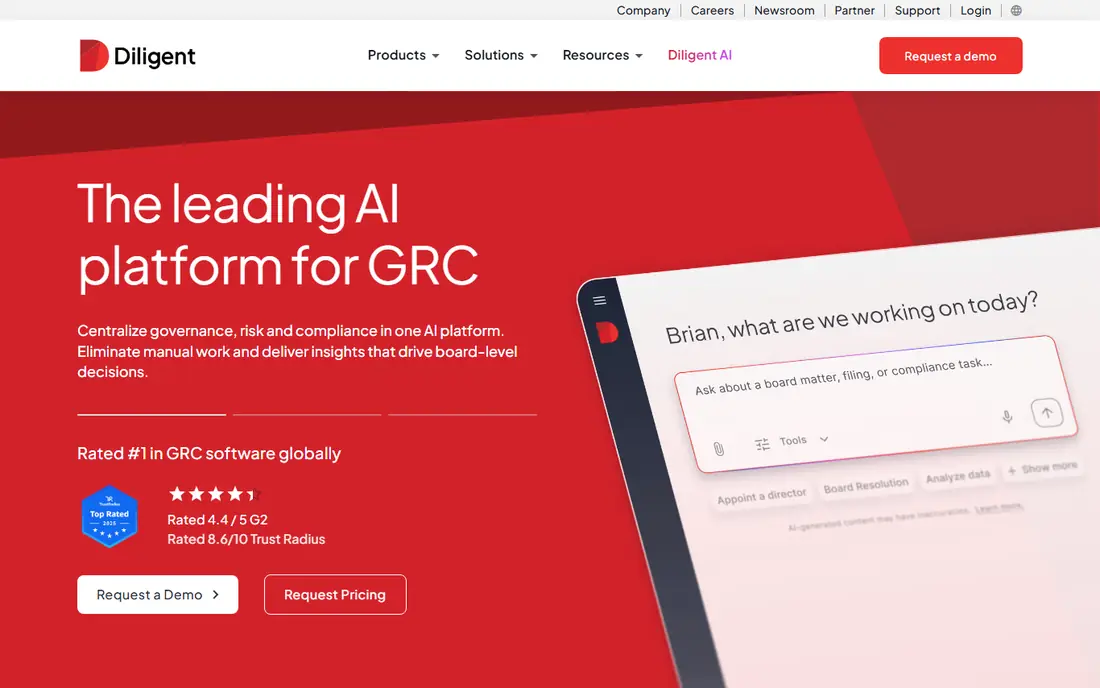
Diligent Boards is the best-known enterprise board portal, and its strength is breadth. Beyond agendas and board books, Diligent offers entity management, questionnaires, evaluations, and compliance tools that large groups need. Security controls, permissions, and audit trails suit public companies and regulated firms that must show how decisions were made.
The cost is the main barrier. Pricing is by quote and enterprise contracts often run into tens of thousands of dollars per year, with setup and training on top. Smaller boards will find the system more than they need. For a large board with complex governance, Diligent remains a safe, widely recognized choice.
- Strong security and compliance controls
- Large governance suite beyond board books
- Used by many large public boards
- Quote-only pricing, often costly
- Interface can feel dated
- Implementation takes time
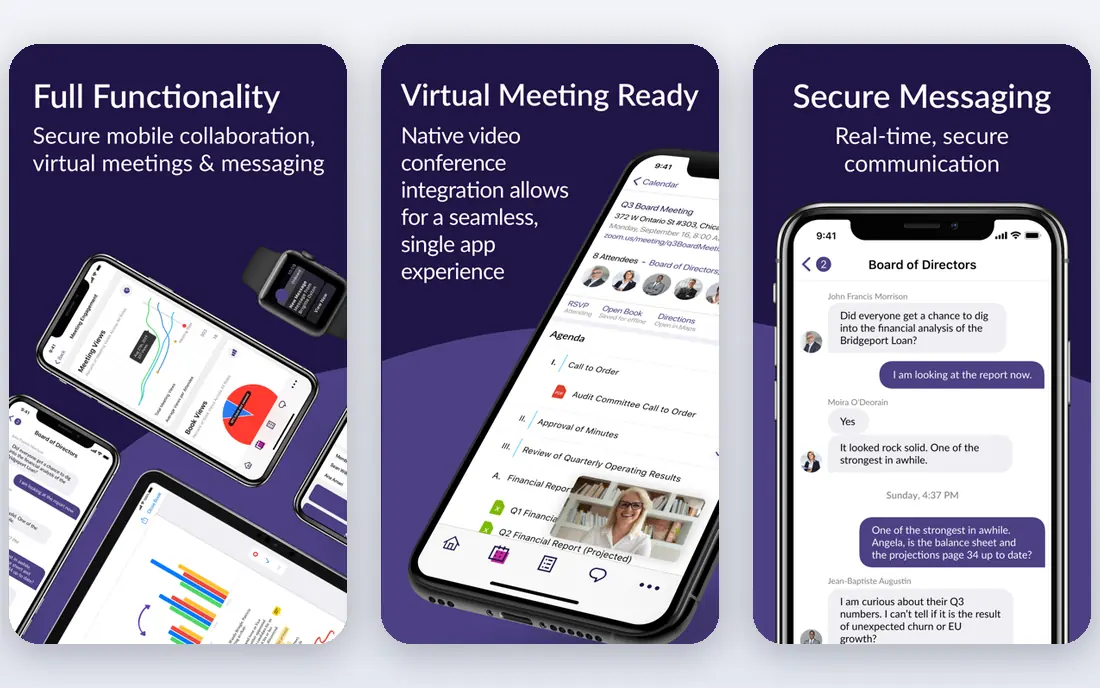
OnBoard is our pick for most mid-market boards because adoption is its main advantage. Directors can open a board book on a tablet, annotate pages, vote, and sign documents without a training course. Meeting prep is faster for staff, since agendas, minutes, and action items live in one workflow rather than in separate files.
OnBoard also covers surveys, evaluations, and secure messaging, so a board can move beyond paper packets without adding a second tool. Pricing is by quote and scales with users and features, so ask for a full quote that includes onboarding. If ease of use matters more than the deepest enterprise suite, OnBoard is the balanced pick.
- Clean, modern interface directors adopt quickly
- Strong agenda and board book tools
- Live voting and e-signatures
- Quote-only pricing
- Advanced governance modules cost more
- Some custom workflows need vendor help
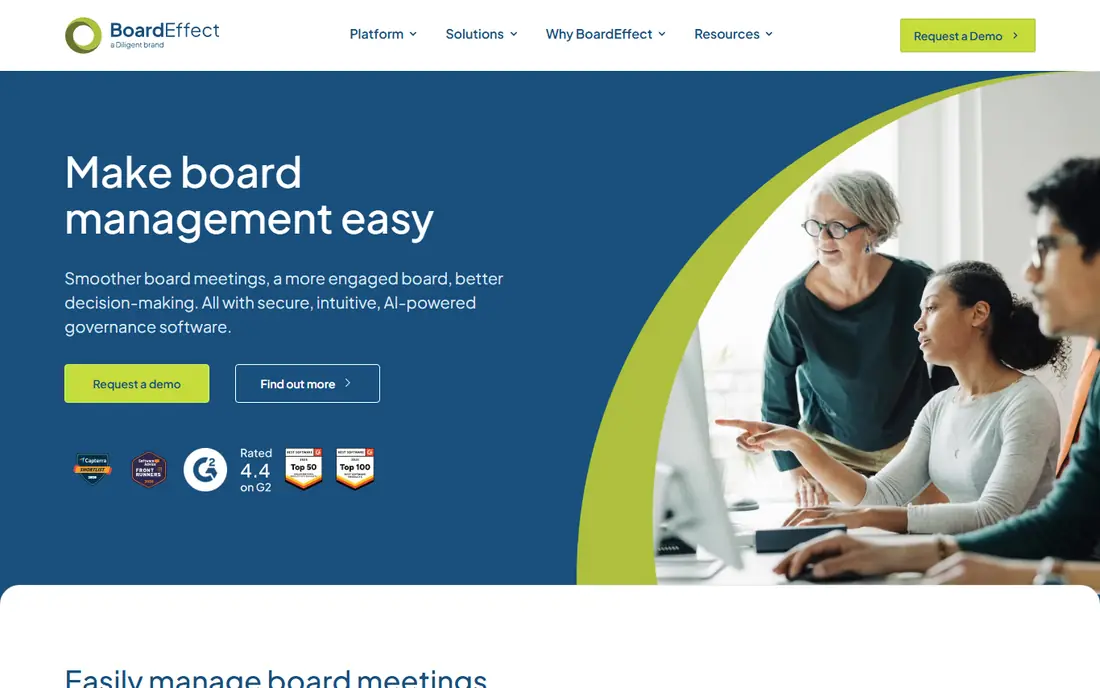
BoardEffect is a nonprofit-focused portal now owned by Diligent. It covers agendas, board books, document storage, voting, and surveys in a workflow that volunteer directors can learn quickly. Schools, hospitals, and charities that need a secure alternative to email will find the feature set well matched to their meetings.
Pricing is tiered by user count rather than per seat in many quotes, which can help a board with many volunteers. Customization is more limited than Diligent Boards, and very large public companies may need the parent platform instead. For a mission-driven board, BoardEffect offers a focused, practical portal.
- Built for nonprofits, schools, and health boards
- Simple meeting and document workflow
- Part of Diligent group
- Quote-only pricing
- Customization is limited
- Advanced enterprise features are thinner
Nasdaq Boardvantage is built for public companies and large listed groups that need a trusted, audited platform. Board books, annotations, voting, questionnaires, and evaluations sit in one secure system, with offline access for directors who travel. The all-inclusive pricing model means new features are less likely to arrive as surprise add-ons.
The cost and scope put it out of reach for most small nonprofits. Implementation and training also take time, since the platform is designed for formal governance processes. For a public board that values the Nasdaq name, audit controls, and a complete feature set, Boardvantage is a strong enterprise pick.
- Nasdaq-backed governance platform
- All-inclusive pricing model
- Strong offline access and questionnaires
- Enterprise pricing is high
- Quote-only
- More than most small boards need
Convene, from Azeus, suits boards that work across languages, regions, and regulators. It offers secure board books, agendas, voting, surveys, and document management, with language support that helps international directors. Government, finance, and regulated boards value its access controls and audit trails.
The platform feels formal, which is a good fit for regulated meetings but less inviting for a small volunteer board. Pricing is by quote, and annual costs for larger boards can be high. If your board spans countries or must meet strict compliance rules, Convene deserves a shortlist spot.
- Multilingual support for global boards
- Strong document and meeting controls
- Used by government and finance boards
- Quote-only pricing
- Interface is formal rather than playful
- Setup needs planning for large groups
Boardable is the most transparent option on this list, with published per-user pricing and a free trial. Small nonprofits can start without a sales negotiation, build agendas, share documents, track tasks, and run meetings from one place. The interface is simple enough for volunteers who meet only a few times a year.
The limits are scope and scale. Boardable does not match Diligent or Boardvantage on entity management, deep compliance workflows, or complex voting rules. Per-user pricing also climbs as a board grows. For a small nonprofit that needs a secure, affordable portal today, Boardable is the best value pick.
- Published pricing, rare in this category
- Simple agenda and document tools
- Good fit for small nonprofit boards
- Governance depth is thinner than enterprise portals
- Some advanced voting features are limited
- Per-user cost adds up
BoardPro prices by board rather than by user, which makes budgeting simple for a small company or nonprofit. You get agendas, board books, minutes, actions, and a document store without worrying that adding a director will raise the bill. The workflow is clear, and staff can prepare a meeting without specialist training.
The trade-off is depth. BoardPro does not offer the full governance suite of Diligent or Nasdaq, and integrations are fewer. That is fine for most small boards, which need reliable meetings more than complex compliance modules. If predictable cost matters most, BoardPro is an easy choice.
- Flat per-board pricing, not per user
- Simple agenda, minutes, and action tracking
- Good for SMEs and nonprofits
- Feature set is simpler than enterprise portals
- Integrations are limited
- Larger boards may outgrow it
Govenda focuses on governance workflows, not just board books. It covers agendas, surveys, evaluations, entity data, and approvals, with automation that reduces manual follow-up for corporate secretaries. Unlimited users on many plans can help a large group with committees and observers, since the bill does not grow with every extra reader.
Pricing is by quote, and the platform has a learning curve for directors used to simpler tools. Brand recognition is also lower than Diligent or Nasdaq, which may matter for a public board that wants a household name. For a corporation that wants workflow automation and predictable user costs, Govenda is worth a demo.
- Unlimited users on many plans
- Governance workflow automation
- Implementation included in some quotes
- Quote-only pricing
- Interface takes learning for new directors
- Smaller brand than Diligent or Nasdaq
Aprio Board Portal is built for small boards that want a complete portal without enterprise complexity. Nonprofits, credit unions, and co-ops can build agendas, share board books, run votes, and store documents in a system that volunteers can learn quickly. The focus on simplicity is the main selling point.
The limits are scale and depth. Larger boards with complex entity or compliance needs will outgrow Aprio, and integrations are fewer than at larger vendors. For a small board that currently uses email and shared drives, Aprio offers a clear, low-friction step up to a secure portal.
- Simple, volunteer-friendly interface
- Agendas, books, and voting in one place
- Suits credit unions and co-ops
- Quote-only pricing
- Feature depth is modest
- Integrations are limited
How we picked these
We compared official product pages, pricing disclosures, and public reviews for board portals that are still sold in October 2026. We favored platforms with secure document handling, agenda and minute tools, voting, and mobile access, and we noted where pricing is published versus quote-only. We included small-board value picks alongside enterprise standards, since board size is the main factor that should drive the choice.
How to choose a board portal without overbuying
Start with your board size, meeting frequency, and compliance needs. A five-person nonprofit board that meets quarterly needs a different tool from a public company board with committees, subsidiaries, and regulators. List the jobs you must do at every meeting, then test each portal against that list during a trial with real directors.
Adoption, security, and total cost
Ask directors to open a sample board book on their own devices during the trial. If they struggle, adoption will fail no matter how strong the feature list is. Check security controls such as permissions, audit trails, remote wipe for lost devices, and data residency. Finally, ask for total cost, including setup, training, extra committees, and renewal increases, not just the first-year quote.
Questions to ask every vendor
Ask how board books are built, whether annotations sync offline, how votes and minutes are recorded, and how long it takes to remove a departing director. Ask about support hours, since board meetings often run in the evening. A vendor that answers these questions clearly is more likely to support your board after the sale.
FAQ
What is the best board governance software?
For large public boards, Diligent Boards and Nasdaq Boardvantage are the standards. For most mid-market boards, OnBoard offers the best mix of ease of use and complete meeting tools. Small nonprofits should start with Boardable or BoardPro, which publish clear pricing.
What are the best board governance platforms for a nonprofit?
BoardEffect, Boardable, and BoardPro are strong nonprofit picks. BoardEffect is built for mission-driven boards, Boardable offers published per-user pricing, and BoardPro offers flat per-board pricing. Choose based on board size, volunteer comfort with technology, and whether you need advanced voting or evaluation tools.
How much does board governance software cost?
Published small-board pricing starts near $20.99 per user per month at Boardable and $165 per month per board at BoardPro. Enterprise portals are quote-only and commonly run from several thousand to tens of thousands of dollars per year, plus setup and training. Always ask for total cost and renewal terms.
Do board portals replace email for board materials?
Yes, in most cases. A portal gives directors one secure place for agendas, books, votes, and minutes, with permissions and audit trails that email cannot provide. Email can still be used for meeting notices, but sensitive board papers should live in the portal, not in inboxes or shared drives.
Is a board portal secure enough for sensitive board papers?
Reputable portals use encryption, role-based permissions, audit trails, and remote wipe for lost devices. Check the vendor security page, ask about certifications, and confirm data residency if your board has regional rules. Train directors to use the portal app rather than downloading papers to personal devices.
Can small boards use board governance software?
Yes. Boardable, BoardPro, and Aprio are built for small boards and volunteer directors. A small board does not need enterprise entity management, but it does benefit from secure books, clear agendas, and recorded votes. Start with a simple plan and upgrade only when meeting volume or compliance needs grow.