Best DaaS Software for 2026: Our 6 Vetted Picks
6 options for the best DaaS software, with entry costs, free tiers and the buyer each one serves. Fit, price and catches for every tool. See the full list.
- Editor's choice
 Databricks
Unified data, analytics and AI
Starts atPricing on requestVisit databricks.comFull review - Great alternativeMicrosoft Azure Synapse Analytics
SQL warehousing plus big data
Starts atPricing on requestVisit azure.microsoft.comFull review - Also considerSAP Datasphere
SAP-centric business data access
Starts atPricing on requestVisit sap.comFull review
Direct answer
Databricks leads the list, best for unified data, analytics and AI. Alternatives: Microsoft Azure Synapse Analytics for SQL warehousing plus big data, and SAP Datasphere for SAP-centric business data access. Details and limits for the rest of the 6 tools are below. None of these vendors publish plan prices, so pricing is on request for every option.
TL;DR:
- This list starts with Databricks, which is built for unified data, analytics and AI.
- IBM Db2 Warehouse fits in-memory querying across sources.
- None of the 6 tools, from Databricks to IBM Db2 Warehouse, has a free plan, so budget for a subscription or use a trial.
- No starting price is shown for any of the 6 tools, Databricks and IBM Db2 Warehouse included, so plan time for sales calls.
Last checked November 2026. Pricing on request: vendors did not publish plan prices when this guide was last checked (November 2026), so ask each vendor for a written quote.
Quick comparison
| Tool | Best for | Starts at | Free plan? | |
|---|---|---|---|---|
| Databricks | Unified data, analytics and AI | Pricing on request | Not stated | Visit |
| Microsoft Azure Synapse Analytics | SQL warehousing plus big data | Pricing on request | Not stated | Visit |
| SAP Datasphere | SAP-centric business data access | Pricing on request | Not stated | Visit |
 Google BigQuery | Automatic, completely managed analytics | Pricing on request | Not stated | Visit |
 Amazon Redshift | AWS-native cloud data warehousing | Pricing on request | Not stated | Visit |
| IBM Db2 Warehouse | In-memory querying across sources | Pricing on request | Not stated | Visit |
The best DaaS software
This LinkVetted guide covers 6 options for DaaS software. Each profile lists a starting price, free plan details, strengths and drawbacks, so you can drop poor fits quickly.
In short, Databricks is for unified data, analytics and AI. Organizations with straightforward, SQL-only reporting needs may find it more than necessary.
Also, choose a narrower managed warehouse if your priorities are entry-level analytics without a broader AI workspace. Check the vendor site for Databricks pricing; none is listed in this comparison. Trial and free access: Not stated.
What to check first: Needs engineering maturity to run well.
- Data-centric approach to building AI
- Unified product for data
- Wide scope can mean a steeper ramp-up time
Microsoft Azure Synapse Analytics
Best for: SQL warehousing plus big data
Where Microsoft Azure Synapse Analytics fits: SQL warehousing plus big data. Since it spans several analytics services, the product can feel complicated to set up and govern.
The main drawbacks: Component complexity can slow adoption.
Teams need clear ownership of each component. In practice, if you run primarily on another cloud or want a more straightforward managed warehouse, a provider-native choice may be simpler to operate. Microsoft Azure Synapse Analytics does not show a starting price in this comparison, so check the vendor site for current pricing. Trial and free access: Not stated.
- Aims to accelerate time to insight
- Suits Microsoft-centric environments
- Most natural inside the Azure ecosystem
SAP Datasphere
Best for: SAP-centric business data access
SAP Datasphere is designed for SAP-centric business data access. It appeals to teams seeking a unified data experience across SAP sources.
The main drawbacks: Broader data estates may need additional integration work.
Consider a cloud-neutral warehouse if your data estate is spread across plenty of non-SAP systems. No starting price is listed for SAP Datasphere here; confirm pricing on the vendor site. Trial and free access: Not stated.
Upsides: Targeted at every data professional.
- Smooth
- Scalable access to mission-critical business data
- Most solid fit for SAP landscapes
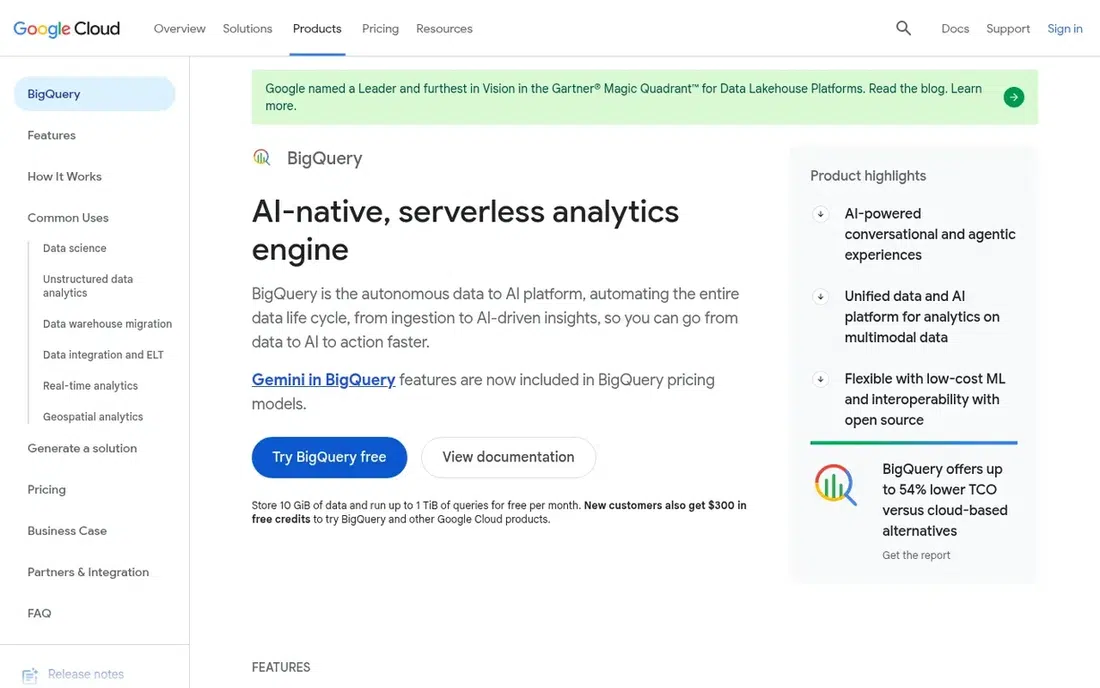
In short, Google BigQuery is for automated, completely managed analytics. BigQuery is Google's autonomous data and AI product, positioned around automating the whole data life cycle so teams can move from data to AI to action quicker. It appeals to teams already working in Google Cloud or planning analytics and machine learning together.
As for the details, cost management also demands attention as workloads grow. Consider another choice if you are committed to a different cloud provider or need tight integration with that provider's native services. Since much of the product is automatic and managed, teams that require fine-grained control over infrastructure may find the abstraction limiting. Check the vendor site for Google BigQuery pricing; none is listed in this comparison. Free options: Not stated.
The main drawbacks: Deep tuning may need cloud expertise.
- Moves from data to AI to action in one environment
- Serverless style of management cuts operations
- Costs can be harder to predict with heavy usage
Amazon Redshift works best for AWS-native cloud data warehousing. Amazon Redshift is a quick, completely managed cloud data warehouse that AWS describes as making it straightforward and economical to analyze all your data. It performs well for organizations that prefer a familiar SQL-based warehouse approach over a broader analytics product.
Honest limits: Best value when already inside AWS.
Performance tuning and workload management still take effort as data volumes grow. In practice, the product is most compelling inside the AWS ecosystem, so teams standardized on another cloud may face friction. Check the vendor site for Amazon Redshift pricing; none is listed in this comparison. Free plan details: Not stated.
- Made for analyzing all your data
- Positioned as straightforward and economical
- Tuning workloads needs some expertise
IBM Db2 Warehouse
Best for: In-memory querying across sources
Choose IBM Db2 Warehouse for in-memory querying across sources. It appeals to teams that require to query across multiple data sources from one warehouse layer.
Downsides: Configuration can be involved.
The product assumes some familiarity with IBM data tooling, which can raise the ramp-up time for teams coming from other stacks. Check the vendor site for IBM Db2 Warehouse pricing; none is listed in this comparison. Trial and free access: Not stated.
- Advanced in-memory processing at massive scale
- Queries data from several sources
- Needs IBM product familiarity
What went into this list
Pricing pages, product documentation and feature lists were the main sources, and every entry carries at least one honest drawback. Plan names, prices and limits change often. Treat the figures here as a starting point and verify them with the vendor. The order reflects how well each tool fits the most common buying scenario for DaaS software, then price clarity, then free plan access. It is a starting point, not a verdict.
Before you commit
- Request quotes from Databricks, IBM Db2 Warehouse and the others; the list shows no fixed prices.
- Read the limits listed for Databricks first: broad scope can mean a steeper ramp-up time.
- Pick one real project and run it in Microsoft Azure Synapse Analytics first; a small pilot shows fit faster than a checklist.
- Look at the help docs and support options for Amazon Redshift before you commit.
- Map your must-have features to a specific IBM Db2 Warehouse plan before you compare prices.
FAQ
Can I try these options before paying?
Not by default. None of the tools, from Databricks to IBM Db2 Warehouse, lists a free plan or a free trial here, so ask each vendor for a demo before committing.
When does Databricks make more sense than a traditional warehouse?
Databricks is positioned as a unified system for data, analytics and AI, so it suits teams that want engineering, analytics and machine learning work in one environment. A traditional warehouse may be more straightforward if your needs are largely SQL reporting.
Is Databricks the right pick for everyone comparing DaaS software?
No single tool suits every team. Databricks comes first because it fits unified data, analytics and AI, while Microsoft Azure Synapse Analytics suits SQL warehousing plus big data and SAP Datasphere suits SAP-centric business data access. Match the tool to your own size, budget and workflow before deciding.
Does any tool for DaaS software here have a free plan?
A permanent free plan is not offered by Databricks, IBM Db2 Warehouse or the other tools here. Plan a short evaluation period instead.
What is DaaS software in the context of data warehousing?
In this context, data-as-a-service refers to managed cloud products that deliver warehousing, analytics and data access without you operating the underlying infrastructure. Vendors deal with much of the provisioning, scaling and maintenance.
How are the tools for DaaS software ordered?
Databricks sits first and IBM Db2 Warehouse last because the order follows typical fit for DaaS software, then price clarity and free access. It is a judgement call, so read each profile for fit and limits.
Sources
- https://www.databricks.com
- https://azure.microsoft.com/en-us/products/synapse-analytics
- https://www.sap.com/products/data-cloud/datasphere.html
- https://cloud.google.com/bigquery
- https://aws.amazon.com/redshift
- https://www.ibm.com/products/db2-warehouse