Best Configuration Management Software in 2026: 8 Tools Compared
Compare the best configuration management software, from Ansible and Puppet to Terraform and Salt, and find the right tool for your servers and cloud setup.
- Editor's choice
 Ansible
Agentless automation for most teams
Starts atFreeVisit ansible.comFull review - Great alternative
 Puppet
Enterprise desired-state control
Starts atSee websiteVisit puppet.comFull review - Also consider
 Chef Infra
Code-driven infrastructure teams
Starts atSee websiteVisit chef.ioFull review
TL;DR:
- Ansible is our pick for most teams starting out, thanks to its agentless design and readable YAML playbooks.
- Puppet, Chef, and Salt still suit large estates that need strict desired-state control and compliance reporting.
- Terraform and OpenTofu handle provisioning rather than ongoing server configuration, so many teams pair them with Ansible.
- CFEngine and Rudder deserve a look for very large fleets or compliance-heavy shops that want a lighter or more guided setup.
Quick comparison
| Tool | Best for | Starts at | Free plan? | |
|---|---|---|---|---|
| Ansible | Agentless automation for most teams | Free | Yes | Visit |
| Puppet | Enterprise desired-state control | See website | Free trial | Visit |
| Chef Infra | Code-driven infrastructure teams | See website | Free trial | Visit |
 Salt | Fast event-driven automation at scale | Free | Yes | Visit |
 Terraform | Multi-cloud provisioning | Free | Yes | Visit |
 OpenTofu | Open provisioning alternative | Free | Yes | Visit |
 CFEngine | Lightweight large-fleet control | Free | Yes | Visit |
 Rudder | Compliance-focused configuration | See website | Free trial | Visit |
The best configuration management software
Configuration management tools keep servers in a known, repeatable state instead of letting each machine drift apart over time. We compared official documentation, pricing pages, and feature sets for the tools below, focusing on how each one actually works in production.
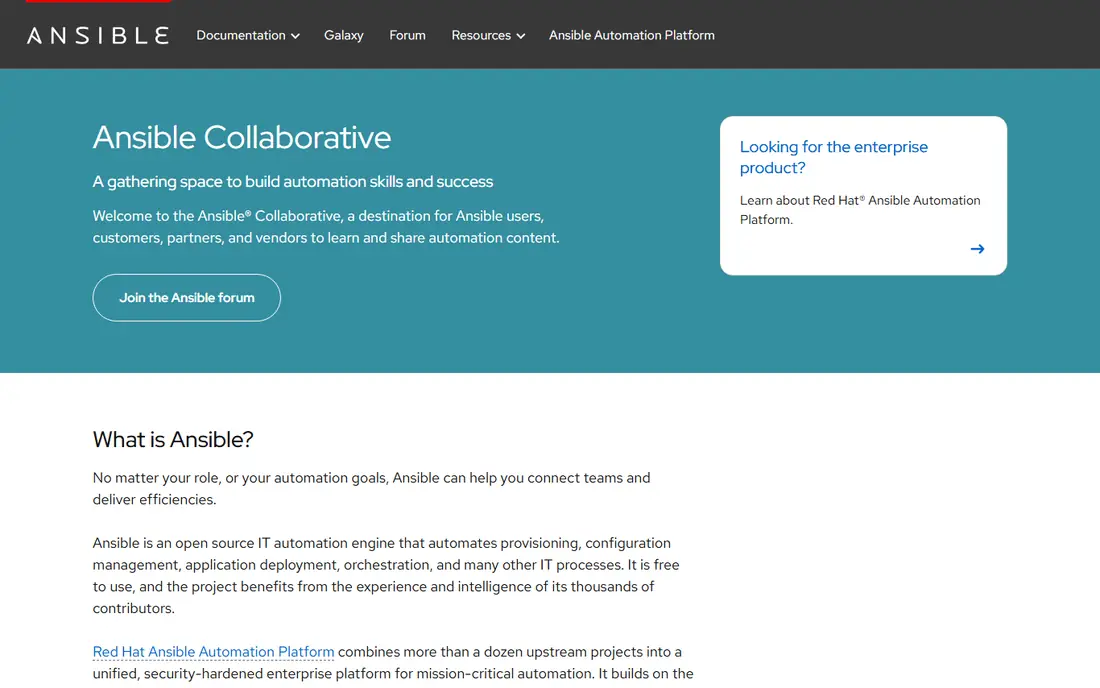
Ansible stands out because it needs only SSH access and Python on the target machines, with no agent to deploy or maintain. You describe the desired state in YAML playbooks, run them from a control machine, and Ansible makes the changes step by step. That simplicity is why so many small and mid-size teams adopt it first. The module library covers packages, files, services, users, and cloud resources, so common tasks rarely need custom code.
The main limit appears at very large scale, where push-based runs and SSH connections take longer than agent-based systems that report continuously. Ansible also does not keep a central database of desired state by itself, though the commercial automation platform adds scheduling, inventories, and role-based access. For most teams, those limits arrive well after Ansible has already paid for itself, and pairing it with Terraform covers provisioning cleanly.
- No agent to install on managed hosts
- YAML playbooks are easy to read
- Large module and role library
- Push-based runs can be slower at very large scale
- No built-in central state database

Puppet has managed some of the largest server estates in the world, and its model still appeals to enterprises that need proof of compliance. Agents on each node regularly check in, compare the machine against the declared catalog, and correct drift without waiting for an operator to run a job. That continuous enforcement matters in regulated settings, where a manual change should not quietly persist. Its reporting also gives auditors a clear record of what changed and when.
The price of that control is complexity. You run a Puppet server, manage certificates, and learn its declarative language, which takes longer than writing a first Ansible playbook. Smaller teams may find that overhead hard to justify. For organisations with thousands of nodes and strict audit needs, though, Puppet remains a serious and proven choice.
- Strong desired-state model with regular enforcement
- Mature module ecosystem
- Detailed reporting
- Agent and server setup takes effort
- Its own language has a learning curve
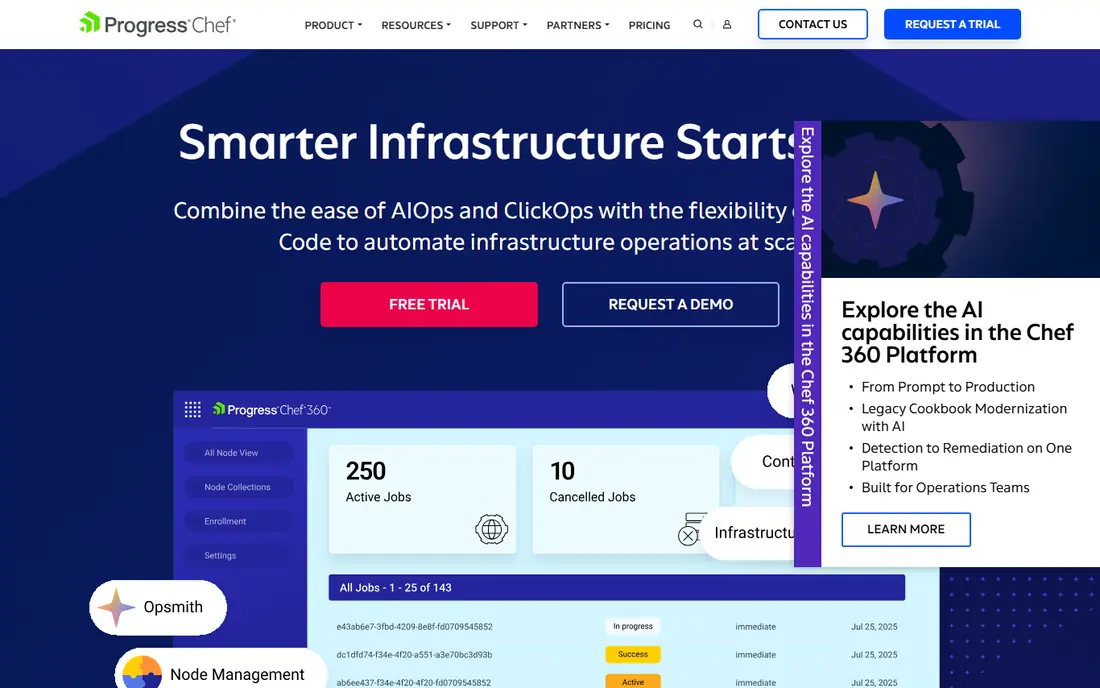
Chef treats infrastructure as code in the fullest sense, letting teams write cookbooks and recipes in Ruby with logic, loops, and tests. That power suits teams who already think like developers and need custom behaviour that a simpler YAML tool cannot express cleanly. Its testing tools, including Test Kitchen and InSpec for compliance checks, help teams catch bad changes before they reach production. InSpec in particular gives Chef an edge for compliance work.
The trade-off is the learning curve. Teams without Ruby experience will spend time learning both Chef and the language, and running Chef Infra Server adds operational work. If your team already writes Ruby or wants test-driven infrastructure, that investment makes sense. If you want the fastest path to automating a modest fleet, start with a simpler tool first.
- Full programming power through Ruby
- Strong testing tools
- Good for complex custom logic
- Ruby knowledge helps a great deal
- Setup and maintenance demand real effort
Salt, also known as SaltStack, is built for speed. Its messaging system lets a master send commands to thousands of minions and get results back quickly, which makes it a strong fit for large fleets and time-sensitive changes. Beyond configuration, Salt supports remote execution and event-driven reactions, so a system event can trigger an automated response without human input. That combination suits data centres and cloud estates where timing matters.
The catch is polish. New users sometimes find the documentation and initial setup less smooth than Ansible, and the community is smaller, so answers can take longer to find. Salt also rewards teams that invest in learning its state files and targeting system. For large, fast-moving estates, that investment returns real speed. For a small fleet, the extra power may not be needed.
- Very fast remote execution
- Event-driven automation
- Flexible agent or agentless modes
- Documentation and setup can feel uneven
- Smaller community than Ansible
Terraform is technically a provisioning tool, not a classic configuration manager, but almost every modern team uses it alongside one. You write infrastructure in HashiCorp Configuration Language, preview a plan of what will change, and then apply it across AWS, Azure, Google Cloud, and many other providers. That plan step is a major safety benefit, since you see destructive changes before they happen. The provider library is broad, covering servers, networks, databases, and DNS.
Terraform does not replace Ansible or Puppet for work inside a server, such as keeping packages and config files in a desired state after the machine exists. It also requires care with state files, which record what Terraform manages and must be stored safely and shared correctly in a team. Use Terraform to create the infrastructure, then hand ongoing configuration to a dedicated tool, and you get the best of both approaches.
- One workflow across many cloud providers
- Clear plan before changes apply
- Huge provider library
- Provisions resources rather than managing server internals
- State files need careful handling
OpenTofu began as a community fork of Terraform, created to keep infrastructure-as-code tooling under open governance. It uses a similar language and workflow, so teams familiar with Terraform can usually move across with modest effort. Features such as state encryption and a community-led roadmap appeal to teams that want a say in the tool they depend on. It is free and open source, which keeps licensing simple for small teams and large enterprises alike.
As a younger project, OpenTofu does not yet match Terraform in every provider detail or third-party integration, so teams with unusual provider needs should test their exact stack first. For standard cloud provisioning, it already works well. If open governance matters to your organisation, or you want an alternative without changing your workflow much, OpenTofu is worth a serious trial.
- Open governance under a neutral foundation
- Compatible with much Terraform workflow
- Free to use
- Provider ecosystem still catching up in places
- Newer project with less history
CFEngine is one of the oldest tools in this field, and its design still has a distinct advantage: agents are small, fast, and able to keep enforcing policy even when the central hub is unreachable. That autonomy suits very large fleets, remote sites, and environments where network links fail. It handles configuration, compliance, and reporting with modest CPU and memory use, which matters when you manage thousands of machines.
The downside is familiarity. Its policy language is less popular than YAML or Ruby, and modern tutorials are harder to find than for Ansible or Puppet. New hires may need extra training. For teams that value efficiency and resilience over fashion, and especially for huge fleets, CFEngine remains a practical and proven option that deserves more attention than it usually gets.
- Very light agent with low resource use
- Autonomous agents keep working if central systems fail
- Long track record
- Its policy language feels dated
- Smaller community and fewer modern tutorials
Rudder aims at teams that want Puppet-style enforcement with a friendlier interface. Administrators build policies in a web UI from ready-made techniques, apply them to groups of nodes, and watch compliance reports show which machines match and which drifted. That guided approach helps operations teams who need audit evidence but do not want to write large amounts of configuration code. Drift correction runs continuously, so small manual changes get undone rather than lingering.
The trade-off is flexibility. Code-first teams may find the UI approach limiting for complex custom logic, and Rudder still needs agents on managed nodes. Pricing is also quote-based for larger use, so budget planning takes a sales conversation. For compliance-heavy organisations that prefer a guided tool over a programming framework, Rudder hits a useful middle ground.
- Web interface with ready-made techniques
- Continuous compliance reporting
- Drift correction built in
- Agent-based setup
- Less suited to teams wanting code-first workflows
How we picked these
We compared official documentation, pricing pages, and architecture descriptions, and we kept tools that are actively maintained and genuinely used for configuration management in 2026. We included both agent-based and agentless designs, and both classic configuration tools and provisioning tools that teams pair with them. We excluded tools that only monitor servers without enforcing state, since that is a different job. Prices marked as See website reflect quote-based or tiered enterprise pricing that varies by node count.
How to choose the right tool
Start by counting nodes and naming your real constraint. A team with fifty servers and one administrator needs simplicity above all, which points to Ansible. A team with five thousand servers and audit rules needs continuous enforcement and reporting, which points to Puppet, Salt, or Rudder. A team that builds cloud infrastructure daily needs Terraform or OpenTofu first, then a configuration tool for what runs inside the machines.
Next, check your team's skills honestly. YAML suits almost everyone, Ruby suits developer-heavy teams, and a web UI suits operations teams that prefer guided policies. Also test the failure modes: what happens when the central server goes down, how a bad change gets rolled back, and how you prove compliance after the fact. Run a small pilot on non-production machines, measure how long onboarding takes, and only then commit the wider estate.
FAQ
What is the best software configuration management system for beginners?
Ansible is the usual beginner pick, because it needs no agent, uses readable YAML, and works over SSH. A new user can automate a first server in an afternoon. Puppet and Chef reward larger investments, but their setup time makes them harder first tools for a small team.
What is the difference between Terraform and Ansible?
Terraform provisions infrastructure such as servers, networks, and databases, while Ansible configures what runs inside those servers after they exist. Most teams use both: Terraform creates the resources, and Ansible keeps software and config files in the desired state. Treating them as rivals misses how well they fit together.
Do I need agents on every server?
It depends on the tool. Ansible works without agents, using SSH or WinRM, while Puppet, Chef, Salt, and Rudder install agents that check in regularly. Agentless designs are simpler to start, while agents give continuous enforcement and faster large-scale execution. Pick based on how strict your drift control must be.
What are the best configuration management tools for compliance?
Puppet, Chef with InSpec, and Rudder stand out for compliance, because they combine desired-state enforcement with reporting that auditors can review. Salt and CFEngine also support compliance use, but their reporting stories need more custom work. Whatever tool you pick, keep its reports as part of your audit evidence.
Can one tool manage Windows, Linux, and cloud servers?
Yes, with limits. Ansible, Puppet, Chef, and Salt all support Windows and Linux, and Terraform covers cloud resources across providers. No single tool does everything perfectly, so test your exact mix of operating systems and cloud services during a pilot before standardising.
Is open source configuration management enough for an enterprise?
Often, yes, for the core automation. Open source Ansible, Salt, Terraform, and OpenTofu run large estates without licence fees. Enterprises usually pay for support, scheduling, access control, and reporting features in commercial editions. Start with the open tool, and buy the commercial layer when those management features become a real need.