Best Companies for Managing IT Infrastructure in 2026: 8 Companies Compared
We compared the best companies for managing it infrastructure on scale, cloud, security and support, so firms can outsource IT operations more wisely.
- Editor's choice
 Kyndryl
Enterprise infrastructure at scale
Starts atSee websiteVisit kyndryl.comFull review - Great alternative
 Rackspace Technology
Multi cloud managed services
Starts atSee websiteVisit rackspace.comFull review - Also consider
 DXC Technology
Regulated enterprises
Starts atSee websiteVisit dxc.comFull review
TL;DR:
- Kyndryl suits large enterprises with mainframe, hybrid cloud and global network needs, while Rackspace suits complex multi cloud estates.
- DXC and NTT DATA suit regulated and large scale enterprises that need compliance depth and global delivery.
- Accenture, Wipro and Infosys suit firms that want infrastructure management paired with application and digital work.
- Ntiva suits mid market firms that want managed IT, cybersecurity and Microsoft 365 support under one contract.
- Most enterprise infrastructure pricing is quote based, so compare service levels, response times and exit terms, not just headline price.
Quick comparison
| Tool | Best for | Starts at | Free plan? | |
|---|---|---|---|---|
| Kyndryl | Enterprise infrastructure at scale | See website | No | Visit |
| Rackspace Technology | Multi cloud managed services | See website | No | Visit |
| DXC Technology | Regulated enterprises | See website | No | Visit |
 NTT DATA | Global infrastructure delivery | See website | No | Visit |
 Accenture | Infrastructure plus digital work | See website | No | Visit |
 Wipro | Cloud and infrastructure operations | See website | No | Visit |
 Infosys | Cloud led infrastructure management | See website | No | Visit |
 Ntiva | Mid market managed IT | See website | No | Visit |
The best companies for managing IT infrastructure
Managing IT infrastructure means running servers, networks, cloud, storage, security and end user support so a business can focus on its own work. Companies outsource this to managed service providers when in house teams cannot cover 24 hour operations, multi cloud complexity or compliance needs. The eight firms below cover enterprise to mid market scale in October 2026.

Kyndryl is our pick for large enterprises with complex infrastructure, especially mainframe estates, hybrid cloud and global networks. Spun off from IBM managed infrastructure business in 2021, Kyndryl runs managed network, cloud, security and digital workplace services at a scale few rivals match. Its mainframe practice, with thousands of specialists, suits banks, insurers and other firms that still run core systems on mainframe.
The catch is accessibility. Kyndryl model is built for enterprise minimums and long engagements, so mid market firms will find simpler, cheaper providers elsewhere. Its engagement process is also complex, which suits a large program but frustrates a smaller buyer who needs fast onboarding.
- Enterprise scale infrastructure services
- Mainframe, hybrid cloud, network and cyber resilience depth
- Global delivery across many countries
- Built for enterprise scale, less accessible for mid market firms
- Engagement process is complex
- Pricing is quote based
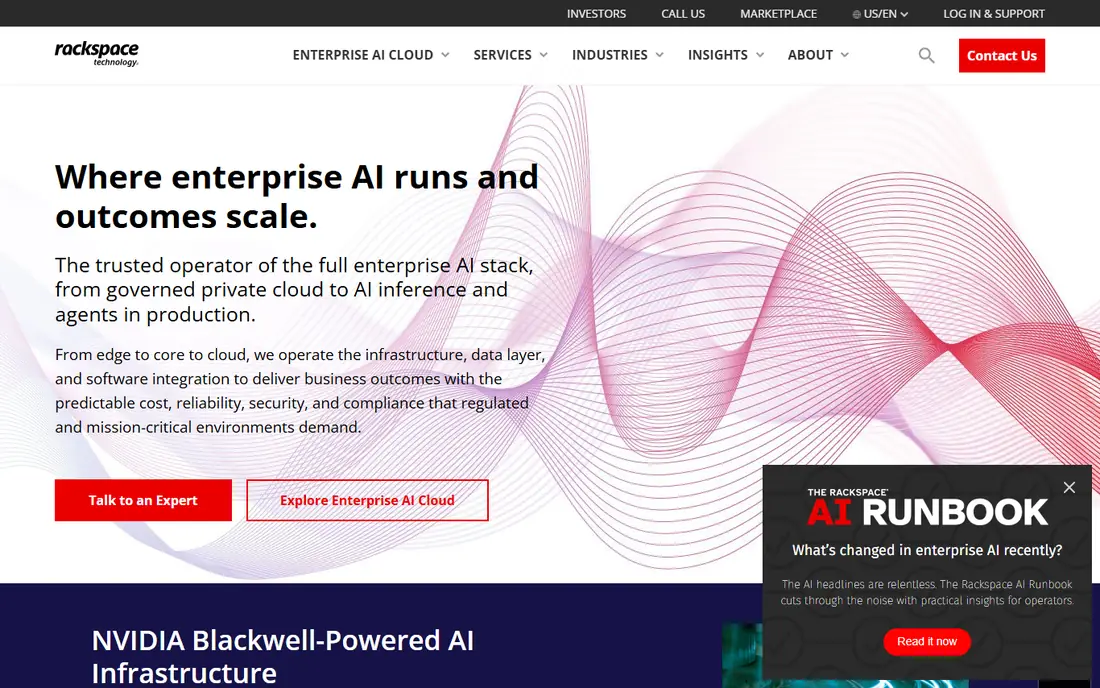
Rackspace Technology suits mid market and enterprise firms running workloads across several clouds. It manages AWS, Microsoft Azure and Google Cloud estates, operates private cloud offerings, and adds data services and security practices for firms that need more than basic hosting. Tiered service levels let buyers choose support depth, from basic operations to fully managed cloud.
Pricing and service levels require a conversation, since tiers set response commitments by contract rather than a single public SLA. That flexibility helps tailor a deal, but it means you should compare tier definitions closely and get response times in writing before you sign.
- Multi cloud expertise across AWS, Azure and Google Cloud
- Private cloud offerings
- Data and security practices
- Pricing is quote based and tiered
- Response commitments vary by service tier and contract
DXC Technology fits regulated enterprises in sectors such as banking, insurance, healthcare and government, where compliance, security and audit trails matter as much as uptime. Its infrastructure services cover mainframe, cloud and workplace, with modernization services that help firms move legacy systems without breaking core operations. Global delivery scale supports multi country estates.
The trade off is large firm complexity. DXC account experience can vary, and its engagement model suits long, structured programs better than fast, small projects. Regulated firms that value compliance depth and scale will find DXC a strong fit, while smaller firms should look to mid market providers.
- Strong in regulated, compliance heavy industries
- Mainframe and modernization services
- Global delivery scale
- Large firm complexity
- Pricing is quote based
- Experience can vary by account team
NTT DATA suits large firms that need infrastructure managed consistently across countries and regions. Its services cover data center, private and hybrid cloud, network and application management, with a global delivery model that supports multi national estates. Independent quadrant reports name NTT DATA among leaders in private and hybrid cloud data center services in the US, which reflects its data center strength.
The limit is process weight for smaller buyers. NTT DATA processes suit enterprise programs, and a mid market firm with a simple estate may find faster onboarding elsewhere. For a global firm that needs consistent operations across sites, NTT DATA scale is a genuine advantage.
- Global delivery across many countries
- Infrastructure, cloud and application managed services
- Strong in private and hybrid cloud
- Pricing is quote based
- Large firm processes can slow small engagements
Accenture fits firms that want infrastructure management as part of a wider transformation, not just a run service. It manages cloud, applications, infrastructure and security operations, and it pairs that operations work with digital, data and AI programs that change how the business works. For a firm modernizing systems while outsourcing operations, that combination avoids a handover between a strategy firm and an operations firm.
The catch is price and focus. Accenture is premium priced, and a firm that only needs steady run operations may get better value from Rackspace, Kyndryl or a mid market provider. Accenture earns its premium when infrastructure work and transformation work belong together.
- Managed cloud, application, infrastructure and security operations
- Pairs infrastructure with digital transformation
- Global scale
- Premium pricing
- Infrastructure is part of a broader offer, so pure run services may cost more than specialists
Wipro suits large and mid market firms that need cloud and infrastructure operations paired with digital operations and cybersecurity. Its managed services cover cloud infrastructure, workplace and security operations, with global delivery that supports multi country teams. For firms already using Wipro for applications or digital work, adding infrastructure management under one vendor simplifies governance.
Account experience varies by engagement size in public reporting, so vet the specific delivery team and service levels for your estate. Wipro works best when infrastructure scope is clear, service levels are written into the contract, and a named delivery lead owns the account.
- Cloud and infrastructure managed services plus digital operations
- Cybersecurity practices
- Global delivery
- Pricing is quote based
- Account experience varies by engagement size
Infosys fits firms that want infrastructure management led by cloud modernization rather than pure legacy operations. Its Cobalt cloud offering frames infrastructure work around cloud migration, automation and application management, which suits firms moving workloads to cloud while outsourcing day to day operations. Global scale and automation tooling help keep large estates consistent.
The trade off is fit for legacy heavy firms. A company that wants its existing on premises estate run as is, with no modernization agenda, may find a pure run provider simpler. Infosys is strongest when cloud migration and managed operations are part of the same program.
- Cloud led infrastructure management through Cobalt
- Application managed services
- Global scale and automation focus
- Pricing is quote based
- Cloud led model suits firms ready to modernize, less for firms that want pure legacy run
Ntiva suits mid market firms that want a single provider for managed IT, cybersecurity, Microsoft 365 and IT consulting. Its per user pricing structures suit companies with tens to hundreds of staff, and its US focused delivery gives smaller firms a responsive partner without enterprise minimums. For a firm that needs help desk, cloud, security and strategy from one team, Ntiva covers the core well.
The limit is scale. Ntiva does not match Kyndryl or DXC on mainframe, global delivery or very large estates, and firms with those needs should choose an enterprise provider. For mid market IT operations, though, Ntiva balance of breadth and accessibility is strong.
- Managed IT, cybersecurity, Microsoft 365 and consulting under one contract
- Per user structures for mid market firms
- US focused delivery
- Smaller scale than global rivals
- Less suited to mainframe or very large global estates
How we picked these
We compared vendor service pages, managed service provider comparisons and independent quadrant reports current in October 2026. We kept only firms with a live managed infrastructure offer and a clear enterprise or mid market fit, and we favored firms with multi cloud, security and 24 hour operations capability. We did not claim hands-on engagement with these firms, and we compared official pages, independent comparisons and public reporting.
How to choose a company to manage IT infrastructure
Start with estate shape, not vendor size. Count servers, cloud accounts, sites, users and compliance needs, since a mainframe heavy bank, a multi cloud SaaS firm and a 100 person professional services firm need different providers. A provider built for global mainframe estates will overcomplicate a mid market Microsoft 365 estate, and a mid market provider will struggle with a global mainframe program.
Next, compare service levels in writing. Check response times by severity, resolution targets, 24 hour coverage, security operations capability, backup and disaster recovery testing, and reporting frequency. Ask how incidents are escalated, who owns the account, and what happens during a major outage. A provider that cannot state service levels plainly is not ready for your infrastructure.
Finally, plan exit before entry. Agree on data ownership, documentation, credential handover, contract length and termination terms, since switching infrastructure providers is harder than switching a software tool. A good provider will document your estate as it runs it, so you are not locked in by missing knowledge. Review service levels quarterly against the contract, not just at renewal.
FAQ
What does a managed IT infrastructure company actually do?
It runs your servers, networks, cloud, storage, security monitoring and often help desk support, so your internal team can focus on business projects. Scope varies, from full outsourcing to co managed support where the provider handles operations and your team handles strategy. Agree on scope, service levels and ownership in the contract.
Should a small business outsource IT infrastructure?
Many small and mid market firms benefit, since 24 hour monitoring, security patching and backup testing are hard to staff in house. A mid market provider such as Ntiva suits firms with tens to hundreds of staff, while enterprise providers suit larger estates. A very small firm may do better with a local managed service provider or a cloud first setup.
How much does managed IT infrastructure cost?
Enterprise pricing is almost always quote based, tied to estate size, service level and geography. Mid market providers often use per user or per device pricing, which makes comparison easier. Always compare total cost including security operations, backup, licensing and project work, not just a monthly run fee.
Is multi cloud management worth outsourcing?
Yes, if you run production workloads on two or more clouds, since each cloud has its own operations, security and cost tools. A provider such as Rackspace or Kyndryl can standardize monitoring, security and cost control across clouds. A single cloud estate may be simpler to run in house or with a specialist for that cloud.
How do I avoid lock in with an infrastructure provider?
Insist on documentation, credential ownership, data portability and a clear exit clause before you sign. Ask the provider to maintain runbooks and architecture diagrams that your team can access, and review them quarterly. A provider that resists documentation is a lock in risk, however good its operations may be.
What security should an infrastructure provider offer?
At minimum, expect patch management, endpoint and network monitoring, backup and recovery testing, access controls and incident response procedures. Regulated firms should also require compliance reporting, audit support and security operations coverage around the clock. Confirm certifications and incident history in due diligence, not just marketing claims.