Best Blockchain Companies in 2026: 9 Companies Compared
Compare the best blockchain companies in 2026, from exchanges and stablecoins to enterprise platforms, with what each company actually builds and sells.
- Editor's choice
 Coinbase
US-regulated crypto access
Starts atSee websiteVisit coinbase.comFull review - Great alternative
 Binance
Global trading depth
Starts atSee websiteVisit binance.comFull review - Also consider
 Ripple
Cross-border payments
Starts atSee websiteVisit ripple.comFull review
TL;DR:
- Coinbase and Binance are the most accessible entry points for buying, holding, and using digital assets, with very different regulatory footprints.
- Circle, Ripple, and Chainlink focus on payments, settlement, and data, rather than trading alone.
- ConsenSys, Alchemy, and Polygon Labs build the tools and networks that developers use to create blockchain apps.
- IBM is the enterprise pick, for organizations that want blockchain inside a wider consulting and cloud relationship.
- This list treats companies as products, so pricing does not apply in the usual sense, and we explain that for each company below.
Quick comparison
| Tool | Best for | Starts at | Free plan? | |
|---|---|---|---|---|
| Coinbase | US-regulated crypto access | See website | No | Visit |
| Binance | Global trading depth | See website | No | Visit |
| Ripple | Cross-border payments | See website | No | Visit |
 Circle | Stablecoin payments | See website | No | Visit |
 ConsenSys | Ethereum tools and wallets | See website | No | Visit |
 Chainlink Labs | Oracle data for smart contracts | See website | No | Visit |
 Alchemy | Developer infrastructure | See website | No | Visit |
 Polygon Labs | Scaling Ethereum apps | See website | No | Visit |
 IBM | Enterprise blockchain services | See website | No | Visit |
The best blockchain companies
A note on pricing first: these are companies, not subscription apps, so there is no monthly plan to compare. Some offer free developer tools or consumer apps, while others sell enterprise services by contract. We list starting price as See website for every company here, because a single subscription price would mislead readers, and we explain the business model for each company in its write-up. This is not financial advice, and digital assets carry risk, including loss of value.
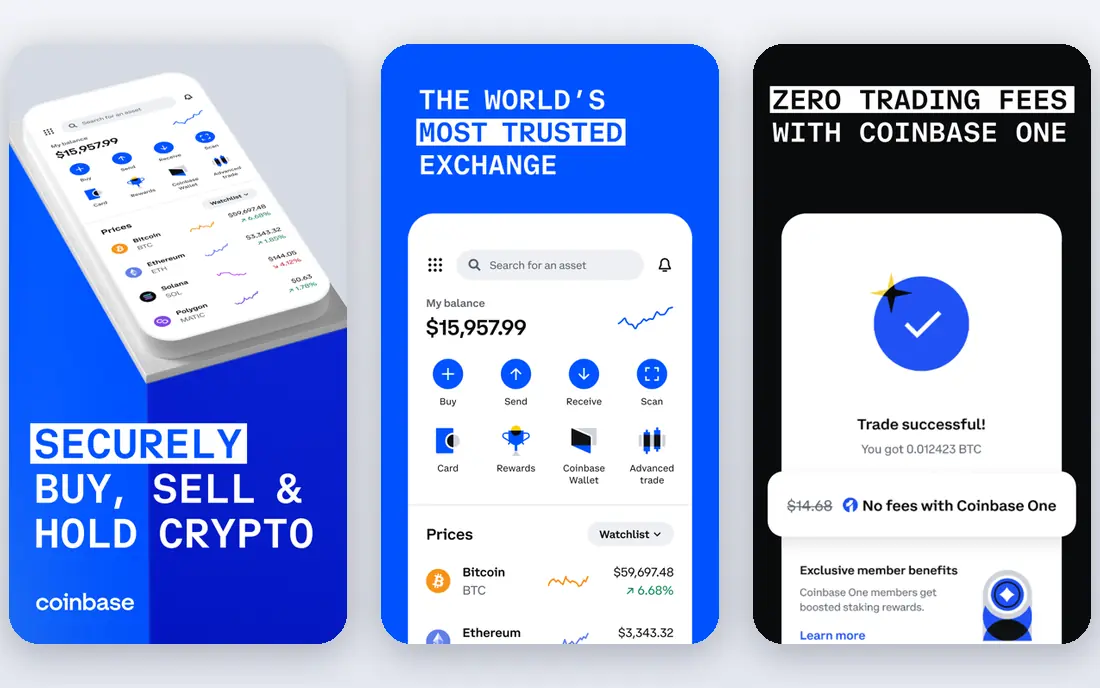
Coinbase is the most straightforward blockchain company for a US consumer or business that wants regulated access to digital assets. Its exchange, wallet, custody, and institutional tools cover the full path from buying to holding, and as a public company it publishes financial reports that private rivals do not. That transparency helps buyers judge stability.
Fees are the main drawback, especially for small trades on the standard consumer app, where costs can exceed those on advanced trading interfaces. Product availability also varies by state and country. For a first, regulated entry point, Coinbase remains the safest default, but compare fees before you trade often.
- Large US exchange with custody and institutional tools
- Clear consumer app
- Public company reporting
- Trading fees can be high for small, frequent trades
- Product availability varies by region
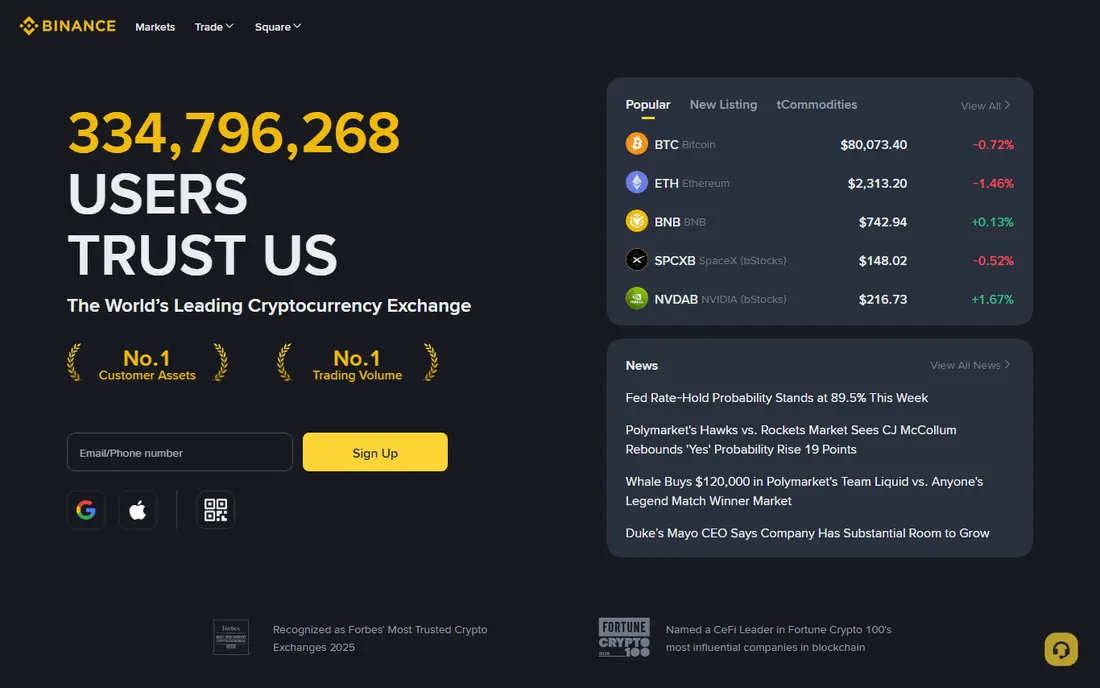
Binance is the largest global crypto exchange by trading volume, with deep liquidity across many tokens, futures, and other products. For traders outside the US, that depth means tighter spreads and more pairs than most rivals offer. Fees are competitive for active traders, especially with volume discounts.
US users do not get the full global platform. Binance.US is a separate, smaller exchange with fewer products, and regulatory scrutiny of Binance has varied by country. If you are outside the US and want depth, Binance is a leading choice. If you are in the US, compare Binance.US with Coinbase on the specific tokens you need.
- Deep global trading liquidity
- Wide range of tokens and products
- Low trading fees for many pairs
- US users face a separate, smaller platform
- Regulatory history varies by country
Ripple builds payment technology for banks, payment providers, and businesses that move money across borders. Its network aims to settle payments faster and cheaper than correspondent banking, and the XRP Ledger offers a public network for developers building payments and tokenization apps. That enterprise focus sets Ripple apart from consumer exchanges.
Ripple is not a consumer trading app, so it will not suit someone who simply wants to buy and hold. Adoption by banks and payment firms drives its value, and XRP, like other digital assets, is volatile. For a business exploring blockchain payments, Ripple is a serious, enterprise-focused option.
- Focus on fast, low-cost cross-border settlement
- Enterprise payment network
- XRP Ledger for developers
- Business model depends on bank and payment adoption
- Token price is volatile
Circle is best known as the issuer of USDC, a dollar-pegged stablecoin used for payments, settlement, and trading. Its developer tools let businesses accept, hold, and move USDC, which can simplify cross-border payments and treasury operations. Circle positions itself as a regulated, transparent issuer, with regular reserve reporting.
Circle is not an exchange, so it will not suit a consumer who wants to trade many tokens. Its value depends on whether partners, wallets, and payment firms support USDC. For a business that wants dollar-denominated digital payments without token volatility, Circle is a leading pick.
- USDC stablecoin for dollar-denominated payments
- Developer APIs for payments
- Regulated issuer approach
- Stablecoin use depends on partner adoption
- Not a trading exchange
ConsenSys builds core Ethereum infrastructure, including MetaMask, the wallet many users meet first, and Infura, the API service developers use to connect apps to Ethereum networks. That combination of consumer and developer tools gives ConsenSys unusual reach across the Ethereum ecosystem. Its consulting and enterprise work also helps large firms build on Ethereum.
The product range can confuse a newcomer, because MetaMask, Infura, and enterprise services serve different audiences. Pricing for enterprise work is quote-based, while consumer tools are free to use, with network fees paid separately. For anyone building or using Ethereum apps, ConsenSys is a central company to know.
- MetaMask wallet used by millions
- Infura developer APIs
- Deep Ethereum expertise
- Consumer tools are free but enterprise services are quote-based
- Product range can confuse newcomers
Chainlink Labs builds the oracle network that lets smart contracts use real-world data, such as asset prices, weather, and randomness. Without oracles, a smart contract cannot know the price of a token or whether an event happened, so Chainlink fills a core gap in decentralized finance. Its cross-chain messaging tools also help apps work across networks.
Chainlink is a developer infrastructure company, not a consumer product, so it will not suit a casual buyer. Its success depends on whether developers keep building on its network. For anyone evaluating blockchain infrastructure, Chainlink is one of the most widely used names in the field.
- Leading oracle network for price and real-world data
- Cross-chain messaging
- Wide DeFi adoption
- Technical product, not a consumer app
- Value depends on developer adoption
Alchemy provides the infrastructure developers use to build blockchain apps, including APIs, node services, analytics, and monitoring. It supports many chains, which helps a team that builds across Ethereum, Polygon, and other networks without running its own nodes. That reliability matters when an app serves many users.
Alchemy is not a consumer exchange or wallet, so it will not help someone who just wants to buy digital assets. Its free tier is useful for learning and small projects, while larger apps pay by usage. For a developer team, Alchemy is a practical, widely used infrastructure choice.
- Developer APIs and node infrastructure
- Analytics and monitoring
- Supports many chains
- Developer-focused, not a consumer product
- Free tier limits vary by plan
Polygon Labs builds scaling technology for Ethereum, letting apps offer faster transactions and lower fees than the Ethereum mainnet. Its ecosystem includes DeFi, gaming, and consumer apps, which gives developers an audience and gives users lower-cost transactions. Tools for developers and enterprises help teams move from Ethereum to Polygon.
Scaling networks involve trade-offs in security and decentralization compared with Ethereum itself, and the POL token, like other digital assets, is volatile. For a developer who wants Ethereum compatibility with lower costs, Polygon is a leading option. For a consumer, Polygon matters mainly through the apps built on it.
- Lower fees and faster transactions than Ethereum mainnet
- Large app ecosystem
- Developer tools
- Network security and decentralization trade-offs vs Ethereum
- Token price is volatile
IBM is the enterprise pick on this list, for organizations that want blockchain as part of a wider technology relationship. Its consulting, cloud, and security services help firms build supply chain, trade finance, and identity applications, with the governance and support that large organizations expect. That enterprise focus is a different value proposition from a consumer exchange.
Blockchain is a small part of IBM, so its blockchain work is less visible than its cloud and AI work. Pricing is quote-based and implementation is a project. For a large organization that already works with IBM, its blockchain services are a natural extension. For a startup, a developer-focused firm such as Alchemy or ConsenSys will be faster.
- Enterprise consulting and cloud services
- Supply chain and trade finance experience
- Strong security focus
- Blockchain is one part of a huge company
- Enterprise pricing is quote-based
How we picked these
We compared official company pages, product documentation, and public reporting, and we favored companies that are still active in October 2026 and that represent distinct parts of the blockchain industry: exchanges, payments, stablecoins, developer tools, scaling networks, and enterprise services. We excluded companies that had closed or pivoted away from blockchain, and we treated companies as products, with official homepages and See website pricing, because subscription pricing does not apply to a company.
How to evaluate a blockchain company
Start with the problem, not the token. A payments company should be judged on settlement speed, cost, and partner adoption. A developer platform should be judged on reliability, documentation, and the apps built on it. An exchange should be judged on regulation, custody, fees, and the tokens it actually lists in your region.
Check regulation and custody carefully, especially for consumer funds. A company that is regulated in your country, publishes audits or reserve reports, and offers clear custody terms is easier to trust than one that does not. Remember that digital assets are volatile, and that a strong company does not make its token a safe investment. This article is for comparison, not financial advice.
FAQ
What is the best blockchain company?
There is no single best company, because exchanges, payment firms, and developer platforms solve different problems. Coinbase suits US consumers, Binance suits global traders, Circle suits stablecoin payments, and Alchemy suits developers.
What is the best blockchain platform?
For Ethereum apps, ConsenSys tools and Polygon scaling are widely used, while Chainlink provides data for smart contracts. For enterprise use, IBM offers consulting and cloud services tied to wider systems.
Which blockchain company is best for beginners?
Coinbase is the easiest starting point for US beginners, because of its consumer app, custody, and public reporting. Beginners should still compare fees, check which tokens are available in their region, and understand that digital assets can lose value.
Is blockchain still relevant in 2026?
Yes, blockchain is used beyond trading, in payments, tokenization, supply chains, and developer infrastructure. Adoption varies by use case, and the strongest companies are those with real users, partners, and revenue, not just a token.
How do blockchain companies make money?
Exchanges earn trading and custody fees, payment firms earn transaction and service fees, and developer platforms earn usage and enterprise fees. Some companies also earn from token holdings or consulting, which is why their business models differ so much.
Is investing in blockchain companies safe?
No investment is safe, and digital assets and blockchain stocks can be volatile. This list compares companies and products, not investment returns. Do your own research, check regulation in your country, and consider professional financial advice before investing.