Best Web3 Blockchain Platform in 2026: 8 Platforms Compared
We compared web3 builders on chains, APIs, and pricing to find the best web3 blockchain platform for apps, wallets, and onchain data projects in 2026.

- Editor's choice
 Alchemy
Production apps on many chains
Starts atFreeVisit alchemy.comFull review - Great alternative
 Infura
Ethereum and Layer 2 apps
Starts atFreeVisit infura.ioFull review - Also consider
 QuickNode
High speed multichain RPC
Starts at$49 per monthVisit quicknode.comFull review
TL;DR:
- Alchemy stands out for production apps on many chains, with a starting point of free.
- Infura stands out for ethereum and layer 2 apps, with a starting point of free.
- QuickNode stands out for high speed multichain rpc, with a starting point of $49 per month.
- Moralis stands out for data rich wallets and nft apps, with a starting point of see website.
- We compared official pricing, feature pages, and public reviews, and we did not claim hands-on testing for any product in this list.
Quick comparison
| Tool | Best for | Starts at | Free plan? | |
|---|---|---|---|---|
| Alchemy | Production apps on many chains | Free | Yes | Visit |
| Infura | Ethereum and Layer 2 apps | Free | Yes | Visit |
| QuickNode | High speed multichain RPC | $49 per month | Free trial | Visit |
 Moralis | Data rich wallets and NFT apps | See website | Yes | Visit |
 Thirdweb | Full stack web3 app building | See website | Yes | Visit |
 Chainstack | Managed nodes for enterprises | See website | Yes | Visit |
 Ankr | Budget multichain RPC | Free | Yes | Visit |
 Tenderly | Smart contract testing and monitoring | See website | Yes | Visit |
The best Web3 blockchain platforms
We reviewed each option below against the same checks: does it truly fit best web3 blockchain platform, what does it cost, and what is the honest trade-off. Our pick for most readers depends on team size and budget, so read the best-for line first.

Alchemy is the default starting point for many production web3 apps.
It provides managed RPC endpoints, data APIs, and webhooks across major chains, so developers do not run their own nodes. Dashboard tools help track usage and debug failed requests.
Usage-based billing can surprise teams during traffic spikes. Set alerts and caps early, and test with the free tier before launch.
- Broad chain support
- Reliable RPC and APIs
- Webhooks and wallet tools
- Usage pricing needs monitoring
- Enterprise features are quoted
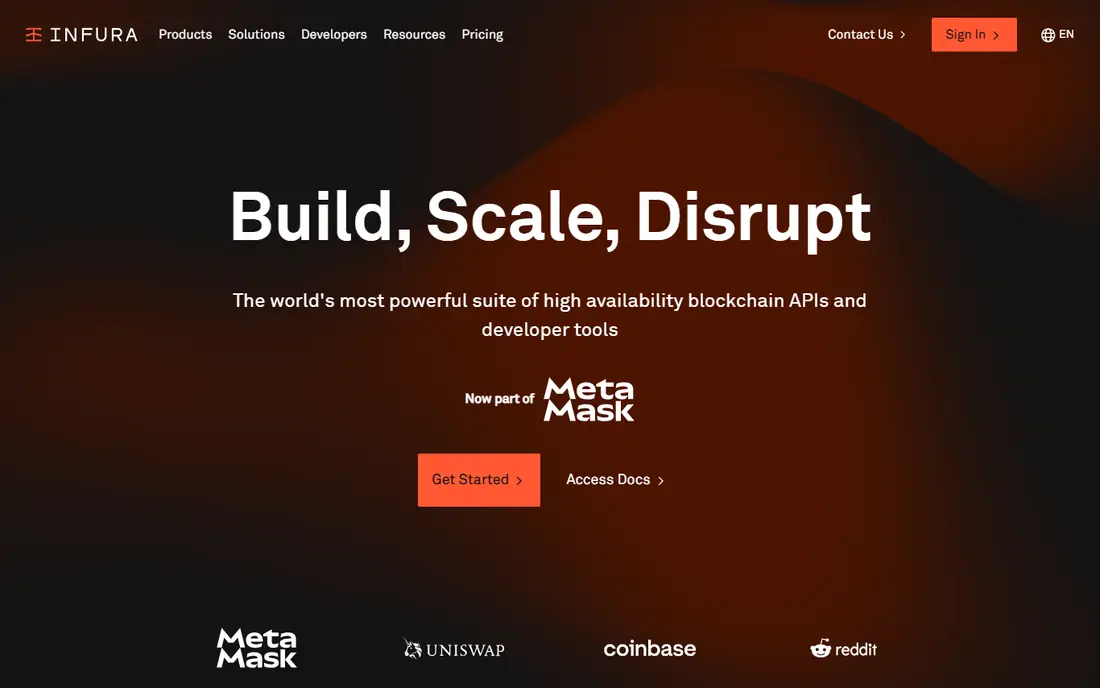
Infura suits teams focused on Ethereum and its Layer 2 networks.
Its managed endpoints, WebSocket support, and archive access cover most wallet, DeFi, and NFT use cases. A free Core plan gives daily credits for testing and small apps.
Teams building across many non-Ethereum chains may need a second provider. Check chain coverage against your roadmap, not just your launch chain.
- Long track record
- Archive data
- Gas and debug APIs
- Chain breadth is narrower than some rivals
- Higher tiers are usage based
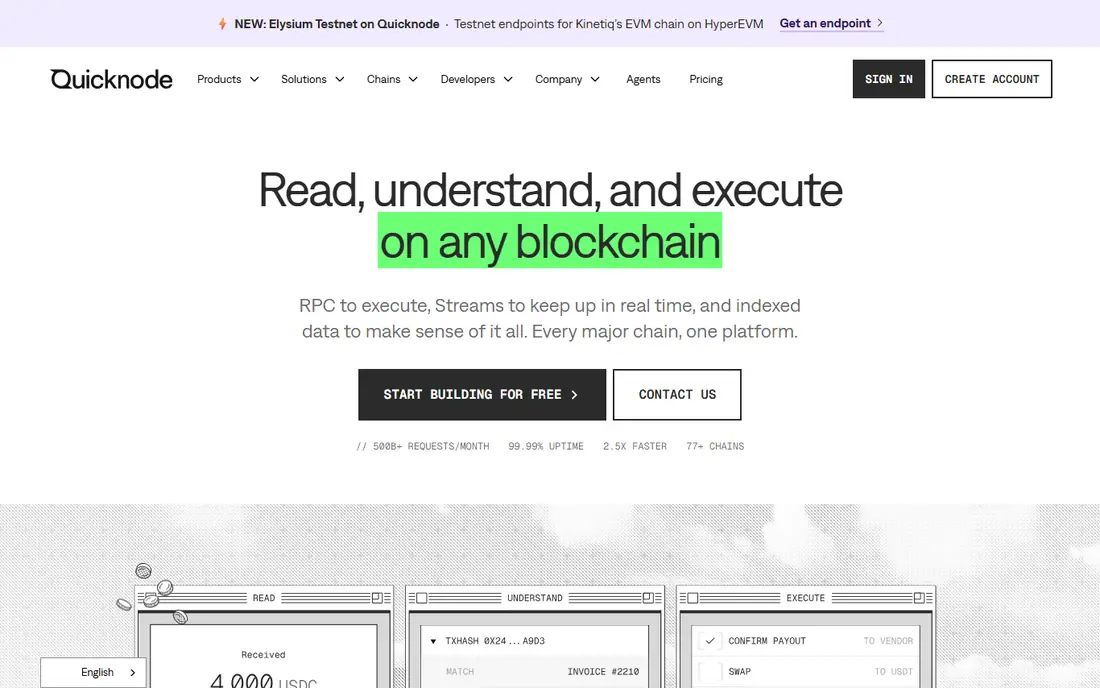
QuickNode fits apps where response time and real-time data matter.
It offers JSON-RPC, REST, and WebSocket endpoints across many chains, plus Streams for event data and an add-on marketplace. Dedicated clusters help high-traffic apps isolate load.
Pricing uses credits, and some methods cost more than others. Read the credit weights for your heaviest calls before committing to a tier.
- Fast endpoints
- Streams and add-ons
- Dedicated clusters on higher plans
- Free access is a trial, not a permanent tier
- Credit math varies by method
Moralis is built for apps that need clean onchain data, not just raw RPC calls.
Its APIs return wallet balances, token holdings, NFT metadata, and prices in a form that front ends can use directly. Streams push updates when onchain events happen.
For simple RPC-only apps, Moralis can be more than needed. Compare its data APIs against a cheaper RPC provider if your app does little data work.
- Wallet, token, NFT, and price APIs
- Streams
- Broad chain support
- Paid plans start higher than basic RPC tools
- API limits need planning
Thirdweb helps teams ship a complete web3 app without assembling every layer.
Developers get audited contract templates, SDKs, wallet connection, and payment tools in one place. Account abstraction features can make onboarding feel closer to a normal app.
The breadth is a strength and a risk. Teams should confirm which features sit behind paid tiers and how usage is metered for their traffic.
- Contracts, SDKs, wallets, and account abstraction
- Many chains listed
- Usage pricing can be complex
- Smaller teams need to watch included limits
Chainstack suits teams that want managed nodes with deployment flexibility.
It supports shared and dedicated nodes across many networks, with options for hybrid cloud setups. Archive nodes and WebSocket access support data-heavy apps.
Self-serve pricing is usage based, so large archive or high-throughput workloads need a quote. Test latency from your users' regions before launch.
- Dedicated and shared nodes
- Hybrid cloud options
- Archive support
- Enterprise pricing is quoted
- Dashboard depth varies by plan
Ankr is a budget-friendly option for multichain projects and prototypes.
Its public and premium RPC endpoints cover many chains, and premium credits are priced lower than several rivals. That makes it easy to test a new chain without a large commitment.
Shared infrastructure means rate limits and variable performance. Production apps with strict latency needs should test under load or use dedicated options.
- Wide chain coverage
- Low-cost premium credits
- Public endpoints
- Shared endpoints have rate limits
- Support depth varies by tier
Tenderly is the testing and safety layer that serious contract teams add.
Developers can simulate transactions, debug failures, and run virtual testnets before deploying to mainnet. Monitoring and alerts catch problems after launch.
It does not replace an RPC provider. Budget for Tenderly alongside your node infrastructure, and train the team on simulation workflows.
- Simulator and debugger
- Virtual testnets
- Transaction monitoring
- Full features need paid plans
- Learning curve for advanced simulation
How we picked these
We started with products that genuinely fit best web3 blockchain platform and are available today. We compared official feature pages, pricing pages, and app store listings, and we checked public reviews for recurring strengths and complaints. We favored tools with clear pricing or a clear quote process, real integrations, and a track record of serving the audience named in each best-for line.
We did not claim hands-on testing, and we did not invent ratings, user counts, or awards. Where a vendor does not publish a price, we wrote See website and advised readers to request a full quote that includes any per-user, per-device, or usage fees. That approach keeps the comparison honest when pricing models differ as much as they do in this category.
What to check before you buy
Start with the problem you need to solve this quarter, not the longest feature list. Write down your top three requirements before you look at demos, and use that short list to keep every vendor comparison honest and focused on outcomes. List the must-have integrations, the devices or channels you support, and the number of users or devices you will actually pay for. Ask each vendor for a written quote that separates subscription, usage, and implementation costs.
Trial and rollout
Run a short pilot with real users and real data, and measure the outcome you care about, such as response time, adoption, or forecast accuracy. Check privacy controls, data export options, and what happens to your data if you cancel. A tool that is hard to leave is a tool that needs extra scrutiny before you sign.
Cost and support
Compare total cost over a year, including seats, devices, usage, and support tiers. Ask about onboarding help, response times, and whether key features such as single sign-on or audit logs need a higher plan. The cheapest headline price is rarely the cheapest full-year cost.
We also checked whether each vendor publishes a clear privacy policy, data processing terms, and security documentation. A tool that handles employee data, customer messages, financial records, or device controls should explain how it stores data, who can access it, and how long it keeps it. If that documentation is hard to find, treat it as a warning sign and ask the vendor directly before you sign a contract.
Red flags to avoid
Be cautious with tools that hide pricing behind a demo, refuse a trial, or will not explain how to export your data. Watch for per-user fees that jump sharply at the next tier, usage charges that are hard to forecast, and features such as single sign-on or audit logs that only appear on the most expensive plan. If a vendor cannot name its support hours, its data location, or its cancellation terms in writing, keep looking. A clear contract and a clean exit path matter as much as a strong feature list, especially when the tool will hold data your team relies on every day.
FAQ
What is best web3 blockchain platform?
A best web3 blockchain platform helps buyers compare tools that solve one specific job, rather than buying a general product and hoping it fits. Look for the best-for line, the starting price, and the honest weakness for each option before you shortlist.
How much does best web3 blockchain platform cost?
Costs range from free plans for small teams to quoted enterprise contracts for large organizations. Always ask for a full-year quote that includes users, devices, usage, and any required add-ons.
Can I try these tools before paying?
Many tools in this list offer a free plan or a free trial, while enterprise tools usually offer a demo and a pilot. Use the trial with real data and real users, and check export options before you commit.
Which option is best for a small team?
Small teams usually do best with a low entry price, a free plan, and simple setup. Start with the budget picks in this list, and move to an enterprise tool only when volume or compliance demands it.
Do I need to switch tools as I grow?
Not always. Some tools scale from a free plan to enterprise tiers, while others are best as a first step. Check user limits, pricing jumps, and data export before you build a long-term workflow around any one product.