Best Asset Leasing Software in 2026: 8 Products Compared
Looking for the best asset leasing software? We compared 8 tools for lease accounting, portfolios, payments, renewals, and compliance in one place today.
- Editor's choice
 LeaseQuery
Clean lease accounting and reporting
Starts atSee websiteVisit leasequery.comFull review - Great alternative
 Visual Lease
Large lease portfolios and reporting
Starts atSee websiteVisit visuallease.comFull review - Also consider
 Crunchafi
CPA firms and mid-size lease portfolios
Starts atSee websiteVisit crunchafi.comFull review
TL;DR:
- Asset leasing software splits into two jobs: lease accounting for compliance, and lease operations for portfolios, payments, and renewals.
- LeaseQuery, Visual Lease, Crunchafi, and Trullion focus on accounting standards such as ASC 842, IFRS 16, and GASB 87.
- MRI Software, LeaseAccelerator, and Odessa cover wider portfolios, including real estate, equipment, and lessor operations.
- Most pricing is based on lease count, entities, and modules, so get a quote tied to your portfolio size before you budget.
Quick comparison
| Tool | Best for | Starts at | Free plan? | |
|---|---|---|---|---|
| LeaseQuery | Clean lease accounting and reporting | See website | Free trial | Visit |
| Visual Lease | Large lease portfolios and reporting | See website | No | Visit |
| Crunchafi | CPA firms and mid-size lease portfolios | See website | No | Visit |
 Trullion | AI-assisted lease data extraction | See website | No | Visit |
 MRI Software | Mixed real estate and equipment portfolios | See website | No | Visit |
 LeaseAccelerator | Enterprise lease lifecycle management | See website | No | Visit |
 iLeasePro | Small portfolios with simple pricing | $99 per month | Free trial | Visit |
 Odessa | Lessor and equipment finance operations | See website | No | Visit |
The best asset leasing software
Leasing an asset creates work long after the contract is signed. Payments must be tracked, terms must be checked at renewal, and accounting rules require schedules and disclosures. These eight tools cover that lifecycle, from a small portfolio of ten leases to a global mix of property and equipment.
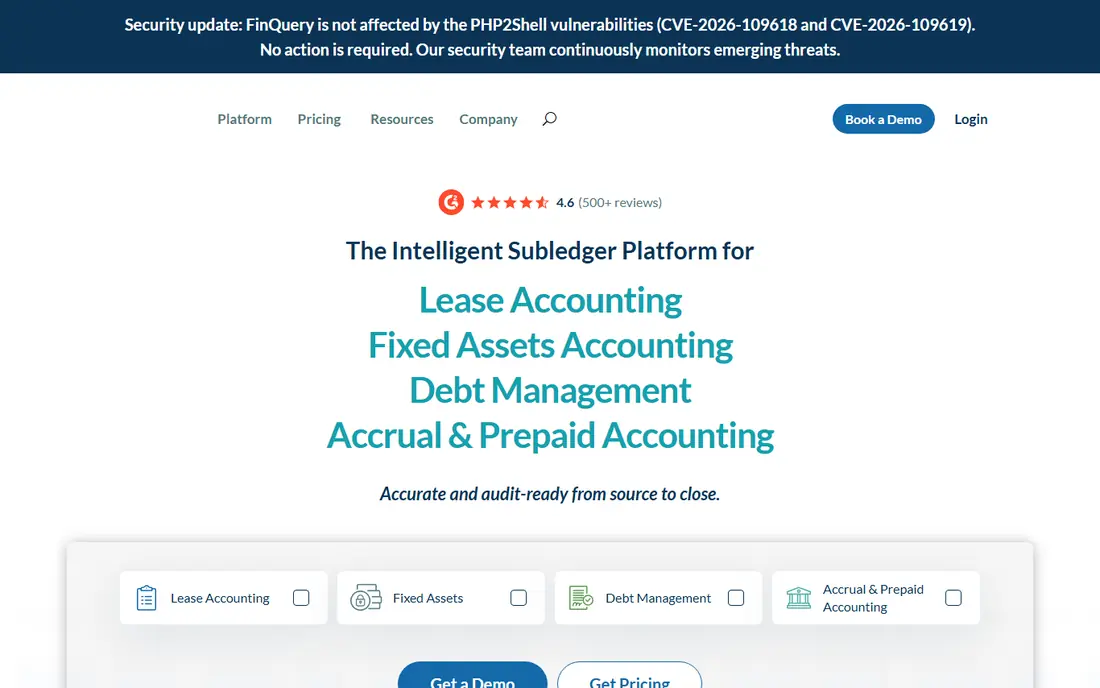
LeaseQuery, now powered by FinQuery, is a practical pick for finance teams that need lease accounting to stand up to audit. You enter lease terms once, and the system builds amortization schedules, journal entries, and disclosure reports. That structure helps at year-end, when auditors ask for the same numbers in several formats. The honest catch is onboarding. Lease data often lives in PDFs, emails, and old spreadsheets, and cleaning it takes effort no matter which tool you choose. LeaseQuery offers a free LeaseGuru option for a small number of leases, which is useful for testing the workflow before committing to a paid plan. For a finance team that values clear reporting over property management depth, it is a strong start.
- Lease accounting for ASC 842, IFRS 16, and GASB 87
- Amortization schedules and journal entries
- Integrations with major ERP systems
- Pricing is quote-based for paid plans
- Implementation takes time for a large or messy portfolio
Visual Lease suits companies with a large or complex portfolio. It covers lease administration, accounting, and reporting, and it can handle real estate and equipment leases in one system. Budgeting and forecasting tools help finance teams plan rent, renewals, and critical dates, rather than reacting to them. That breadth has a learning curve. Teams with a small portfolio may find Visual Lease more than they need, and reporting customization can require help for very specific calculations. For a retailer, healthcare system, or corporation with hundreds of leases across entities, that depth is the point. Shortlist it when portfolio size and reporting needs are the main problem.
- Long history in lease administration
- Portfolio, budgeting, and reporting tools
- Integrations with ERP and business intelligence tools
- Quote-based pricing
- Interface can take longer to learn than simpler accounting tools
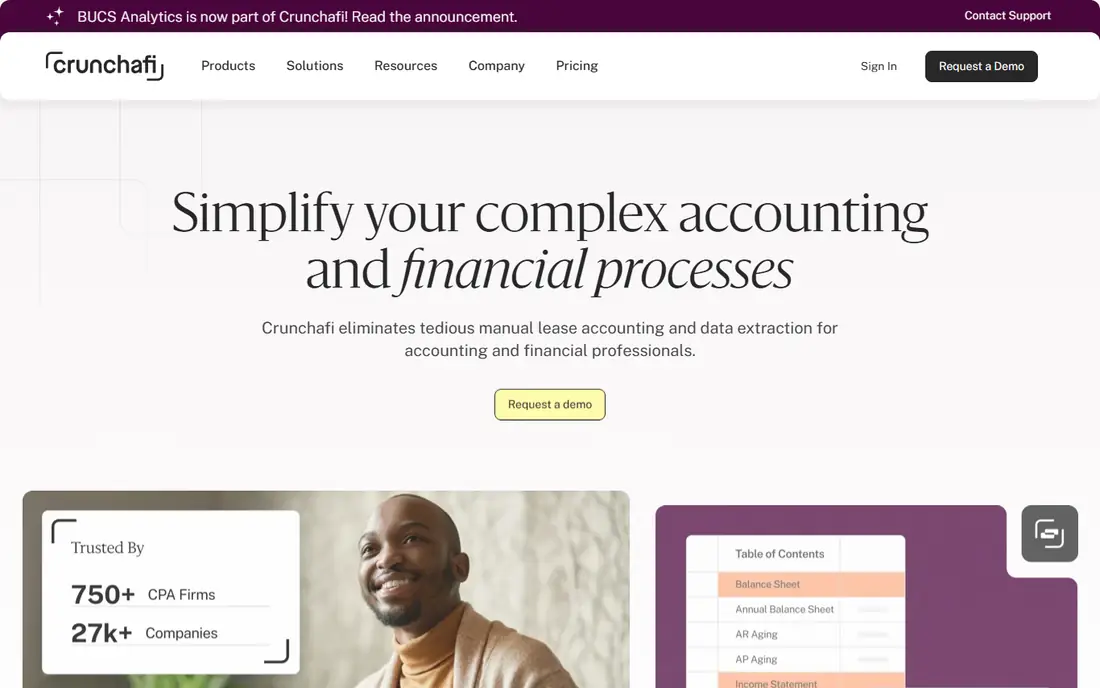
Crunchafi, formerly LeaseCrunch, is built for accountants and for companies that need compliance without a large platform. Guided wizards walk you through lease terms, then produce journal entries, footnote disclosures, and amortization schedules. CPA firms can manage several clients in one system, which is a clear advantage for an accounting practice. The limit is scope. Crunchafi is strong on calculations and reports, but it is not a full property management or lessor operations tool. If your main need is to get lease accounting right for five to five thousand leases, that focus is welcome. If you also need day-to-day property operations, pair it with an administration tool or choose a wider platform.
- Step-by-step lease calculation wizards
- Audit-ready reports and schedules
- Compliance with ASC 842, IFRS 16, and GASB standards
- Pricing varies by lease count and firm type
- Less property management depth than a full administration platform
Trullion appeals to teams drowning in lease documents. Instead of typing every term by hand, you upload contracts and let AI pull out dates, payments, options, and clauses. That can cut onboarding time sharply for a portfolio built from scanned agreements and varied formats. AI extraction is not a substitute for review. Lease terms affect financial statements, so a human should verify extracted terms, especially for renewal options, variable payments, and termination clauses. Trullion fits teams that want faster onboarding and a clean interface, and that are willing to build a review step into the process. For a small portfolio with clean data, a simpler tool may be enough.
- AI extraction of lease terms from PDF contracts
- Clear calculation schedules
- Support for ASC 842, IFRS 16, and GASB 87
- AI output still needs human review for accuracy
- Smaller review base than older lease platforms
MRI Software, including MRI Lease Accounting, fits mid-size and large companies with a mixed portfolio. Real estate and equipment leases sit on one platform, with calculations for free rent periods, escalations, and capitalization. That mix helps when a company leases offices, vehicles, and equipment under different terms. New users often report a learning curve, and the interface is less simple than LeaseQuery or Crunchafi. MRI is best when portfolio complexity justifies that learning time. If your leases are mostly one type and your team is small, a focused accounting tool will be faster to adopt.
- Central lease accounting for real estate and equipment
- Automation for rent periods and capitalization schedules
- Broad property tools
- Interface can feel complex for new users
- Pricing and modules require a sales conversation
LeaseAccelerator is built for large organizations that treat leasing as a managed lifecycle, not just an accounting entry. It covers lease sourcing, administration, accounting, and asset management, with controls for approvals and critical dates. That breadth helps global companies keep leases, payments, and accounting aligned across business units. For a small or mid-size team, LeaseAccelerator will feel heavy and costly. Implementation and change management take real effort. It earns its place when lease volume, entity count, or audit complexity is high, and when a single platform for the full lifecycle is worth the investment.
- Full lease lifecycle from sourcing to end of term
- Accounting, procurement, and asset tracking in one platform
- Strong controls for large portfolios
- Enterprise-leaning implementation and pricing
- More system than a small portfolio needs
iLeasePro is the low-friction entry point on this list. A small business with a handful of leases can start at a published monthly price, rather than waiting for a quote. The tool covers lease tracking and accounting basics, which is enough when the portfolio is small and the main goal is to stop tracking leases in a spreadsheet. The limit is scale. As lease count, entities, or reporting needs grow, iLeasePro may need a higher plan or a move to a larger platform. That is not a flaw for its target buyer. Start here if you have under ten leases and want a clear price, and move up only when reporting or portfolio size forces the change.
- Published starting price for up to ten leases
- Free tier for very small portfolios
- Cloud access for small finance teams
- Less depth for large portfolios and complex reporting
- Advanced features may require higher tiers as lease count grows
Odessa covers the other side of leasing: the company that leases assets out. It supports origination, pricing, servicing, billing, and asset management for equipment finance and leasing businesses. That lessor focus sets it apart from the accounting-first tools on this list. A lessee that only needs ASC 842 compliance should not pick Odessa. Its value shows up for banks, captives, and independent lessors that run a portfolio of customer leases and need operations, not just schedules. If you are a lessor, put Odessa on the shortlist and judge it on servicing workflows, not just accounting reports.
- Built for lessors and equipment finance
- Origination, servicing, and asset management workflows
- Configurable for finance products
- Quote-based and enterprise-leaning
- Less suited to a lessee that only needs accounting compliance
How we picked these
We compared official feature pages, pricing pages, and public reviews for tools that manage leased assets, lease accounting, or lessor operations. We included both lessee accounting tools and lessor platforms, because the search term covers both sides of a lease. We left out generic accounting software where leasing is only a minor feature. Prices shown are starting prices from vendor pages or recent public summaries checked in October 2026. Where pricing is based on lease count and modules, we list See website rather than an estimate. This article is general information, not accounting advice, and lease accounting treatment should be confirmed with a qualified accountant for your standards and jurisdiction.
What to check before you choose
Decide whether you are a lessee, a lessor, or both
Lessee tools focus on accounting, schedules, and disclosures. Lessor tools focus on origination, servicing, and collections. Some platforms cover both, but most lean one way. Picking the wrong side is the most common mistake in this category.
Count leases, entities, and standards before you price
Vendors price by lease count, entity count, and modules. Gather those numbers first, plus which standards apply: ASC 842, IFRS 16, GASB 87, or a mix. A quote without those inputs will not be comparable across vendors.
Test data import with your messiest leases
Upload a scanned contract, a lease with options, and a lease with variable payments during a trial. How the tool handles those three cases tells you more than a clean demo. Check how options, escalations, and modifications are recorded and reported.
Plan for audit and renewal dates
Ask how journal entries, disclosures, and audit trails are produced, and how critical dates are alerted. A tool that only stores leases will not help at year-end or at renewal. The reporting and alerting workflow is where leasing software earns its fee.
FAQ
What is asset leasing software?
It is software that tracks leased assets, contracts, payments, and accounting. Lessee tools focus on compliance and reporting, while lessor tools focus on originating and servicing leases. Some platforms cover both sides.
Do small businesses need lease accounting software?
It depends on lease count and accounting rules. A business with one or two simple leases may manage in a spreadsheet with accountant help. A business with many leases, multiple entities, or audit requirements will benefit from a dedicated tool that builds schedules and disclosures.
What are ASC 842, IFRS 16, and GASB 87?
They are lease accounting standards for US private and public companies, international companies, and US government entities, respectively. They generally require many leases to appear on the balance sheet, with schedules and disclosures. The right tool depends on which standard applies to you.
How is leasing software priced?
Most vendors price by lease count, with add-ons for entities, users, and modules. A few publish a starting price, such as iLeasePro at $99 per month for up to ten leases. Most larger platforms require a quote tied to portfolio size.
Can leasing software integrate with my ERP?
Many tools on this list integrate with ERP systems such as NetSuite, SAP, Oracle, and Microsoft Dynamics. Confirm the exact integration for your ERP, including how journal entries and payments sync, before you sign.
What happens at lease renewal or termination?
Good leasing software tracks critical dates, options, and end-of-term steps, and it updates schedules when terms change. Check how modifications, renewals, and terminations are handled in a trial, since those events cause most accounting errors.