Best Apps for Workout Tracking in 2026: 9 Apps Compared
Compare the best apps for workout tracking in 2026, from gym logs and AI programs to running and general fitness, with free plans and pricing notes included.

- Editor's choice
 Strong
fast minimalist gym log
Starts at$4.99 per monthVisit strong.appFull review - Great alternative
 Hevy
social gym logging at low cost
Starts at$2.99 per monthVisit hevyapp.comFull review - Also consider
 Fitbod
AI-built gym sessions
Starts at$12.99 per monthVisit fitbod.meFull review
TL;DR:
- Gym logging and programmed workouts are different jobs, so pick a logger if you have a plan, and a program builder if you do not.
- Free plans from Strong and Hevy cover real training, while Fitbod and similar program builders are trial-based.
- Export matters if you switch apps, since a training history built over years is worth keeping.
- Running, cardio, and general fitness need a different app than a barbell log, so match the app to your main training type.
Quick comparison
| Tool | Best for | Starts at | Free plan? | |
|---|---|---|---|---|
| Strong | fast minimalist gym log | $4.99 per month | Yes | Visit |
| Hevy | social gym logging at low cost | $2.99 per month | Yes | Visit |
| Fitbod | AI-built gym sessions | $12.99 per month | Free trial | Visit |
 JEFIT | deep exercise library and analysis | See website | Yes | Visit |
 Caliber | coach-designed programs | Free | Yes | Visit |
 FitNotes | simple free Android log | Free | Yes | Visit |
 GymBook | low-cost gym logging | $2.99 per month | Yes | Visit |
 Nike Training Club | guided general workouts | Free | Yes | Visit |
 Strava | running and cardio tracking | Free | Yes | Visit |
The best apps for workout tracking
The best apps for workout tracking help you record what you did, see progress over time, and stick with a plan, without getting in the way during a set. This list covers gym logs, program builders, and cardio trackers, so you can match the app to your training style. This is general fitness information, not medical advice, and you should check with a clinician before starting a new training program if you have a health condition.
Strong is the minimalist logger many lifters return to, because logging a set takes only a few taps and the app stays out of the way between sets. You can build routines, log weights, reps, and rest times, and review progress over time, with custom exercises for anything missing from the preset list. The free tier allows unlimited saved workouts and CSV export, which is generous for a free plan.
Charts and some advanced features require Pro, and the preset exercise list is smaller than JEFIT or Fitbod, though custom exercises close much of that gap. If you already have a program and want the fastest, cleanest log for it, Strong is our pick for most lifters.
- Very fast set entry
- Unlimited saved workouts on free tier
- Straightforward CSV export
- Smaller preset exercise list than some rivals
- Charts and advanced features sit in Pro
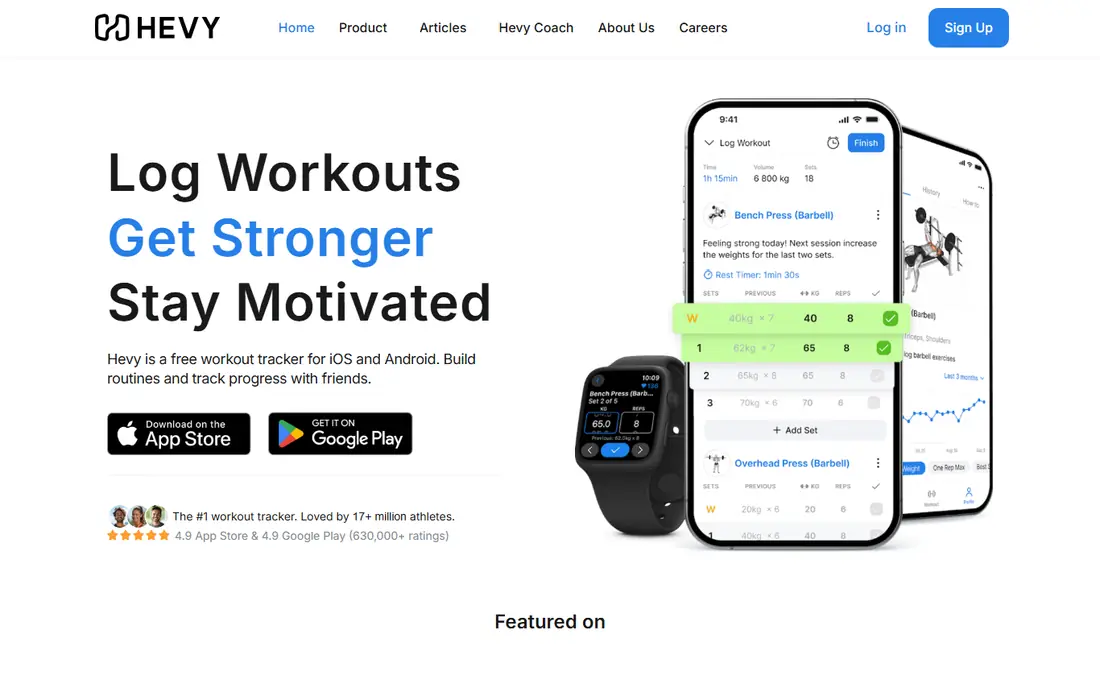
Hevy pairs a clean gym log with a social feed, so you can follow friends, see their workouts, and compare progress on leaderboards. Logging is template-based and quick, with a large exercise library and routine sharing that helps a new lifter start from a proven template. Pro adds more routines, deeper analytics, and AI workout help at a price lower than most rivals.
The free tier caps routines, so a lifter who runs many different programs will need Pro, and its analytics are less deep than JEFIT. If social motivation helps you train consistently, and you want the lowest-cost upgrade in this list, Hevy is a strong choice.
- Low-cost Pro plan
- Social feed with friends and leaderboards
- Free tier works indefinitely with routine limits
- Free tier caps routines
- Analytics depth is less than JEFIT

Fitbod is for lifters who do not want to plan each session themselves. It builds a workout around your available equipment, training history, and muscle recovery, rotating exercises to balance muscle groups over time. That structure suits a gym-goer who otherwise wanders between machines without a plan, and its exercise library is larger than Strong or Hevy.
There is no free tier, only a trial, so you must pay to keep using it, and a lifter with a trusted barbell program may fight the algorithm rather than follow it. If you want a session built for you each time you walk in, Fitbod is the leading program builder in this list.
- Builds each session around your equipment and recovery
- Large exercise library
- Tracks muscle fatigue and balance
- No free tier, only a trial
- Less suited to lifters who already follow a fixed program
JEFIT suits lifters who want depth, with a large exercise library, community programs, and analysis that shows sets per muscle group, movement balance, and recovery. Its Elite plan adds a periodised 12-week plan and deeper progress analysis, which helps a lifter who wants to see which muscles are undertrained. The free tier covers logging and many programs, so you can trial it properly before paying.
The interface packs a lot into one screen, which can feel busy next to Strong, and the free tier includes ads. Pricing has also varied, so check the current Elite price on the vendor site. For analytics and exercise depth, JEFIT is the most detailed logger here.
- Very large exercise library
- Per-muscle analysis and 12-week plans on Elite
- Community programs
- Interface can feel busy
- Free tier includes ads
- Elite price has varied over time
Caliber offers coach-designed strength programs for free, which makes it a strong starting point for a beginner or intermediate lifter who does not want to pay for a program. Programs include progression guidance, so you know when to add weight, and tracking covers the core lifts and accessories most strength programs need. That combination of a real program plus a log, at no cost, is unusual in this list.
Advanced lifters who run highly custom programs may find Caliber less flexible than Strong or JEFIT, and some coaching features sit in paid tiers. For a lifter who wants a solid program without a subscription, Caliber is an excellent first trial.
- Free coach-designed strength programs
- Clear progression guidance
- Good for beginners to intermediates
- Less flexible for advanced custom programming
- Coaching features vary by plan
FitNotes is a simple, free Android app for lifters who want a log and nothing else. Logging is quick, with a calendar view, simple charts, and custom routines, and there is no subscription or paywall for core features. That simplicity appeals to lifters who find larger apps distracting during a workout.
FitNotes is Android only, so iPhone users need another app, and it offers no social feed, AI programs, or coaching. If you train on Android and want a free, no-frills log that just works, FitNotes is hard to beat.
- Completely free
- Fast tap logging
- Simple charts and calendar view
- Android only
- No social or AI program features
GymBook is a low-cost alternative for lifters who want template-based logging without paying a premium price. You can build routines, log sets quickly, and track progress, with Pro adding more features at a modest monthly price. It suits a lifter who tried Strong or Hevy and wants a similar, simple experience with a different interface.
Its community and program features are smaller than Hevy or JEFIT, and it does not build sessions for you like Fitbod. For a budget-conscious lifter who wants a clean log and a low upgrade price, GymBook is a worthwhile trial.
- Low-cost Pro plan
- Template-based logging
- Good for lifters who want a simple alternative to Strong
- Smaller community than Hevy or JEFIT
- Fewer program features than Fitbod
Nike Training Club suits general fitness, with free guided workouts, training plans, and sessions for strength, cardio, yoga, and mobility. A beginner or a general fitness user can follow a structured plan without paying, and the coaching cues help with form and pacing. That guided approach is quite different from a blank gym log, and it suits users who want to be told what to do next.
It is not a detailed barbell log, so a powerlifter tracking heavy sets, rest times, and one-rep maxes will prefer Strong, Hevy, or JEFIT. For general fitness, home workouts, and guided plans at no cost, Nike Training Club is a strong, accessible pick.
- Free guided workouts for strength, cardio, and mobility
- Plans for different levels
- No subscription for core content
- Not a detailed barbell log
- Less suited to powerlifters tracking heavy sets
Strava is the cardio counterpart to a gym log, with GPS tracking for runs, rides, walks, and other outdoor activity, plus a social feed, segments, and challenges that motivate many runners. The free tier covers core tracking and social features, while the paid subscription adds deeper analytics, route planning, and training logs. For a runner or cyclist, Strava is the default community and tracking app.
It does not log gym sets in the way Strong does, so a lifter who also runs may use both Strava and a gym app. That pairing is common, since no single app does both jobs equally well. For running and cardio tracking, Strava remains the leading choice.
- Strong GPS tracking for runs, rides, and cardio
- Social feed and segments
- Free tier covers core tracking
- Not a gym set logger
- Deeper analytics sit in the paid subscription
How we picked these
We compared official feature pages, pricing pages, free plan terms, and public comparisons, and we favoured apps with a current, widely used tracking product that fits a clear training type. We looked for a mix of gym logs, program builders, general fitness, and cardio trackers, rather than nine versions of the same barbell log. We checked free tier limits, since a free plan that caps routines is not the same as one that logs without limit.
We also weighed export and switching costs. A training history built over years has value, so apps that let you export data scored better than those that lock history behind a paywall, and that point is noted where it applies.
How to choose a workout app
Start with your main training type. A barbell lifter with a program needs Strong, Hevy, or JEFIT, while a lifter without a program should trial Fitbod or Caliber. A general fitness user should trial Nike Training Club, and a runner should trial Strava, possibly alongside a gym log if they also lift. Buying a program builder when you already have a program, or a blank log when you need guidance, is the most common mismatch.
Then trial the app during real workouts, not only on the couch. Check logging speed between sets, offline behaviour in a gym with poor signal, and whether charts show the progress you care about. Check export before you build a long history, and check whether the free tier covers your routine count. An app you open every session beats a more powerful app you avoid.
FAQ
What are the best apps for workout tracking for the gym?
Strong is the fastest minimalist log, Hevy is the best low-cost social log, JEFIT offers the deepest analysis, and Fitbod builds sessions for lifters without a plan. The best gym app depends on whether you have a program, want social features, or want sessions built for you.
What is the best workout tracking app for free?
Strong and Hevy both offer free tiers that cover real training, FitNotes is completely free on Android, and Nike Training Club offers free guided workouts. Fitbod has no free tier, only a trial, so free-first users should start with Strong, Hevy, or FitNotes.
What is the best app for tracking workouts for beginners?
Caliber suits beginners who want a free coach-designed program, Nike Training Club suits beginners who want guided general workouts, and Hevy suits beginners who want a simple log with templates. A beginner should pick guidance first, then move to a detailed log as their program becomes fixed.
What is the best fitness log app for weightlifting?
Strong, Hevy, and JEFIT are the leading weightlifting logs, with Strong fastest, Hevy cheapest to upgrade, and JEFIT deepest on analysis. A powerlifter tracking heavy sets should also check one-rep max tracking and export, since those features differ across the three.
What are the best workout log apps for running?
Strava leads for running, with GPS tracking, segments, and a social feed, while Nike Training Club covers guided running plans. A runner who also lifts will often pair Strava for cardio with Strong or Hevy for gym sets.
Can I switch workout apps without losing my history?
Often, yes, but it depends on export. Strong offers straightforward CSV export on the free tier, while some apps place export behind paid tiers. Check export before you commit a long history, and export a backup regularly.