Best Apps for Nursing Students in 2026: 8 Products Compared
We compared the best apps for nursing students on NCLEX prep, drug guides and price, so students can pick the best nursing apps for study and clinical work.
- Editor's choice
 UWorld Nursing
Serious NCLEX preparation with detailed rationales
Starts atSee websiteVisit nursing.uworld.comFull review - Great alternative
 Picmonic
Visual learners who remember through picture mnemonics
Starts atSee websiteVisit picmonic.comFull review - Also consider
 SimpleNursing
Short, clear video lessons and study sheets
Starts atSee websiteVisit simplenursing.comFull review
TL;DR:
- UWorld and Archer Review lead for NCLEX-style questions, with detailed rationales and practice exams.
- Picmonic and SimpleNursing suit visual learners who remember concepts better through images and short videos.
- Epocrates and Nursing Central suit clinical rotations, where quick drug and reference checks matter most.
- The best free nursing apps are useful for review, but serious NCLEX prep usually needs a paid question bank.
- Use one main question bank, one visual aid, and one reference app, rather than five overlapping tools.
Quick comparison
| Tool | Best for | Starts at | Free plan? | |
|---|---|---|---|---|
| UWorld Nursing | Serious NCLEX preparation with detailed rationales | See website | Limited | Visit |
| Picmonic | Visual learners who remember through picture mnemonics | See website | Limited | Visit |
| SimpleNursing | Short, clear video lessons and study sheets | See website | Limited | Visit |
 Archer Review | Affordable NCLEX practice with readiness exams | See website | Limited | Visit |
 NCLEX Mastery | On-the-go review with questions, flashcards, and tracking | See website | Limited | Visit |
 Epocrates | Quick drug reference and interaction checks on clinical rotations | Free | Yes | Visit |
 Nursing Central | An all-in-one reference with a drug guide and dictionary | See website | Limited | Visit |
 Osmosis | Visual explanations across anatomy, disease, and clinical topics | See website | Limited | Visit |
The best apps for nursing students
We compared official feature pages, pricing pages, app store listings, and public reviews for the best apps for nursing students. The list covers NCLEX preparation, visual learning, and clinical reference, since nursing students need different tools at different stages. All apps here are available in 2026, and prices should be checked on vendor sites before you buy.
UWorld Nursing
Best for: Serious NCLEX preparation with detailed rationales
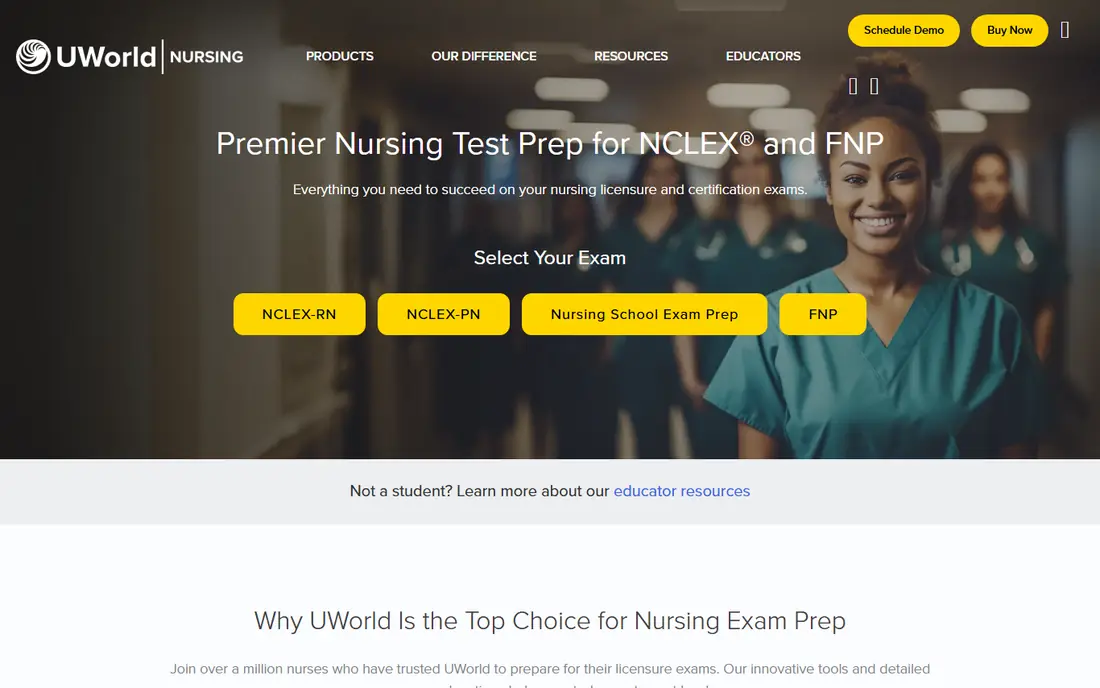
UWorld is the most widely recommended NCLEX question bank for a reason: questions mirror exam style, rationales explain why the correct answer is correct and why other options are wrong, and performance analytics show weak areas by system. Practice exams and self-assessments simulate the real test format, which helps with timing and stamina as well as knowledge. The price is the main barrier. UWorld plans are premium compared with many rivals, and the free offer is limited to a trial, so check current pricing on the official site and consider how many months you need. For students in the final NCLEX phase, UWorld is our first pick as a main question bank, paired with a cheaper visual aid for concepts that do not stick.
- Large NCLEX-style question bank, detailed rationales, practice exams and analytics
- Higher price than many rivals, no useful free tier beyond a trial
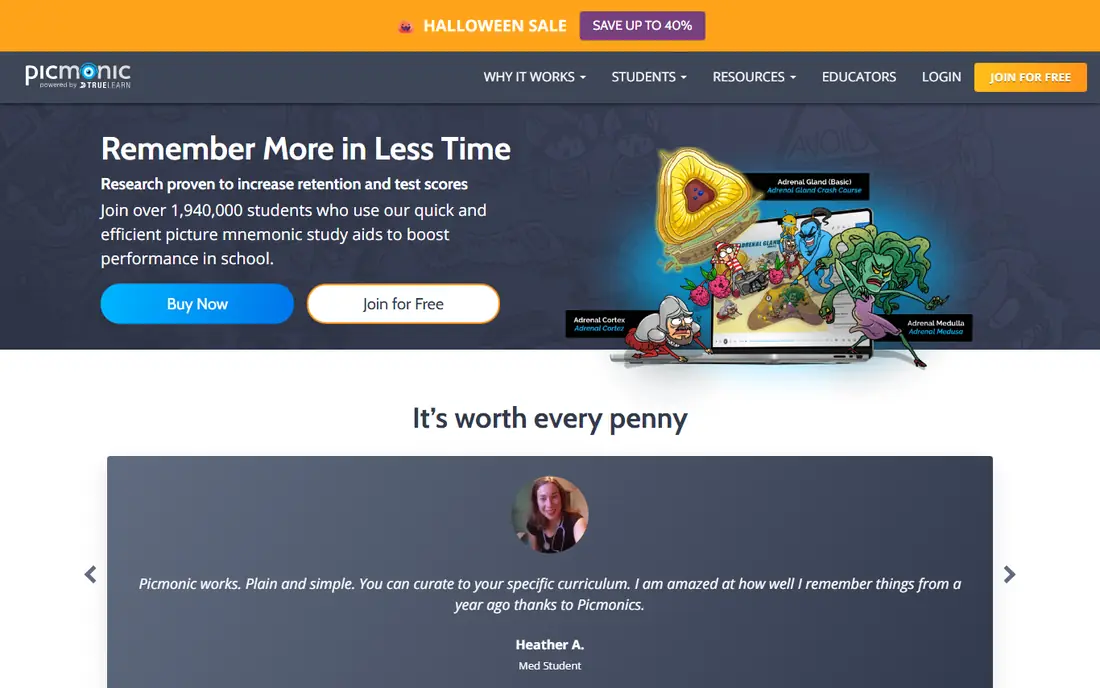
Picmonic turns hard concepts into memorable pictures, with characters and stories that link facts together. That visual approach helps many students remember pharmacology, microbiology, and pathophysiology details that plain notes lose. Quiz questions and spaced review tools let you test recall, rather than only rewatching videos. The mnemonic style is not for everyone, and some students prefer straightforward video lessons. Full access requires a paid plan, with a limited free or trial period, so check current pricing on the official site. Picmonic works best as a supplement to a question bank, for topics where you keep forgetting details despite repeated reading.
- Picture mnemonics, quiz questions, spaced review tools
- Mnemonic style may not suit everyone, full access needs a paid plan
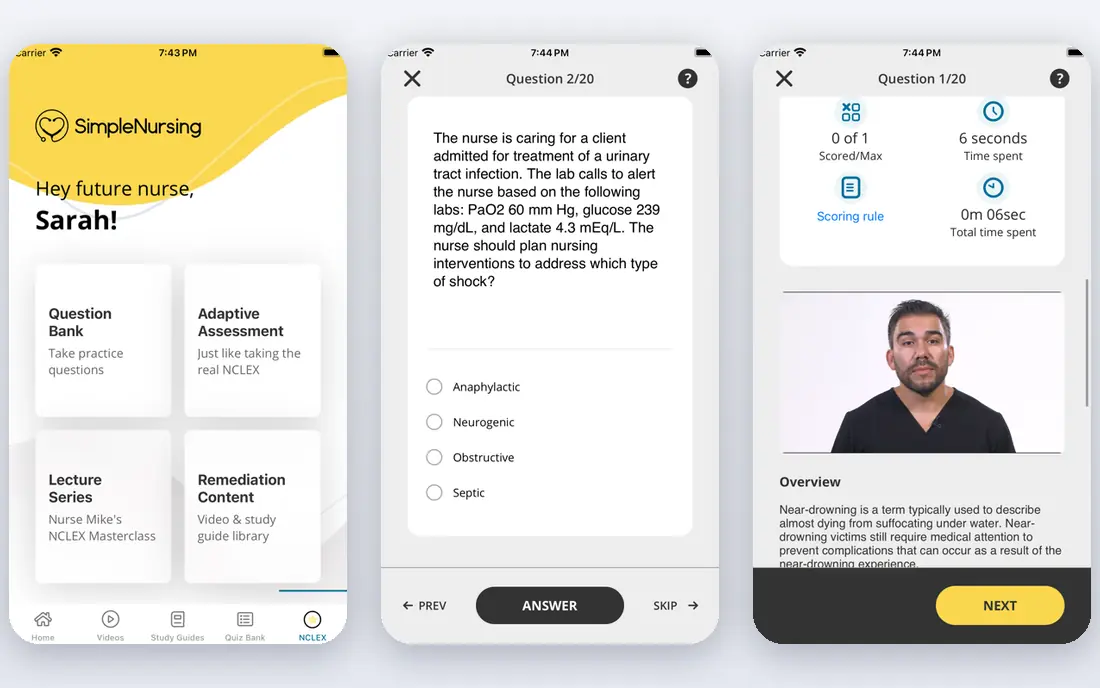
SimpleNursing explains complex nursing topics through short, animated videos and clear study sheets, which helps when a textbook chapter feels dense. Lessons break topics into steps, with memory aids and examples that suit visual and auditory learners. NCLEX-style questions let you test understanding after each lesson, though the bank is smaller than UWorld. Full access requires a paid plan, with a limited free or trial offer, so check current pricing on the official site. SimpleNursing works best early in a course, when you need to understand a concept, while UWorld works best later, when you need exam-style practice. Many students use both in sequence for that reason.
- Engaging video lessons, study sheets, NCLEX-style questions
- Question bank smaller than UWorld, full access needs a paid plan
Archer Review offers a large NCLEX question bank and readiness exams at a lower entry price than UWorld, which makes it popular with students on a budget. Practice exams simulate the computer adaptive test format, and readiness assessments give a rough sense of exam preparedness. That combination makes Archer a strong main question bank for many students. Rationales are generally good, though some students find them less detailed than UWorld in certain topics. Check current pricing on the official site, since plans vary by duration and features. If budget matters and you want a full question bank plus readiness exams, Archer is a sensible first choice, with Picmonic or SimpleNursing as a visual supplement.
- Large question bank, readiness exams, lower entry price than UWorld
- Rationales less detailed than UWorld in some topics, interface less polished
NCLEX Mastery
Best for: On-the-go review with questions, flashcards, and tracking
NCLEX Mastery, from the makers of the Mastery series, is built for short study bursts on a phone. Questions, flashcards, mnemonics, and study tips fit commutes and breaks between classes, and progress tracking shows which topics need more work. That mobile focus makes it easy to study daily, even on busy clinical days. Explanations are shorter than UWorld, so NCLEX Mastery works better as a daily review tool than as a sole exam preparation system. Check current pricing on the official site, since plans vary by duration. Pair it with a larger question bank for full preparation, and use it for the daily habit of answering questions.
- Mobile-friendly questions, mnemonics, study tips, progress tracking
- Explanations shorter than UWorld, fewer advanced analytics
Epocrates
Best for: Quick drug reference and interaction checks on clinical rotations
Epocrates is a clinical reference, not a study app, and that distinction matters. On rotations, you need fast, reliable drug information: doses, interactions, contraindications, and pill identification. Epocrates covers those needs in a mobile app that many clinicians already know, with a free core tier that covers essential drug tools. Premium features add deeper content and tools, with current pricing on the official site. Epocrates will not teach you nursing theory or prepare you for NCLEX questions, so use it beside a study app, not instead of one. For clinical days, it is one of the most practical apps a nursing student can carry.
- Drug monographs, interaction checker, pill identifier, free core tools
- Full premium features need payment, not a study or NCLEX app
Nursing Central
Best for: An all-in-one reference with a drug guide and dictionary
Nursing Central, from Unbound Medicine, bundles Davis Drug Guide, Taber Medical Dictionary, and disease, lab, and procedure references into one app. That bundle suits students who want one reference for clinical questions, rather than separate apps for drugs, terms, and conditions. Search is fast, and entries are written for clinical use. The subscription cost should be checked on the official site, and a limited trial lets you test the content first. Nursing Central is a reference tool, not an NCLEX question bank, so pair it with UWorld or Archer for exam preparation. For students who value a single, trusted reference on rotations, it is a strong choice.
- Davis Drug Guide, medical dictionary, disease and lab references
- Subscription cost, reference focus rather than exam practice
Osmosis
Best for: Visual explanations across anatomy, disease, and clinical topics
Osmosis explains health science topics through clear videos, illustrations, flashcards, and questions, with spaced review to support long-term recall. Nursing students use it for anatomy, physiology, pharmacology, and disease processes, especially when a textbook explanation does not click. The visual style suits learners who need to see a process, not only read about it. Osmosis covers many health professions, so content is not nursing-specific, and full access requires a paid plan, with pricing on the official site. Use Osmosis for concept learning, and use a nursing-specific question bank for NCLEX practice. That pairing covers understanding and exam style, which are different skills.
- Clear videos, flashcards, questions, spaced review tools
- Broad health focus, not nursing-specific, full access needs a paid plan
How we picked these
We compared official feature pages, pricing pages, app store listings, and public reviews, and we favoured apps that are actively maintained, widely used by nursing students, and clear about free limits. We looked at question quality, rationale depth, visual learning tools, reference reliability, and price at realistic study durations. We did not claim hands-on testing that did not happen. Prices for NCLEX prep change often and vary by duration, so we wrote "See website" where a current figure could not be verified with confidence. This guide is study information only, not medical advice, and clinical decisions should follow your programme, your instructors, and current clinical guidelines, not only an app summary.
Studying smarter as a nursing student
Pick one main question bank
Using three question banks at once splits your analytics and wastes time on duplicate questions. Pick one main bank, such as UWorld or Archer, and complete it properly, reviewing every rationale, including for questions you answered correctly. Use other apps for concepts, visuals, or reference, not for a second full question bank.
Learn concepts before you drill questions
Questions test understanding, but they do not always teach it. When a topic keeps failing, go back to a video or visual aid, such as SimpleNursing, Picmonic, or Osmosis, and rebuild the concept before you drill more questions. That loop, learn, test, review, relearn, is slower than endless questions, but it produces stronger recall on exam day.
Use short, daily study bursts
NCLEX preparation rewards daily consistency more than weekend cramming. Answer a set of questions each day, review rationales the same day, and use flashcards or mnemonics for weak topics. NCLEX Mastery and Picmonic suit short bursts, while longer study blocks suit full practice exams and video lessons. Protect sleep and rest days, since tired studying teaches little.
Practise clinical reference skills early
Learn to use Epocrates or Nursing Central before rotations get busy, so drug checks become a quick habit, not a stressful search. Practise looking up doses, interactions, and contraindications with sample cases, and always check with your instructor or preceptor when unsure. Apps support clinical learning, but they do not replace supervision, guidelines, or clinical judgement.
FAQ
What is the best app for nursing students preparing for the NCLEX?
UWorld is our pick for serious NCLEX preparation, thanks to exam-style questions, detailed rationales, and practice exams. Archer Review is a strong, more affordable alternative with readiness exams. The best app for nursing students depends on budget, time to exam, and whether you prefer detailed rationales or a larger, lower-cost bank.
Are there best free nursing apps worth using?
Yes, Epocrates offers a useful free core tier for drug reference, and many study apps offer limited free trials or free content. Free tiers are useful for review and reference, but serious NCLEX prep usually needs a paid question bank. Check free limits carefully, and use free trials to test question style before you pay.
What is the best nursing app for students who learn visually?
Picmonic suits visual learners who remember through picture mnemonics, while SimpleNursing and Osmosis suit learners who prefer short videos and illustrations. Try each free or trial offer for a hard topic, such as pharmacology, and keep the app whose style helps you recall details a week later, not only on the day.
How is UWorld different from Archer Review?
UWorld is known for very detailed rationales and polished analytics, at a higher price, while Archer offers a large bank and readiness exams at a lower entry price. Both cover NCLEX-style questions and practice exams, so the choice often comes down to budget and rationale preference. Check current pricing and trial offers on both official sites before deciding.
Do nursing students need a drug reference app?
Yes, for clinical rotations, a drug reference such as Epocrates or Nursing Central is highly practical, since it gives fast access to doses, interactions, and contraindications. Study apps alone do not cover that need well. Learn your reference app early, and always verify with instructors, preceptors, and current guidelines when a case is complex.
Can I study for the NCLEX using only a phone app?
A phone app can cover a large part of NCLEX preparation, especially questions and review, but most students also benefit from notes, textbooks, or course materials for weak topics. Use a main question bank on your phone, add a visual aid for hard concepts, and use practice exams to build stamina. If scores plateau, seek help from instructors or a tutor, rather than only adding more apps.
Sources
https://nursing.uworld.com https://www.picmonic.com https://simplenursing.com https://archerreview.com https://nursemastery.com https://www.epocrates.com https://www.unboundmedicine.com/products/nursing-central https://www.osmosis.org