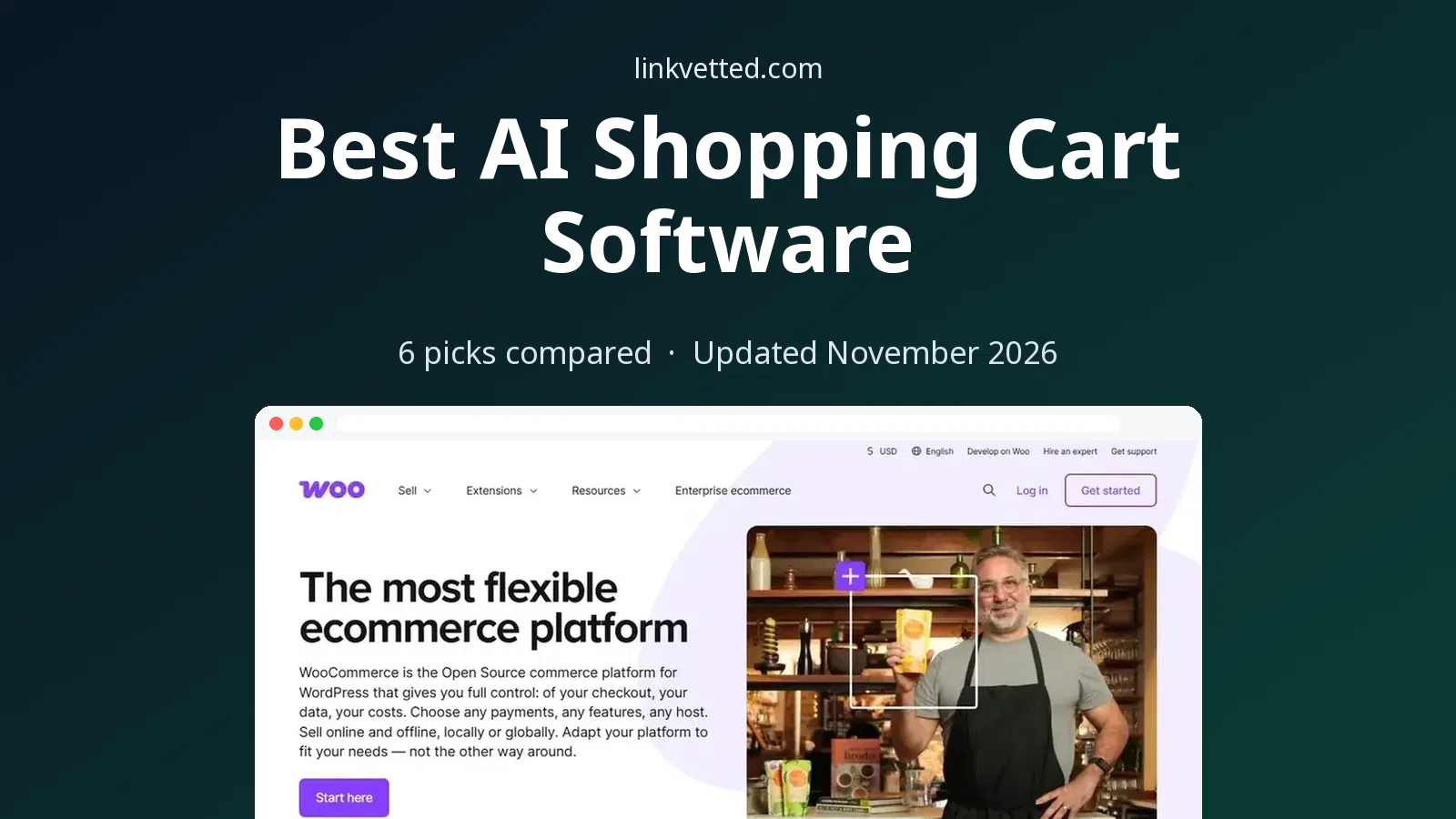
Best AI Shopping Cart Software (2026): 6 Picks Checked on Vendor Pages
6 options for the best AI shopping cart software, with entry costs, free tiers and the buyer each one serves. Each profile ends with a plain caveat. No hype.
- Editor's choice
 WooCommerce
Open-source cart for developer control
Starts at$29 per monthVisit woocommerce.comFull review - Great alternative
 Wix eCommerce
Beginners building a first store
Starts atSee websiteVisit wix.comFull review - Also consider
 Adobe Commerce
Composable B2B and B2C at scale
Starts atSee websiteVisit business.adobe.comFull review
Direct answer
For open-source cart for developer control, WooCommerce is where this list starts. Listed starting prices: WooCommerce from $29 per month and Shopify from $19 a month. Look at Wix eCommerce for beginners building a first store, and at Adobe Commerce for Composable B2B and B2C at scale. The remaining 3 options are covered below with prices and limits.
TL;DR:
- WooCommerce takes the first slot, best suited to open-source cart for developer control.
- Before buying Shopify, weigh this: less control over core code than open-source carts.
- Starting prices begin at $19 per month with Shopify.
- A permanent free plan is missing from all 6 tools, WooCommerce and BigCommerce included; plan for a trial or a premium start.
Last checked November 2026. Prices and plan details were read from the vendors' own pages in November 2026; vendors change plans often, so confirm the current price on the vendor site before you buy.
Quick comparison
| Tool | Best for | Starts at | Free plan? | |
|---|---|---|---|---|
| WooCommerce | Open-source cart for developer control | $29 per month | Not stated | Visit |
| Wix eCommerce | Beginners building a first store | See website | Not stated | Visit |
| Adobe Commerce | Composable B2B and B2C at scale | See website | Not stated | Visit |
 Shopify | All-in-one hosted cart with AI tools | $19 a month | Free trial | Visit |
 Salesforce Commerce Cloud | Enterprise commerce tied to CRM data | See website | Not stated | Visit |
 BigCommerce | Scaling brands selling across regions | See website | Not stated | Visit |
AI Shopping Cart Software, one by one
This LinkVetted guide covers 6 options for AI shopping cart software. Each profile lists a starting price, free plan details, strengths and drawbacks, so you can drop poor fits quickly.
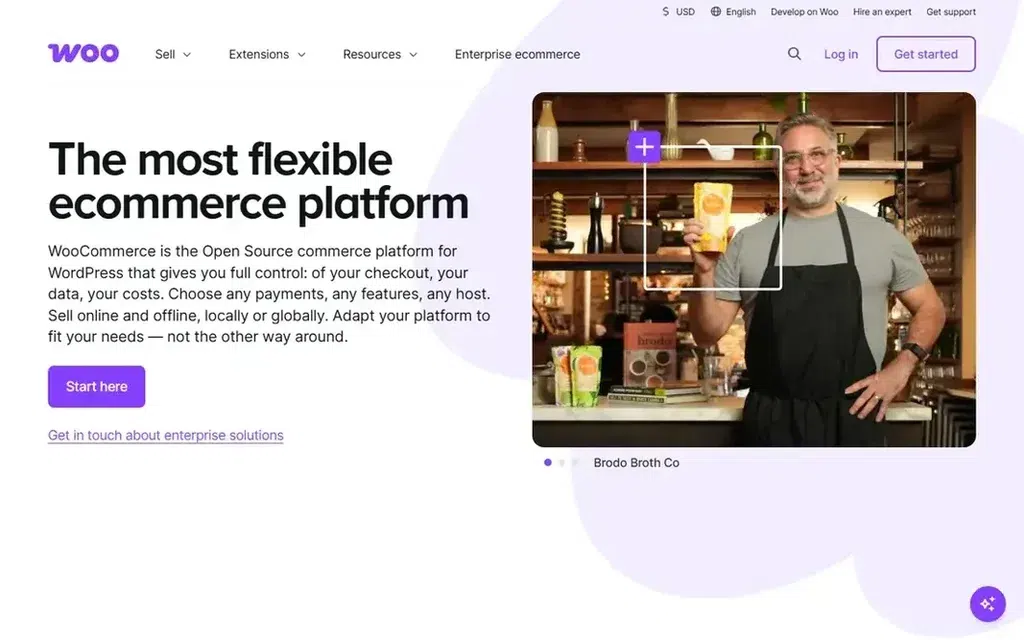
Pick WooCommerce if this describes you: open-source cart for developer control. Since the cart runs on an open foundation, teams can shape storefronts, checkout and integrations to their own requirements.
That freedom includes responsibility: maintenance, security and performance tuning fall to the merchant or their developer. The starting price for WooCommerce: $29 per month. As for free access: Not stated.
Where it is weaker: AI features rely on added plugins.
- Pitched at both merchants and developers
- Open-source system with long-term adaptability
- Needs more technical upkeep than hosted carts
Wix eCommerce is aimed squarely at beginners building a first store. The builder approach keeps design and cart management in one interface, which fits first-time sellers and small firms without technical staff.
For everyday use, merchants planning complicated B2B workflows or heavy customization should weigh more adaptable choices before committing. Wix eCommerce does not show a starting price in this comparison, so check the vendor site for current pricing. As for free access: Not stated.
Trade-offs to know: Heavy customization can hit builder limits.
- Template-driven setup for non-technical users
- All-in-one builder with a configurable storefront
- Less depth for complicated catalogs
Adobe Commerce is a good fit for Composable B2B and B2C at scale. Its composable approach lets organizations assemble services around the cart instead of accept a fixed bundle. Bigger brands and B2B sellers with technical resources are the intended audience.
From a buyer's view, the system carries real operational weight: implementation, hosting choices and customization all require planning and skilled staff. Smaller merchants or those without developer support may find more straightforward hosted carts a better match for their needs. No starting price is listed for Adobe Commerce here; confirm pricing on the vendor site. Trial and free access: Not stated.
Drawbacks to consider: Complicated to implement and maintain.
- AI-powered composable commerce product
- Designed for personalized experiences at global scale
- Best value at bigger catalog and team sizes

Shopify is aimed squarely at all-in-one hosted cart with AI tools. Shopify presents itself as an all-in-one commerce system, pairing a hosted shopping cart with tools to handle payments, inventory and marketing.
In daily use, AI features are woven into store building and growth workflows, which fits sellers who want to launch rapidly without assembling separate systems. Small and mid-size merchants, plus brands expanding across channels, are the clearest fit. Entry price for Shopify: $19 per month. Free access: Free trial.
Watch-outs: Less control over core code than open-source carts.
- Payments and operations in one system
- AI features targeted at building and expanding a business
- App extras can add cost and complexity
For enterprise commerce tied to CRM data, Salesforce Commerce Cloud is a natural candidate. It is geared toward bigger retailers and brands that require commerce connected to customer records across teams.
- Part of a wide customer product
- Fits complicated
- Implementation demands significant resources

BigCommerce makes the most sense for scaling brands selling across regions. Since it leans toward scale, very small keeps may find the system more than they need, and advanced customization can call for technical help.
The main drawbacks: Custom work may need developer involvement.
Sellers prioritizing simplicity over multi-channel reach might look at a lighter hosted builder. Pricing for BigCommerce is not stated here, so ask the vendor for current figures. Free options: Not stated.
- Made for buying experiences across brands and regions
- Single scalable foundation for several channels
- Enterprise-leaning setup can feel heavy for tiny shops
What went into this list
Pricing pages, product documentation and feature lists were the main sources, and every entry carries at least one honest drawback. Seat minimums, billing terms and add-ons can move the real cost, so the starting prices here are a guide and not a quote. Tools are placed by general fit for AI shopping cart software, with price clarity and free access as tie-breakers. A different team can reasonably rank them differently.
A buyer's checklist
- Ask Wix eCommerce, Adobe Commerce, Salesforce Commerce Cloud and BigCommerce for a written quote, since no starting price is shown.
- Run a trial of Shopify with real work before paying for a year; your own workflow is the best test.
- Read the limits listed for WooCommerce first: needs more technical upkeep than hosted carts.
- Look at which plan of Adobe Commerce unlocks the features you need; entry tiers are often cut down.
- Add up seats, add-ons and usage charges for Wix eCommerce before comparing it with cheaper entries.
FAQ
What makes shopping cart software AI-powered?
AI features usually appear in product recommendations, content and storefront generation, search relevance and merchandising support. Check the specific workflows you depend on before choosing.
Does any tool for AI shopping cart software here have a free plan?
A permanent free plan is not offered by WooCommerce, BigCommerce or the other tools here. Shopify offer a trial. Plan a short evaluation period instead.
Is WooCommerce the right pick for everyone comparing AI shopping cart software?
No single tool suits every team. WooCommerce comes first because it fits open-source cart for developer control, while Wix eCommerce suits beginners building a first store and Adobe Commerce suits Composable B2B and B2C at scale. Match the tool to your own size, budget and workflow before deciding.
Do these tools publish their prices?
Not all of them. Wix eCommerce, Adobe Commerce, Salesforce Commerce Cloud and BigCommerce publish no starting price, so expect a quote request for those. The rest, WooCommerce included, show a starting price, though seats and billing terms still change the final cost.
What is the cheapest option for AI shopping cart software in this list?
On published monthly entry prices, Shopify is the lowest here at $19 per month. Entry price is only part of the cost, because seats, add-ons and billing terms can change the total. Each of the 6 options in this AI shopping cart software guide has its own card above with the price, free plan and limits.
Sources
- https://woocommerce.com
- https://www.wix.com/ecommerce
- https://business.adobe.com/products/magento/magento-commerce.html
- https://www.shopify.com
- https://www.salesforce.com/commerce
- https://www.bigcommerce.com