Best AI Red Teaming Tools in 2026: 8 Tools Compared
Compare the best ai red teaming tools for testing LLM apps, agents and RAG systems against jailbreaks, injection and data leakage risks today in 2026.
- Editor's choice
 Promptfoo
CI testing for LLM apps
Starts atFreeVisit promptfoo.devFull review - Great alternative
 Giskard
Scanning LLM and RAG systems
Starts atFreeVisit giskard.aiFull review - Also consider
 Microsoft PyRIT
Custom multi-turn attacks
Starts atFreeVisit azure.github.ioFull review
TL;DR:
- Open-source tools such as Promptfoo, Giskard, PyRIT and Garak give developers a free starting point for LLM security testing.
- Enterprise platforms such as Mindgard and HiddenLayer suit teams that need continuous testing, reporting and managed attack libraries.
- Test prompts, retrieval data and agent tool calls together, since attacks often move across those layers.
- Red teaming finds weaknesses, but it does not replace guardrails, access controls and human review for high-risk use cases.
- Track fixes after each scan, or the same weaknesses will reappear in the next release.
Quick comparison
| Tool | Best for | Starts at | Free plan? | |
|---|---|---|---|---|
| Promptfoo | CI testing for LLM apps | Free | Yes | Visit |
| Giskard | Scanning LLM and RAG systems | Free | Yes | Visit |
| Microsoft PyRIT | Custom multi-turn attacks | Free | Yes | Visit |
 NVIDIA Garak | Fast baseline vulnerability scans | Free | Yes | Visit |
 Lakera Red | Enterprise chatbot testing | Free | Yes | Visit |
 Mindgard | Continuous enterprise red teaming | See website | No | Visit |
 HiddenLayer | Red teaming inside AI security | See website | No | Visit |
 DeepTeam | Red teaming with DeepEval | Free | Yes | Visit |
The best ai red teaming tools
We picked tools that actively attack LLM applications to find prompt injection, jailbreaks, data leakage and unsafe outputs. The list mixes open-source frameworks developers run themselves with managed platforms for larger teams.
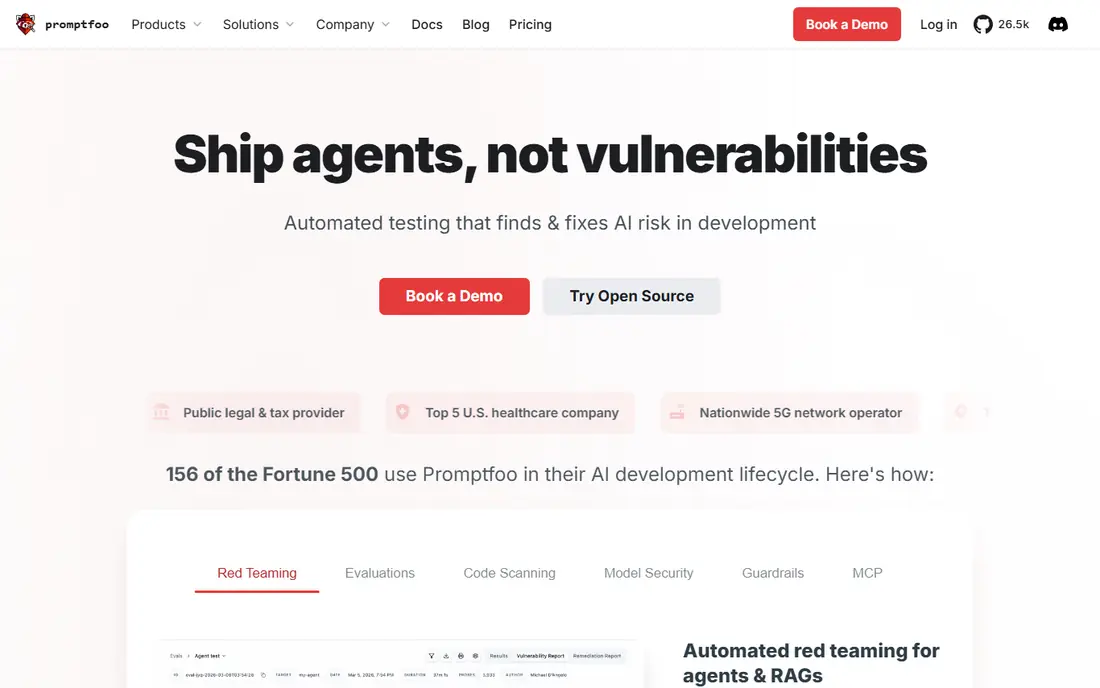
Promptfoo is an open-source LLM evaluation tool with a red team module that generates adversarial test cases for a configured app. Developers define attack goals in config, run the tests in CI and get pass or fail results per category, including prompt injection, jailbreaks and harmful content. That pipeline fit makes it popular for teams that ship LLM features often.
The open-source version covers single-turn and many standard attacks well, while deeper RAG and agent tool-call testing needs custom work. For development teams that want automated checks on every pull request without a commercial budget, Promptfoo is a strong first choice.
- Large plugin library for red team attacks
- CI-friendly config
- Maps tests to common LLM risks
- RAG and agent testing needs extra setup
- Enterprise features are paid

Giskard offers an open-source testing library plus a Hub for team scanning and reporting. Its scans probe LLM apps, agents and retrieval pipelines for injection, data leakage, hallucination and bias, then present findings with examples teams can reproduce. That breadth suits teams that want one scan across model and retrieval layers.
The library is free, while the Hub is priced for enterprises. Small teams can start with the library in Python and add the Hub later if they need shared dashboards and scheduled scans. Giskard works well when quality and security testing share one workflow.
- Open-source scanning library
- Covers injection, leakage, hallucination and bias
- Hub for team use
- Hub pricing is enterprise quote-based
- Advanced reports need the paid Hub
PyRIT, the Python Risk Identification Toolkit, is Microsoft's open-source framework for orchestrating adversarial attacks against AI systems. It supports multi-turn conversations, adaptive attacker models and custom targets, which makes it suited to pre-release audits and research. Microsoft's AI red team uses PyRIT in its own work, and it powers parts of Azure's red teaming agent.
PyRIT is a framework, not a point-and-click product. Teams need Python skills to build campaigns and interpret results. For security researchers and engineering teams with that skill, it offers depth that simpler scanners do not match.
- Flexible multi-turn attack orchestration
- Used by Microsoft's own red team
- Strong research base
- Needs Python skills to use well
- No polished managed dashboard out of the box
Garak is an open-source LLM vulnerability scanner from NVIDIA that runs many attack probes against a model from the command line. It can test for jailbreaks, injection, leakage and other known weaknesses, and it runs fast enough for baseline checks across models. Teams use it to compare models or to catch regressions after a model change.
The output is technical and needs triage, since not every probe failure is a real product risk. Garak is best as a baseline scanner in a wider testing plan, paired with manual review and targeted tests for your specific app. For a quick, free first scan, it is hard to beat.
- Fast command-line scans
- Many attack probes
- Good baseline for model comparison
- Command-line only for most use
- Results need manual triage
Lakera Red tests enterprise chatbots and LLM apps for prompt injection and related attacks, and it pairs with Lakera Guard for runtime protection. The community tier gives teams a free starting point with a monthly request allowance, which suits a first test or a small app. Enterprise plans add higher limits, self-hosting options and integrations.
Request limits mean larger apps will need a paid plan for continuous testing. For teams that already use or plan to use Lakera Guard, Red adds a natural testing layer beside runtime defense. For others, the free tier is a useful way to judge the approach before committing.
- Free community tier
- Pairs with Lakera Guard for runtime protection
- Clear enterprise reporting
- Community tier has request limits
- Full enterprise features are quote-based
Mindgard offers continuous automated red teaming for LLM apps, agents and multimodal models, with a researcher-built attack library behind it. It tests production-style systems, not only isolated models, and integrates with CI so teams can gate releases on results. That continuous model suits companies where AI features ship often and risk needs ongoing checks.
Pricing is custom and enterprise-focused, so small teams may prefer an open-source starting point. For larger organizations that need scheduled testing, evidence for audits and a managed attack library, Mindgard is a leading managed option.
- Continuous automated testing for models, agents and multimodal apps
- Researcher-built attack library
- CI integration
- Enterprise pricing is custom
- May be more than a small team needs
DeepTeam is the red teaming framework from Confident AI, built to work beside DeepEval for LLM evaluation. It covers many vulnerability types and attack methods in an open-source package, with a unit-test style workflow that developers find familiar. Teams already using DeepEval for evals can add red team tests without learning a separate system.
The community is smaller than Promptfoo's, and agent testing needs extra setup. For teams that already evaluate with DeepEval, DeepTeam is a natural extension. For others, it is still a credible free option, especially for LLM apps with clear eval datasets.
- Open-source red teaming beside DeepEval evals
- Many vulnerability types
- Unit-test style workflow
- Newer tool with a smaller community than Promptfoo
- Agent testing needs setup
How we picked these
We reviewed official docs, open-source repos, pricing pages and public comparisons of red teaming tools. We kept only tools that currently run adversarial tests against LLM apps, agents or models, not only runtime guardrails. Where pricing is custom or enterprise-only, we wrote See website.
How to choose a red teaming tool
Start with your app type and your team's skills. A chatbot, a RAG assistant and an agent with tool calls need different attack coverage, and a framework that needs Python skills will fail if no one on the team can run it.
Test the full app, not only the model
Attacks often target retrieval data, system prompts and tool calls, not only the base model. Choose a tool that can test your retrieval pipeline and agent actions, or pair a model scanner with manual tests for those layers. A clean model score means little if retrieved documents leak data.
Build red teaming into releases
Run a small smoke set on every change and a broad set before major releases. That rhythm catches regressions early without slowing every pull request. Track which findings were fixed and retest them, since a fix that is not verified is only a guess.
Pair testing with guardrails
Red teaming shows where attacks succeed, but guardrails, input checks and output filters stop many of them in production. Use scan results to tune those controls, and retest after each change. For high-risk uses such as medical, financial or safety advice, add human review as well.
FAQ
What is AI red teaming?
It is the practice of attacking an AI system with adversarial prompts, injections and multi-turn conversations to find weaknesses before real attackers do. The goal is to discover unsafe outputs, data leaks and bypasses, then fix them before release.
Is red teaming the same as penetration testing?
They are related, but red teaming for AI focuses on model and app behavior, such as jailbreaks and prompt injection, while traditional penetration testing focuses on networks, servers and application code. Many teams need both for a complete security review.
Can open-source tools replace a human red team?
Open-source tools catch many known attacks at low cost, but human experts still find novel, context-specific weaknesses that automated probes miss. Use automated tools for continuous coverage and human testing for high-risk releases.
How often should I red team an LLM app?
Run small automated tests on every major change and a broad scan before major releases or model changes. Continuous testing suits apps that ship often, while point-in-time testing suits stable apps with rare updates.
Does red teaming guarantee an AI app is safe?
No. Red teaming reduces risk by finding known and testable weaknesses, but it cannot prove an app is safe against every future attack. Combine it with guardrails, monitoring, access controls and a clear incident response plan.
Who should own red team results inside a company?
The product team that owns the AI app should own fixes, with security advising on risk and priority. Assign each finding an owner and a retest date, and track open findings in the same system used for other product bugs so they are not forgotten after the scan.