Best AI Optimization Platforms for Data Transparency in 2026: 8 Platforms Compared
We compared the best ai optimization platforms data transparency buyers need, covering prompt tracking, citations, and proof behind AI visibility claims.
- Editor's choice
 Profound
Enterprise AI visibility with detailed reporting
Starts atSee websiteVisit profound.aiFull review - Great alternative
 Peec AI
Prompt tracking with clear answer evidence
Starts atSee websiteVisit peec.aiFull review - Also consider
 Scrunch
Agent and AI search monitoring
Starts atSee websiteVisit scrunch.comFull review
TL;DR:
- AI visibility tools sample prompts rather than observing a ranking, so honest platforms show prompt lists, dates, and answer excerpts, not only a single score.
- Profound, Peec AI, Scrunch, and Brandlight lead the specialist field, while Semrush and Ahrefs add AI visibility to a broader SEO suite.
- Data transparency means you can see which prompts were run, which AI systems were checked, and which sources were cited, and you can export that proof.
- No vendor can guarantee a citation, since no answer engine sells placement in an organic answer, so promises of guaranteed mentions are a warning sign.
- Start with a small, fixed prompt set tied to buying questions, and judge tools on repeatable reporting before you expand tracking.
Quick comparison
| Tool | Best for | Starts at | Free plan? | |
|---|---|---|---|---|
| Profound | Enterprise AI visibility with detailed reporting | See website | No | Visit |
| Peec AI | Prompt tracking with clear answer evidence | See website | Free trial | Visit |
| Scrunch | Agent and AI search monitoring | See website | Free trial | Visit |
 Brandlight | Brand visibility across AI answers | See website | No | Visit |
 Otterly AI | Small teams tracking AI mentions | See website | Free trial | Visit |
 Goodie AI | AI visibility plus content guidance | See website | No | Visit |
 Semrush | SEO teams adding AI visibility | See website | Free trial | Visit |
 Ahrefs | SEO teams tracking brand mentions in AI | See website | No | Visit |
The best AI optimization platforms for data transparency
We compared vendor product pages and public 2026 guides on generative engine optimisation and answer engine optimisation. The eight below all track how brands appear in AI answers, and we judged them on whether they show their workings: prompts, systems checked, citations, and change over time. A tool that only shows a score, with no prompt-level proof, did not make this list.
Profound is one of the best-known specialist AI visibility platforms, built to track how a brand appears across ChatGPT, Perplexity, Google AI Overviews, and other answer systems. Its reporting shows prompts, answers, citations, and competitor comparisons, which helps enterprise teams prove whether AI visibility work is actually changing what answer engines say. That prompt-level detail is exactly what data transparency should mean in this category.
The trade-off is cost and complexity. Profound pricing is handled through sales, and the platform rewards teams that already have a content, PR, and SEO programme to act on its findings. A small business with no content footprint may learn that it is invisible in AI answers, without yet having the assets to change that result.
- Broad AI answer tracking
- Detailed prompt and citation reporting
- Enterprise reporting and integrations
- Pricing is quoted
- Enterprise focus can overwhelm small teams
- Setup needs a clear prompt strategy

Peec AI tracks brand mentions, citations, and sentiment across AI answers, and it presents the underlying prompts and answers so teams can check claims themselves. That evidence matters, because AI answers vary from run to run, and a single score without the prompt behind it can mislead. Peec also benchmarks competitors on the same prompt set, which helps teams see whether a visibility gap is a brand problem or a category problem.
Peec, like every tool here, samples prompts rather than observing a true ranking. Teams should keep their prompt set fixed for several weeks, run the same questions consistently, and judge progress on trends and citation evidence, not on one good day.
- Clear prompt-level tracking
- Answer and citation evidence
- Competitor benchmarking
- Coverage depends on prompt set and plan
- Newer category means methods change fast
- Reporting depth varies by tier
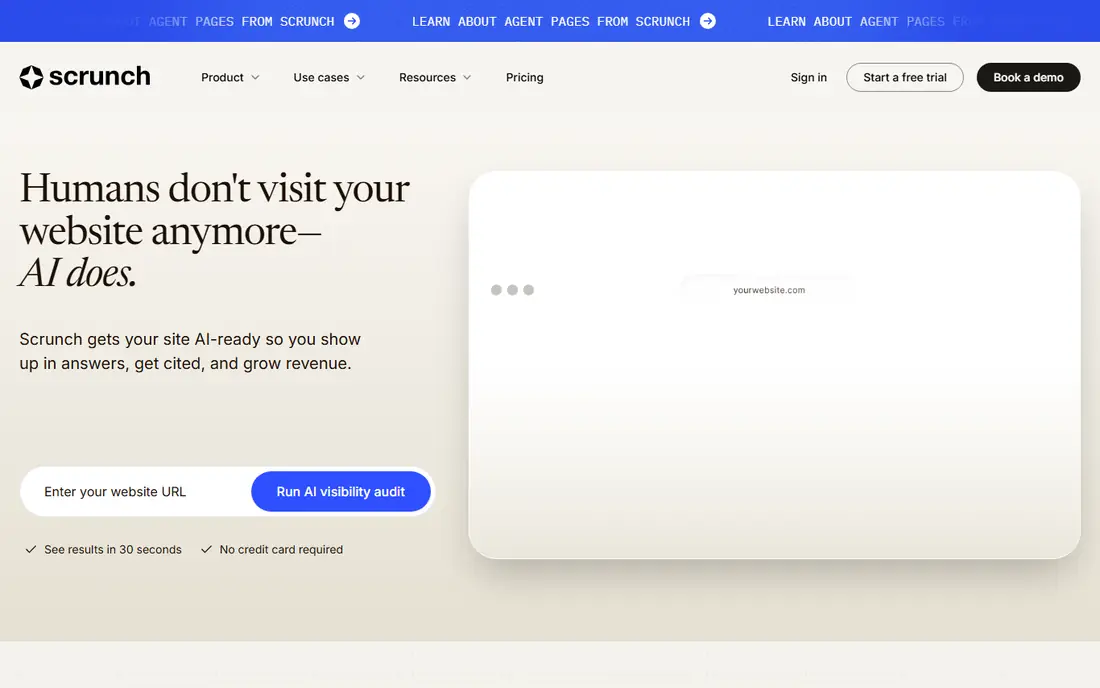
Scrunch monitors how brands show up in AI search and in agent-driven discovery, with persona-based testing that checks how different buyer types get different answers. That approach suits marketing teams that sell to several distinct audiences, since a single generic prompt set can hide important gaps. Its dashboards aim to turn prompt results into actions for content, PR, and product pages.
Scrunch is still working in a fast-moving category, so coverage of newer agents and answer systems can change. Teams should confirm which systems and personas sit in their plan, and keep their own record of prompts and answers for the metrics that matter most to leadership.
- Monitoring across AI search and agents
- Persona-based prompt testing
- Reporting for marketing teams
- Pricing and plan limits need checking
- Agent coverage is still maturing across the market
- Best with a defined audience strategy
Brandlight focuses on brand visibility inside AI answers, tracking mentions, citations, and share of answer across a chosen prompt set. Its competitor comparisons help teams see which rivals appear in answers for buying questions, and which sources those answers cite. For brand and communications teams, that framing is more useful than a generic SEO rank report.
Brandlight pricing is handled through sales, so budgeting needs a conversation about prompt volume and systems covered. As with all tools here, the prompt set is the real product: a thoughtful set of buying questions will teach you far more than a large set of generic queries.
- Brand-focused AI visibility tracking
- Citation and share-of-answer reporting
- Competitor comparisons
- Pricing is quoted
- Smaller vendor footprint than Semrush or Ahrefs
- Reporting value depends on prompt quality
Otterly AI gives smaller teams a simpler way to track brand mentions, links, and citations across AI answers, without an enterprise contract. Its dashboards focus on the essentials: which prompts mention your brand, which competitors appear instead, and how that picture changes over time. For a small business or agency testing AI visibility for the first time, that simplicity is a strength.
Larger teams may outgrow Otterly once they need persona testing, deep integrations, or large prompt sets. Start here to learn whether AI visibility tracking earns its keep for your business, then move to Profound, Peec, or Scrunch when the prompt volume and reporting needs justify it.
- Accessible entry point
- Brand mention and citation tracking
- Simple dashboards for small teams
- Less depth than enterprise specialists
- Prompt and system limits by plan
- Newer tool with evolving features
Goodie AI pairs AI visibility tracking with guidance on what content to create or improve, so teams get both measurement and next steps. Its analysis shows how answers cite sources, which topics competitors win, and where a brand page could be clearer, better structured, or better supported with evidence. That link from measurement to action suits marketing teams that need a work plan, not only a dashboard.
Content guidance from any AI tool still needs human review. Recommendations should be checked for accuracy, brand voice, and legal claims before publishing, especially in finance, health, and other regulated topics. Used that way, Goodie can speed up the content loop without replacing editorial judgment.
- AI visibility tracking with content recommendations
- Answer and citation analysis
- Marketing-team friendly reporting
- Pricing is quoted
- Content guidance needs editorial review
- Category methods are still standardising
Semrush adds AI visibility tracking to its established SEO platform, so teams that already use Semrush for keywords, site audits, and content can add AI answer monitoring without learning a whole new vendor. Its AI Visibility Toolkit tracks brand mentions and citations across AI systems, alongside traditional search data, which helps teams see AI and organic search together rather than in separate silos.
Specialist tools may offer deeper prompt, persona, or agent coverage than Semrush on a given plan, so teams whose main job is AI visibility should compare prompt limits and systems covered. For SEO teams that want AI visibility as one more lens on existing work, Semrush is the most practical pick on this list.
- AI Visibility Toolkit inside a full SEO suite
- Keyword, backlink, and content tools in one place
- Familiar reporting
- AI visibility features depend on plan and add-ons
- Specialist depth may trail pure-play tools
- Suite pricing adds up
Ahrefs Brand Radar tracks how brands appear in AI answers, alongside its well-known backlink, keyword, and content explorer data. That combination helps SEO teams connect AI citations with the links, pages, and mentions that likely support them, which is useful when deciding whether to invest in content, PR, or digital PR. Its reporting style will feel familiar to anyone who already uses Ahrefs for organic search.
Ahrefs is not a pure-play AI visibility specialist, so teams that need large prompt sets, persona testing, or agent monitoring should check plan limits carefully. For teams already paying for Ahrefs, adding Brand Radar is often cheaper and simpler than buying a separate specialist tool for a first AI visibility programme.
- Brand Radar for AI mention tracking
- Strong backlink and content data
- Trusted SEO reporting
- AI features sit inside paid plans
- Specialist prompt depth may be narrower
- Best for teams already using Ahrefs
How we picked these
We compared vendor product pages and public 2026 guides on AI search optimisation, and we kept only platforms that track brand appearance in AI answers and show prompt-level evidence. We favoured tools that name the AI systems they check, show answer excerpts and citations, allow prompt-set control, and support exports or integrations for independent checking. We included both specialists and SEO suites so teams can choose depth or breadth.
We did not run paid trials on each platform for this guide. Our findings rest on official product documentation and public guides, and AI answer behaviour changes often as models and systems update. Confirm current system coverage, prompt limits, and pricing on the vendor site, and run a trial on your own prompt set before committing.
How to judge data transparency in this category
Ask for the prompt list first. A transparent vendor will show every prompt it runs, how often it runs each one, which AI systems it checks, and what answer it captured. A vendor that only shows an aggregate visibility score, with no way to see prompts or answers, is asking you to trust a number you cannot audit. Keep your own copy of prompts and results each month.
Ask how variation is handled. AI answers change between runs, so a good platform should show variation, sample size, and trends over time, not only the best result it found. Ask whether it re-runs prompts, how it handles location and personalisation, and whether it separates brand mentions from citations, since a mention without a citation is weaker evidence than a linked source.
Ask what the tool cannot see. No vendor observes a true AI ranking, and no vendor can guarantee a citation, since answer engines do not sell organic placement. A vendor that explains sampling limits, shows raw answers, and avoids guaranteed-mention promises is more trustworthy than one that hides uncertainty behind a polished score.
A transparent starter prompt set
Pick 20 to 40 prompts tied to real buying questions, such as best tools for a job, comparisons, and how-to questions your customers actually ask. Add brand prompts, competitor prompts, and category prompts, and keep the set fixed for at least a month. Review answers weekly, note which sources get cited, and use that evidence to improve pages, FAQs, and third-party coverage.
FAQ
What is an AI optimization platform?
An AI optimization platform, also called a GEO or AEO platform, tracks and improves how a brand appears in AI-generated answers from systems such as ChatGPT, Perplexity, Gemini, and Google AI Overviews. It monitors prompts, mentions, citations, and competitor visibility, and it suggests content, structure, and authority improvements. It builds on SEO foundations such as clear pages, schema, and credible sources, rather than replacing them.
What does data transparency mean for AI visibility tools?
Data transparency means you can see and check the evidence behind a visibility claim: the prompts run, the AI systems checked, the dates, the answer excerpts, and the sources cited. Transparent tools allow exports and show variation over time, so you can audit results yourself. Tools that only show a single score, with no prompt or answer detail, do not meet that standard.
Can any platform guarantee my brand will be cited by AI?
No. No answer engine sells placement in an organic answer, and no vendor controls which sources a model cites. A platform can improve your chances by making content clear, structured, well-sourced, and widely corroborated, and by tracking results honestly. Any promise of a guaranteed citation should be treated as a warning sign.
How many prompts should I track to start?
Start with 20 to 40 prompts tied to real buying questions, including brand, competitor, and category questions, and keep the set fixed for at least a month. A small, stable set gives cleaner trends than a large, changing set. Expand only after you can explain what the first set is telling you and what action it supports.
Is AI optimization the same as SEO?
No, but the two overlap. SEO aims for rankings and clicks in traditional search results, while AI optimization aims for mentions and citations inside AI-generated answers. Good SEO foundations, such as helpful content, clear structure, schema, and credible third-party coverage, support both. AI optimization adds prompt tracking, answer analysis, and content shaped for extraction and citation.
Which tool is best for a small business starting out?
Otterly AI is our pick for most small businesses starting out, because of its simpler dashboards and trial access. Semrush or Ahrefs also work well if the team already uses one of those suites for SEO. Choose the tool that shows prompt-level proof clearly, and avoid paying for enterprise depth before you have a content footprint for AI systems to cite.